Lloyds share price: the pressure is on as Barclays sets a ‘high bar’

1

Lloyds share price (LON:LLOY) fell on Thursday after Barclays announced a 68% loss in Q4 net profit. Overall, Barclays announced a 30% dip in pre-tax profit to £3.1bn for the year, down from £4.3bn in 2019.

Barclays’ results have set the pace for the other banking giants that will be making their own end-of-year announcements in the coming days.

The bank’s competitors, including Lloyds, will do well to match Barclays, according to investment director at AJ Bell, Russ Mould:

“The boardrooms of Barclays’ rivals may be feeling a bit more nervous this morning as they prepare to unveil their own fourth quarter numbers as it feels like the first big name out the door has set a fairly high bar and still received a knock back from investors.”

While Barclays’ results suffered from the coronavirus pandemic, the blow was cushioned by its investment banking arm and the globalised nature of its operations.

Lloyds’ earnings may well reveal the bank was not as well equipped to deal with the economic impact of lockdowns on the banking sector. Analysts are forecasting pre-tax profit of £1bn for Lloyds, down from £4.4bn in 2019.

Payment holidays for Covid-19

Throughout 2020, Barclays has provided over 680,000 payment holidays, valued at £27bn, to customers struggling to deal with the impact of Covid-19. The decision came under pressure from banking regulators. 

As the customers of Lloyds will face similar struggles to pay their mortgages, credit cards and loans, it can be expected that the bank will announce a similar dent on its finances to Barclays’ payment holidays.

Corporate and investment banking

Despite Covid-19 hitting Barclays’ overall profit levels, the volatility caused by the pandemic benefitted the high-performing corporate and investment banking arm of the company. Barclays Corporate and Investment Bank (CIB) posted record earnings of £12.5m, up 22%, as a result of a “buoyant trading environment”, softening the blow of major losses elsewhere.

Lloyds, on the other hand, does not have a strong investment banking unit to fall back on. While Barclays was able to capitalise on the frenzied trading levels throughout 2020, Lloyds could be exposed next Wednesday.

UK earnings down for Barclays

Income made from Barclays’ operations in the UK is down by 14% from 2019 to £6.3bn. The dip is a result of lower unsecured lending balances and interest rates, issues which affect the wider banking sector.

While this is a significant drop, a large share of the Barclays’ operations are located in the US, including a major credit card portfolio and a range of corporate and investment banking exposures. Whereas Lloyds’ functions, including its retail and commercial arms, are more UK focused and therefore more vulnerable to a negative economic environment in the country.

Lloyds share price

Lloyds’ share price fell on Thursday in line with Barclays, suggesting the market had concerns over the release of the bank’s results next week. The performance of shares in both Lloyds and Barclays have behaved relatively similarly in 2021 year-to-date, with Lloyds up 2% and Barclays down less than 1%.

Lloyds shares were trading down 4.4% at 37.2p going into the close on Thursday.
Mast Energy Developments IPO Presentation

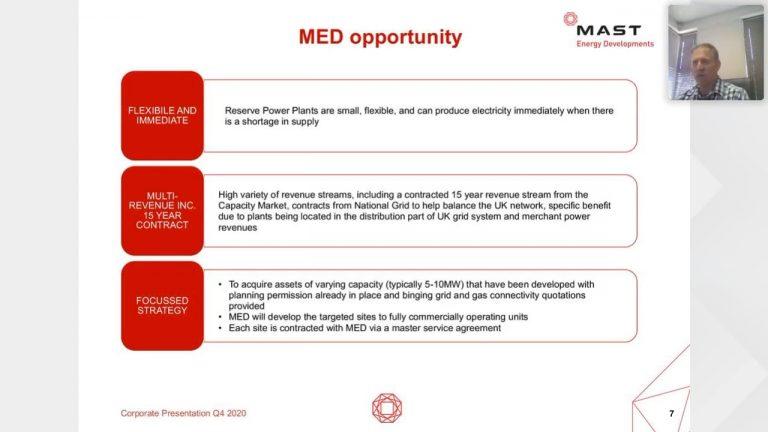
Mast Energy Developments presents their investment case ahead of the upcoming IPO.

Non-exec Chairman Louis Coetzee leads the presentation and details Mast’s plans to harness the opportunity in Reserve Power generation in the UK.

Risk Warning:

Investments in IPOs involve a high degree of risk and are not suitable for all investors. Capital is at risk.

ARK Invest Innovation ETF: all set for further gains in 2021

The US economy is recovering from the coronavirus-induced downturn faster than anticipated. The Congressional Budget Office (CBO), a non-political branch of America’s legislature, forecasts economic growth to increase by 1.7% per year from 2020-2004. 

If one lesson can be learned from the coronavirus pandemic heading forward, it is the importance of innovation. Shopping and working habits, along with a plethora of other sectors, will increasingly be online. 

In addition, electric vehicle sales will make up just under 4% of all sales in the US and 5% in Europe. Solar power is going to become cheaper than ever before, and increasingly competitive with coal. It could also be the year of virtual reality, as the International Data Corporation forecasts shipments of virtual reality headsets to rise to around 92m in 2021. 

Conditions could be ideal for investors looking to capitalise on the resurgence of the US economy, while gaining exposure to disruptive technologies. Enter Ark Invest, the asset management firm that shot to prominence in 2020, by doing exactly that.

ARK Invest

Ark Invest’s reputation has soared over the past 12 months as one of the pre-eminent asset managers in the world. The company has outperformed established Wall Street investors as bullish positions on Tesla and other disruptive companies paid off.

In contrast to other ETF providers, Ark’s holdings are actively managed, favouring businesses it believes can outdo the market. Ark charges an expense ratio of 0.75%.

ARK Invest Innovation ETF

The ARK Fintech Innovation ETF is the company’s forerunning fund, and after an outstanding run in 2020, it is being closely watched by investors. The fund aims for a thematic multi-cap exposure to innovation across sectors, while seeking long-term growth of capital.

The fund’s top holdings are in electric car manufacturer Tesla (8.53%), streaming company Roku (6.87%) and the financial services and mobile payments firm founded by Jack Dorsey, Square (5.17%). The ARK Innovation ETF was one of the leading ETFs of 2020, rising by 168%. To compare, the benchmark S&P 500 finished the year up 16.8%. Since the beginning of the current year the fund has continued to make impressive gains, up over 24% on the year-to-date.

Risks

The challenge now is for the ARK Innovation ETF to sustain its performance levels. That could be easier said than done. The fund has a total of 55 stocks within its holding which means, compared to the S&P 500, it is less diversified.

The fund could also be vulnerable to a tech-driven stock market bubble akin to the dot-com bubble of 2000. In this case, the ARK Innovation ETF would see a more substantial drop-off than the S&P 500. Many of the stocks the fund invests in are expensive as they have already priced in significant future growth. For example Tesla’s share price accounts for the soaring demand for electric vehicles and batteries.

While there are risks, as long as investors keep their faith in high-growth tech stocks, the ARK Innovation ETF can continue to earn excellent returns.

Smith & Nephew profits plummet as healthcare company impacted by Covid-19

2

Smith and Nephew Thursday’s biggest faller on the FTSE 100

Smith & Nephew, the medical equipment and manufacturing company, announced a 7.1% fall in its underlying revenue during Q4 of 2020. Down to $1.3bn from $1.4bn over the same period of 2019. 

Over the full year, underlying revenue was down to $4.6bn, with pre-tax profit falling to $246m from $743m in 2019. 

Heading into lunchtime Smith & Nephew’s share price is down 5% on yesterday’s close to 1,487.93p, and is the day’s top faller on the FTSE 100 so far. The company’s full-year dividend stayed the same at 37.5 cents. 

Russ Mould, investment director at AJ Bell, said there are often misconceptions about the impact of the coronavirus pandemic on the healthcare sector.

“Because of the focus Covid-19 has placed on the healthcare sector it would be easy to assume the pandemic had acted as a positive driver for earnings across the board,” Mould said.

“However, as today’s results from Smith & Nephew reveal that is not necessarily the case. This is because the coronavirus response has swamped other areas of patient care, particularly the elective surgeries which require Smith & Nephew’s replacement prosthetic hips and knees.”

Roland Diggleman, chief executive of Smith & Nephew, reflected on the year gone, while outlining the company’s areas of focus for the remainder of 2021.

“In 2020 we continued to strengthen Smith & Nephew through increased investment in R&D, new product launches and strategic acquisitions in our higher-growth segments. We achieved this while also managing unprecedented disruption from COVID-19. The resilience of the business and strength of the balance sheet also meant we are able to maintain our progressive dividend policy,” said Diggelmann.

“We start 2021 with three clear priorities: to return to top-line growth and recapture momentum; to drive further operational improvement, and to continue to respond effectively to COVID-19. We will build on the progress we are starting to make in areas where we have recently invested and introduced innovation. We will again invest more in R&D and I am excited by the pipeline of new technologies approaching launch, and by the potential of our recent acquisitions.”

WATR – The Smart Water Quality Monitor accelerates growth plans on the Seedrs platform

WATR – The Smart Water Quality Monitor which has the mission to improve water quality around the globe has launched on the Seedrs Crowdfunder platform.

The business that took Web Summit by storm three years ago and made it to the investor final in front of over 20,000 people is ready to kick start mass production and progress expansion plans. Over the last three years WATR has evolved from an embryonic idea to proof-of-concept and prototype. WATR is now in the exciting position to begin mass-production and launch the product worldwide.

The product has been nominated as finalists inedie’s Sustainability Leaders Awardsin the Water Management category.

Water is the most valuable resource on the planet and is needed for survival, but it is well documented that water quality around the globe does not meet the standards required. As a result, 1 million people die each year from poor water sanitation and hygiene-related diseases.

The UK has over 4,000 waterways and the Environment Agency have released a report that states that none meet the required standards of water quality. 

WATR – The Smart Water Quality Monitor (www.watr.tech), is a product that aids the mass deployment of sensor units due to the cost effectiveness and portability of the product, this makes it possible to monitor water quality data live across millions of sites.

The product has been described as “the smoke detector for the water industry”

Unlike its competitors, WATR is low-cost, solar-powered and low-maintenance, whilst offering a wide array of multi-parameter probes for different use cases.

The product communicates live data, 24/7, to our desktop and mobile dashboards. alerts and notifications can trigger early intervention to issues. 

This reduces the impact on the environment andthe financial costs of rectifying the problem, as well as limiting the impact of negative PR on a business’s reputation and share price.     

The dashboard provides the opportunity to track trends across all units deployed through artificial intelligence. 

The API ensures that data can easily integrate with our customers’ existing data dashboard services and also control equipment, such as aerators and pumps, for automated intervention.

During 2020, we have focused on the positives and continued with our product development, deploying units as part of water company trials. 

To date, these have been extremely successful – we have a letter of intent for 108 units to be installed in catchments and reservoirs, with potential for nearly 1,500 units to monitor up and downstream wastewater outlets. 

2021 begins with new projects. WATR are in partnership with two other UK water companies and in discussion with others from around the globe. 

The combined global target market is worth over £4bn across the industry including drinking water, utilities, agriculture, fashion, fish farms and many more.

“With this fundraising round, we would love to revolutionise the water industry and significantly improve water quality across the globe. 

This Seedrs campaign is a unique opportunity for us to supercharge our growth, by bringing our valued connections on board as shareholders

It doesn’t matter how large or small your investment is, we’d like as many people to come on this journey as possible.” – Glyn Cotton co-founder, CEO.  

FTSE 100 edges back with major news yet to come

0

The FTSE 100 fell by 0.2% this morning to below 6,690 as the index gradually retreated following heavy gains from Monday and the week before. Next Monday will provide a clearer indication of where the UK economy is at as an announcement is expected around the easing of lockdown restrictions.

“The latest day of destiny for investor sentiment feels like it is coming on Monday when Boris Johnson is set to reveal the pace at which coronavirus restrictions will be eased in England,” said Russ Mould, investment director at AJ Bell.

Barclays reported its end of year results, while on the FTSE 250, Moneysupermarket confirmed losses due to a slump in demand over 2020. Barclays is the first of the major banks to release results over the coming days, with Natwest posting on Friday, while HSBC and Lloyds will provide updates early next week.

The FTSE 100 movers

Rio Tinto (3.54%), Evraz (3.19%) and Ashtead Group (3.07%) head up the index as the day’s biggest risers so far.

Down at the bottom, Smith and Nephew (5.4%), Imperial Brands (4.8%) and Barclays (3.54%) have seen the biggest drops at mid-morning trade on Thursday.

Barclays

Barclays announced a 68% loss in Q4 net profit following the company’s decision to set aside funds as an insurance for bad loans. This offset strong results from the bank’s investment banking arm during the coronavirus pandemic.

Barclays’ profits dropped from £618m in the fourth quarter of 2019 to £220m a year on. However, the results exceeded analyst expectations of  a small loss. Overall, the FTSE 100 bank announced a 30% dip in pre-tax profits to £3.1bn for the year, down from £4.3bn in 2019.

Moneysupermarket

On the FTSE 250, Moneysupermarket’s profit and revenue slumped in 2020 as lockdowns resulted in a fall in demand for the price-comparison website’s travel insurance and credit products. The company confirmed pre-tax profit had fallen to £69.3m in 2020, down from £94.9m the year before. Moneysupermarket also announced a dividend of 11.7p per share, which is the same level as 2019.

Barclays Q4 profits down by 68% due to bad loan provisions

0

Barclays will resume dividend payments

Barclays announced a 68% loss in Q4 net profit following the company’s decision to set aside funds as an insurance for bad loans. 

This offset strong results from the bank’s investment banking arm during the coronavirus pandemic. 

Barclays’ profits dropped from £618m in the fourth quarter of 2019 to £220m a year on, however, the results exceeded analyst expectations of  a small loss. 

Overall, Barclays announced a 30% dip in pre-tax profits to £3.1bn for the year, down from £4.3bn in 2019.

The bank held back £4.8bn as it anticipated loans not being repaid due to the coronavirus pandemic. 

Barclays’ balance sheet was supported by its investment banking department which recorded robust revenues from its equities and fixed income businesses as customers rushed to the markets in 2020. 

The fixed income, commodities and currencies entity confirmed a 53% rise in income, while equities saw a 31% increase. Barclays’ banking fees rose by 8% 

Despite the fall in profits, Barclays confirmed it would be resuming dividend payments, as well as offering to buy investors’ shares back. 

Barclays will pay a full-year dividend of 1p per share and will buy back £700m worth. The bank’s previous dividend payments were 3p, 2.5p and 1p in December of 2019, 2018 and 2017 respectively. 

Russ Mould, investment director at AJ Bell, said a low dividend level was to be expected as the regulator has “stipulated that any dividends for 2021 have to be accrued rather than doled out”.

“There may also have been some disappointment at the pretty nominal nature of the dividend – though anyone who thought payouts were going straight back to pre-pandemic levels in a hurry wasn’t paying attention,” said Mould.

This comes following the Bank of England’s announcement at the end of last year that banks may again payout dividends. 

Barclays’ share price is down by 1% to 152.78p during morning trading, following a year of sideways movement in the bank’s share price. 

James Staley, Barclays’ chief executive, reflected on the bank’s performance in 2020.

“In a year in which the COVID-19 pandemic affected people across the globe, 2020 demonstrated our strengths, our values, and our resilience,” Staley said.

“Throughout the pandemic we have focussed on preserving the financial and operational integrity of the firm so that we can maximise our support for clients and customers, for colleagues, and for the communities in which we live and work.”

Moneysupermarket profit down to £69.3m as demand drops due to pandemic

0

Moneysupermarket share price up 6% on Thursday mid-morning trade

Moneysupermarket’s profit and revenue slumped in 2020 as lockdowns resulted in a fall in demand for the price-comparison website’s travel insurance and credit products. 

The company confirmed its pre-tax profit had fallen to £69.3m in 2020, down from £94.9m the year before.

Total revenue dropped by 11% to £344.9m, while adjusted earnings per share fell to 13.1p, down by 28%.

The company announced a dividend of 11.7p per share, which is the same level as 2019. 

In addition to lockdowns, challenging market conditions are making life difficult for Moneysupermarket, according to analysts. 

“In 2020 the availability of credit products was a real challenge for Moneysupermarket, as banks and credit cards tightened lending criteria. This resulted in a less compelling range of alternatives for consumers,” said Dan Thomas, senior analyst at Thirdbridge. 

“Players like Experian and Clearscore are also moving into Moneysupermarket’s territory offering competing services alongside their more traditional credit bureau products,” Thomas continued. 

Moneysupermarket could raise its prices to counteract the impact on revenue from a drop-off in demand, said Thomas. 

“Price comparison websites like Moneysupermarket could offset potential volume headwinds by negotiating higher fees with insurers as they seek to reflect the increased customer lifetime value associated with lower churn.”

Moneysupermarket’s share price traded over 6% up on Thursday at mid-morning trade at 284p, while the company remains some way off its price point from 12 months ago of 367.7p. 

Peter Duffy, chief executive of Moneysupermarket Group, believes there is work to be done to get customers back after a tough year for the company. 

“We have again helped millions of UK households save on their bills, while providing indispensable financial advice throughout the Covid-19 pandemic,” said Duffy. 

“Our job now is to encourage consumers to engage with us more and save on more of their bills. We will use our data better so consumers find our sites easier to use and are reminded when there are savings available to them.”

Kanabo shares continues surge on second day as a listed company

1

Kanabo shares up by 700% in less than two days of trading

Following its impressive stock market debut on Tuesday, Kanabo, the medical cannabis company, soared again on day two. 

Kanabo made further gains of 108% at mid-afternoon trade on Wednesday, with the Kanabo share price up to 38.4p. At one point, Kanabo peaked at 48.95p per share.

Kanabo closed on 18.38p per share on its debut, more than 292% up from its opening price of 4.75p. The company had set an IPO price of 6p.

Since the company was floated on Tuesday morning, Kanabo shares are up by over 700%. 

Avihu Tamir, chief executive of Kanabo shared his excitement around the company’s initial public offering (IPO). 

“We share the enthusiasm shown by the investment community in the UK for this important day. The reaction we have seen since we published our prospectus two weeks ago has been overwhelming,” Tamir said.

Kanabo follows MGC Pharmaceuticals, another medicinal cannabis company, which listed on the LSE recently. Analysts are predicting more of the same following the FCA’s ruling permitting cannabis firms to join the stock market.

“[The FCA’s decision] could create a major European trading hub for cannabis companies which is currently dominated by Toronto and New York,” said Neil Wilson, the chief market analyst at Markets.com. 

The money generated by the IPO will be reinvested into research into a cannabis treatment for insomnia, among other areas. 

Avihu Tamir believes his company’s float is just the beginning

“With the support of the Financial Conduct Authority (FCA) and the London Stock Exchange, the medical cannabis industry is set to take off in the UK and in Europe, similar to what’s happened in North America in recent times. This is just the beginning.”

Oil prices keep marching higher

Oil reaping the benefits from economic optimism

The only way is up for the price of oil as the commodity’s recent resurgence shows no signs of slowing down. 

Brent crude oil was up at $64.62 on Wednesday, a gain of over 2% on the previous day’s close. 

West Texas Intermediate climbed to $61.11 during the same trading day, with slightly a more modest 1.77% increase. 

Both benchmark oils are following recent upward trends which have seen all-time highs. 

For the year-to-date Brent crude oil has seen a 23.1% increase from $51.09 per barrel, while the price of West Texas Intermediate has risen by 24.1% from $48.4. 

The commodity is benefiting from a number of favourable macroeconomic factors. 

As Texas froze over this month, there were pressures on both the demand and supply, causing oil prices to rise. 

While Joe Biden is yet to pass his $1.9trn stimulus package through Congress, the President of the US appears to be inches away, and markets have reacted accordingly. 

Covid-19 appears to be on the retreat in America, and across many parts of the world, causing hope of lockdowns coming to an end. 

In the UK, the FTSE 100 has benefited from strong performances from oil companies, in addition to mining firms, relying on both sectors for recent gains.

“Between them they provide a fifth of the index’s market capitalisation and are forecast to provide 31% of total profits and 28% of aggregate dividends in 2021,” according to Russ Mould, investment director at AJ Bell. 

However, Mould warned that things could quickly change as the recent performances of mining and oil companies is dependent on a favourable economic climate.

“The danger is that the global economy double-dips, as the virus refuses to go away, debt proves too onerous and corporate and consumer confidence slips away. Neither commodity prices nor mining and oil stocks are likely to thrive in such an environment.”