Deliveroo aiming for $10bn valuation in London IPO

0

Deliveroo committed to making London its “long-term home”

Deliveroo has its sights set on a $10bn valuation ahead of its initial public offering, which would be the highest valued new listing in London for a number of years.

The food delivery business, which saw demand rocket during the pandemic, is looking to benefit from new rules making it easier for companies to list in the UK’s capital city.

Deliveroo, which operates internationally, also committed to making London its “long-term home”.

Will Shu, who founded Deliveroo in London eight years ago, said the city was “a great place to live, work, do business and eat. I’m so proud and excited about a potential listing here”.

If Deliveroo is able to float at the level of its target range, the food delivery company will have a market cap in excess of £7bn.

Following a private financing in early 2021, Deliveroo was valued at $7bn, a figure that since Amazon led up an investment round n 2019.

In a private financing in January Deliveroo was valued at about $7bn, a figure that had already doubled since an Amazon-led investment in 2019.

Professor John Colley, Associate Dean of Warwick Business School and an expert on tech firm IPOs, commented on the prospective valuation.

“This valuation of Deliveroo seems excessive for a business which is still many years from profit, especially given that some hold significant doubt whether the home takeaway delivery model can become profitable outside of London.”

“Indeed, the sole basis for this valuation appears to be the immense amounts of cash looking for growth technology stocks.”

Colley also outlined difficulties in making profit in an already squeezed industry.

“Ultimately Deliveroo will have to charge customers and restaurants far more to make a profit, but that brings its own difficulties. For restaurants, margins are already narrow. And at what price do customers simply decide to collect their own meals?”


Revolution Bars is anticipating a surge in demand as it prepares to reopen

0

Revolution Bars expecting “significant pent-up demand” following the easing of restrictions

Revolution Bars (LON: RBG) confirmed today that it will be opening 20 of its locations when hospitality companies are allowed to serve customers outdoors in April.

The AIM-listed company, which owns 66 sites in total, is expecting “significant pent-up demand” following the easing of restrictions.

While the company would liked to have resumed business sooner, the roadmap out of lockdown has enabled it to prepare properly ahead of reopening, according to a Covid-19 update released today.

Revolution Bars has been getting through around £400,000 to £450,000 per week, according to the statement, which also stated that the company has £9.8m of liquidity.

The company’s share price soared today by 15.55% to 3,270p per share following its announcement. Year-to-date, Rovolution Bars’ share price is up from 2,100p.

Rishi Sunak confirmed yesterday during his budget announcement that retail and hospitality businesses will receive a special “restart” grant to help them reopen in April.

Rob Pitcher, chief executive of Revolution Bars Group, commented on the company’s outlook for thee remainder of the year and beyond.

“With the encouraging progress of the vaccination programme, clarity in the timetable to reopening, and the additional financial support measures announced by the Chancellor, the light at the end of the tunnel is getting brighter.”

“Notwithstanding that good news, our industry remains on the critical list and the continued support announced by the Government is required to ensure that we can be in a position to return to growth and be a driver of national job creation once again particularly for young people who are the lifeblood of our industry and who have been severely impacted over the last year.”

“We are excited at the prospect of welcoming back our colleagues and guests and providing fun and memorable experiences for them as lockdown restrictions ease.”

Construction sector rebounded in February on increase in commercial activity

0

IHS Markit/CIPS UK Construction Total Activity Index was at 53.3 in February

Following a setback at the beginning of the year, UK construction companies delivered a robust return to growth in February, according to survey compiled by IHS Markit.

PMI data also revealed that new orders had regained momentum, as well as more projects beginning, amid economic optimism.

The seasonally adjusted IHS Markit/CIPS UK Construction Total Activity Index was at 53.3 in February, up from 49.2 the month before. Any measure above 50 signals a an increase on overall construction output.

Despite lockdowns, the index has registered above the 50.0 no-change mark in eight of the past nine months.

Residential work remained the strongest area of growth, although the speed of recovery eased slightly since January.

FTSE 100 construction companies, including Persimmon and Taylor Wimpey, have propped up London’s blue-chip index in recent months, as other sectors have struggled through the pandemic.

The industry received a boost yesterday as the Chancellor pledged to “stand behind home buyers” during his budget speech in the House of Commons.

Tim Moore, Economics Director at IHS Markit, commented on the survey’s findings:

“Construction work regained its position as the fastest-growing major category of UK private sector output in February. The rebound was supported by the largest rise in commercial development activity since last September as the successful vaccine rollout spurred contract awards on projects that had been delayed at an earlier stage of the pandemic,” Moore said.

“House building is still the engine of recovery for the construction sector, although there was a loss of momentum since January as adverse weather and longer wait times for materials contributed to some temporary delays on site.”

“Stretched supply chains and sharply rising transport costs were the main areas of concern for construction companies in February. Reports of delivery delays remain more widespread than at any time in the 20 years prior to the pandemic, reflecting a mixture of strong global demand for raw materials and shortages of international shipping availability. Subsequently, an imbalance of demand and supply contributed to the fastest increase in purchasing costs across the construction sector since August 2008.”

Are the house builders a stock pickers dream?

Alan Green joins the Podcast to explore the recent moves in the FTSE 100 and we pay particular attention to the house builders following the Budget.

With the Stamp Duty holiday being extended and the government guaranteeing 5% mortgages, the market has reacted positively sending the shares of house builders higher.

In addition, we question other underlying factors at play in the shares of house builders and how the FTSE 100 could soon become a market for the stock picker.

We discuss EQTEC (LON:EQT), Xpediator (LON:XPD) and Mirriad Advertising (LON:MIRI).

Why the Scottish Mortgage Investment Trust share price is sinking

Scottish Mortgage Investment Trust Share Price

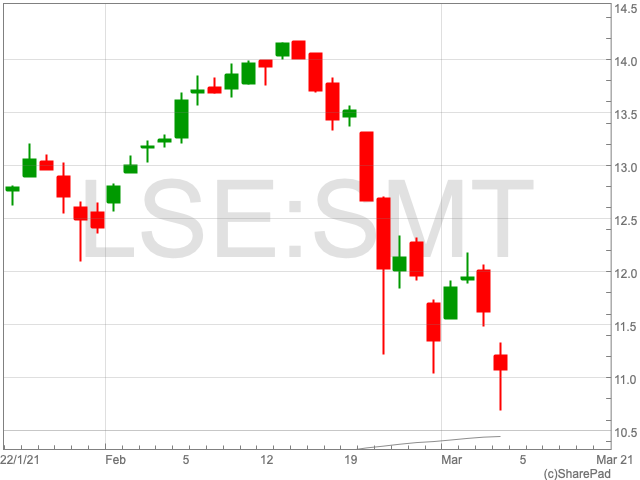
The Scottish Mortgage Investment Trust (LON:SMT) was down by 7% in morning trading on Thursday. It is a continuation of a recent trend for Baillie Gifford’s flagship investment trust which saw sharp falls throughout February. Since the middle of February, when the Scottish Mortgage Investment Trust was valued at 1,415p per share, its value has plummeted by 29% to 1,095.7.

Scottish Mortgage Investment Trust share price

Investors have been monitoring the trust closely as the dip could represent an ideal opportunity to buy in. This article will take a closer look at the trust’s holdings and the causes for its recent drop-off in value.

Rising bond yields

Bond yields are rising and it is causing concern for investors. The benchmark 10-year US Treasury bond yield climbed to 1.477% through the night, having reached a one-year high of 1.614% a week ago.

The yields, which are adjusted for expected inflation, have jumped recently as investors anticipate Joe Biden’s stimulus package will result in stronger US price growth.

Rising bond yields have begun to have an impact on US stocks, in particular those held within the Scottish Mortgage Investment Trust.

“The higher the yield on bonds, the more we see this push to move out of stocks,” said Jeffrey Carbone, managing partner at Cornerstone Wealth, North Carolina.

US tech stocks

The S&P 500 dipped by 1.31% on Wednesday, losing 50.51 points, as investors sold off their technology stocks following the continued news of rising bond yields. Tesla, the Scottish Mortgage Investment Trust’s fourth largest holding, has been particularly affected in recent weeks by the move away from technology and high-growth stocks.

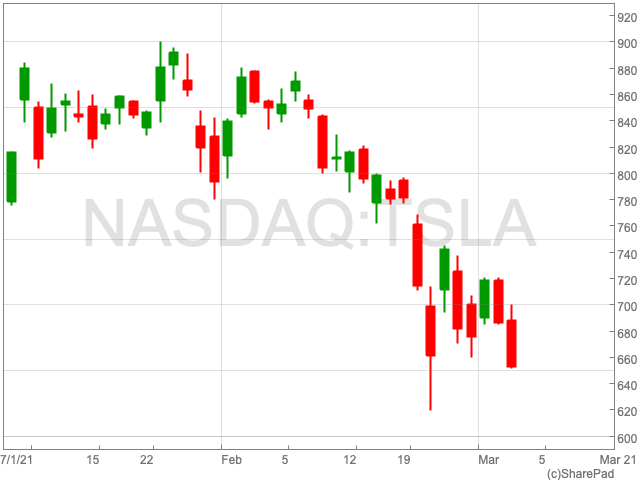
In January, Tesla was close to breaking the $900 mark following massive growth during the pandemic. However, the electric car manufacturer has since plummeted, now trading at $653.20 per share.

Tesla’s share price from 7/1/21 to 4/3/21

Amazon, one of the notorious FAANG stocks, and the Scottish Mortgage Investment Trust’s third largest holding, also bore the brunt of investors’ move away from tech. From 3,380p per share on 2 February, the online retailer has since dropped to 3005p per share, a fall of 12%.

Asia

The Scottish Mortgage Investment Trust has holdings in some of Asia’s top companies, however, even they could not escape investors’ renewed scepticism. Technology companies saw dips across the region yesterday. In Japan, the Nikkei 225 dropped by 2.3% to 28,930.11, while the the Shanghai Composite lost 2.05% to 3,503.49.

The Scottish Mortgage Investment Trust’s top holding, Tencent, the Chinese technology company fell by 4.56%, while Alibaba, the online retailer, and the Scottish Mortgage Investment Trust’s sixth top holding, fell by 2.56.

Both Tencent and Alibaba have seen dips over the past month or so, in line with their American counterparts. Tencent fell from 766.5HKD on January 25 to 690HKD today, a fall of 11%, while Alibaba dropped from 265HKD TO 227.2HKD, a fall of 17%, over a similar time period.

FTSE 100 suffers knock-on effect of rising US bond yields

0

The FTSE 100, London’s blue-chip index, was hit hard on Thursday as it fell by 0.74% just after midday to 6,626.05. The index felt the knock-on impact of a rise in US bond yields which dragged commodity prices down, as well as causing a sell-off on US tech stocks.

FTSE 100 Top Movers

Aviva (2.53%), Sage Group (2.4%) and British Land Group (2.29%) headed up the index at midday on Thursday.

Mining giants Rio Tinto (-7.84%) and BHP (-6.10%) were the top two followers on the FTSE 100 at lunchtime closely followed by the Scottish Mortgage Investment Trust (-5.9%).

FTSE 100 Mining Companies

It was a tough day for oil and mining companies on the index as the price of oil came down. This followed a rally in recent weeks, particularly for mining groups, in anticipation of a commodities supercycle.

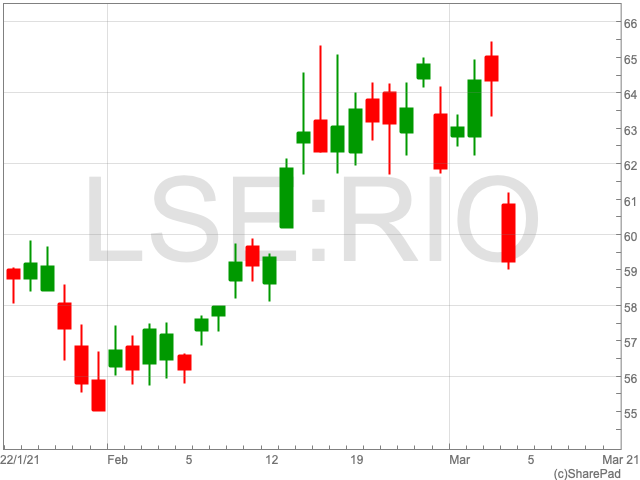
After a strong climb since early 2020, Rio Tinto shares plumetted by nearly 8% to 5,933p. Other FTSE 100 mining companies, including BHP, Antofagasta and Glencore also saw significant falls in the value of their shares.

Rio Tinto’s share price from 22/1/21 to 4/3/21

Aviva

Aviva confirmed on Thursday that the company is set to sell its Italian arm in 2021 as it looks to pay down its debt. The insurer also announced a net profit of £2.9bn, up from £2.7bn in 2019.

The FTSE 100 insurer proposed a final dividend of 14p per share, bringing the total dividend for 2020 up to 21p per share. This is up from 15.5p per share in 2019.

Schroders

Schroders confirmed on Thursday that its pre-tax profit fell by 2.3% in 2020, while its assets under management soared to a record high. The asset management company posted a profit before tax of £610.5m in 2020, down from £624.6m in 2019.

The FTSE 100 company now manages assets worth £574.4bn, up from 15% the year before.

Melrose posts operating loss as talks to sell-off Nortek commence

0

Melrose operating profit down to £340m

Melrose Industries (LON:MRO), owner of GKN, confirmed on Thursday morning it had initiated the process of selling its Nortek air-conditioning division.

However, there can be “no certainty a disposal will be completed”, according to the company’s financial statement released today.

The manufacturing company also posted a sharp drop in its operating profits, from £1.1bn in 2019 to £340m.

Adjusted free cash generation was £628 million, 6% higher than 2019, prior to £172 million of restructuring costs.

Melrose’s strong cash generation resulted in the company’s net debt falling by over £400 million to £2.85 billion by the end of 2020. This is down from £3.3bn from the year before.

The FTSE 100 company has proposed a final dividend of 0.75p “given the excellent cash generation achieved in the year”, according to the financial statement. This follows Melrose’s decision to withdraw its dividend for 2019 on account of the global pandemic.

The Melrose share price was up by 1.1% on early Thursday morning trading to 178.9p per share following the company’s announcement. Year-to-date the value Melrose shares are up by 97p per share.

Justin Dowley, chairman of Melrose Industries, commented on the results:

“Whilst the COVID-19 crisis has had a major detrimental effect this year, Melrose has generated record cash flows and continued to invest to improve our businesses.  All of this positions the Group well for a good recovery and strong performance in the future. Amidst these difficult conditions, Melrose has also managed to significantly reduce the £1 billion GKN UK pension scheme funding deficit that we inherited at the time of acquisition.”

Entain swings to profit following stateside venture

0

Entain’s joint venture in US has 18% market share of live markets

Entain (LON:ENT), the owner of Ladbrokes, swung to a profit during 2020 as growth from its venture into the US market reaped higher sales.

Following a loss of £131.2m in 2019, Entain posted a profit of £113.8m for 2020.

The FTSE 100 company saw its revenue remain steady at £3.5bn, as earnings rose by 10% to £862.1m.

BetMGM, Entain’s joint venture with MGM Resorts, is now live in 12 states, and the company’s market share of live markets is up to 18%.

Harry Barnick, Senior Analyst for leisure sector companies at Third Bridge, commented on Etain’s reliance on growth in the US:

“Growth in the US is fundamental to Entain’s long-term future. This increasingly competitive market has outperformed expectations and is the key growth pillar for the group,” Barnick said.

The board announced in the financial statement that a dividend would not be paid, as it did not consider it a “prudent” measuring with the ongoing uncertainty caused by Covid-19. In 2019 Entain paid a dividend of 17.6p per share.

Entain’s share price is down 2.05% on market opening on Thursday to 1,431p per share.

Jette Nygaard-Andersen, chief executive at Entain, commented on the results:  

“Having spent more than two decades working with digital companies using technology to transform and disrupt industries, I am hugely excited about the future prospects for Entain.  We are a digital entertainment company with a clear strategic focus on growth and sustainability.  As such, we have a fantastic platform from which to use our proprietary technology to expand into new markets and reach new audiences around the world.”

“Today’s results demonstrate the extraordinary resilience and professionalism of our people, as well as the importance of having a truly diversified business model that is not overly reliant on any one product, brand, territory, or channel.  Furthermore, we firmly believe that the launch during the year of our Sustainability Charter, which includes our game-changing Advanced Responsibility & Care player protection programme, will be a key component in helping us to deliver on our vision of being the world-leader in sports-betting and gaming entertainment.”

“The strong underlying momentum within our business, the rapid growth of our US joint-venture, and our continuing international expansion mean that we are as confident as ever in the long-term prospects for Entain.”

Schroders assets under management at a record high

0

Schroders profit before tax down by 2.3%

Schroders (LON:SDR) confirmed on Thursday that its pre-tax profit fell by 2.3% in 2020, while its assets under management soared to a record high.

The asset management company posted a profit before tax of £610.5m in 2020, down from £624.6m in 2019.

The FTSE 100 company now manages assets worth £574.4bn, up from 15% the year before.

The board announced a final dividend of 79p per share, bringing the full-year payment to 114p -unchanged from the previous two years.

Schroders’ share price was down by 2.28% at early morning trading on Thursday to 3,510p per share. The company’s share price is up year-to-date by 95p from 3,415p.

Peter Harrison, chief executive at Schroders, commented on the company’s results:

“The strength of our investment performance showcases the benefits of active investment management and our ability to deliver good outcomes for our clients. I would like to thank our employees for their hard work and ongoing dedication to our clients which helped us to deliver a strong financial performance in 2020 despite the challenging environment,” said Harrison.

“Assets under management increased 15% to reach a record high of £574.4 billion. We generated net inflows of £42.5 billion with strong demand in our Private Assets, Wealth Management and Solutions businesses. These higher growth areas now account for 54% of our assets under management. Our geographic diversification continued with our US business reaching a milestone of more than $100 billion of assets under management. We also continued to expand in Asia through our growing network of partnerships which contributed strongly to the Group in 2020.”

“I am proud of our continued progress in building a leading position in sustainability and impact investing. We now incorporate ESG factors into decision-making across our investment range. This fulfils a commitment we made in 2019. De-carbonisation is a critical issue. We are focused on supporting companies in their transition to net zero.”

Aviva to sell off Italian operation to pay down debt

0

Aviva posts net profit of £2.9bn

Aviva confirmed on Thursday that the company is set to sell its Italian arm in 2021 as it looks to pay down its debt.

The insurer will offload its Italian operation by selling for €873m in cash according to its financial statement released today. Aviva expects a £1.7bn debt reduction in the first half of 2021.

The insurer also announced a net profit of £2.9bn, up from £2.7bn in 2019.

Aviva had a record year with strong sales of bulk annuities, in which the company took on a large portion of corporate pension scheme liabilities.

Aviva proposed a final dividend of 14p per share, bringing the total dividend for 2020 up to 21p per share. This is up from 15.5p per share in 2019.

On Thursday’s market opening, Aviva’s share price was up by 0.89% to 386.4p per share. Year-to-date the company’s share price is up by over 20p.

Amanda Blanc, chief executive at Aviva, commented on the results:

“2020 was a year of significant change for Aviva. We have taken major steps forward in simplifying the business, most recently with the sale of Aviva France and today’s announcement of the sale of the rest of our Italian operations. Our strategic focus is now on the UK, Ireland and Canada where we have leading positions. We are putting customers at the heart of everything we do and I am confident we will transform Aviva’s financial performance and deliver greater value for our shareholders. I recognise we have much more to do and we are getting on with it.”

“Our performance in 2020 demonstrates the resilience of our Core businesses and our growth potential. We delivered record sales in group protection; record sales of bulk purchase annuities; and record net flows in savings and retirement, where we are the largest provider of workplace pensions in the UK.”

“Aviva is financially strong and following the completion of the major disposals, we will be in a position to make a substantial return of capital to our shareholders. We are also announcing today an £800m debt tender offer. This allows us to accelerate our debt reduction plans and lower debt by a total of £1.7bn in the first half of this year.”