Share Tip: McBride Group – this morning’s Interim Results announcement reports a solid performance

Upon announcing the McBride Group (LON:MCB) Interim Results to end-December this morning, its CEO praised the group’s employees for their hard work and its investors for their continued support, stating that together, they are building a strong, resilient and reset McBride, poised for future success. 
The Group built on the momentum of the last financial year and delivered a solid performance both financially and operationally, demonstrating further evidence of the Group's higher performance levels.  
Despite the backdrop of inflation, strong operational delivery, careful manage...

Is Vela Technologies at risk of going to zero?

From a long-term shareholders’ perspective, Vela Technologies may as well be trading at zero.

The company has made some terrible investment decisions, and investors are paying the price. In their last quarterly update, the executive director suggested the UK small-cap market was the problem. This argument has some merit, but the real problem is disastrous investment selection and poor portfolio management. 

Investors are understandably calling for a change in management after shares lost 93% of their value over the past five years.

Vela Technologies’ recent RNS archive is a catalogue of disasters and bad news. Quarterly investment updates reveal a steady decline in the portfolio’s value. The investment company has revealed that private company investments are going into administration, and one of their other holdings, Tribe Technology, recently announced it was delisting.

There are valid questions about the overall strategy and the leadership team’s ability to manage a portfolio of early-stage companies. 

An investment in NASDAQ-listed Conduit Pharmaceuticals was an utter catastrophe, with a multi-million dollar investment declining to be worth under £100,000.

In a recent update, the company said it planned to recycle capital into new investments while avoiding crystallising material losses. This isn’t very encouraging, as it suggests they lack confidence in their current portfolio.

As an investment company, Vela should seek out innovations and exciting management teams to make meaningful investments. Instead, through their most recent investment, they have effectively outsourced this job to another investment company, Igraine. 

It seems like the Vela management team has given up.

Vela recently announced the sale of a proportion of their stake in Ensilica at 46p, netting just £10k profit after holding the stock and adding to it since the beginning of 2022.

The company said it needed the cash for working capital purposes. This means the company is selling down investments to keep the lights on, which clearly isn’t a sustainable strategy.

After the sale of the stake in Ensilica and the delisting of Tribe Technology, the company’s listed equity portfolio is now only worth around £1m.

If things keep going as they are, it is only a matter of time before they delist or conduct a heavily discounted placing that obliterates any remaining value in shares. It’s also difficult to see investors having much interest in funding a placing at this point.

Vela desperately needs a big winner in its portfolio. Unfortunately, where that comes from isn’t immediately obvious.

Vela has invested heavily in Aquis-listed Igraine and is required to make further cash investments in the company, totalling £150,000, through convertible loan notes. There is an option for Vela to invest a further £300,000, but they would have to flatten several of their other positions to do so.

Igraine has exclusive investment rights in battery storage company GEM Energia Limited, which is establishing battery systems across the UK. Vela’s investment in Igraine will likely fund the construction of this network. It’s an interesting business, but it’s capital-intensive and unlikely to produce any meaningful returns for many years.

Vela Technologies is on thin ice.

Adsure Services announces software contract to enhance AI LLM training and provide efficiencies

Adsure Services has announced that its operating subsidiary, TIAA Ltd, has entered into an agreement with K10 Vision to implement advanced audit working paper software, marking a substantial step forward in Adsure’s digital transformation journey.

The selection of K10 Vision followed a thorough competitive evaluation process, with the company standing out for its innovative platform capabilities.

This strategic investment aligns with Adsure’s broader initiative to develop specialised Large Language Model (LLM) artificial intelligence tools, specifically designed to enhance operational efficiency for government-funded organisations, including NHS trusts, housing associations and local governments.

The company has previously announced the development of the TIAA Insights tool, which has been supported by an Innovate UK grant.

The new software system promises to deliver substantial benefits for Adsure and TIAA on multiple fronts. For TIAA Ltd, the transition to an online working paper platform will streamline audit processes, improving both efficiency and accuracy.

In addition, the software’s structured data architecture will provide Adsure with valuable datasets for training advanced AI algorithms, strengthening the company’s technological capabilities in the audit and assurance sector.

Large Language Models are trained by large data sets to produce meaningful computation and output for real-world business applications. The new software will play a vital part in Adsure training their model and applying it to boost efficiency across the business.

The implementation of the K10 Vision software is currently in progress, with comprehensive integration expected to be achieved within the coming months.

“Implementing K10 Vision’s cutting-edge audit software is a significant step forward in our strategic roadmap,” said Kevin Limn, CEO of Adsure Services.

“This system will not only enhance our operational efficiencies but also provide a structured foundation for developing next-generation AI tools tailored to audit and assurance services.”

FTSE 100 gains as German elections boost sentiment

The FTSE 100 has started the week on the front foot. The index ticked higher following the German election, paving the way for higher defence spending and increased investment throughout Europe’s largest economy, lifting sentiment across the region.

London’s leading index was 0.1% higher at the time of writing, while the German DAX rose 0.3%.

The election results were largely in line with expectations, and the leading conservative CDU party will now have to set about forming a coalition government, which could take around two months.

“A dose of more certainty has been injected into European politics, with the Germany’s Conservatives winning the elections. It comes at a crucial time for the continent,” explained Susannah Streeter, head of money and markets, Hargreaves Lansdown.

“Three years on from the invasion of Ukraine, high stakes deal making between the US and Russia continues, Ukraine is out in the cold and the outcome will have huge implications for security in Europe.

“There is a dawning realisation that European nations will have to pull together and present a more united deterrent force, and Friedrich Merz, the CDU leader, is reading from that script. He has pledged to relax fiscal rules, to increase defence spending and inject the economy with much needed investment.”

In London, BAE Systems was one of the biggest beneficiaries of the German election result, with shares gaining more than 2%. The defence stock has been in focus since Trump’s approach to Ukraine appeared to suggest that Europe would be forced to bolster defence spending to help support Ukraine and prevent NATO from unravelling.

Miners were among the top fallers after the sector enjoyed a buoyant week last week. On Monday, short-term profit-taking targeted Anglo American and Antofagasta.

There was also minor profit taking in Standard Chartered and Pershing Square.

Centrica continued its march higher with another 2% gain after releasing an encouraging set of results last week.

Elsewhere in the utilities sector, National Grid shares rose 1.4% after announcing the sale of its US onshore renewables business for $1.7bn as part of its wider streamlining strategy.

“National Grid has to spend a lot of money to upgrade its electricity networks on both sides of the Atlantic and slimming down in other areas of the business has always been a component of that strategy,” said AJ Bell investment director Russ Mould.

“The sale of the company’s US onshore renewables business is not a rushed response to the Trump administration’s more sceptical views on green energy, but something which has been in the works for some time, having first been announced in May last year.

“The fact the company has got the deal across the line in the new political environment might be met with some relief. The price tag looks reasonable for a set of assets which made a modest contribution to the group.”

Boss leaves discount retailer B&M as it cuts profit guidance

0

Discount retailer B&M European Value Retail (LON: BME) has lowered its guidance on profit and chief executive Alex Russo is leaving at the end of April. The retailer is the worst performer in the TSE 250 index today. The share price slipped 8.53% to 266.1p and has fallen 27% this year. B&M was in the FTSE 100 index until December 2024.

The company expects 2024-25 underlying EBITDA to be in the range of £605m to £625m. As well as general economic uncertainty, there is exchange rate volatility, although tis is a non-cash item. Previously the EBITDA range was £620m to £650m. The post-year trading update will be published in April.

Alex Russo has been chief executive since September 2022, having previously been finance director under Simon Arora. Severance terms will be in line with his service agreement. He will be eligible for a bonus for the current year and will retain his share options. A replacement is being sought with the help of an executive search firm.

The share price has not been this low since March 2020 and before than the end of 2016. B&M has been paying special dividends on a regular basis, though. The latest special dividend of 15p/share was paid earlier in February and there was a special dividend of 20p/share in 2023 and 2024. All dividends since 2020 when Alex Russo joined the board are worth £2bn.

AIM movers: EnergyPathways makes progress with MESH and ValiRx ends Imperial College collaboration

0

EnergyPathways (LON: EPP) has signed a non-binding memorandum of understanding with a clean energy fund, which would be a cornerstone investor in an equity funding at higher than the current share price. This will provide cash for the development of the MESH energy storage project. A FTSE 100 constituent is interested in long-term storage capacity. The final concept engineering report has been submitted and a decision on the application for a gas storage licence is expected soon. The MESH project could be operational by the end of 2027. The share price jumped 40.2%

Celsius Resources Ltd (LON: CLA) affiliate Makilala Mining Company has signed a binding term sheet with Maharlika Investment Corporation outlining terms of a bridge loan facility of up to $76.4m. This will fund the Maalinao-Caigutan-Biyog copper gold project in the Philippines. This cash will finance the updated feasibility study and front-end engineering design, plus some development activities. There is a requirement for additional equity funding to bring the mine into production. The share price recovered by one-fifth to 0.6p.

US focused oil and gas explorer and producer Nostra Terra Oil & Gas (LON: NTOG) says current oil production is averaging 130 barrels/day. The workover programme at Pine Mills has nearly doubled production at this asset in Texas. The company is generating cash from operations. The share price rose 8.06% to 0.0335p.

Corcel (LON: CRCL) says the El-1 well at the Irai gas field in Brazil has been tested at a rate of 120 barrels of oil equivalent/day. This is better than forecast. Corcel will workover a second well and decide whether to take up the option of a 20% stake in Irai. This would require spending $2.95m on development work over two years. There is right of first refusal over the other 80%. The share price increased 5.41% to 0.195p.

FALLERS

Oil and gas company Synergia Energy (LON: SYN) is raising £750,000 at 0.03p/share. This will provide working capital as income from the 50% working interest in the Cambay gas and condensate field builds up. The share price declined 16.4% to 0.0305p.

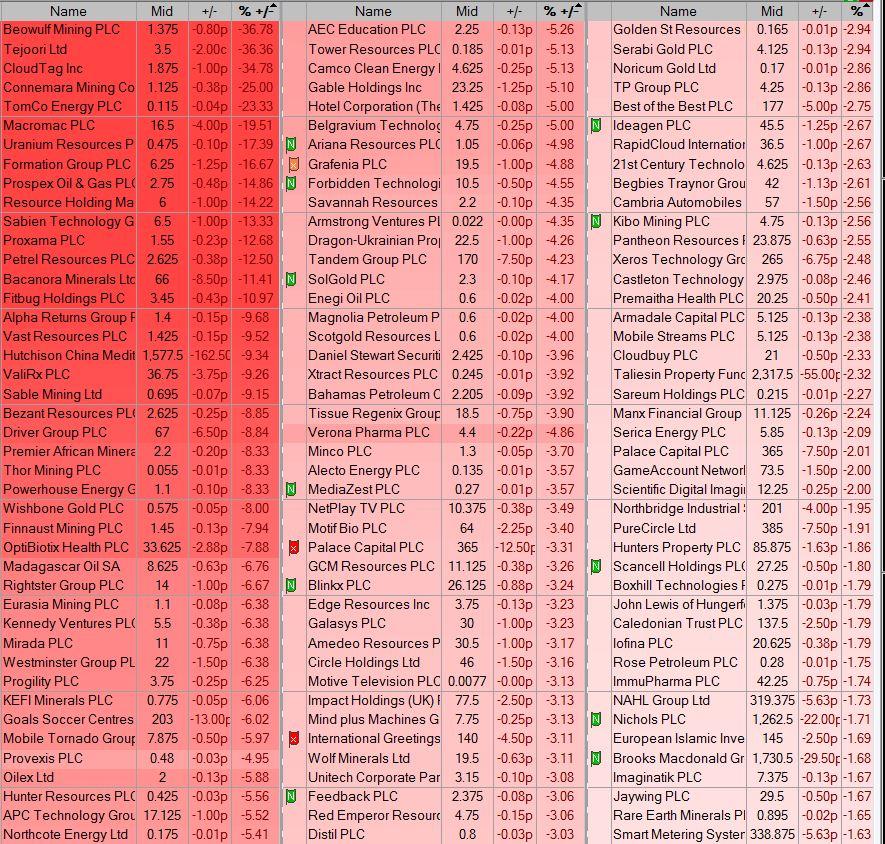
Cancer treatments developer ValiRx (LON: VAL) has ended its collaboration with Imperial College London. The evaluation project for drug candidates from the Dual Kinase series did not produce sufficiently good results to continue to invest cash in it. The share price slipped 12% to 0.55p, which is a new all-time low.

Real-time financial data software provider Arcontech (LON: ARC) grew interim revenues by 4% to £1.5m, although profit was slightly lower due to investment in additional staff and one-off costs. Cavendish still expects full year pre-tax profit to be £800,000, down from £1.1m. Net cash should reach £7.6m and the dividend could be edged up to 3.9p/share, which would be 1.5 times covered by forecast earnings. There could be scope for special dividends or share buybacks or even acquisitions. The share price decreased 8.8% to 98.5p, the lowest level since September.

Antibody profiling company Oncimmune (LON: ONC) shares continue their decline as it says that it is in talks to raise cash ahead of the current money running out in April. Alvarez & Marsal has been appointed to target potential partners and investors. The share price fell 9.27% to 2.25p an all-tine low.

Share Tip: Macfarlane Group – this week’s 2024 Finals report should help investors to realise that this group’s shares are undervalued

This Thursday morning will see Macfarlane Group (LON:MACF) announcing its Final Results for the year to end-December 2024.  
The protective packaging products group suffered ‘headwinds’ last year, which could well have eased fractionally its sales and profits for the year.  
However, the current year should be showing a noticeable improvement, boosted by the mid-January announced acquisition. 
The Business 
Headquartered in Glasgow, the Macfarlane Group, which was established way back in 1899, went public in 1973.  
The £172m-capitalised group employs ov...

In search of real diversification 

Gabriel Sacks, Co-Manager, abrdn Asia Focus plc 

Diversification is one of the investment world’s most important concepts. Its basic premise is that a portfolio consisting of multiple asset types is likely to perform better than one consisting of relatively few. 

The idea first emerged almost three quarters of a century ago, when Harry Markowitz published his groundbreaking Modern Portfolio Theory. Further research has reinforced its relevance ever since, as has a wealth of real-world experience. 

Even today, though, diversification’s full potential frequently goes unrealised. How some investors approach emerging markets (EMs) serves as a classic illustration. 

Imagine, for instance, investing in EMs via the MSCI Emerging Markets Index. Comprised of more than 1,200 companies drawn from 24 countries, this offers what might be described as “broad” exposure. 

The chance to access shares in hundreds of businesses in dozens of nations certainly sounds impressive. Yet it is interesting to reflect on some of the dimensions along which diversification is not so apparent. 

When diversification is only skin-deep 

Perhaps most obviously, the index is “top-heavy”. Four economies – China, Taiwan, India and South Korea – dominate1. This significantly reduces the degree of diversification at a stroke. 

In addition, there is no trace of smaller companies. Only large-cap and mid-cap businesses feature, despite small-caps’ proven ability to outperform their more sizeable counterparts over time. 

An essential lesson here, then, is that diversification is often only skin-deep. Contrary to initial appearances, it may barely scratch the service of what is possible in terms of diversifying within an asset class. 

It is right to stress at this point that the MSCI Emerging Markets Index serves many investors perfectly well. So do other indices that have attributes similar to those highlighted above. 

Nonetheless, as active managers, we feel the scope for diversification in EM equities is greater than many investors appreciate. The key lies in moving beyond the bigger picture, adopting a more granular view and digging deeper. 

Identifying hidden gems 

Since abrdn Asia Focus does not have to track the performance of an index, we have the freedom to seek out opportunities that most investors are likely to overlook. As a result, we have substantial exposure to EM smaller companies. 

Crucially, we aim to identify the most promising of these businesses by conducting our own in-depth research. This includes face-to-face engagement, which helps us assess policies, practices and prospects at first hand. 

One reason why this is vital is that the analysts who work for major investment banks, fund brokers and other research-intensive organisations tend to pay these stocks little heed. They generally prefer to focus on large-caps and mid-caps. 

Unearthing hidden gems has therefore become a job for specialists who can draw on their own “on the ground” knowledge. We believe this serves as an extremely powerful source of diversification. 

The insights we generate enable us to spot EM smaller companies with a capacity for long-term growth. Many of these businesses are notably innovative, forward-looking and capable of supporting – or even driving – positive, far-reaching disruption. 

The value of a bottom-up approach 

Of course, diversification has its limits. Effectiveness seldom stems from sheer numbers, as might be demonstrated by exploring how many of the 1,200-plus companies in the MSCI Emerging Markets Index possess genuine appeal from an investment perspective. 

We normally hold around 50 to 60 stocks in abrdn Asia Focus. These represent high conviction “best ideas” that are sensibly diversified across countries, sectors, industries and market capitalisations, as well as factors such as demographics, regulation and politics. 

The bigger picture does play a part in our investment decisions. National and regional events, along with geopolitics and geo-economics, inevitably help shape our thinking. 

But it is micro-developments at a company level that really count for us. Remaining invested in high-quality stocks – as opposed to, say, attempting to second-guess who might win an election or whether inflation will go up or down – is our guiding principle. 

In our view, diligent stock-picking and active management are absolutely central to realising diversification’s full potential. In other words, real diversification comes from the bottom up – not from the top down. 

Important information 

  • The value of investments, and the income from them, can go down as well as up and investors may get back less than the amount invested. 
  • Past performance is not a guide to future results. 
  • Emerging markets tend to be more volatile than mature markets and the value of your investment could move sharply up or down. 

Other important information: 

Issued by abrdn Fund Managers Limited, registered in England and Wales (740118) at 280 Bishopsgate, London EC2M 4AG. The company is authorised and regulated by the Financial Conduct Authority in the UK. 

Find out more at abrdn.com/aas or by registering for updates. You can also follow us on X, Facebook and LinkedIn

National Grid sell US onshore renewables business for $1.78bn as part of streamlining strategy

National Grid has announced a strategic divestment of its US onshore renewables business, National Grid Renewables, to Brookfield Asset Management and its partners in a deal valued at $1.735 billion. The sale aligns with National Grid’s May 2024 strategy to streamline operations and concentrate on its core networks business.

The transaction, which values National Grid Renewables at an enterprise value of $1.735 billion, will be finalised subject to customary completion adjustments. The deal encompasses a significant renewable energy portfolio, including 1.8GW of operational assets and 1.3GW under construction across utility-scale solar, onshore wind and battery storage facilities in the United States.

The sale is expected to conclude in the first half of the financial year ending 31 March 2026, pending necessary regulatory approvals and consents. This strategic move represents a significant step in National Grid’s broader initiative to streamline its business operations and sharpen its focus on network infrastructure.

National Grid shares were 1% higher at the time of writing.

Is it time to buy Wood Group shares?

Wood Group is a major casualty of the slowdown in oil and gas upstream activity over the past five years. The company has racked up nearly $700m in net debt and is set for a year of negative free cash flow.

The green energy transition has ravaged Wood Group’s fossil fuel energy business. The decline in upstream spending has directly contributed to Wood Group’s demise. Investors, however, will be rightly critical of the company’s management of the situation.

Although the writing has been on the wall for more than a decade, Wood Group has only recently started to report substantive sustainable energy-related revenues.

Wood Group is doing really interesting things in hydrogen, carbon capture, LNG and waste-to-energy. Sustainable activities made up around 21% of revenue in the recent half-year period, and the company said its sales pipeline is around 40% sustainable solutions related. Some would argue that this is too little, too late. 

Notwithstanding Wood Group’s weighting to fossil fuels and sustainable solutions, the immediate concern is the company’s poor financial position, which was highlighted by a trading update in February. Wood Group shares halved the day it was released.

Be under no illusion that the trading statement released in mid-February deserved the market reaction it got. 

Wood Group is haemorrhaging cash and is being forced to sell off assets to plug an expected negative free cash flow of between $150m – $200m. 

Negative free cash flow is a concern because it raises questions about Wood Group’s ability to manage and improve its debt situation. This is a major red flag and is the main contributor to the 80% decline in the Wood Group share price over the past year.

The company is in trouble. Macro influences have been unkind, and Wood Group could have handled the headwinds better. Adjusted EBITDA more than halved from $885m in 2019 to $423m in 2023.

However, those looking at shares at 26p and attempting to gauge whether now is a good time to buy must consider the future and whether the company has a clear path to recovery.

Shares are trading below 30p for a reason. Wood is struggling to generate cash, and debts are mounting. Cash generation is key to a rebound in shares. The company is disposing of assets to raise cash this year, but selling off assets isn’t a long-term solution. 

Wood is undergoing a cost savings programme that is expected to reduce the cost base by around $145m between 2023 and 2026. Reducing costs will help improve cash generation, but the company desperately needs top-line growth.

Thankfully, the industry may just be turning in Wood’s favour.

The upstream fossil fuel industry is showing signs of increased investment, which will provide much-needed business for Wood Group.

After peaking at $814bn in 2014, annual investment in upstream oil and gas hit lows of around $400bn before steadily picking up to an estimated $580bn in 2024. Forecasters at the International Energy Forum see this increasing to around $780bn by 2030. A continued and steady increase in upstream investment would underpin Wood Group’s growth over the next five years. 

Donald Trump’s approach to oil and gas will be welcomed by Wood Group executives.

Meanwhile, Wood Group continues to win new business from the world’s largest energy companies, including BP, Shell, and Saudi Aramco, and will likely beneift if these major players increase their activity. As an example, Wood recently announced a $120m contract extension with Shell to develop brownfield offshore and onshore assets across the UK.

There could well be a rewarding medium-term trade in Wood Group as bargain hunters step in the hope disposals go well, and cash generation improves. The longer-term picture relies heavily on the company’s ability to become free cash flow positive in the coming year and whether forecasts of an uptick in upstream investment come to pass.

This is a high-risk play for those investors who believe the oil and gas sector will contribute to the global energy supply for years to come but also see renewable infrastructure spending expanding.

Wood Group has attracted private equity interest in recent years. The recent decline may have some licking their lips.