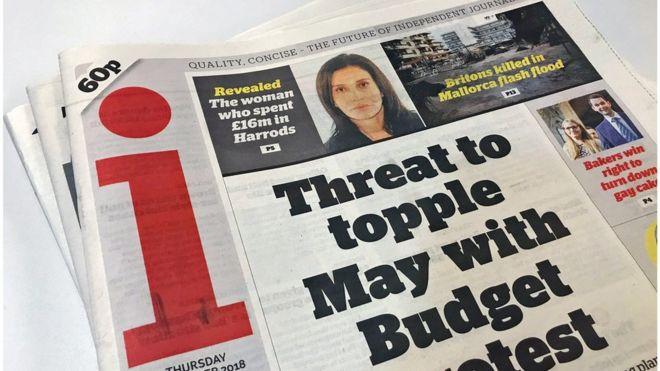
Johnston Press shares soar 20% on i sale rumours

0
Shares in Johnston Press jumped by more than 20% on Monday morning. Following reports that the Daily Mail-owner DMGT (LON: DMGT) is planning to buy the newspaper after it put itself for sale in October. The news was first reported by Sky. Johnston Press has not yet commented on the developments. The group, which owns The Scotsman and The Yorkshire Post, has been struggling £220 million debt, which must be paid off by June 2018. Jane Martinson, who is the professor of business journalism at City University, said on the Today programme that DMGT might buy the i newspaper, which is “quite complementary to the other papers in its stable, particularly the Metro”. “It is cheap, there is actually a cost to buy the i whereas the Metro is free. The overlap with the Metro is quite good in terms of readers, they are both neutral politically which is really interesting for DMGT, the owner of the Mail.” According to Martinson, seeing Johnston Press sell of different titles is “a sad way to end”.

“They were making huge fat profit margins but used it to spend lots and lots of money for titles like the Scotsman, like the Yorkshire Press and it now looks like, saddled with £220 million to pay back next summer, they cannot do it.”

“They have had to put themselves up as a fire sale.”

In a note to investors last month, Johnston Press said: “In order to assess all strategic options to maximise value to its stakeholders, the board of Johnston Press announces today that it has decided to seek offers for the company.” “There can be no certainty that any offer will be made for Johnston Press, nor that any transaction will be executed, nor as to terms of any such offer or transaction.” Shares in Johnston Press (LON: JPR) are trading up 20.43% at 3.95 (1038GMT).

Anglo African Agriculture shares rally over 60%

1
Anglo African Agriculture shares (LON:AAAP) rallied over 60% on Monday morning after the company issued a trading update. The agricultural trading group, which focuses its efforts in Africa, confirmed that it had met the conditions of a proposed provision of a $1 million loan to a Kenyan-based port and logistics group. David Lenigas, Non-Executive Chairman, commented; “I am delighted that we have completed our due diligence and decided to advance this loan to Comarco. This transaction and funding will allow them to fully capture the recent upswing in its port activities and for AAA to develop our relationship.” He added: “Since our announcement that we intended entering into this loan, we have been approached by numerous parties expressing their interest to cooperate with us in various forms. This is significant, as this clearly demonstrates that we have managed to find a very valuable and uniquely positioned asset with potentially very large upside potential.” Back in September, the company announced it had secured funding for the loan, totalling £1,055,000. The company said that the capital was raised with the intention of helping to further develop Comarco Group. The remainder of the funds would be used to support additional transaction costs. Shares in Anglo African Agriculture are currently trading +60% as of 10:31 AM (GMT).

Castleton Technology shares are good value with further growth on horizon

Castleton is an AIM listed technology company with roots firmly in the software business and provision of solutions for the social housing market.
The group operates in the property market providing solutions to housing associations seeking to streamline the management of their properties, tenants and workflow.
The technology firm currently works with around 1,700 housing associations of which 700 have more than 1,000 houses. ,
Castleton's software suite allows housing associations to create bespoke technological interfaces and models to help deliver crucial processes such as the management of...

UK economy hits two-year high, growing 0.6%

0
The UK economy has picked up over the third quarter, growing at the fastest rate in two years. The Office for National Statistics (ONS) showed economic growth to rise by 0.6%, however, has also warned that it is likely to slow down before Brexit. “The economy saw a strong summer, although longer-term economic growth remained subdued,” said Rob Kent-Smith, the head of national accounts at the ONS. “There are some signs of weakness in September, with slowing retail sales and a fall back in domestic car purchases.” “However, car manufacture for export grew across the quarter, boosting factory output. Meanwhile, imports of cars dropped substantially helping to improve Britain’s trade balance.” Figures in the future are likely to slow down as businesses and consumers are preparing themselves for a Brexit where no-deal has been decided on the Ireland border issue. Andy Scott, associate director at independent financial risk management consultancy JCRA, said: “The overall picture of the UK economy is, however, one of resilience. With unemployment at multi-decade lows and wages accelerating, the robust levels of household spending should continue to act as a buffer against weakening sectors such as manufacturing, preventing the economy from stalling or worse, contracting.” Brussels has predicted UK output growth to be 1.2% next year, placing the UK towards the bottom of the growth table next to Italy. “Brexit-related uncertainties could intensify over the coming months, if the EU rejects whatever final document the cabinet agrees on or if MPs vote against a deal,” said Thomas Pugh, an economist at Capital Economics. “In the absence of those developments, however, we expect growth of about 1.3% over 2018 as a whole.”

DUP accuses Theresa May of “total betrayal”

0
The Democratic Unionist Party (DUP) has rejected Theresa May’s suggested plans for a customs border down the Irish Sea. Following a leaked letter from Theresa May to DUP leader Arlene Foster, East Antrim MP Sammy Wilson has accused the Prime Minister of “total betrayal”. “If she continues down the road of bringing something forward which is unacceptable to a large part of her own party and ourselves, then I think the inevitable consequence is that it will be voted down in the House of Commons,” Wilson told Sky News. “She is now contemplating signing up to a legal agreement which, regardless to her aspirations, would be binding on the government of the UK. Secondly, it would be a legal agreement which the government of the UK could not walk away from – that could only be broken if the government in the UK and the EU agreed to it being changed,” he added. In the letter, which was leaked to the Times, May admitted that the EU was pushing a Northern Ireland-only backstop arrangement alongside a UK-wide solution. May wrote in the letter: “They want to maintain a Northern Ireland-only ‘backstop to the backstop’ in case the future negotiations are unsuccessful.” “I am clear that I could not accept there being any circumstances or conditions in which that ‘backstop to the backstop’, which would break up the UK customs territory, could come into force.” “That is why it is critical that the provision for a UK-EU joint customs territory is legally binding in the Withdrawal Agreement itself, so that no ‘backstop to a backstop’ is required.” Foster also commented on the letter and tweeted on Friday: “The PM’s letter raises alarm bells for those who value the integrity of our precious union & for those who want a proper Brexit for the whole UK. From her letter, it appears the PM is wedded to the idea of a border down the Irish Sea with NI in the EU SM [single market] regulatory regime.” Despite issues surrounding the Irish border, the government has suggested Brexit deals are almost finalised.  

Fastjet shares down 6% on new warning

3
Fastjet, the budget African airline, has warned that it could collapse unless investors provide money by the end of the month. The airline issued a warning in October saying that it was close to collapse unless an injection of cash was provided soon. In a statement, the Fastjet said: “The company continues to review its current cash requirements and is able to continue operating during November due to some improvement in trading, cash generation and internal efficiencies.” “The headroom available allows the company further time to continue discussions with its major shareholders and creditors,” it added. “While discussions to date with certain shareholders and creditors have been positive, discussions are ongoing and there can be no guarantee of a successful outcome.” “If the company is unable to carry out an equity fundraise and / or reach an agreement with its key creditors, the group would be unable to continue trading as a going concern.” Following the news, shares in the group fell 6%. The budget airline was founded by easyJet (LON:EZJ) founder, Sir Stelios Haji-Ioannou. The group has a cash balance of $3.9 million (£3 million), however, £3 million of this is held inside Zimbabwe and has restricted access. Shares plummeted 70% in June on a previous financial warning after saying it was “at risk of not being able to continue trading as a going concern”. The airline was first launched in Tanzania in 2012 but has expanded over South Africa, Zimbabwe, Zambia, Mozambique, Uganda, Malawi and Kenya. Shares are currently down 4.11% at 1.68 (1259GMT).  

High street faces toughest conditions in 5 years

27
A new report by PwC has found has found that the UK high street is facing the toughest trading conditions in five years. The number of shops, pubs and restaurants that have closed this year has surged to 4,400 in the first six months of 2018. Fashion and electrical stores are being the hardest hit as shoppers are moving online. Lisa Hooker, who is the consumer markets leader at PwC, said: “Looking ahead, the turmoil facing the sector is unlikely to abate.” “Store closures in the second half of the year due to administrations and company voluntary arrangements [a form of insolvency] already announced will further intensify the situation,” she added. Retail chains including House of Fraser, Evans Cycles and Maplin have collapsed into administration. Other chains including Carpetright (LON: CPR), Mothercare (LON: MTC) and Homebase have had to carry out store closures and slash their rent bills. Restaurants that have been affected include Jamie’s Italian, Carluccio’s and Gourmet Burger Kitchen as people are eating out less. Pubs have also been hit in the current climate of the high street. Brigid Simmonds, the chief executive of the British Beer & Pub Association, said: “Despite the positive measures announced in the budget, one in three pounds spent in the pub still goes to the taxman and pubs pay, per pound of turnover, more in business rates than any other sector.” Fashion, however, remains the hardest hit with Patrick O’Brien, a retail analyst at GlobalData saying: “Clothing is where the shift to online is happening fastest. Over £7 billion of sales have moved online in clothing and footwear in the last five years. That dwarves any other sector.” According to PwC, the greatest number of closures have been in Greater London, which had 716 store closures over this year and only 448 have opened.  

FTSE 100 rises on back of strong trading updates

0
The FTSE 100 closed 23.40 points higher on Thursday at 7,140.68. Eight companies made updates today, including Game Digital (LON:GMD) and Theworks.co.uk (LON:WRKS) and Burberry (LON: BRBY).

Burberry

Burberry revealing a rise in profits for first-half profits, which were helped on the back of growth in Asia and the new debut collection from chief creative officer Riccardo Tisci. “We made good progress in the half as we began to transform and reposition Burberry, while maintaining our focus on financial and operational discipline,” said Burberry in a statement. “While the early signs are encouraging, transitioning the product offer, evolving our distribution, changing wider consumer perception and seeing this translate into positive business performance will take time,” it added. Shares in the group closed 3.15% higher at 1,873.20. Ian Forrest, an investment research analyst at The Share Centre, said on the fashion retailer’s growth: “Luxury retailer Burberry’s interim figures today were reassuring if not spectacular. The company said the debut collection from its chief creative officer Riccardo Tisci had received an exceptional response.” “The figures were slightly better than expected and Burberry’s CEO confirmed that the company was on track to achieve cost savings of £100 million and meet expectations for both next year and 2020.” “Despite a sharp drop in the share price over the past two months the shares have still outperformed the market so far this year, and they rose modestly again this morning in response to the results. With the forward price-earnings ratio looking more demanding we continue with our ‘hold’ recommendation for investors who are seeking a balanced return and willing to accept a medium to higher level of risk,” he added.

Game Digital

After full-year earnings rose by over 25%, the retailer saw shares increase by 6.25% on Thursday’s trading. Whilst the group posted flat revenues and a decline in profits, it made cost savings of approximately £11.4 million. “Game Digital has performed well in a challenging market,” saidPaul Hickman, an analyst at Edison Investment Research. “Management is focused on the Belong gaming arena initiative. In its existing 21 sites the concept has demonstrated high occupancy, high margin and low capex.”

Theworks.co.uk

Also sending the FTSE 100 up on Thursday was newly listed Theworks.co.uk, where shares surged 11.97%. The group reported half-year revenues to increase by 15% on the back of strong sales. Full-year is expected to be in line with expectations.      

5 Reasons Why You Should Invest In Fine Wine In 2019

This article was written by Daniel Carnio, CEO of Oenofuture.
  1. Uncertain times ahead
With Brexit looming ever larger on the horizon, investors are rightly feeling nervous and uncertain about what the future will hold. The facts make for grim reading; during what has been dubbed Red October $8 trillion has been wiped off global markets, the FTSE is at its lowest level since 2007, and former UK Prime Minister Gordon Brown warned in September that the world economy was “sleepwalking into a future crisis”. In these unsettling times, fine wine represents a safe harbour for those looking to shelter from the storm until a clearer picture emerges of the implications of Brexit and the global economic situation.
  1. Excellent Potential Returns
Fine wine represents a sound investment in these uncertain times because prices are not correlated to any other asset or market. Instead, prices are normally dictated by supply and demand with limited production and rare fine wines offering excellent potential for savvy investors. With the ever-growing appetite for fine wine in Asia and the limited quantities produced by the world’s top estates each year, the future is looking very bright indeed for investors who have the foresight to get ahead of the game.
  1. Seek Out Alternative Regions
In addition to the high potential for rare and limited production wines, the fine wine investment market is opening up to new and alternative regions. The Liv-ex has just added two new indices for Port and California. This is a strong indication that the fine wine investment market is becoming more nuanced and recognising that bringing alternative regions into the fold will bring rich reward. This suggests that these alternative regions will become increasingly important in the future, offering investors even more options when it comes to making wise investments.
  1. Increasing Demand For Fine Wine
In Asia purchases of bottles of wine over $200 in value has increased by over 70% over the past year, hinting at the incredible demand for fine wine in markets like China, Hong Kong and Japan. On a yearly basis 118 billion glasses are consumed in China alone and with global wine production at a 60 year low since 1950 prices are looking very strong. According to Forbes, the price of wine set to increase by 20% in 2019 and even the legendary Warren Buffet has recommended that a percentage of every portfolio should be in wine.
  1. A Win-Win Investment
With stock losses of 74% predicated in the aftermath of Brexit, investors will need a little something to ease their pains. Fine wine investment has the unique advantage over other investments that you can always drink your stock if things go wrong! Leaving the joking aside, with such demand across the globe and limited production capabilities, fine wine investment represents a solid alternative to the volatile stock market and one that can always be enjoyed if you decide to cash in on your investment by pouring out a glass or two of something delicious!

Dyson wins five-year legal battle with European courts

0
Dyson has won a legal battle with the European courts on Thursday that lasted for five years. The battle concerned the energy labelling of its vacuum cleaners. Though the legal battle was dismissed in 2015, Dyson appealed it in 2016. The case was sent to the General Court for a new assessment and was upheld on Thursday. In 2013, Dyson began challenging the European Union’s regulations because the vacuum cleaner energy efficiency tests were “flawed” according to the UK engineering company. It considered this aspect of the energy label regulations misleading. It said that EU regulations permit vacuum cleaners to be tested in a laboratory without any efforts made to replicate real world conditions. Therefore, the results are misleading, flawing energy labels in their current form.

Dyson said the energy labelling regulations were often exploited by manufacturers in order to make their products appear more efficient than they actually are.

Bloomberg have said that the legal victory is a “vindication” for the company’s founder and boss James Dyson. This is as a result of his strong support for the UK’s departure of the European Union. A spokeswoman for the company commented: “This is welcome news and a win for consumers across Europe. We have been arguing consistently that the Commission committed two legal violations to the detriment of European consumers and Dyson.” “This benefited traditional, predominantly German, manufacturers who lobbied senior Commission officials. Some manufacturers have actively exploited the regulation by using low motor power when in the test state, but then using technology to increase motor power automatically when the machine fills with dust – thus appearing more efficient.” “This defeat software allows them to circumvent the spirit of the regulation, which the European Court considers to be acceptable because it complies with the letter of the law.“In these days of Dieselgate, it is essential consumers can trust what manufacturers say about their products. But the Commission endorsed a measure that allowed Dyson competitors to game the system.” “The legal process has been long, distracting and expensive, with the odds stacked against us. Most businesses simply do not have the resources to fight regulations of this nature. It is appalling that this illegal and fundamentally anti-competitive behaviour has been endorsed for so long.” The current labelling regulations will remain in place for 10 weeks to allow time for appeal. Dyson also recently announced that it will manufacture its new electric car in Singapore in 2020, with the first car to be launched in 2021.