Lloyds shares: is it time to book gains?

The Lloyds share price has enjoyed a sharp rally from January’s lows around 53p to trade above the key 60p level, where it has since remained trading in a tight range.

The catalyst for the rally in January was a shift in expectations around interest rates amid concerns about stagflation in the UK and positive news around motor insurance litigation and potential redress that could cost Lloyds billions.

Chancellor Rachel Reeves intervened in the motor financing litigation process to prevent any “considerable economic harm” through higher motor financing costs in the future and impact on banking capitalisation. This was a major win for Lloyds and its investors, who now await further developments with a semblance of optimism.

The other major factor at play for Lloyds’s share price is the expectations of the number of interest rate cuts in 2025.

Interest rate traders rolled back pricing on the number of interest rate cuts they saw in January 2025, with the Bank of England appearing to have their hand tied by stubbornly high inflation, and potential stagflation.

This is a double-edged sword for Lloyds.

The prospect of interest rates staying higher for long is a major positive for Lloyds and other banks as it provides the opportunity for higher net interest margins and greater profitability.

However, in recent days, the number of interest rates predicted by interest rate markets has grown, suggesting the Bank of England will indeed have to act on interest rates to stem the UK economy’s decline caused by the Labour government’s economic policies.

There is an argument this hasn’t been properly priced into Lloyds shares yet.

That said, traders have a balancing act to contend with. While interest rates may fall later in the year, underlying demand for mortgages and other products remains robust. With underlying demand remaining strong, the volume of products sold will offset any impact on earnings from lower interest rates. This is reflected in the sideways nature of trade in Lloyds in recent days.

The positive macro factors seem to be priced into Lloyds, leaving the stock needing additional developments to break higher.

From a technical perspective, Lloyds formed a number of small gaps higher during the run higher, leaving the stock vulnerable to a pullback to close these gaps.

The first small gap was around the 54p level in mid-January, and the second more material gap occurred from 59p to 61p in late January. In the grand scheme of things, these gaps are relatively small. That said, technical traders will be eyeing the close of these gaps if the stock retreats.

In addition, Lloyds has become horribly rangebound, and the wider range of 63p – 53p will take some breaking. With shares near the top end of this range, the weight of historical price action favours a decline in Lloyds shares in the absence of any majorly positive macro developments.

Results due for release later in February could prove to be the next major catalyst.

Vodafone shares sink as German business slows

Vodafone is becoming a perpetual disappointment. A rally in the middle of last year proved short-lived, and now the company is really struggling in its key German market. 

VOD shares were down 5% at the time of writing after releasing Q3 results.

Vodafone has posted a 5.0% increase in total revenue to €9.8 billion for its third quarter, driven by organic service revenue growth, though partially offset by unfavourable foreign exchange movements. 

The telecommunications giant saw its group service revenue climb 5.6% to €7.9 billion, with organic growth of 5.2%, marking an improvement from the previous quarter’s 4.2%.

Group Adjusted EBITDAaL rose by 2.2% on an organic basis to €2.8 billion, although the adjusted EBITDAaL margin contracted by 0.5 percentage points year-on-year to 28.8%. 

However, for all the positivity around the top line and EBITDAaL, Q3 operating profit saw a significant decline of 18.4% to €1.0 billion.

The company’s financial performance was strong in some markets, with particular momentum in the UK and Africa. It was the slowdown in the key German market – accounting for 34% of Vodafone’s group service revenue – that was the major disappointment for investors.

German Market Headwinds Persist

The German operation continues to face significant challenges, with revenue declining by 7.6% to €3.1 billion in Q3. Service revenue in Germany contracted by 6.4%, slightly worse than the previous quarter’s 6.2% decline. 

This downturn was largely attributed to the impact of recent TV legislation changes affecting Multi Dwelling Units (MDU), which came into full effect in July 2024.

The German fixed service revenue experienced a particularly sharp decline of 10.7%, while mobile service revenue decreased by 1.0%. 

The implementation of a national roaming agreement with 1&1 has seen slower-than-anticipated customer migration, though this is expected to accelerate in coming quarters.

After enduring their fair share of disappointment, Vodafone investors were treated to an upbeat trading update this morning as the telecoms giant looks to break free of the “one step forward two steps back” performance that has plagued the business in recent years,” said Mark Crouch, market analyst at investment platform eToro.

“Internal cost cutting coupled with sales of underperforming assets mean Vodafone has boosted revenues while maintaining generous shareholder returns. However the mammoth task facing the company is by no means complete. With so much being pinned on a merger with Three UK, which has at last been given the green light, it is perhaps not surprising that investors haven’t poured in to invest, underlining the issues still facing the company. 

“Whether or not the deal goes through. Challenges remain for Vodafone. Unable to simply raise prices to prop up the balance sheet – something they’ve learned the hard way in Germany with declining customer numbers – Vodafone will need to come up with something other than asset sales and price hikes if they are ever to recapture their former glory.”

Made Tech – provides Digital, Data and Technology services to help organisations make a positive impact, will tomorrow’s Interims make an impact?  

Tomorrow morning will see Made Tech (LON:MTEC) publish its Interim Results for the six months to end-November 2024. 
The group’s strategy is to provide software and services to run and improve public services worldwide and it could show a positive outlook despite its challenging backdrop. 
The Business 
Founded in 2008 and listed on AIM in 2021, with staff based in four ‘hub’ locations across the UK (London, Manchester, Bristol and Swansea), Made Tech provides services that enable central government, healthcare, local government and public infrastructure organisations to digital...

New Aquis admission: Can Cardiogeni bounce back?

Cellular medicines developer Cardiogeni (LON: CGNI) joined Aquis at the end of January 2025. The core CLXR-001 product is targeting the cardiac market, specifically coronary artery bypass grafting (CABG).
Cardiogeni floated to increase its profile and attract a broader shareholder base. The share price slumped from the subscription price of 147p to 60p on the first day and the bid/offer spread is 45p/75p. There were no declared trades on the first day of trading. On the second 300 shares were traded, which were two buys of 150 shares at 66p each. Despite that the share price was unchanged on t...

FTSE 100 slumps as Trump tariffs rock markets

The FTSE 100 tracked global equities to the downside after Donald Trump imposed tariffs on Canada, Mexico and China, threatening a far-reaching global trade war.

London’s leading index was down 1.2% at the time of writing as traders assessed the implications for individual companies and sectors.

“Investors are rattled at the prospects of a full-blown trade war breaking out after the US slapped punishing tariffs on Canada, Mexico and China, prompting retaliation,” said Susannah Streeter, head of money and markets, Hargreaves Lansdown.

“Investors are buckling up for a rollercoaster ride for the global economy, with the European Union expected to be next in line for punitive duties.”

The sharp reaction in stocks on Monday reflects an element of complacency in markets after Trump’s inauguration. Donald Trump had held off some of the most dramatic measures in the early days of his presidency, which cultivated a sense of relief that the worst of his campaign rhetoric would not be acted on.

Anyone positioning for this school of thought was humbled on Monday as US futures sank and Europe followed. That said, while the delines were pronounced, they were relatively contained, suggesting markets were pricing for some of the most damaging tariffs to be short-lived.

“Financial markets had assumed that Trump would talk tough on tariffs and back off when he got a deal, so the US president’s plan to act first and then (perhaps) talk has come as a nasty surprise to share prices around the world, especially as Canada and Mexico have already threatened retaliation,” says AJ Bell investment director Russ Mould.

“Trump’s launch of tariffs in 2018 did raise revenues for America but US corporate profits took a hit that year and America’s S&P 500 index fell by a fifth, so markets have understandably taken fright this time around.”

European and US car manufacturers were among the most heavily hit on Monday. The interconnectedness of the auto industry in North America means components move backwards and forwards across the border on many occasions.

Unsurprisingly, there were few gainers in London, with 90% of the FTSE 100 trading in negative territory.

The Scottish Mortgage Investment Trust was the top faller as traders reacted to a drop in the NASDAQ and the technology shares held in the trust’s portfolio. Copper miner Antofagasta was sharply lower as copper prices fell amid additional tariffs on China.

Elsewhere, there were broad declines in retailers, financials, miners, property stocks and engineering firms.

It appears the market is taking a ‘sell first, ask questions later’ to tariffs, with the impact on UK stocks not immediately obvious and uncertainty about whether Trump will strike closer to home in the coming weeks.

AIM movers: LungLife AI running out of cash and leaving AIM, while Zanaga Iron Ore signs power deal

0

Mosman Oil & Gas (LON: MSMN) has completed the acquisition of 82.5% working interest in the Sagebrush project in Colorado. The sale of the EP-145 interest remains dependent on government approvals. The share price rose 13.8% to 0.0455p.

Zanaga Iron Ore (LON: ZIOC) has signed a memorandum of understanding with Centrale Électrique du Congo, which supplies more than 70% of Congo’s power, to evaluate potential ways to satisfy demand for power at the Zanaga iron ore project. The share price increased 11% to 9.1p.

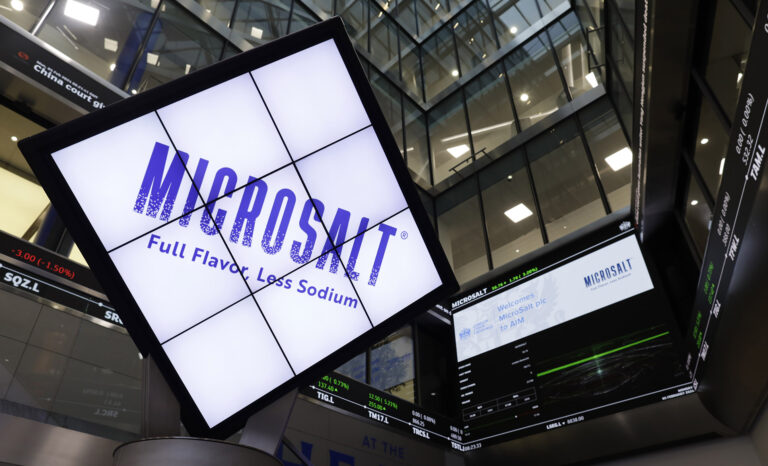
MicroSalt (LON: SALT) raised £2.3m at 70p/share in an oversubscribed placing. There will be £1.2m to finance inventory for orders from snack manufacturers and £600,000 to fund sales and marketing. The rest will go towards working capital and development spending. There are commitments for an additional 290 metric tonnes for 2025 and the current year volumes are likely to be ten times the level of 2024. The share price improved 10.7% to 77.5p.

ASICs designer EnSilica (LON: ENSI) has been awarded £10.4m of funding from the UK Space Agency, which will help it to gain business in the satellite communications sector. The funding is for developing user terminal chip sets. To receive the cash EnSilica has to spend double the amount over around three years. There are no customers signed up but potential buyers, such as Airbus and Thales, will be consulted during development. The share price is 5.95% higher at 44.5p.

FALLERS

Lung cancer diagnostics developer LungLife AI (LON: LLAI) is planning to leave AIM with discussions continuing with one strategic partner. However, there is unlikely to be an agreement in the short-term and cash, currently $1.31m, is only going to last until later in the second quarter. A public share issue is unlikely to be viable. If no source of funding can be found, then the company would be wound up. The share price slumped 79% to 2.15p.

GreenRoc Strategic Materials (LON: GROC) is raising £735,000 at 1.3p/share. Every two shares come with a warrant to subscribe for a share at 2p each. This will enable investigation of potential grant funding for the Amitsoq graphite project and make progress with the exploitation licence application. There is also further spending on testing and discussions with offtake partners. The share price declined 18.7% to 0.2125p.

Oriole Resources (LON: ORR) says the first four holes have been completed as part of a $4m spend on exploration at the Mbe gold project in Cameroon to take its stake from 10% to 50%. There have been multiple gold mineralised intersections. There are narrower zones of high grades and broader envelopes of lower grade material. There will be further results later this month. Drilling also continues at the Bibemi orogenic gold project in Cameroon. Additional intersections have been discovered. Phase 5 drilling will be completed in this first quarter of 2025. The share price fell 18.4% to 1.55p.

Major General Graham John Binns is stepping down from the board of Westminster Group (LON: WSG) as part of a cost cutting move by the security services company. The share price slipped 12.1% to 1.45p.

Share Tip: Alumasc Group – supplying building products for a sustainable future while driving shareholder value

Tomorrow morning will see The Alumasc Group (LON:ALU) announce its Interim Results for the six months to end-December 2024, they should be more than positive and help to identify just how attractive its shares are at the current 292.50p. 
I am looking for the group to point to its current year sales to continue the growth shown over the previous six years. 
The Business 
Based at Burton Latimer in Northamptonshire, this £106m capitalised group is a sustainable building products, systems and solutions business.  
With over 90% of group sales made into the UK market, its...

MicroSalt shares soar after forecasting 10x volume growth in 2025, launches new french fry product

MicroSalt shares surged in early trade on Monday after the low-sodium salt technology announced forecasts for 2025 alongside an oversubscribed fundraise at current market prices.

The Tekcapital portfolio raised £2.3 million in an oversubscribed subscription to fund the development of a recently launched ‘Quick Service restaurant’ product, which the company sees as a ‘tremendous opportunity for growth’.

However, the most exciting takeaway from today’s RNS is that MicroSalt forecasts 2025 B2B volumes to increase more than 10 times the amount of low sodium salt manufactured in 2024. This represents a step-change in customer demand and suggests MicroSalt salt will be used in the production of millions, if not tens of millions, of individual food products.

MicroSalt said it had received orders for an additional 290 metric tonnes of low-sodium salt for 2025 already and expects this to increase.

Investors will also be delighted to hear the company has received positive feedback subsequent to the launch of the Quick Service restaurant and MicroSalt will target the massive french fry market. This development, should it result in the commercial reformulation of products, would open the doors to a market of billions of people globally that consume fast food products.

MicroSalt shares were 20% higher at the time of writing.

Investor confidence in MicroSalt was further demonstrated by the £2.3 million fundraising being completed at current market prices, with investors prepared to commit substantial levels of cash without demanding a discount to the recent share price.

“We are pleased to close this oversubscribed fundraising at the current market price, at a time when many other fundraisings are consummated at substantial discounts,” said Rick Guiney, CEO of MicroSalt.

“This additional capital will enable us to further scale our B2B sales to snack manufactures and help us meet anticipated customer demand in the QSR segment since our January 2025 product launch.

“I am very optimistic on the upside potential for anticipated rapid growth in 2025, particularly at a time when governments are increasingly focused on initiatives to reduce Sodium consumption in manufactured foods. Indeed, only last month the US FDA proposed new short form nutritional labels to be applied to the front of packaged foods where the levels of (i) Saturated Fat; (ii) Sugars; and (iii) Sodium are to clearly labelled as Low, Medium or High. For MicroSalt, this is potentially game-changing and we already have food companies engaging with us to actively address the need to lower Sodium levels in their products.” 

EnSilica wins UK Space Agency contract for satellite technology development

EnSilica shares jumped on Monday after the group announced a UK Space Agency contract win.

EnSilica, the British chip manufacturing specialist, has been awarded a substantial £10.38 million contract from the UK Space Agency to develop next-generation semiconductor chips for satellite broadband equipment.

EnSilica, which specialises in mixed signal ASICs (Application Specific Integrated Circuits), will focus on creating semiconductor chips for mass-market satellite broadband user terminals.

These terminals will be designed to interface with various satellite networks, including OneWeb and the European Union’s planned IRIS2 multi-orbit constellation.

The market for user terminals is projected to reach US$16.5 billion by 2031, and investors will be delighted that EnSilica is positioning itself early in the growth cycle.

Modern satellite terminals require hundreds of specialised chips to operate their electronically steerable antennae, highlighting the significant commercial potential of this project.

The funding has been allocated through the UK Space Agency’s Connectivity in Low Earth Orbit (C-LEO) programme, which maintains a total funding pool of £160 million over four years.

The programme aims to strengthen Britain’s position in the competitive global market for Low Earth Orbit satellite constellations by supporting the development of advanced satellite technology and hardware.

After a poor 2024 for EnSilica shares, investors will hope the relationship with the UK Space Agency develops over time.

EnSilica shares were 8% at the time of writing.

Tip update: Hargreaves Services shares are only beginning to recognise the value

Interim figures from Hargreaves Services (LON: HSP) show good progress with the services business and highlight the potential value of assets of the AIM-quoted company.
In the six months to November 2024, revenues are 14% ahead at £125.3m. HRMS in Germany made a small profit contribution, compared with a £1.9m loss in the corresponding period. Pre-tax profit nearly doubled to £5.3m. That was despite a higher loss in the property business. The dividend was raised 3% to 18.5p/share.
Services margins are being retained as additional earthmoving contracts are won.
Property income can be lumpy. The...