
08/09/2016
Morning Round-Up: Micro Focus-HP deal, workers on zero hours increase, Dixons Carphone up

Micro Focus shares up on HP deal
Shares in UK tech firm Micro Focus have risen nearly 20 percent this morning after announcing a deal to buy Hewlett-Packard’s software business.
The deal, worth $8.8 billion, will make Micro Focus one of the UK’s biggest tech companies. It is part of Hewlett-Packard’s attempts to downsize after splitting into two last year, and will take Micro Focus’s business to the next level. Revenues at the company doubled in 2015, and entered the FTSE 100 last week after replacing ARM.
Kevin Loosemore, Micro Focus executive chairman, said: “Today’s announcement marks another significant milestone for Micro Focus and is wholly consistent with the long-term business strategy we have been pursuing to be the most disciplined global provider of infrastructure software.”
Micro Focus is currently up 16.39 percent at 2,276 (0937GMT).
Workers on zero hours contracts jump
The number of workers on zero hours contracts jumped in the second quarter, according to the Office for National Statistics.
903,000 people were on zero hours contracts between April to June this year, a sharp rise from 744,000 in the same period last year. The figure accounts for 2.9 percent of all people in employment.
This data comes after the release of Sports Direct’s working practice report, in which the company vowed to offer 12 hour contracts to all direct employees.
Dixons Carphone release strong results
Dixons Carphone saw revenue rise 4 percent in the 13 weeks in July, saying Brexit had had “no detectable impact on consumer behaviour”.
Total sales increased by 9 percent, pushing shares up 3.29 percent to 386.5 (0951GMT).
Carney defends BoE post-Brexit monetary policy approach
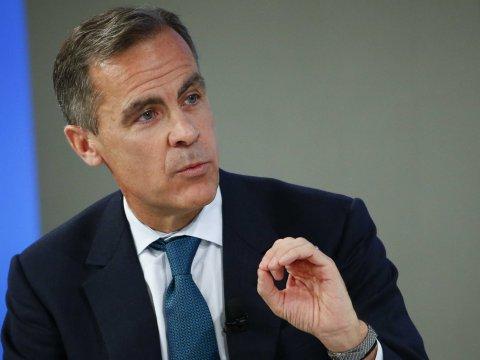
In Wednesday afternoon’s inquisition by the Treasury Select Committee, BoE governor Mark Carney firmly defended the Bank of England’s approach to monetary policy in response to the UK’s vote to leave the European Union.
Carney criticised for view on Brexit effects to economy
Carney had warned of the possible adverse effect an exit of the European Union could have on the on the UK economy. Euro-sceptics criticised this opinion for being to pessimistic. After the Leave-vote became in June, Carney and the BoE decided to cut interest rates and implement further expansionary monetary policy in preparation for possible recessionary pressures. Amid a cohort of data suggesting that two months after the Brexit vote there are no clear indications for a contraction in UK economic activity, Carney is now under criticism of acting to quick on implementing expansionary measures. However, analysts and expert believe that it is still to early to judge whether Carney’s preparation for a worst-case scenario was misplaced. Long-term effects of the UK’s decision still remain unclear. In today’s inquisition, Carney defended his policy measures against the MP’s criticism with these arguments. He also noted that he is prepared to add more stimulus to the economy and lower interest rates further if future data indicate a necessity for such measures.Pound weakens
The Pound weakened amid the inquisition, dropping 0.43% against the Dollar between 2.10pm and 5.49pm, bringing the GBP/USD to 1.33253Katharina Fleiner 07/09/2016
Latin America funds outperform Emerging Market benchmark

Since the January selloff, a selection of UK Unit Trusts and OEIC’s focused on Latin America have provided investors with significant gains. Returns on investment greatly outpaced benchmark gains in emerging markets.
Threadneedle Latin American, Stewart Investors Latin America and Invesco Perpetual Latin American all saw returns to investment above 40% by the start of September.
The highest performers are Aberdeen Latin American Equity with 59.51% and Scottish Widows Latin American with 59.95%, this year to date.

Emerging markets recover from 2015 slump.
After emerging markets struggled greatly under increased volatility in global financial markets as well as higher commodity prices throughout last year and the beginning of 2016, their performance has improved greatly since the start of the year. The recent Brexit vote gave this trend another boost. Initial worries connected to the Brexit vote concerned that growing global uncertainties may spur an investor exit from riskier emerging market, to flood into so called “safe haven assets”. In the immediate aftermath of the vote, distress was felt in emerging markets. The Mexican Peso, usually a preferred emerging market currency due to its high liquidity, became the world’s second-worst performer, after the British Pound. However, the initial signs of distress did not prevail and emerging markets got a boost in late June. Emerging market assets, while considered to represents riskier investments, yield higher returns to their investors, which, with uncertainty and risk also growing in developed world, becomes a more attractive option. As a result, the Brexit helped emerging markets gain nearly 8% in the days after the vote.Latin America has by far outperformed other emerging countries.
UK Retail Funds invested in Latin America received on average around a 12% performance boost. The Brazilian real has done extraordinarily well since the start of the year and the IBrX gained 28.34% over the last year. The Argentinian Burcap gained as much as 49.75% in the past 12 months and the Peruvian S&P/BVLPeruGeneral is up 54.59%. UK Retail Funds reflect this divergence from the emerging market index in their Latin American activity performance.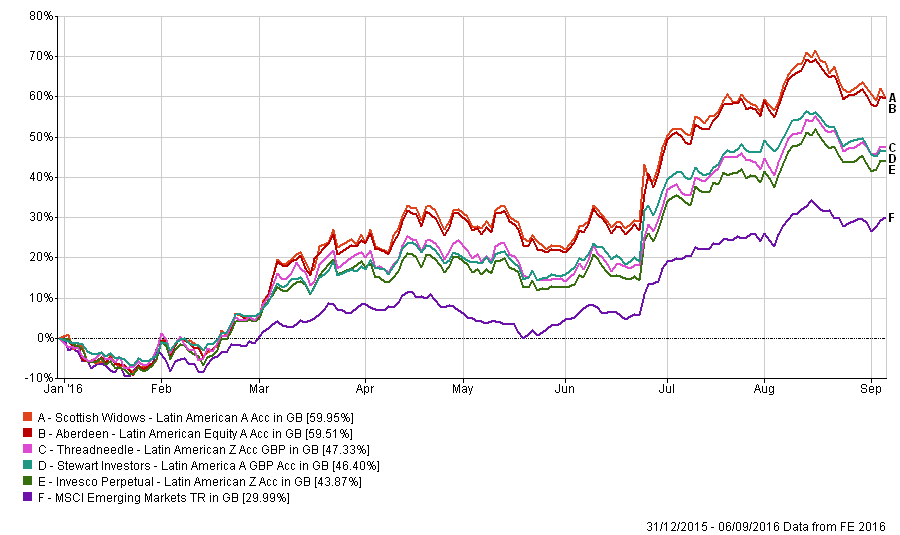
Katharina Fleiner 07/09/2016 Information based on data from FE
Hong Kong Monetary Authority takes initiative to boost local FinTech Scene

The Hong Kong Monetary Authority (HKMA) has announced plans for a “FinTech Innovation Hub” to support the development of the Hong Kong FinTech sector.
HKMA announces new FinTech Hub in collaboration with the Applied Science and Technology Research Institute
Norman T.L. Chan, Chief Executive of the HKMA, revealed the plans for the new hub in his speech at the Treasury Markets Summit 2016 on Tuesday. The hub, set up by the HKMA in collaboration with the Applied Science and Technology Research Institute, will allow both small and big businesses to carry out proof of concept trials for their products and services in a safe, contained environment separate from their internal systems. Further, Chan announced, that the HKMA will launch a second initiative called the “FinTech Supervisory Sandbox”, to allow banks to test and trial newly developed technologies and applications within a pilot program.Chan said:
“Within the Sandbox, banks can try out their new Fintech products without the need to achieve full compliance with the HKMA’s usual supervisory requirements. This will enable banks to gather real-life data and user feedback on their Fintech products or services more easily and in a controlled environment, so that they can make suitable refinements to their products before the full launch.”Building a “Brand” for financial services
Chan began his speech by stating the ambition of building Hong Kong as a “Brand” for financial services. So far, the Chinese territory, which is well known as a global financial hub, has lagged behind other Asian competitors in the development of a technology start-up sector. However, the regulatory authority has in recent months hoped to boost FinTech in Hong Kong through a range of new support initiatives, including setting up the “Fintech Facilitation Office” (FFO) earlier this year and launching the “Cybersecurity Fortification Initiative” in May. With the new initiatives, launched today, Hong Kong is hoping to catch up to other FinTech innovators in the region. The new hub and Sandbox also hope to address important issues of safety to businesses and customers, which Chan also commented on at large in his speech.Chan stated:
“While very few people would dispute the convenience and speed in which new technology can offer in financial services, there is an important catch that no regulators should and could overlook. The issue is whether the new technology is safe enough for the consumers and investors.” “The more correct narrative is that, without compromising consumer and investor protection, the HKMA embraces the use of Fintech and innovation.”Regulations and support matter for start-up development
The HKMA’s commitment to help the development of FinTech along is likely to have a significant impact on the sector. Singapore, currently the leader in the Tech start-up sector in Asia, can attribute much of the positive development to favourable and supportive government-initiatives as well as local investor support. In many cases, the development of a vibrant start-up community hinges on the successful government campaigns to support their development and provide a favourable environment. In the UK, many tech start-ups quote favourable regulations and supportive authorities as a main reason why they chose to set up their business at this location. While Brexit has sparked some worries that start-ups may abandon the UK due to the exit from the European Union, a serious case can be made for the country to hold on to its position as FinTech capital of Europe, if the FCA and other government bodies manage to provide a more favourable regulatory and supportive environment for start-ups, than other European locations.Katharina Fleiner 07/09/2016
GKP shares continue to fall a week after launch of Open Offer

Gulf Keystone Petroleum share prices have fallen to record lows, a week after the company announced its open offer to raise $25 million as part of a wider balance sheet restructuring plan.
GKP launches Open Offer
The London Stock Exchange listed oil and gas exploration business is currently offering 2.29 billion new common shares to its shareholders registered on the membership record by 5pm on the 30th of August. The offer, which launched on the 31st of August, allows shareholders to purchase twenty new common shares per nine shares already held, at a price of 0.8314 pence per share. Latest completed application forms and payment in full will have to be received by the 15th September, with results of the open offer being announced the day after. Admission and commencement of dealings of the new shares is to be expected around the 14th October. The measure, intended to raise $25 million to improve the company’s liquidity, is part of a wider balance sheet restructuring plan announced on the 14th of July.Kurdish oil exploiter suffers under low oil prices and regional geopolitical issues
GKP, which operates in the Kurdish region of Iraq, has suffered in recent months due to low oil prices and the current unstable geopolitical conditions in the Kurdistan region. Since the second half of 2014, oil prices have seen significant and prolonged reduction due to a continued oversupply of crude oil. For operators in the Kurdistan region, supply disruptions due to the ongoing geopolitical issues in the region have further added to these troubles. GKP is currently unable to either service or refinance debt of over $600 million in Guaranteed Notes and Convertible Bonds, which will mature in April and October next year respectively.Balance Sheet Restructuring Transaction will reduce debt to $100 million
The Balance Sheet Restructuring Transaction, announced last month, is intended to reduce debt to $100 million. With the added liquidity from the Open Offer, GKP hopes to maintain the Shaikan field production at around 40,000 barrels per day, with a possible increase to 55,000 barrels a day in the future.In the announcement of the restructuring plan in July, Chairman Andrew Simons stated:
“Our Shareholders, and those of the other Kurdistan focused operators, have suffered significant value destruction over recent months, as a result of the low oil price and extraordinary regional geo-politics. For us this has been further compounded by a debt burden of over $600 million repayable next year. To address the liquidity and significant leverage situation faced by the Company, we have to restructure the balance sheet now. “ “A new and strengthened management team and Board have been working tirelessly for the benefit of all stakeholder, to ensure GKP’s survival. Following month of negotiation, and in the absence of deliverable alternatives, the Board believes the proposed restructuring offers the best possible outcome for all.”CEO John Ferrier added:
“Without the restructuring and the improved liquidity delivered by the transaction, the Company cannot avoid insolvency or capture the significant future potential of the Shaikan field.”Norwegian oil exporter bids on GKP
Shortly after the announcement of the restructuring plan, Norwegian oil exporter DNO ASA made an offer to buy GKP for $300 million, conditional on the successful completion of the restructuring plan. The offer exceeds the companies likely post-restructuring valuation by $50million.Brokerage firm, Canaccord Genuity noted on the offer:
“The question, once this [restructuring] is done and dusted, is whether the new shareholders decide to go for the DNO offer…or strike out as an independent to develop the Shaikan field.” “We see significantly more upside and risk to the go-it-alone route” for Gulf Keystone. Share prices for GKP (LON: GKP) fell sharply after the launch of the open offer and have continued to fall throughout the last five trading days. Since the 30th of August the stock lost more than 56%. On Wednesday morning, the stock was trading at 2.12p at 11.58am (+1.19%), trading at lowest levels since 2009.Katharina Fleiner 07/09/2016
Morning Round-Up: Joules sales strong, Sports Direct down ahead of AGM, house prices slow

Lifestyle brand Joules hits strong sales
British lifestyle brand Joules saw impressive earnings for the year to May, with pretax profits up 41.5 percent.
The group, who floated on the stock market earlier this year, saw revenue rise 12.8 percent “in line with trading expectations”.
Earnings per share rose 42.9 percent. CEO Colin Porter commented on the results:
“The Group has a clear growth strategy, underpinned by the consistent quality and design of our products and the skill and commitment of our enterprising team.
“Our active customer base and international sales have also grown impressively, all of which is great testament to the growing strength and appeal of Joules as a premium lifestyle brand.”
Sports Direct chairman offers to step down
Sports Direct shares fell nearly 10 percent this morning after announcing it had rejected chairman Keith Hellawell’s resignation.
The company released its work practice report yesterday, vowing to change their working conditions ahead of its annual general meeting with shareholders today.
The retailer warned that 2016-17 profit was expected to fall 21 percent, with shares already down 60 percent on last year.
Chairman Keith Hellawell, who has been in the role since 2009, offered to step down but was asked to stay on by the board.
Sports Direct is currently trading down 9.79 percent at 315.37 (1008GMT).
House prices continue to slow – Halifax
House price growth slowed in August to 0.7 percent, according to mortgage lender Halifax.
The pace of growth slowed in August, with property values falling by 0.2 percent compared with July. However, houses remained 6.9 percent higher than this time last year, with the average home costing £213,930.
Martin Ellis, housing economist at the Halifax, commented:
“House price growth continued the trend of the past few months in August with a further moderation in both the annual and quarterly rates of increase. There are also signs of a softening in sales activity.
“The slowdown in the rate of house price growth is consistent with the forecast that we made at the end of 2015. Increasing difficulties in purchasing a home as house prices continued to increase more quickly than earnings were expected to constrain demand, curbing house price growth.”
07/09/2016
US Non-Manufacturing PMI down, Dollar falls – What will the Fed do?

Data released by the Institute for Supply Management (ISM) at 3pm on Tuesday afternoon showed business conditions worsening in the US non-manufacturing sectors in August. The Dollar fell against the Pound in response to the news.
A cohort of recently published US economic data came in below expectations, begging the question: what the Fed will decide to do this month?
ISM Non-Manufacturing PMI falls in August
The US ISM Non-Manufacturing PMI for August came in at 51.4. The figure dropped 4.1 points from July, the biggest drop since September 2013 and missing estimates by 4.3 points. Further, an index for the Labour market conditions in August, published by the Fed this afternoon, also fell. The figure stood at -0.7, down 1.3 points from July. On Thursday last week, the ISM Manufacturing PMI came in well below expectations.The Dollar weakened against the Pound on the new data release.
Between 2.40 and 3.48pm the USD/GBP lost 0.69% to a new value of 0.74501. The dollar also recorded major losses on Thursday and Friday last week, after the ISM Manufacturing PMI and labour market data for August came in well below expectations.May the Fed still hike rates?
Data releases on the performance of different economic sectors and the labour market will be watched closely by the Federal Reserve, which will make its next decision on monetary policy measures in a meeting on the 20. and 21. of this month. In a speech on Friday the 26th Fed chair Janet Yellen said “the case for raising interest rate had strengthened” on the back of July’s encouraging figures on economic activity and improvements in labour market condition. She did however refrain from giving any clear indication when a rate hike should be expected. Since Yellen’s speech data on US labour market growth in August disappointed with 104,000 less jobs being created than in the previous month. The latest figures on developments in the indices for business conditions in the manufacturing and non-manufacturing sectors adds to the discouraging data. The CME Group’s FedWatch Tool has decreased its probability rating for a Fed rate hike in September. The probability of an increase to 50-75 stands at 18%, down 3% from Monday. However, a rate hike is still expected this year. The FedWatch Tool currently indicates a 42.9% probability for an increase in December, up 1.8% from the previous day.Katharina Fleiner 06/09/2016
Redrow reports on 23% rise in FY pre-tax profits and no adverse Brexit-impact
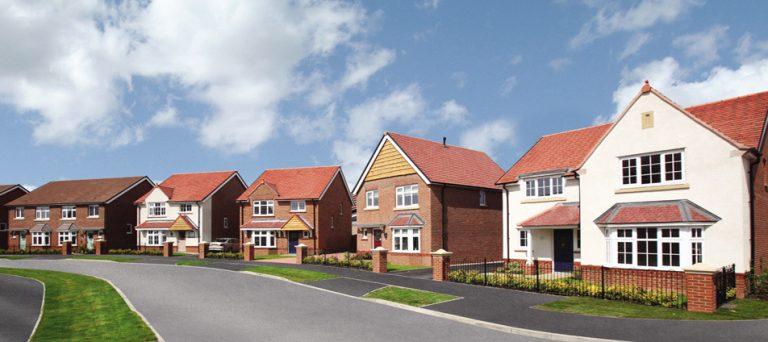
Welsh housebuilder Redrow plc (LON: RDW) reported record full year earnings on Tuesday, with chairman Steve Morgan also mentioning that the recent Brexit vote seems to have no adverse effect on the company’s profitability.
However, Shore Capital analyst Robin Hardy suggests troubles may still be to come.
Redrow plc reports a 23% increase in pre-tax profits for their 2016 fiscal year
The company’s pre-tax profits rose from £204 million in 2015 to £250 million by the 30th June 2016, up 23% in its third consecutive year of record earnings growth. Revenues grew by 20% to £1.38 billion over the one-year period. Improved earnings were driven both by an increase in house sales and rising house prices. Redrow reported 694 more house sales than the previous year, bringing the total number of legally completed sales to 4,716. House prices were on average 7% higher, with the average house selling at a price of £288,600. The board increased the last dividend payment to six pence per share to reflect the higher earnings. This will bring the total pay-out for the year to ten pence, up four pence from the previous year’s pay-out.Chairman states Brexit has not impacted the company negatively
Steve Morgan, Chairman of Redrow said:
“Redrow entered the new financial year with a record private order book of GBP807 million, up 54% year on year…Our strategy of continued growth for the business is on track and I am confident this will be another year of significant progress for Redrow…We have seen very little impact as a result of the Brexit vote.” In the first ten weeks of the new fiscal year, sales are already up 8% from the same period the previous year.Share price rises on higher earnings and favourable statement on post-Brexit performance
The FTSE-250 listed company saw share prices rise to 410 pence by 1.54pm on Tuesday, up 6.69% from previous market close.Has the UK housing market successfully avoided adverse impacts from Brexit?
While the positive earnings report lead to an increase in share prices, the positive outlook on the post-Brexit environment, provided by Morgan, will have also helped push prices upwards. His statement added to last weeks published figure of a 5.6% increase in nationwide housing prices in August, ringing positive for the development of the UK housing market. However, not everyone is quite so confident that the UK housing industry has completely avoided adverse effects from the UK’s recent decision to leave the European Union.Shore Capital analyst Robin Hardy stated:
“While the market could return to its previous path, we still not believe that [its] rating can return to previous levels. The risk profile has changed as Brexit could still alter wider economic prospects or the narrower housing market in a way that was not present before the vote.” “Policy stimulus measures and pricing pressures added to the mix will further complicate the market”, he added.Katharina Fleiner 06/09/2016
Is this the end of the oil industry?

Oil is one of the main drivers of the global economy, but prices went into freefall at the start of this year with rates reaching as little as $28 a barrel in January. While it has recovered somewhat since then, the heady days of prices reaching $100 a barrel are little more than a distant memory. The new reality is a two-year slump that shows no signs of ending anytime soon: with hopes of a production freeze fading, the reality of oversupply continues to bog down the market.
Simply speaking, the reasons behind the price decrease in oil are excessive supply coupled with decreased demand. China’s economic slowdown is affecting a lot of commodities at the same time as Saudi Arabia, in an effort to maintain its large market share as a crude oil producer, is refusing to reduce productions. And across the Atlantic we have increasing shale production by the US leading it to becoming a self-sufficient energy nation.
It’s now becoming increasingly difficult for oil companies in the North Sea, like BP, Shell and Total, to operate with these low prices and we’ve already seen a number of projects stalled. Oil’s lowered price is already hitting construction companies in two directions. On one hand half of all firms are reporting a decline in fuel costs but the flip side is the possible cancellation of major projects, particularly in oil producing countries in the Middle East. As nations come under increasing budgetary pressures, construction projects are under threat. Abu Dhabi, for example, have stalled or cancelled US$200 billion worth of projects.
The positive side of the oil slump is that many producer countries are looking seriously at the prospect of renewable energy to guarantee future consumption and export growth in an environment growing increasingly hostile to fossil fuels.
Following the historic climate deal in Paris, in which nearly 200 countries participated, Russia, Saudi Arabia, Kuwait and other major oil producers have announced plans to overhaul their energy strategy in order to diversify away from fossil fuels. For these and other oil exporting countries, crude oil and liquefied gas are no longer seen as reliable in generating the state revenues needed to foster economic growth and development.
In many ways, the world is already preparing for the end of the oil industry, though the final blow to crude prices – the largescale use of electric cars – is still a few years away. As major automakers ramp up production of affordable electric and hybrid cars, many analysts believe that oil demand could drop further still.
In the wake of such projections, the importance of focusing on green building methods has never been greater. Assuming lower prices for the two benchmark crude oils, Brent (Europe, North Sea) and WTI (West Texas Intermediate), for a sustained period, the effect on the construction industry would be noticeable. Those companies that will be stand out as able to succeed in this brave new world will be those who have embraced new, green technologies and who continue to promote and push for further innovations.
Risk warning: Forward Rate Agreements, Options and CFDs (OTC Trading) are leveraged products that carry a substantial risk of loss up to your invested capital and may not be suitable for everyone. Please ensure that you understand fully the risks involved and do not invest money you cannot afford to lose. Our group of companies through its subsidiaries is licensed by the Cyprus Securities & Exchange Commission (Easy Forex Trading Ltd- CySEC, License Number 079/07), which has been passported in the European Union through the MiFID Directive and in Australia by ASIC (Easy Markets Pty Ltd -AFS license No. 246566).
Nikolas Xenofontos, Director of Risk Management at easyMarkets on 06/09/2016
 Risk warning: Forward Rate Agreements, Options and CFDs (OTC Trading) are leveraged products that carry a substantial risk of loss up to your invested capital and may not be suitable for everyone. Please ensure that you understand fully the risks involved and do not invest money you cannot afford to lose. Our group of companies through its subsidiaries is licensed by the Cyprus Securities & Exchange Commission (Easy Forex Trading Ltd- CySEC, License Number 079/07), which has been passported in the European Union through the MiFID Directive and in Australia by ASIC (Easy Markets Pty Ltd -AFS license No. 246566).
 Morning Round-Up: Retail spending falls, Redrow shares up, Payday loan complaints triple
Retail spending falls in August after strong July
Spending fell back in August after a surprise hike in July, according to the British Retail Consortium on Tuesday.
Hot weather kept customers off the high street last month, causing spending to fall 0.3 percent on August 2015. This is a sharp fall from July’s 1.9 percent spike.
The figure was the weakest in two years, but the BRC were quick to highlight that it was unlikely to be linked to Brexit.
Redrow shares up on strong profits
Welsh housebuilder Redrow reported strong figures on Tuesday, with pre-tax profits up 23 percent to £250 million.
Sales were “very encouraging” over 2016, despite a warning from Chairman Steve Morgan last year that more expensive regulations might make housebuilding harder.
Shares in Redrow are up 7.47 percent at 413.00 (1005GMT).
Payday loan complaints triple
Complaints over payday loan companies have risen sharply in 2016, more than tripling compared with the last six months of 2015.
A total of 4,186 complaints were made about pay day loan companies in the first six months of the year, with 53% of these being upheld by the Financial Ombudsmen.
However these issues continue to be dwarfed by PPI complaints, which accounted for 54% of claims considered by the ombudsman.
169,132 new cases in total reached the ombudsman in the first half of the year.
06/09/2016