YouGov poll: Corbyn on track to win Labour leadership

1
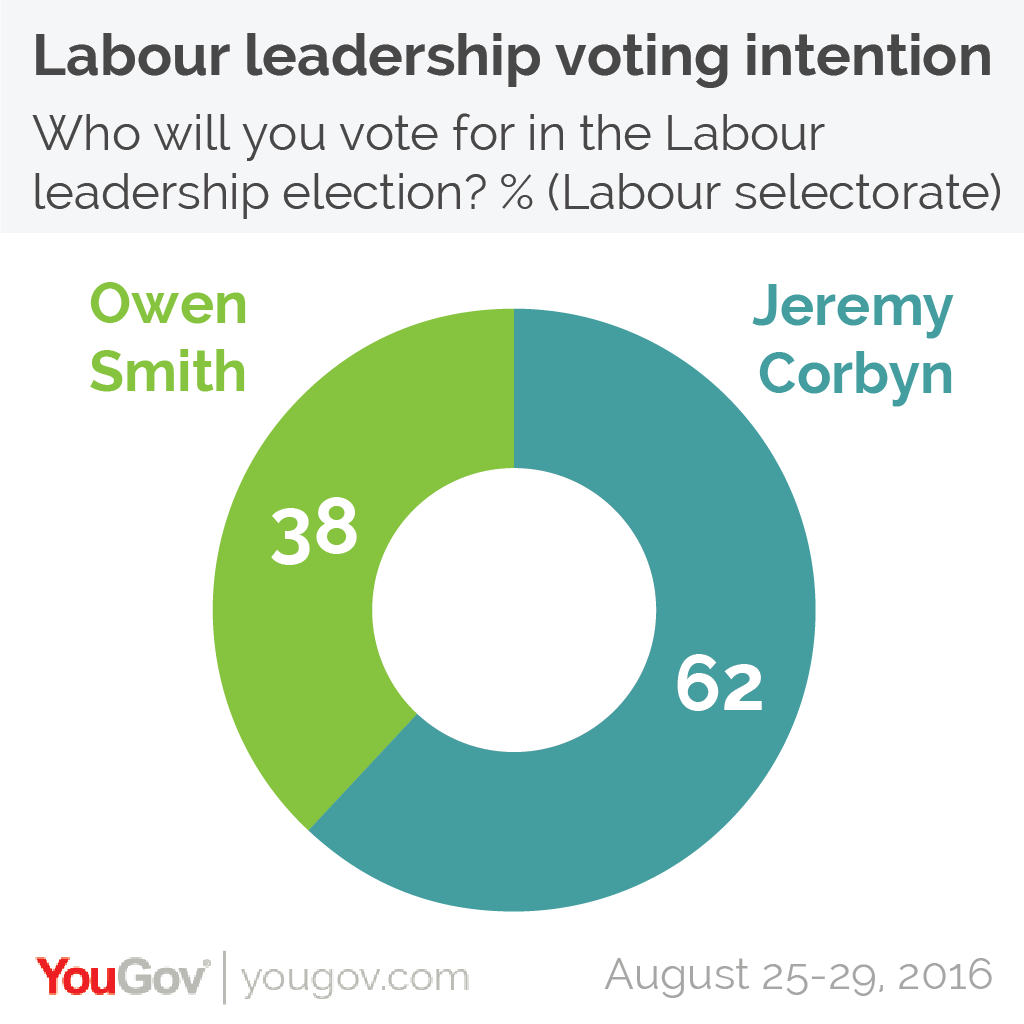
Jeremy Corbyn looks set to retain his leadership of the Labour party ahead of next month’s vote, according to the latest poll from YouGov. The latest figures, polled between August 25 – 29, put Corbyn in the lead with 62 percent against Owen Smith’s 38 percent. YouGov’s figures proved reliable in the last Labour leadership contest last summer, suggesting Corbyn would win with 59 percent of first preference votes.
Latest YouGov poll
Latest YouGov poll
Currently 70 percent of registered supporters have said they will back Corbyn, who also has the majority support of trade union affiliates. Corbyn’s case is helped by the 57 percent of people saying they believed he is doing a good job, with 32 percent saying that, should Labour split after a Corbyn victory, they would follow him to a new party. A leadership election contest was called after criticism of Jeremy Corbyn’s lacklustre approach to the EU referendum campaign provoked mass resignations and a vote of no confidence. Several other Labour MPs announced their intention to run against him, with Owen Smith remaining the only one still in the race. Ballots were mailed out to eligible voters on August 22nd, and the ballot will close on September 21st at 12pm. The result will be announced at the Labour party conference on September 24th.
31/08/2016

Morning Round-Up: 888 strong, house prices rise, Amazon Dash launched

0
888 reports strong first half results Gambling group 888 Holdings reported “impressive” revenue increase in the first six months of the year, hitting company records. Pre-tax profits were up 39 percent, achieving record revenues of $262 million – up 19 percent on the same period last year. Active players rose 35 percent in Q2 of 2016, alongside strong European growth in both Spain and Italy, where revenues rose over 40 percent. Itai Frieberger, 888’s CEO, called the performance “encouraging”, and “remains confident of delivering against expectations for the full year”. 888 (LON:888) are trading up 3.72 percent at 223.00 (0947GMT). House prices up in August – Nationwide House prices rose 0.6 percent in August, despite recent signs of a slowdown in the housing market in the wake of Brexit. The figures, released by Nationwide in their most recent House Price Index, show an annual rise of 0.4 percent on July, up to 5.6 percent. Nationwide said the unexpected rise could be explained by a decline in demand being matched by weakness in supply. Robert Gardner, Nationwide’s chief economist, commented: “Surveyors report that instructions to sell have also declined and the stock of properties on the market remains close to thirty-year lows. This helps to explain why the pace of house price growth has remained broadly stable.” Amazon launches Dash button in the UK Amazon has launched its Dash button in the UK, allowing consumers to instantly order household items at the push of a button within their home. The wireless buttons can be set next to items in the house, including toilet roll, nappies and condoms, and instantly set up on order for new products when pushed. They are linked on to the customers’ Amazon accounts, and cost £4.99 each. The director of Amazon Dash, Daniel Rausch, said: “There is no retail therapy in buying toilet roll or bin bags. It’s just work. We wanted to take the one-click experience from our website and put it right where people need it most, in the home, near the products that run out. So that buying them is no longer work.”
31/08/2016

Sundried and Cupris become latest success-stories on CrowdCube

UK start-ups are increasingly turning to equity crowdfunding through CrowdCube to establish or grow their business. Ethical sportswear brand Sundried and healthtech start-up Cupris have become the latest successfully funded projects on CrowdCube, one of the UK’s leading equity crowdfunding platform.
Sundried
The London based start-up produces “ethical active-wear products” and launched its first collection in June this year. It is supported by the Low Carbon Innovation Fund. Through its campaign on CrowdCube, the business hoped to raise £125,000, offering 12.11% in equity, to expand its business and gain a greater share of the UK’s booming sportswear market. The campaign ended last week, having raised £176,060, 141% of their targeted amount. 208 investors participating in the funding campaign. The largest single contribution of £40,000 amounts to more than a fifth of the full amount raised.
Cupris
Also a London based start-up, Cupris has designed a “medical device attachment” which can help diagnose hearing loss and other ear conditions with the help of a smartphone. With the application, the healthtech business hopes to gain a share in the fast growing international online medical consultation market, which is currently estimated to be worth $60 billion for developed countries. In 2015 the company won the “Signs and Symptoms” Category at the AXA PPP HealthTech and You Awards. Cupris also won the “Value and Improvement in Telehealth” Award at the HSJ Value in Healthcare Awards 2015. It is partnered with the NHS and Innovate UK, the technology strategy board. Their campaign on CrowdCube targeted £500,000, offering 17.58% in equity. It closed three days ago having raised £548,260 from 380 investors. The highest single contribution figure stood at £200,000.
Other UK start-ups are also performing well in driving their equity crowdfunding campaigns to success.
Graphene Composite is a NanoTech start-up hoping to create “one of the strongest, lightest, most resilient materials ever made”. It raised 149% of their target amount of £100,000 with 17 days to go in their crowdfunding campaign on CrowdCube. The funds will help the early stage business to develop their product further and patent the prototype. RiskSave Technologies, a company building a new investment platform, only started their campaign last week but have since raised over 80% of their targeted £150,000, before the end of the first week. With another 23 days to go, the campaign has already raised 106% of their initial target from 89 investors.
Katharina Fleiner 30/08/2016

High yielding media investment outperforming the banks

Sponsored Content

Introducing the UK’s Fastest selling franchise with low levels of investment and expected high returns.

• 3 Year Term
• Projected High Returns
• Quarterly payments
• Low Entry Level
• Hassle Free Franchise
• London Based

This is the Fastest Selling UK Franchise as ranked by Franchise Direct the No1 directory. The project has appeared in over 5 national newspapers including the Guardian, The Mirror, Evening Standard and The Sun.
Offering a unique opportunity for investors to access a booming market worth $93 billion worldwide. Hassle free franchise with no requirement for premises or staff.
Contact us now for more information….. Limited allocations left at current market price!

Enquire Now:

Articles are general information and not a recommendation to act. Please seek independent investment advice before entering into any financial transaction. By entering into any financial transaction that involves securities, derivatives or property puts your capital at risk. The UK Investor Magazine is not regulated by the Financial Conduct Authority and will not accept any liability for any action taken after using this website in any form. By entering your details

By entering your details you agree to be contacted by UK Investor Magazine and the company operating this investment opportunity regarding this opportunity specifically and similar investment opportunities and news.

FTSE100 steady as mining stocks sink and ABF rallies

0
Losses in mining shares did not weigh heavy on the FTSE100, which is up marginally by 0.1% this morning, thanks to a rise in share prices of Associated British Foods, the owner of Primark.
ABF shares rise thanks to favourable RBC note
Associated British Foods recorded the greatest growth rate on Tuesday. The stocks gained 2.37% in morning trading. This can be attributed to a confident RBC note on the company. The Royal Bank of Canada has upgraded its recommendations for ABF from “sector perform” to “outperform”. It also increased the target price by more than one fifth, from £28 to £34.
In its statement on Primark, BRC stated:
“We think Primark is relatively well positioned as it is the cheapest retailer in the price-conscious UK apparel sector. It has also improved on customer perception for product and style according to our latest customer survey. In addition, it has relatively high non-UK exposure (around 50% of Primark and around 57% of group sales) meaning it is relatively shielded from cost and currency pressures in the UK. We expect like for like sales to remain muted owing to a tough consumer backdrop and the lack of an ecommerce offer, however we have raised them slightly versus easy comparisons.”
Other businesses run by ABF should also perform better in the future
RBC commented on AB Sugar:
“For Sugar a reduction in EU stock levels and a recent increase in world sugar prices have resulted in a strengthening in European sugar prices. This should help AB Sugar’s profit trajectory from next year. We also think an exit from China would be well received by the market and would further strengthen ABF’s already under- leveraged balance sheet.”
Other FTSE100 companies are also up more than 2% today
Industrial equipment rental company Ashtead Group is up 2.07%. CRH plc, mother company to an international group of buildings material firms, rose 2.14%. The banking and financial company HSBC Holdings gained 2.07%, at midday.
Katharina Fleiner 30/08/2016

Mining stocks down on stronger dollar

Mining stocks suffered on Tuesday morning due to the rising strength of the US Dollar. The London Stock Exchange Mining Sector Index lost 382.18 points in morning trading on Tuesday. At 10.57am it stood at 11,508.26, down 3.21% from market close on Friday.
Diversified mining companies record losses
Diversified mining companies have seen share prices drop. BHP Billiton was down 2.87%, Anglo American dropped 2.53% and Rio Tinto lost 3.69% in the morning trading hours.
Gold and silver mining stocks down
Gold and silver mining companies Hochschild Mining, Acacia Mining and Avocet Mining lost 6.34%, 6.83% and as much as 11.49% respectively. Prices of the precious metals surged in the first seven months of the year, due to low Fed rates and growing economic uncertainty. This helped mining companies, specialising in the extraction and handling of gold and silver, to record high earnings. However, Friday’s speech by Fed chair Yanet Yellen increased expectations of a new Fed rate hike later on this year. This continuously strengthened the dollar over the past days and hit mining stocks. The GBP/USD fell from 1.32599, before Yellen’s speech on Friday, to 1.30796 at 11.03am on Tuesday morning, down 1.4%.
A stronger USD hits mining companies.
As commodities are largely priced in USD, the strengthening of the currency leads to higher prices and lower demand. This lowers revenue expectations for miners, seeing mining stocks tumble. While gold and silver miners seem to be most affected by the recent hit, more diversified miners have this year already suffered greatly due to lower prices for copper and nickel as China, the largest consumer of such metals, heavily reduced demand.
Katharina Fleiner 30/08/2016

Morning Round-Up: Foreign investment in UK at record high, markets up, Japanese unemployment hits low

0
Foreign investment into UK hits record high Foreign investment into the UK rose 11 percent on last year, according to figures from the Department for International Trade released on Tuesday. The UK attracted 2,213 inward investment projects over the last year, making it the most popular country in the European Union for foreign investment. According to the report, the investment created 116,000 jobs in the UK. International Trade Secretary Liam Fox commented: “These impressive results show the UK continues to be the place to do business. “We’ve broadened our reach with emerging markets across the world to cement our position as the number one destination in Europe for investment.” Global stocks up after Bank Holiday weekend Global stock markets bounced on Tuesday despite lukewarm comments from Janet Yellen on Friday, leaving investors in the dark as to when rates will rise. The Shanghai Composite closed up 0.15 percent at 3,074.68, with the Hang Seng up 0.85. The EuroStoxx 50 is currently up 1.06 percent, with the FTSE 100 up modestly also. Investors have been given conflicting information as to when rates will rise, with Vice Chair Stanley Fischer suggested the September meeting may be the moment. Markets were quiet last week ahead of Federal Chair Janet Yellen’s keynote speech in Jackson Hole, where investors were hoping for a more solid timescale. Japanese unemployment lowest in 21 years Japan’s unemployment rate has fallen to the lowest figure in 21 years, despite slow economic growth. Unemployment fell to 3 percent in July, down from 3.1 percent in June. The figure is a spot of good news amongst mostly weak economic data; Japanese economic growth fell to 0.2 percent last month, with inflation in the world’s third biggest economy remaining well below the 2 percent target. Japanese Prime Minister Shinzo Abe has consistently tried to promote economic growth in the country but has seen his economic policy – named Abenomics – struggle to make any real headway.
30/08/2016

BREAKING: Yellen speech “hawkish” but still no date set

2
Janet Yellen has unveiled a “monetary policy toolkit” to maintain control over the uncertain US market, in her speech in Jackson Hole on Friday. She conceded that the case for raising interest rates has “strengthened” but did not highlight any immediate plans. Whilst performance remained “solid”, business investment stayed soft and economic growth was slow, leading Yellen to abstain from giving a definite date for a rate hike. The Fed have designed a “monetary policy toolkit” to allow its action to stimulate further growth in the US market, after highlighting the effectiveness of the last toolkit unveiled in December. Reactions to the highly-anticipated speech have been mixed, with some taking her comments as a hawkish intention to raise rates before the end of the year. Her lack of definite date for a rise, however, means little solid evidence can be drawn from the speech.
26/08/2016

Helicopter Money – The next step for Japan?

“Helicopter Money”, the metaphorical term coined by economist Milton Friedman in 1969, has gained momentum in the discussion of what the BoJ’s next strategy may be. While there is no clear consensus on how Helicopter Money should be implemented, in theory it is the strategy of providing money directly to the private economy to boost consumption, therefore fuelling economic activity. It therefore circumvents the current issue: that money given to financial institutions through asset purchases does not enter the real economy. So far, Governor Kuroda has strongly refuted the idea of Helicopter Money, pointing to the fact that it is currently illegal under Japanese law. However, an ongoing poor performance of the Japanese economy have led economists and analysts to believe that it is an option they need to seriously consider. Mark Mobius, executive chairman of Templeton Emerging Markets Group, said in an interview with Bloomberg that he expects Kuroda to implement helicopter money as soon as next month. The benefits the new unconventional policy is aiming to achieve are clear to most, stimulating consumption by handing money directly to market participants.
The dangers, however, are more widely debated.
Raghuram Rajan, India’s central bank governor, been prominent with his criticism of the strategy. The first issue is the lack of control the Central Bank has over real money supply, as base money is expanded through the functions of financial institutions. Therefore, no one can fully predict the consequences of a release of fiat money into the private economy may have on money supply in the long term. In the worst case scenario, it could lead to hyperinflation as seen in Germany in the 1920s. Secondly, many assume that helicopter money will involve the BoJ giving more money to the government to distribute through fiscal policy measures, without an expansion of government debt. This bears the risk that the government will use this new power for political means, overstimulating the economy before elections, and targeting money for political purposes. Lastly, Rajan points out that Helicopter Money may, exactly like current measures, not ever fulfil their prime purpose – that of increasing consumer consumption. Helicopter Money as a policy communicates to consumers and investors that the BoJ is handing out large amounts of free money and, given the possible negative consequences outlined above, consumers which receive the cash benefits may be more inclined to save the money, rather than spend it, due to an uncertain economic future. Therefore, Helicopter Money may have weaknesses on both sides of the spectrum. On one it may lead to unintended overshooting of targets and therefore hyper-inflation and on the other hand, it may lead consumers to save more instead of less and strengthens current deflationary trends.
However, the success and side-effects of Helicopter Money will likely depend on the way it is implemented – opinions on this vary greatly.
One idea, which former Fed Chairman Ben Bernanke advocates, is to give controlled amounts of money to the government for investments in infrastructure. In this way, the money would reach the economy in form of higher employment and wages for workers in infrastructure sectors instead of free uncontrolled money to consumers or the government to spend as they wish. It would then create demand for construction firms to expand and invest, and reach consumers through higher incomes.
While this strategy may seem one to engage with further, one big issue remains.
Some factors always lie outside of the control of the government of central bank and artificially inducing liquidity to the market without a foolproof strategy to absorb it again if necessary can be very dangerous. We have seen cases where adding liquidity to the market has far overshot targets and lead to dire consequences. When the United States began quantitative easing, shortly after the global financial crisis, many emerging economies struggled to keep their currencies from appreciating greatly against the dollar. Especially Brazil used vast amount of resources to induce liquidity in their own market to keep the Brazilian Real down. When however, the United States successfully ended its expansionary policy measures and successfully managed to soak up excessive liquidity in in 2013 and throughout 2014, the Brazilian authorities were not able to do the same and the Brazilian Real went into freefall. With the current debate as to whether the Fed will hike interest rates any time soon, there is once again uncertainty about future strength of the dollar. Should Japan increase the money supply through more new, unconventional, and not fully understood measures, a rate hike and following appreciation of the dollar may have terrible consequences for the Japanese economy. Therefore, any future measures the BoJ will adopt, largely depend on the level of control they are able to assert over the money supply it creates. The benefits of Helicopter Money, should it ever come to play in practice, will depend on the way it is implemented.
Katharina Fleiner 26/08/2016

The faltering Japanese economy and why QE has not achieved growth

Japanese economic data remains discouraging

This morning, a new set of Japanese economic data, published by the statistics bureau, showed that the Bank of Japans expansionary monetary policy measures have not increased inflation, the main measure of economic activity, in Japan. The National CPI came in at -0.4% for July, exactly where it was a month before and now decreasing for the fifth month in a row. This adds to a growing cohort of data suggesting that current measures to end two decades of deflationary economic developments, by both the government and the Central Bank of Japan, are insufficient. Japans All Industry Activity Index for June came in at 1%, also flat from May’s figures. Industrial production in June decreased by 1.5% compared to the same month the previous year. GDP growth for the second quarter of 2016 stood at 0% compared to the first quarter of the year. The Nikkei Manufacturing PMI for August came in at 49.6. Although this figure is 0.3 points higher than July’s figure, it still represents a contraction in manufacturing activity over the month. There is little data, if any, to suggest that the Bank of Japan’s extensive quantitative easing program has done anything to increase real economic activity.

Japanese history of QE and why it hasn’t worked

After years of strong economic growth, the Japanese economy began to falter in 1990s and has since experienced the most prolonged period of slow growth and a deflationary economic environment. In 2012, when Shinzo Abe took office as Japanese prime minister again, he introduced an aggressive strategy including fiscal and monetary stimulus to drive the Japanese economy towards growth. Since 2013, his government has tried to boost the economy with ever greater fiscal stimulus packages, the latest and greatest of ¥28 trillion being announced last month, in response to the UK’s decision to leave the European Union and the possible adverse effects this could have on economic growth around the world. The Bank of Japan, under governor Haruhiko Kuroda, began implementing similarly aggressive expansionary policies. A round of quantitative easing of between ¥60 trillion and ¥70 trillion a year began in 2013. This was expanded to ¥80 trillion a year in 2014, where it has since remained. Interest rates were lowered to record levels. However, neither fiscal nor monetary stimulus has translated in an increase in real economic activity and has failed to help the Japanese economy recover targeted growth and inflation levels.
Why has Japanese growth not returned?
Many economists, analysts and for sure the BoJ have wondered why all this stimulus has not helped the Japanese economy to return to growth. Reasons may be intractable, however, there are some factors which definitely have had an influence.
QE does not always enter the real economy
Firstly, quantitative easing does not necessarily have to induce money in the real economy. The money is given to banks and other financial institutions through the purchases of assets by the Central Banks. It will then only translate into economic activity if companies and private households take out loans form these financial institutions to spend money in the real economy. This however, has to a large part not happened. Pressuring businesses to invest in expansions and therefore driving economic activity through low, maybe even negative interest rates, has some shortfalls. A business may not be inclined to see a business expansion as a viable investment in a deflationary economic environment, characterized by low demand. Investing more money, if at low rates or not, bares the risk of failing to achieve revenue growth, which could potentially drive a firm out of business. Therefore, in a particularly deflationary environment where businesses are aware that there is little demand for products, the incentive to produce more is low and the risks of doing so are high.
Japanese households save more and spend less
In Japan, there is one particular factor which adds to this crisis. Japanese consumers tend to save more and spend less of their income. It is debatable what has driven this generally observable trend, but the current demographic crisis Japan is experiencing could have some impact. The Japanese fertility rate has been decreasing since 1970, being consistently below 2.0 since 1975 and in 2012 it stood at 1.41. Similar developments have been observed in European countries, such as Germany, however not at such alarming rates. Less births mean less people growing towards working age and, with extending life expectancy, this adds up to a rapidly aging Japanese population. This can for one have a direct effect on productivity in the economy, for the other part also incentivises people to save for their later years, rather than spend their income now, as the likelihood of getting a good state funded pension decreases with a decreasing number of working, tax paying adults. While this may not be all the factors, as international influences, such as the global financial crises, which caused a, still ongoing, economic slowdown on a global scale, they can at least in part explain why current strategies to stimulate the economy have not had the desired effect.
How long can QE continue?
Furthermore, it has also been continuously noted, that the BoJ may be fast approaching its limit on current measures, as it is running out of assets to buy to fuel its massive quantitative easing program. With no more assets to buy, what can the BoJ do to still be doing something? Helicopter Money – The next step for Japan?
Katharina Fleiner 26/08/2016