Why MT4 expert advisors remain popular in automated forex trading

Automated forex trading has come a long way, but MetaTrader 4 expert advisors are still everywhere. Even as newer tech and platforms pop up, traders keep coming back to them. Here’s why.

Look at any modern financial market, automation is baked in. Whether it’s a big hedge fund or just someone trading from home, algorithms now run the show. They handle trades, crunch data and manage risk. But in forex, nothing’s had the staying power of MetaTrader 4 expert advisors.

AI, cloud trading and platforms like MetaTrader 5 have tried to steal the spotlight. Doesn’t matter. MT4 EAs still dominate. Every day, thousands of traders use them to scan for trades, spot opportunities and pull the trigger, all on autopilot. Why stick to these old tools? It boils down to three things: Traders know them, they’re flexible and there’s a massive ecosystem behind them.

How automated forex trading took off

To really get why MT4 EAs are still a big deal, think back to how the whole automation trend started. Forex is the world’s biggest market, trillions move through it daily. Markets run 24/7, and no one can watch charts that long without burning out. Traders needed a way to stay in the game without living at their screens.

Enter trading algorithms. By turning strategies into code, traders let software do the heavy lifting: Analyse prices, spot signals and execute trades, all without babysitting. MetaTrader 4 made this easy. It had a simple interface, strong charting and support for automated programmes called expert advisors (EAs). What can EAs do? Pretty much everything:

  • Analyse indicators.
  • Place trades.
  • Set stops and take profits.
  • Run strategies around the clock, minus the emotional rollercoaster.

For a lot of traders, this was a total game changer.

Why MT4 took over

The real reason MT4 EAs still run the show? MT4 became the default. When it launched in 2005, brokers loved it. It was light, stable and, compared to everything else, easy to use. As more brokers picked it up, its popularity snowballed.

Developers jumped in. They built tools, scripts and a ton of EAs for MT4. Traders shared ideas. Forums exploded. Tutorials popped up everywhere. Pretty soon, if you traded forex, you used MT4. Simple as that.

And because EAs were built just for MT4, the library grew fast. Some bots just did basic stuff, like moving average crossovers. Others were wildly complex, tracking dozens of indicators at once. That huge collection of tools? It’s still pulling in new traders every day.

The push toward MetaTrader 5

MT4 still leads the pack in retail automated trading, but the industry’s slowly nudging toward MetaTrader 5. MT5 comes with upgrades: More timeframes, a beefed-up strategy tester and support for more than just forex.

Even so, the shift’s taking longer than a lot of analysts thought it would. The reason’s pretty simple; ecosystem momentum. Years’ worth of MT4 expert advisors are already out there, and most traders would rather stick with what they know than start over.

You’re starting to see some platforms bridge the gap. They build automated solutions for newer systems but keep things as simple as traders want. For instance, some companies still highlight their tools as the best expert advisor for MT4, while also pushing their latest products, like Majestic EA, that run on MetaTrader 5. The idea is to give traders a straightforward, customisable way to automate their strategies without losing control over risk or preferences. 

Familiarity breeds loyalty

There’s another reason people stick with MT4 EAs: They’re comfortable. Traders like what they know.

A lot of forex traders started out on MT4 years ago. They know every button and quirk. They trust it. Switching to something new means learning from scratch, changing routines and maybe giving up strategies that only run on MT4.

If you’ve got something that works, why bother changing it? For these traders, there’s just no reason to move. That sense of comfort is a bigger deal than most people think.

The massive EA developer ecosystem

One of MT4’s biggest strengths is its developer community. The platform’s been around for ages, so thousands of programmers have picked up the MQL4 language, the backbone for building expert advisors. Because of that, there’s always something new popping up. Automated systems, fresh EAs and creative scripts, you name it, someone’s probably building it.

Jump into any online marketplace or trading forum and you’ll find creators offering everything from basic freebies to sophisticated, niche robots. This constant competition keeps things moving forward. Traders get more options and the tools keep getting smarter.

Some EAs go all-in on scalping. Others chase trends, run grids or focus on news events. With so much variety, traders don’t have to start from scratch. They can mix and match, test different ideas and find what actually works for them.

Automation helps remove emotion from trading

Expert advisors aren’t just about convenience, they’re a psychological lifeline for a lot of traders. Trading stirs up emotions. Fear, greed and impatience, they all mess with your head and your decisions. Automated systems help take some of that out of the equation.

When an EA runs, trades happen by the rules. No hesitation, no second-guessing. For anyone who struggles to stay disciplined, this kind of consistency is a lifesaver.

Of course, automation isn’t magic. A bad algorithm can blow up an account just as fast as a reckless trader. But when you use them right, expert advisors help you stick to your plan, trade after trade. Plenty of traders trust that steady hand.

Topps Tiles shares slip after reporting slow half year sales growth

Topps Tiles shares slipped on Wednesday after the flooring specialists reported slowing sales amid difficult market conditions.

The group said it is outperforming a weak home improvement market but has moved to cut costs, announcing the closure of 23 underperforming stores as it prioritises margin over top-line growth.

But this wasn’t enough to spark enthusiasm for the stock, which was down 3% at the time of writing.

Group revenue for the 26 weeks to 28 March came in at £142.7 million, marginally down year-on-year, though that reflects disruption at trade brand CTD following a lengthy CMA process rather than any underlying weakness.

Strip CTD out, and the core Topps Tiles business grew revenue by 2.1%. This compares to a wider market that contracted by around 2.5% over the same period.

To help cut costs, Topps said 23 sites will be shut across the financial year, with the company expecting sales to transfer elsewhere in the estate rather than simply disappear. The savings are expected to land mainly in the second half and should both support this year’s numbers and deliver a structural improvement in profitability going forward.

CTD itself is recovering. Housebuilder volumes have been rebuilding since the end of FY25, and CTD stores posted like-for-like growth of 1.0% in the half. The business remains on track to return to profit for the full year.

“Topps continues to outperform a softer market,” said Chief Executive Alex Jensen.

“In light of subdued consumer sentiment and geopolitical uncertainty as well as the cumulative impact of cost inflation, the management team is implementing a targeted programme of self-help measures weighted towards the second half. These actions are designed to support year on year profit growth and provide a stronger financial platform for 2027 and beyond.”

FTSE 100 rips higher with end to war in sight

Global stocks surged higher on Wednesday as investors reacted to signals from Donald Trump that the war in the Middle East would end.

Trump has given a 2-3 week timeline for ceasing military operations in Iran. As we all know, anything the US President says should be taken with a tanker of salt, but his assertion that he doesn’t need a deal with Iran to end the war makes his timeline more realistic than it otherwise might have been. 

The prospect of an end to constant missile strikes and even the reopening of the Strait of Hormuz sparked a risk-on rally on stocks, aided by Brent falling below $100.

The FTSE 100 was trading 1.5% higher at 10,344 at the time of writing.

“There’s been a roar of recovery on equity markets as investors cling to high hopes of an end to the war with Iran in weeks,” said Susannah Streeter, chief investment strategist, Wealth Club.

“President Trump is blinking furiously faced with painfully high energy costs, which risk derailing Republicans’ chances at the midterm elections, and is signalling a rapid wrap-up to the conflict.”

The major story for equity bulls is that an end to the war reduces the likelihood of sentiment-killing interest rate hikes by major central banks.

You would have expected the FTSE 100’s housebuilders to surge on today’s news, but the sector faced unwanted news from Berkeley Group Holdings, which has warned of the impact of the war on trading. 

“Berkeley has a longstanding reputation for being adroit at calling the ups and downs of the property market, particularly under the leadership of its late founder Tony Pidgley,” said AJ Bell investment director Russ Mould.

“In that context, the moves the company has announced today will make others sit up and take notice.

“New land acquisitions are on hold. Berkeley plans to prioritise profitability and maintaining balance sheet strength as it looks to navigate what it clearly expects to be a difficult period for the industry.”

Berkeley Group shares were down 16% at the time of writing.

Copper miner Antofagasta was back at the top of the FTSE 100 index as the group again proved itself as one of London’s leading risk-on proxies. Anglo American also rose on Wednesday, adding 5%. 

Rolls-Royce shares joined the party on Wednesday, gaining around 6% on hopes that disruption to air travel would continue to fall. This sentiment was also felt by IAG, whose shares added 5%. 

Banks were higher, as were most of the FTSE 100’s financial contingent.

Oil prices falling below $100 are good for almost everybody, apart from those involved in extracting, refining, and trading it. Signs that the war was near a conclusion made the recent rallies in BP and Shell look vulnerable, and the pair fell on Wednesday. Shell was down 3%. 

AG Barr: excellent Final result sees shares increase 10% to 681p, with more to come 

Last Thursday we highlighted the shares of AG Barr (LON:BAG), the Scots-based soft drinks maker famous for its IRN-BRU brand. 
That was ahead of yesterday’s Finals for the year to end-January. 
The then £697m-capitalised group’s shares were trading at a lowly 628p. 
They had previously been up to 715.32p in the last month or so, before falling back to a recent Low of 608p, scored early in March. 
After some profit-taking the shares closed the day up 6.65% at 658p, some 41p better on the day, capitalising the business at £730m. 
The Final Results 
The&nbs...

Filtronic wins new European defence contract

Filtronic has landed a fresh contract with a major European defense prime, extending its relationship with the customer into an entirely new business unit.

The initial contract is worth £0.4 million and is scheduled for delivery in FY2027, covering the design, development, and supply of a new wide-bandwidth solution.

Filtronic said the deal is a sign that confidence in the company’s RF technology is growing within some of Europe’s largest defense organisations.

While the headline contract value is modest, there are signs of potential follow-on business from the deal.

The work will be produced at Filtronic’s newly opened facility in Sedgefield, a purpose-built, secure and automated microelectronics site designed specifically for high-volume manufacture of complex RF modules for demanding defense applications.

“This latest award from an existing major European defence customer demonstrates continued confidence in our technology and ability to deliver high-quality programmes,” said Nat Edington, Chief Executive Officer.

“The Company is increasingly well positioned to address long-term demand for complex, high-performance wideband solutions, reinforcing Filtronic’s strategic position in the expanding defence sector.”

Filtronic recently announced an $8 m deal with a US firm for its Amplifier technology as the flow of new orders continues.

Berkeley Group issues profit outlook as geopolitical turmoil hits housebuilder

Berkeley Group has issued a strategy and trading update, warning that recent global instability has snuffed out the early signs of a market recovery it had begun to see at the start of the year.

The builder is starting to feel the pressure of a housing market slowdown and has provided an update on plans to address the changing face of the UK property market.

But the FTSE 100 housebuilder still expects to deliver pre-tax profit of £450 million for the year ending April 2026, in line with guidance set two years ago, which makes the 16% drop in shares on Wednesday seem a little harsh.

The group has also taken a medium-term approach to guidance and is now targeting cumulative pre-tax profit of £1.4 billion over the four years to FY30.

From a strategic perspective, Berkeley is leaning hard into its existing landbank rather than chasing new sites. With over 50,000 homes already in its portfolio across London and the South-East, the company believes it can add £2 billion in value through planning optimization alone, without acquiring a single new plot.

The group’s build-to-rent arm, Berkeley Living, continues to progress. Its first six buildings are on track for completion in FY28, representing around £400 million of investment at cost. Early lettings at Foundry Yard, its debut BTR building at Alexander Gate, are reportedly ahead of expectations.

Berkeley is also pushing down costs, having already trimmed operating expenses by 25% in real terms from £178 million to £150 million, while cutting land creditors from £900 million to around £470 million.

On shareholder returns, £336 million of the £2 billion Berkeley 2035 target has been distributed. With the share price trading below net asset value per share the board is prioritising buybacks as the most efficient way to return capital.

Selecting leading-edge AI and technology companies with TMT Investments

In this episode, we sit down with Alexander Selegenev, Executive Director of TMT Investments, the AIM-listed venture capital firm focused on high-growth technology companies across AI, software, and fintech.

Alexander opens with an introduction to TMT’s business and investment philosophy, then walks us through the firm’s strategy and thesis in detail.

We explore how TMT balances genuine excitement about artificial intelligence with the valuation discipline required to generate returns for shareholders.

We dig into the numbers, asking why deployed capital fell sharply in 2025 compared to the prior year, and what that tells us about how the team is reading the current opportunity set. Alexander then takes us through the portfolio’s core holdings, including the standout story of Scale AI, which delivered a 138% uplift in just eight months following Meta’s investment, and what originally attracted TMT to the business.

We also look at Bolt, now EBIT positive and active in more than 800 cities globally, and discuss how close the ride-hailing giant might be to an IPO or significant exit event. On the other side of the ledger, Alexander addresses the write-downs seen over the past year and the factors behind them.

Alexander provides insight into their thinking around balancing special dividends with share buybacks and what success looks like for TMT Investments.

RC Fornax builds order momentum, sees £5.1m revenue in FY26

RC Fornax has had a tough start to life as a publicly traded company, with poor sales and management issues driving shares down by 75% since its IPO in early 2025. But today’s update shows the firm may be heading in the right direction.

The defence engineering consultancy has reported a sharp pickup in order intake, with the company now guiding for more than £5.1 million in sales under purchase order or subject to contract for the current financial year.

This compares to around £4 million in revenue in 2025.

The AIM-quoted company said it secured around £1.9 million in orders during its second quarter, covering December through February, despite the usual seasonal lull over the Christmas period.

March has continued in the same vein, with roughly £1.4 million in new orders in the month alone, including three new purchase orders, two new public-sector opportunities, and six extensions to existing contracts.

That follows what the company described as its strongest ever quarter in the opening three months of FY26. Management points to a combination of improved market conditions and internal operational changes as the drivers, noting that it has already secured more recurring purchase orders this year through extensions and new wins than it did throughout FY25.

“The progress we are seeing represents a clear step change in the scale and consistency of our commercial performance. We are now delivering materially higher levels of orders on a recurring basis, with this improved run rate providing a stronger foundation for revenue visibility. Importantly, this momentum is not only supporting our expectations for the current year but is also establishing a more meaningful platform as we look ahead,” said Paul Reeves, Chief Executive Officer of RC Fornax.

“We are particularly encouraged by the strength of performance in the recent period, which delivered a robust level of order intake despite seasonal factors, and by the strong momentum we are seeing at the start of the current period.”

AIM movers: Ironveld share trading recommences as it seeks funds and BRCK approach

0

Building products supplier BRCK Group (LON: BRCK) has received an unsolicited bid approach from Atlas Holdings LLC and after initial contact and exchange of information a 65p/share indicative offer was made. The share price has not been that level since June 2025. That offer was rejected by the board. Atlas will be provided with additional information to see whether it can come up with a better offer. The share price jumped 26.3% to 51.8p.

Defence sector services provider RC Fornax (LON: RCFX) has won £1.4m in orders so far in the third quarter. Cavendish has maintained its full year forecast loss of £2m. The share price recovered 12.45 to 8.15p.

GreenRoc Strategic Materials (LON: GROC) says it has “achieved an independent ESG rating of BB following its latest annual submission to Digbee ESG”. The corporate ESG rating improved to BBB. The share price improved 13.1% to 4.75p.

CleanTech Lithium (LON: CTL) has published the pre-feasibility study for the Laguna Verde lithium brine project in Chile. This shows a NPV10 of $699m over a 25-year period. This assumes extracting 15,000t per year of battery-grade lithium carbonate. The operating cost is assumed to be $5,768/t and a sale price of $22,500/t. Upfront capex is $748m. First production would be 2031. The share price rose 10.1% to 9.25p.

FALLERS

Trading was restored in Ironveld (LON: IRON) shares following the publication of full year results to June 2025 and interims to December 2025. Cash was £75,000 at the end of 2025. The company is exploring funding operations. It hopes to generate cash when Daemaneng restarts operations and is producing DMS-grade magnetite. The share price slumped 44.8% to 0.024p.

Wellheads and connectors Plexus Holdings (LON: POS) reported a reduction in interim revenues from £2.9m to £1.2m because of delays in projects, particularly in the North Sea due to tax uncertainty and inability to offset decommissioning costs. Activity is likely to remain subdued in the second half with the assumption that work will recover in 2026-27. A full year loss is forecast before a return to profit in 2026-27. The share price lost 37% to 2.9p.

Digital finance hub Tap Global Group (LON: TAP) interim revenues fell from £1.8m to £1.7m. There was also £210,000 of income from settlement with crypto currency exchange Bitfinex. Cash was £433,000 at the end of 2025. The share price slipped 35.7% to 1.125p.

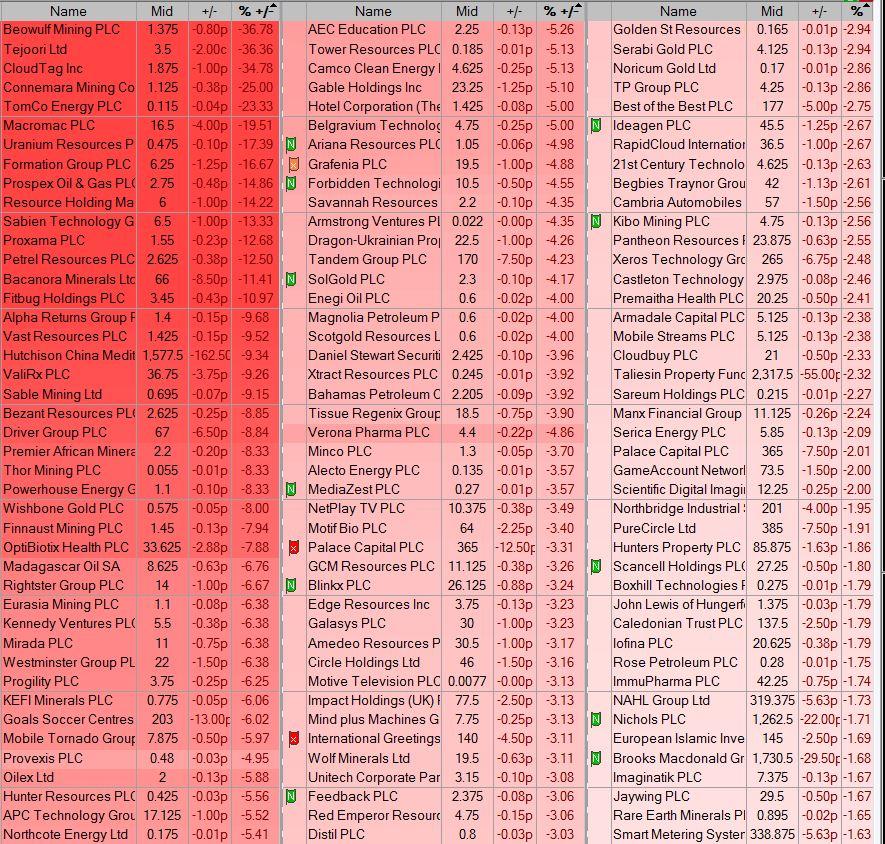
Beowulf Mining (LON: BEM) needs to secure additional cash in the near term. Heads of terms have been signed for the sale of Kosovo-based Vardar. This will help to finance the Kallak iron ore project PFS. Investors are being sought for Grafintec and this could raise €5m. The share price declined by one-quarter to 4.5p.

Bezant Resources (LON: BZT) has raised £2.07m at 0.065p/share. This will fund the acquisition of a further 20% of the Hope and Gorob copper gold project, taking the stake to 90%, and improve productivity at the processing plant. The share price dipped 20.6% to 0.0675p.

FTSE 100 jumps again as Trump signals potential end to war

The FTSE 100 surged again on Tuesday after Donald Trump suggested he would end the war without reopening the Strait of Hormuz.

London-listed stocks jumped on the news, with the FTSE 100 trading above 10,200 in early trade. Oil prices slipped on the news, but Brent still remained above $110 per barrel.

Donald Trump’s comments suggest there could be an end to the war without the US securing some of its previously stated aims. There are signs that both sides could walk away claiming victory. 

But Trump’s unpredictability makes any market positioning risky as he’s liable to post something to the contrary before long.  

That could be why stocks rallied on Tuesday, but oil remained steady. Energy traders seemed unprepared to wind down their long positions with tensions still high in the region amid ongoing attacks. 

Stocks, on the other hand, were quite happy to rally on the slightest hint of optimism on the suggestion that the conflict could be entering its final stages. 

“The FTSE 100 consolidated Monday’s gains to stand firmly above the 10,000 mark as investors continue to weigh competing narratives over the Iran conflict,” said AJ Bell investment director Russ Mould.

US futures also rose on Tuesday, pointing to a stronger session in the cash market this afternoon. 

London’s interest rate-sensitive stocks were among the best performers of the session. 

Should the conflict end in the near term and the oil shock be prevented from causing a material impact on the global economy, there’s a whole raft of UK-listed stocks that will start to look attractive.

They include some of Tuesday’s top risers, including JD Sports, Barratt Developments, and the top riser at the time of writing, Antofagasta, which was 2.6% higher.

Housebuilders have been crushed during the Middle East war and could be among the sectors to recover if it looks like interest rates won’t have to be hiked to fight off inflation.

Persimmon added 0.8% as Barratts rose 2%.

Unilever shares were 0.7% higher after confirming late-stage talks on the potential sale of its foods business to McCormick for a reported mix of $15.7 billion in cash and McCormick shares, with Unilever owning 65% of the new entity.

“The market could be about to make its own version of Marie Rose sauce as a combination between Unilever’s food business, which encompasses Hellman’s mayonnaise, and McCormick, owner of French’s Ketchup, moves closer to fruition,” Russ Mould said.

“The presence of activist investor Nelson Peltz on the shareholder register since 2022 has led to consistent pressure on Unilever’s management to streamline the business.

“Having shed its ice cream division last year, this demerger of its food business is the first big strategic move under CEO Fernando Fernandez since he took the top job a year ago.”

The prospect of an end to the conflict is making the oil majors less attractive, with BP and Shell falling on Tuesday. BP was down 0.3%.