Vodafone shares were down on Thursday after reporting Q3 results, but investors shouldn’t be too disappointed. Growth was respectable, and the share price decline is likely a consequence of the strong run going into results and slight disappointment around the UK and Germany.
The company recorded adjusted EBITDAaL growth of 2.3% on an organic basis to €2.8 billion. Total revenue surged 6.5% to €10.5 billion, propelled by continued expansion in Africa and the consolidation of Three UK and Telekom Romania assets.
Africa was again a bright spot with organic service revenue growth of 13.5%, matching the previous quarter’s impressive momentum. Turkey also contributed significantly, with service revenue increasing 3.7% in euro terms.
UK service revenue declined by 0.5%, while Germany grew by 0.7%. As the group’s two largest geographies by revenue, this will be a concern that balances out encouraging numbers elsewhere.
Vodafone has completed €3.5 billion in share buybacks since May 2024. A further €500 million tranche begins today, underscoring management’s confidence in the business’s trajectory and its commitment to returning capital to shareholders.
Vodafone shares were down 7% on Thursday but are still up 65% over the past year.
“Investors shouldn’t read too much into the fall for Vodafone this morning, given the strong run from the shares in recent months,” said Chris Beauchamp, Chief Market Analyst UK at IG.
“All the signs point to continued strong performance in coming months, and even the competitive pricing pressures in Europe appear not to be having too much of an impact. Some retrenchment would be welcome, allowing a measured view to develop on what is one of the FTSE’s more impressive turnaround stories.”
Shell shares were lower on Thursday after the oil major revealed profits fell in the fourth quarter of 2025.
Adjusted earnings were down 40% to $3.3bn, largely due to the timing of a tax charge. Apart from that, everything at Shell looks just fine.
Look past the impact of taxes, and each unit is ticking along nicely, with Shell successfully navigating the lower-fossil-fuel-price environment.
There will be concerns about lower refinig margins, but this won’t be a surprise to investors who are well aware of oil prices.
Importantly, underlying cash generation is strong, and continued share buybacks will be welcomed by investors.
“Shell’s latest quarter wasn’t spotless, with profits down 11%, but the miss says more about tax timing than underlying performance,” said Mark Crouch, market analyst at eToro.
“Strip that out and the oil giant remains firmly on the front foot. Management’s decision to press ahead with a $3.5 billion share buyback speaks louder than the profit dip and highlights the strength of underlying cash flows.”
“With Energy emerging as the best-performing sector of 2026, capital continues to rotate into the space even as oil and gas prices remain historically on the low side.
“Shell’s shares are trading close to all-time highs regardless, reflecting balance sheet strength, reliable cash generation and renewed upside potential in the share price. Progress on major projects in Australia and Brazil adds further visibility to medium-term growth.”
London’s AI adopter software stocks cratered this week after news broke that Anthropic was developing an AI-powered legal tool that could extinguish their aspirations for AI-driven growth.
RELX shares were down 16% on Tuesday as the London Stock Exchange Group and Experian lost around 10%. Over the pond, the losses have been just as severe.
US software stocks have been selling off for months as investors rotated away from names that had long been the darlings of tech investors, fearing AI-related obsolescence.
The table below illustrates the extent of the losses.
Name
1 year change (%)
Fiserv Inc
-72.1
Gartner Inc
-71.1
HubSpot Inc
-68
GoDaddy Inc
-54.5
ServiceNow Inc
-45
Tyler Technologies Inc
-43.6
Salesforce.com Inc
-42
Accenture Ltd
-38.3
Roper Technologies Inc
-37.7
Fidelity National Information Services Inc
-36.8
Paycom Software Inc
-36.8
Adobe Inc
-36.5
Workday Inc
-34.5
Paychex Inc
-34.1
Block Inc
-33.4
CDW Corp
-30.7
EPAM Systems Inc
-27.6
Intuit Inc
-24.7
In many cases, software companies have been slow to provide AI tools, and many offer tools inferior to those developed by AI-native startups or directly by OpenAI, Google, or Anthropic. They can also be costly.
Unfortunately for software stocks, it’s not just the world’s leading AI startups that are threatening their business models.
Those companies with the right know-how and the power of AI can build a CRM like HubSpot, or a Work Operating System like Monday.com, or even an app to teach you another language like Duolingo does, at very little cost, and at great speed.
AI is empowering businesses to build their own solutions, making incumbents look very expensive.
Are the declines warranted?
HubSpot is down 70% over the past year, but you may argue this is at odds with recent results. Customer numbers are still rising, Q3 revenue was up 21%, and operating profits increased 29%.
This, however, was from a low base, and the threat of replacement by those with only a slight understanding of AI has proved too much for the market.
CRM competitor Salesforce is down 42% despite its AI offering’s ARR surging 114% over the past year. Investors just aren’t buying.
Duolingo is an obvious casualty. When chatbots can produce course curricula for almost any language on earth in seconds, why will people pay £10 a month?
Adobe shares have lost 36.5%. ChatGPT can create a suite of product images in minutes. And there are many better alternatives to ChatGPT for image creation. Adobe subscriptions aren’t the must-have they once were.
Gartner, a provider of insights and guidance to the C-Suite, has tumbled 70% as firms realise that the information available through AI isn’t much different from professional insight that costs tens of thousands of dollars.
It’s not all bad news. When looking at the software sector, remember that not all software stocks are created equal. The stocks most at risk are those providing tools. Tools can be replaced easily by AI.
Gaming companies have performed well, presumably because their software has a more creative element. Take-Two, the owner of the Grand Theft Auto series, saw its shares hit this week but are still 10% higher over the past year.
SaaS investors should rightly be worried by recent developments for the reasons explained above. On the other hand, the names with defensible data moats, particularly UK names Experian and RELX, look hard done by.
Once the dust settles, there will be buying opportunities in the sector.
Google is expected to reveal continued strength in its cloud business as AI adoption accelerates when it reports its Q4 numbers on Wednesday.
With Google’s AI-powered chatbot now sitting at the top of everyone’s internet browser, analysts see a path ahead for its search business, which is expected to see revenue increase 13%.
Google Cloud, which is projected to generate $16.25 billion in revenue with impressive 35.9% growth, is demonstrating the company’s success in the enterprise cloud computing market as businesses scramble to implement AI solutions.
Beyond business-unit performance, Google Gemini is quietly becoming a favoured foundation model for developers, and it will be interesting to see what the firm has to say about its plans for AI services.
“Google is expected to deliver a solid fourth-quarter print, with Search and Cloud both showing clear momentum,” said Lale Akoner, global market analyst at eToro.
“Search growth is benefiting from stabilising competitive pressures in AI-driven discovery, with paid clicks accelerating and volume offsetting some moderation in pricing. Cloud remains the structural growth engine, supported by a large and expanding backlog and strong demand for AI infrastructure, pointing to continued acceleration into 2026.
“However, while estimates have moved higher, they are now broadly aligned with consensus. That matters because Google shares have already re-rated meaningfully over recent months, leaving less room for upside from a “beat-and-raise” quarter alone. Margins should continue to improve, but at a slower pace than earlier in the year as investment intensity remains elevated.”
Akoner continued to explain that expectations are rising among investors, and results alone will not be enough to send shares higher.
“For the stock to outperform from here, investors will likely need to see sustained earnings revisions across the market, not just a reassuring quarter.”
The FTSE 100 stormed to fresh records again on Wednesday as London’s leading index brushed off concerns about threats to the UK’s leading AI adopters.
After closing lower yesterday amid heavy selling in names such as Pearson, RELX, and LSEG, the UK’s leading equity index burst higher to trade above 10,400 for the first time.
The FTSE 100 was 1.2% higher at 10,446 at the time of writing.
UK investors didn’t dwell on the potential impact of Anthropic’s new legal AI toolkit on the business models of AI service providers such as RELX and Pearson, and shifted focus to M&A and strong corporate updates.
“The dust settled on Wednesday after a dramatic session for tech-related stocks amid new AI disruption,” said Dan Coatsworth, head of markets at AJ Bell.
“A lot of the focus since the AI theme emerged has been on the winners and while there has been attention on potential losers from the proliferation of artificial intelligence, this part of the story has mainly stayed in the background.
“That changed on Tuesday when a raft of data and software businesses endured double-digit share price losses on the launch of a new suite of tools from AI outfit Anthropic for the legal sector.”
Although RELX, Pearson, and the London Stock Exchange Group fell again on Wednesday, there was enough strength elsewhere to push the FTSE 100 higher.
GSK shares soared above 2,000p for the first time since 2001 as investors cheered a doubling of operating profit amid strong sales growth.
“A Q4 sales and profit beat was driven by broad-based double-digit growth across higher-value specialty franchises. Oncology continues to stand out, while Respiratory, Immunology and HIV all delivered excellent gains, reinforcing confidence that GSK’s growth is by no means reliant on a single pillar,” said Mark Crouch, market analyst for eToro.
“Management now guides to 3–5% revenue growth in 2026, following a strong 7% advance in 2025. While that implies moderation, it also signals a more disciplined and sustainable trajectory. Shares have broken above levels not seen in over two decades, pointing to a genuine shift in investor sentiment after years of mediocrity.”
The insurance sector was well bid after Beazley announced the board had agreed to a takeover by Zurich Insurance. Beazley was the FTSE 100’s top riser, jumping over 8% on the news, providing a boost to the sector, with Hiscox rising 4%.
“It was clear from previous statements that Zurich was determined to own Beazley. Having done the M&A dance for some time and tried its luck with various proposals, Zurich has finally offered the right number to win over the target’s board,” Dan Coatsworth said.
“There is always the right price for everything, and Zurich appears to have found it.”
The combination of acquisitions and strong organic growth culminated in a positive trading update for DCC, which sent shares 8% higher.
After dominating headlines over the past week, mining companies had a less dramatic session, with Fresnillo creeping up 1% and Antofagasta losing 1%.
This publication is intended to be of general interest only and does not constitute legal, regulatory, tax, accounting, investment or other advice nor is it an offer to buy or sell shares in the Company (or any other investments mentioned herein).
Nothing in this publication should be construed as a personal recommendation to invest in the Company (or any other investment mentioned herein) and no assessment has been made as to the suitability of such investments for any investor. In deciding to invest prospective investors may not rely on the information in this document. Such information is subject to change and does not constitute all the necessary information to adequately evaluate the consequences of investing in the Company.
Theshares in the Company are listed on the London Stock Exchange, and their price is affected by supply and demand and is therefore not necessarily the same as the value of the underlying assets. Changes in currency rates of exchange may have an adverse effect on the value of the Company’s shares (and any income derived from them). Any change in the tax status of the Company could affect the value of the Company’s shares or its ability to provide returns to its investors. Levels and bases of taxation are subject to change and will depend on your personal circumstances.
Past performance is not a reliable indicator of future returns. Any return estimates or indications of past performance cited in this document are for informational purposes only and can in no way be construed as a guarantee of future performance. No representation or warranty is given as to the performance of the Company’s shares and there is no guarantee that the Company will achieve its investment objective.
Overview
Majedie Investments (MAJE), managed by Marylebone Partners, pursues a liquid endowment-style investment strategy designed to deliver an annualised return of at least 4 per cent above UK consumer price inflation over rolling five-year periods.
The approach is long-term and fundamentally driven. Like the leading US university endowments, it seeks to emulate, the strategy avoids market timing and instead emphasises patient capital allocation, drawing on a combination of actively managed equities and a select range of complementary asset classes. Unlike many endowment portfolios, however, Majedie avoids illiquid assets such as private equity, venture capital and real estate. All holdings are marked to market, preserving liquidity and transparency.
The portfolio is organised across three segments: specialist external managers (spanning equity and absolute-return strategies), direct investments, and special investments. The latter provides exposure to differentiated opportunities that are unlikely to feature in conventional portfolios.
Since Marylebone Partners assumed responsibility for the trust at the end of January 2023, Majedie has comfortably exceeded its CPI + 4 per cent objective. Over the three calendar years to 31 December 2025, the trust generated an NAV total return of 44 per cent and a share price total return of 58 per cent, compared with cumulative UK CPI inflation of 11 per cent. The trust employs no gearing. Dividends remain a core component of total return, with quarterly distributions targeted at 0.75 per cent of quarter-end NAV, equivalent to an annualised yield of 3 per cent.
Quarterly investment performance
During the first quarter of Majedie’s financial year (October to December 2025), the Company’s NAV rose by +4.3 per cent1, with positive returns recorded in each month despite unsettled market conditions. While investors remained focused on the trajectory of monetary policy, geopolitical developments and the sustainability of valuations in artificial intelligence-related equities, Majedie’s performance was driven primarily by stock- and strategy-specific factors.
The ten largest contributors to performance comprised a broad mix: three equity-focused external managers, one absolute-return manager, four direct investments and two special investments. This breadth of contribution reflects a highly differentiated portfolio and underlines its appeal as an absolute-return proposition, particularly on a risk-adjusted basis.
One of the more striking features of recent performance has been the even distribution of returns across strategies, regions, sectors and style factors. Outcomes driven by diverse and idiosyncratic sources tend to be more resilient than those reliant on a single theme or favourable market timing. In that respect, the quarter’s results are encouraging not only in absolute terms, but also for what they suggest about the portfolio’s ability to navigate a range of market environments.
Performance by strategy
External Managers
External managers largely avoided the weaker segments of the market. Among equity-oriented strategies, Paradigm BioCapital Fund (US biotechnology) made the strongest contribution, benefiting from renewed interest in the sector amid increased M&A activity, regulatory approvals and expectations of lower interest rates. The Helikon Long/Short Fund (European special situations) also performed well, supported in particular by positions in gold mining equities.
Additional gains came from the Contrarian Emerging Markets Fund, focused on emerging market credit, and from a new allocation to the Fearnley Energy Alpha Fund, a low net exposure long/short strategy based in Oslo.
Direct Investments
The largest positive contribution from direct holdings came from Global X Copper Miners ETF. While atypical relative to Majedie’s usual preference for individual equities, the position was established to capture what we regarded as compelling value across the copper mining sector, while avoiding company-specific risk. Other contributors included Computacenter and IMI. Allfunds Group, a recent addition to the portfolio, announced it was in strategic discussions with Deutsche Börse. The principal detractor over the period was Stabilus, a European automotive supplier.
Special Investments
Performance within the special investments portfolio was mixed. Orizon, a Brazilian waste management company, delivered a strong return following improved earnings and a bolt-on acquisition. The co-investment in Oxford Biomedica also performed well, with the company entering discussions regarding a potential cash offer from EQT. VF Corporation continued its recovery, while CVS Health sustained the gains achieved earlier in the year. Not all positions met expectations over the quarter, though we remain constructive on the long-term return potential of the programme.
Market Environment
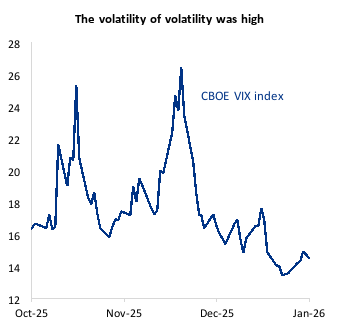
Market conditions over the quarter were unsettled. October saw a sharp, if short-lived, rise in volatility, with the VIX index briefly exceeding 25 as investors reassessed interest rate expectations amid concerns over US fiscal deficits, a potential government shutdown and heavy bond issuance.
In November, attention shifted to growing divergence among global central banks. The US Federal Reserve remained cautious on the timing of rate cuts, the Bank of Japan signalled further tightening, and the European Central Bank adopted a less accommodative tone. This lack of synchronisation unsettled equity and bond markets and contributed to increased currency volatility, notably a weaker US dollar.
By December, volatility had subsided. Economic data and corporate earnings generally surprised to the upside, reviving hopes of eventual rate cuts and supporting a year-end rally. Markets embraced a renewed ‘Goldilocks’ narrative, with the VIX ending the year close to its lows.
Credit spreads finished the quarter broadly unchanged. Precious metals reached new highs as real yields eased and geopolitical tensions persisted. Industrial metals, including copper, benefited from a softer dollar and tightening supply conditions, while energy prices declined.
Source: CBOE, Bloomberg.
Portfolio Outlook
Our objective remains unchanged: to compound shareholders’ capital at an attractive rate above inflation, while minimising the risk of permanent capital loss. Achieving this requires more than simple participation in rising markets. The liquid endowment approach depends on accessing differentiated sources of return and insisting on a margin of safety when deploying capital.
The post-pandemic investment landscape is characterised by structurally higher interest rates and greater dispersion both across and within asset classes. Such conditions are less forgiving of error but more rewarding of selectivity.
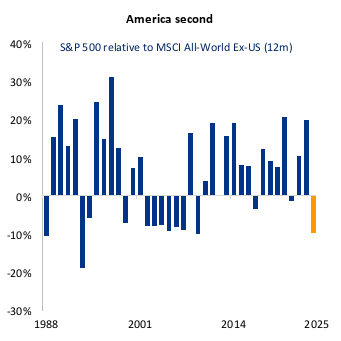
We believe our focus on highly idiosyncratic opportunities positions Majedie well to continue delivering inflation-beating returns, even if broad equity markets struggle to replicate the exceptional gains of recent years. By contrast, market performance has become increasingly dependent on a small group of very large technology companies and their ability to generate adequate returns from unprecedented investment in artificial intelligence.
While we do not doubt the transformative potential of AI, we see little justification, given our mandate, for concentrating risk in a single theme where expectations are elevated and outcomes unusually uncertain. In our view, the opportunity set beyond the AI-related mega-cap stocks is broader and often less risky, supported by lower valuations and greater earnings visibility.
Source: Bloomberg.
Accordingly, the portfolio has gravitated towards mid-cap companies—particularly outside the United States—and towards situations where identifiable catalysts reduce reliance on subjective market sentiment. In this environment, discipline and selectivity are paramount. That means concentrating capital in our highest-conviction ideas, grounded in company-specific fundamentals. The past year has shown that it is possible to generate attractive absolute returns without compromising investment principles or assuming undue risk.
Business Development
On 12 November we received regulatory approval for Marylebone Partners to become part of Brown Advisory. The team has since relocated to Brown Advisory’s Hanover Square offices and integration is progressing. There will be no change to Majedie’s mandate, investment decision-making autonomy or the relationships with its shareholders.
We believe the benefits of the partnership will become increasingly evident over time.
In a further demonstration of alignment, the management fee on Majedie was reduced by 10 basis points (up to a market capitalisation of £150 million). With the debenture now repaid and additional advantages from the Brown Advisory relationship emerging, we believe the trust is well positioned. We have recently increased our own personal investment.
Important Information:
This document has been prepared by Marylebone Partners LLP (“Marylebone”) in its capacity as alternative investment fund manager of Majedie Investments PLC (“the Company”). The document has been approved and issued by Marylebone as a financial promotion for distribution in the United Kingdom. Marylebone Partners LLP is part of Brown Advisory and is authorised and regulated by the Financial Conduct Authority (Firm Reference Number: 596118). Marylebone is registered in England and Wales (Company Number: OC381480) and has its registered office at: 1 Giltspur Street, Farringdon, London EC1A 9DD. The Company is registered in England and Wales (Company Number: 109305) and has its registered office at: Dashwood House, Old Broad Street, London, EC2M 1QS, United Kingdom.
This document is intended to be of general interest only and does not constitute legal, regulatory, tax, accounting, investment, or other advice nor is it an offer to buy or sell shares in the Company (or any other investment mentioned herein). Nothing in this document should be construed as a personal recommendation to invest in the Company (or any other investment mentioned herein) and no assessment has been made as to the suitability of such investments for any investor. In making a decision to invest prospective investors may not rely on the information in this document. Such information is subject to change and does not constitute all the information necessary to adequately evaluate the consequences of investing in the Company. Investors should not subscribe for any shares in the Company on the basis of the information in this document. Investors should refer to the information contained within the Company’s Key Information Document (KID) and the latest Annual or Half-Yearly Financial Reports before making any decision to invest. Investors should also seek independent professional advice before making any decision to invest in the Company.
Capital at risk. The value of shares in the Company (and any income derived from them) can go down as well as up and you may not get back the amount that you have invested. The shares in the Company are listed on the London Stock Exchange and their price is affected by supply and demand and is therefore not necessarily the same as the value of the underlying assets. Changes in currency rates of exchange may have an adverse effect on the value of the Company’s shares (and any income derived from them). Any change in the tax status of the Company could affect the value of the Company’s shares or its ability to provide returns to its investors. Levels and bases of taxation are subject to change and will depend on your personal circumstances. The Company can borrow money to make investments (known as ‘gearing’), which can enhance returns in a rising market but will magnify losses if the value of the Company’s investments falls. You should consult your own professional advisers on the tax implications of making an investment in, holding or disposing of any of the Company’s shares, and on the receipt of dividends.
Past performance is not a reliable indicator of future returns. Any return estimates or indications of past performance cited in this document are for information purposes only and can in no way be construed as a guarantee of future performance. No representation or warranty is given as to the performance of the Company’s shares and there is no guarantee that the Company will achieve its investment objective.
For more information on the Company, and the risks associated with an investment in the Company’s shares, please refer to the Company’s Key Information Document (KID) and the latest Annual or Half-Yearly Financial Reports, copies of which are available at: https://www.majedieinvestments.com/.
This document is not intended for distribution in whole or in part in or into the United States, the European Economic Area, Australia, Canada, Japan, the Republic of South Africa or any other jurisdiction where the distribution of this document could be unlawful. The distribution of this document in other jurisdictions may be restricted by law and the persons into whose possession this document comes should inform themselves about, and observe, any such restrictions. Any failure to comply with these restrictions may constitute a violation of the securities laws or the laws of any such jurisdiction.
Marylebone has taken all reasonable care to ensure that the information contained in this document is accurate at the time of publication, however it does not make any guarantee as to the accuracy of the information provided. Marylebone has no obligation to provide further information, to update the information or correct any inaccuracies identified. While many of the thoughts expressed in this document are presented in a factual manner, the discussion reflects only Marylebone’s beliefs and opinions about the financial markets in which it invests portfolio assets following its investment strategies, and these beliefs and opinions are subject to change at any time. Where information provided in this document contains “forward-looking” information including estimates, projections and subjective judgment and analysis, no representation is made as to the accuracy of such estimates or projections or that such projections will be realised. Comparison to an index, where shown, is for information only and should not be interpreted to mean that there is a correlation between the portfolio and the index.
To the fullest extent permitted by law, neither Marylebone nor the Company shall have any responsibility or liability whatsoever (for negligence or otherwise) for any loss howsoever arising from any use of this document or its contents or otherwise arising in connection with this document. Should you undertake any investment or activity based on information contained in this document, you do so entirely at your own risk.
Tertiary Minerals (LON: TYM) revealed results for four holes drilled during the phase 3 programme at Target A1 at the Mushima North project in Zambia. They indicate further high-grade silver and copper mineralisation with significant potential for it to be extended. The share price jumped 27.8% to 0.115p.
Advanced coating provider Hardide (LON: HDD) shares continue their upward trajectory following yesterday’s order from a North American energy company worth $1m. This should be delivered in the second half. Cavendish upgraded its earnings forecast by one-quarter to 1.9p/share on a £1m increase in forecast revenues to £9m. The share price is a further 13.3% higher at 23.5p.
Corero Network Security (LON: CNS) chief executive Carl Herberger bought 138,000 shares at 13.26p/share. He owns 1.84 million shares. The share price rose 5.16% to 13.25p.
Yesterday afternoon, Tap Global Group (LON: TAP) said that the High Court of Justice Business and Property Courts of England and Wales has dismissed all claims against chief executive Arsen Torosian and Tap N Go. Tap Global was dismissed from the proceedings in 2024. The share price improved 3.33% to 1.55p.
FALLERS
Tiger Alpha (LON: TIR) has deregistered its KDN-1 subnet investment within the Bittensor network. There was an initial investment of 200 TAO at a cost of $86,000 and following deregistration 900 TAO were issued at a value of $161,875. The share price dipped 10.5% to 0.425p.
Alien Metals (LON: UFO) joint venture partner West Coast Silver has announced assay results from the Elizabeth Hill silver project in the Pilbara region of Western Australia. Silver was intersected in multiple drill holes and there were some exceptionally high grades and broad zones of mineralisation. There are indications of opportunities to the north west of any previous drilling. The exploration continues and West Coast Silver has increasing confidence in the potential for the project. The share price fell 9.52% to 0.19p.
Berenberg has cut its share price target for Next 15 Group (LON: NFG) from 580p to 510p, but it retains the buy recommendation. The share price slipped 10.8% to 291.75p.
Marketing services provider YouGov (LON: YOU) traded in line with expectations in the first half. Revenues grew in low single digits despite a slight decline in YouGov Shopper. The data products division was flat, and the research division grew. There is positive momentum going into the second half, but management is cautious. Operating profit will depend on cost control. The interim results will be published on 24 March. The share price declined 6.9% to 205.75p.
Gold producer and explorer Ariana Resources (LON: AAU) has settled outstanding loan balances due under the facility agreement with RiverFort Global Opportunities PCC, which issued a conversion notice. The outstanding balance of $782,575 was converted into 40.4 million shares and these are likely to be admitted to trading on 5 February. RiverFort is not likely to be a long-term shareholder so these shares could be sold in the near-term. The share price slid 6.25% to 1.95p.
GSK reached its highest level since 2021 on Wednesday after the pharma group announced upbeat 2025 results and an encouraging pipeline of new treatments.
GSK reported total sales of £32.7 billion for 2025, up 7% at constant exchange rates, driven by robust growth across its Specialty Medicines portfolio.
The pharmaceutical giant’s Specialty Medicines division posted sales of £13.5 billion, rising 17%. Oncology led the way with 43% growth, whilst HIV sales climbed 11% to £7.7 billion. The company’s Respiratory, Immunology & Inflammation franchise grew 18% to £3.8 billion.
Vaccine sales reached £9.2 billion, up 2%. Shingrix, GSK’s shingles vaccine, advanced 8% to £3.6 billion. Meningitis vaccines rose 12% to £1.6 billion.
Investors were clearly pleased to see operating profit double amid rising sales as shares headed towards the 2,000p level.
“GSK enters 2026 with a renewed sense of purpose and, for the first time in years, looks ready to step out from the long shadow of AstraZeneca. Under new CEO Luke Miels, momentum has accelerated as pipeline execution sharpens and operational delivery improves,” explained Mark Crouch, market analyst for eToro.
“A Q4 sales and profit beat was driven by broad-based double-digit growth across higher-value specialty franchises. Oncology continues to stand out, while Respiratory, Immunology and HIV all delivered excellent gains, reinforcing confidence that GSK’s growth is by no means reliant on a single pillar.
“Management now guides to 3–5% revenue growth in 2026, following a strong 7% advance in 2025. While that implies moderation, it also signals a more disciplined and sustainable trajectory. Shares have broken above levels not seen in over two decades, pointing to a genuine shift in investor sentiment after years of mediocrity.”
GSK shares were 2.3% higher at the time of writing.
Yesterday’s Full Year Trading Update from A.G. Barr (LON:BAG) was really quite positive.
Capitalised at £765m, the multi-beverage business boasts a broad portfolio of market-leading UK brands including IRN-BRU, Rubicon and Boost.
The group has now acquired two other brands operating in the Adult Soft Drinks market – paying £38m for Fentimans, well-known for its soft drinks and mixers, and for £13m it purchased Frobishers Juices, famed for its fruit juices and soft...