The FTSE 100 once again broke to all-time highs on Wednesday as optimism around UK economic growth boosted sentiment in UK stocks.
The index was also support by another strong session from BP after their shares received an ambitious 1,000p price target from analysts at Barclays. BP shares were 3% at the time of writing on Wednesday.
General sentiment improved on Wednesday after the National Institute of Economic and Social Research (Niesr) Think Tank said they expected the UK economy to avoid recession.
⚡️The return of the ‘squeezed middle’⚡️
The UK is likely to avoid a ‘protracted #recession’ in 2023, but for million of #households it will certainly feel like a recession⚠️
— National Institute of Economic and Social Research (@NIESRorg) February 8, 2023
The Think Tank’s prediction is at odds with the Bank of England’s forecast of a recession – although the bank have recently improved their outlook from a prolonged downturn, to a short and shallow contraction.
“The tide of optimism washing over the London market is being pushed higher with the latest economic assessment judging that the UK could avoid a recession,” said Susannah Streeter, senior investment and markets analyst Hargreaves Lansdown.
With the outlook for the UK economy improving in most quarters, the FTSE 100 was helped 0.6% higher to 7,919. The index had hit 7,933 earlier in the session – a fresh intraday all-time FTSE 100 high.
UK domestic stocks
While BP was doing a lot of the heavy lifting on Wednesday, the FTSE 100’s UK-focused stocks provided support for the index after the more optimistic UK economic prediction.
Housebuilders and retailers were among the top risers.
The homebuilding sector was spurred on by an upbeat release from Barratt Developments. Barrett’s said although forward sales were considerably lower than this time last year, they had seen signs of a revival in January.
“While the outlook for the second half of Barratt’s financial year remains uncertain, we’re cautiously optimistic for the group’s prospects in the long run. Recession fears have put housebuilders in a tricky spot, but Barratt’s significant net cash position of £965m gives it plenty of breathing room, even if the housing market deteriorates further,” said Aarin Chiekrie, equity analyst at Hargreaves Lansdown.
Barratt’s shares rose 2.2% but it was Persimmon, storming ahead by 3.2%, that was the FTSE 100’s top riser at the time of writing. Persimmon will release final results 1st March.
Fraser Group’s consumers will enjoy a healthier UK economy and investors bid their shares up by 3% to 808p. The same sentiment was shared by Next with the bellwether retailer adding 2.8%.
URU Metals (LON: URU) shares are higher on news about 74.28% owned Zeb Nickel Corp that was released yesterday afternoon. Analysis of drilling shows a higher grade nickel mineralised zone below the historical resource. Deeper drilling should increase the resources grade. There will also be infill drilling on the gold discovery. The share price is one-third higher at 200p.
There was a small rise in the share price of clinical communications technology developer Feedback (LON: FDBK) on Tuesday when it reported its interim results, but today it has jumped 19.1% to 146.5p. Progress has been slow but there are signs that it could accelerate. The £450,000 contract with a Sussex community diagnostic centre is up for renewal and should be worth much more when it is renewed. Other NHS trusts are showing interest in the company’s services. There was cash of £9.23m at the end of November 2022, so Feedback can finance further development and cover losses.
Deltic Energy (LON: DELT) says that there is a 300bcf gas discovery on Shell-operated Pensacola well in the southern North Sea, where it has a 30% working interest. Management will decide whether to fund further development or sell the interest. The share price rose 16.7% to 3.15p.
Training and software services provider Pennant International (LON: PEN) confirmed that it was profitable in 2022 even though revenues declined. Gross margins improved because software revenues are a greater proportion of revenues. Net debt has fallen to £400,000 and there should be net cash by the end of 2023. The order book is worth £25m.The share price recovered by 14% to 32.5p.
Chain and transmission equipment supplier Renold (LON: RNO) has sparked an upgrade with its latest trading statement. In the 10 months to January 2023 trading has continued to be strong. Sales growth was 17%. Even excluding the major military contract, order intake was more than one-fifth higher. The 2022-23 earnings forecast has been raised by 6% to 4.8p a share. The share price moved up by 10.4% to 27.05p.
Online fashion retailer Sosandar (LON: SOS) is raising £4m at 22p a share and up to £500,000 more from a retail offer. The retail offer closes on 16 February. The share price slipped by 12.9% to 23p. This cash will finance higher stock levels for third parties, including Sainsbury, and further investment in building up the customer base.
A placing by kidney diagnostics developer Renalytix (LON: RENX) has generated £16.9m at 90p a share or $2.17 for an American Depositary Share, which represents two shares. The majority of the cash will be used for clinical product development and marketing. The share price fell 10.2% to 110p.
Laundry technology developer Xeros Technology (LON: XSG) will report a higher than expected loss for 2022. This is due to the timing of milestone payments and restructuring costs. Cash is lower than forecast at £6.5m. Cash burn should reduce from £500,000/month this year. finnCap still assumes that Xeros Technology can become profitable in 2025. The share price declined by 7.14% to 4.55p.
We start by looking at the UK economy and a Think Tank prediction a UK recession will now be avoided. The FTSE 100 has reached new all-time highs above 7,900 – we look at the future trajectory for London’s leading index. We also the FTSE 250 and AIM, and the correlation with certain UK economic data points.
After a torrid year for Barratt Developments shares in 2022, there was reason for optimism in this morning results after the homebuilder said they were encouraged by January sales figures. We delve into the numbers.
The industrial chains and related power transmission products group Renold (LON:RNO) has issued a very positive Trading Update, it is noting record order books and is now expecting to beat market profit forecastsfor the year.
The group, which is a global leader in the manufacture of industrial chains, is also a manufacturer of a range of torque transmission products.
Its products, which are sold throughout the world to a broad range of original equipment manufacturers and distributors, are used in a wide variety of industries including manufacturing, transportation, energy, steel and mining.
For the ten months to the end of January 2023 the group’s order intake was £216.5m, some 19.2% better, leaving the current order book at a record £104.1m.
Its order intake is running far ahead of its sales, with its turnover for the first ten months of the current year to end March, showing a 25.4% growth at £199.0m.
In excess of market expectations
The group stated that given the continued sales growth, a strong orderbook, benefits of the cost reduction and efficiency programmes, and the successful recovery of cost inflation on raw material and energy, the company is confident the current trading momentum will deliver revenues and underlying operating profit for the full year in excess of market expectations.
Analyst Opinion – Target Price of 52p
David Buxton at brokers finnCap has estimated that the current year to end March will see revenues lift to £238.3m (£195.2m) generating adjusted pre-tax profits of £14.3m (£11.5m) and taking earnings up to 4.8p (4.0p) per share.
For the coming year he has pencilled in £233.8m sales, £13.9m profits and 4.6p of earnings.
Anticipating a rerating for the group’s shares over the next two years he has a 52p Target Price out on the shares.
Conclusion – a very healthy upside on 5.4 pe
This group’s shares are currently on a very low rating, trading at 24.5p which puts them on only a 5.4 times price-to-earnings ratio.
Fiinu Bank (LON:BANK) will soon offer a Plugin Overdraft solution to millions of customers without anyone needing to switch their existing bank. The stand-alone unbundled overdraft can potentially be a Monzo-like phenomenon, and the long-term investing opportunity is immense.
About four years ago, 32 million people — or 62% of the population — used some form of overdraft annually. Today, only about 20% of the 100 million personal current accounts population include access to overdraft, whilst the cost-of-living crisis is increasing the demand.
The gap between supply and demand has resulted in over £10 billion short-term credit funding gap in the market and an increase in non-bank lending. By way of example, more than 21 million have resorted to BNPL, and according to FCA, some of these alternatives can have adverse effects on credit files. Fiinu’s primary research suggests that 53% of the population would be very likely to add a Plugin Overdraft to their current account for as long as they didn’t need to change their bank. Fiinu Bank plans a soft launch in late spring and a full launch this summer.
According to Panmure Gordon’s research (Jan 2023), the FTSE AIM fintech group with a ticker “BANK” could fetch a valuation of £1.2 billion — though, as usual with AIM investing, this is not a risk-free trade.
Plugin Overdraft: how it works
Fiinu was founded in 2017, by second-time entrepreneur Dr Marko Sjoblom, as a fintech platform and a provider of consumer banking products. The publicly listed group comprises two separate businesses: Fiinu Bank, which has been granted a restricted deposit-taking, will offer the flagship Plugin Overdraft, and Fiinu Services Ltd, which will provide Bank Independent Overdraft platform to other banks.
The Plugin Overdraft is an ‘unbundled’ overdraft solution. Fiinu provides customers with an overdraft facility by intelligently using the Open Banking scheme without anyone needing to switch their current account away from their present bank. Fiinu Bank loan book is funded through one-year fixed-term deposits, FSCS-guaranteed of up to £85,000.
The solution gives the customer access to mainstream credit, an overdraft, from a third-party bank, and unlike some non-bank alternatives, it does not negatively impact their credit score. According to the Experian website, an overdraft in the credit file can improve credit scores.
After receiving the restricted deposit-taking licence in July 2022, Fiinu is now in the ‘mobilisation’ period, where newly authorised banks typically operate for 12 months before fully opening up to trade.
As with any other retail bank authorised by the Bank of England regulators, the PRA and the FCA, the company is currently undergoing its technical audit. It is also advancing its operational capabilities, recruiting senior managers, building out risk, internal audit, and compliance functions, investing in IT systems, contracting with third-party suppliers, and finalising the company’s recovery plan. At the same time, the PRA/FCA continue to assess whether the group is ready to exit mobilisation and become fully operational.
For context, the total deposits a new bank can accept in the mobilisation period is just £50,000 — little more than pocket change in banking terms. Fiinu plans to exit the mobilisation by 7 July 2023 after submitting a Variation of Permission to the PRA/FCA alongside evidence that required actions and capital is in place.
Fiinu FTSE AIM IPO
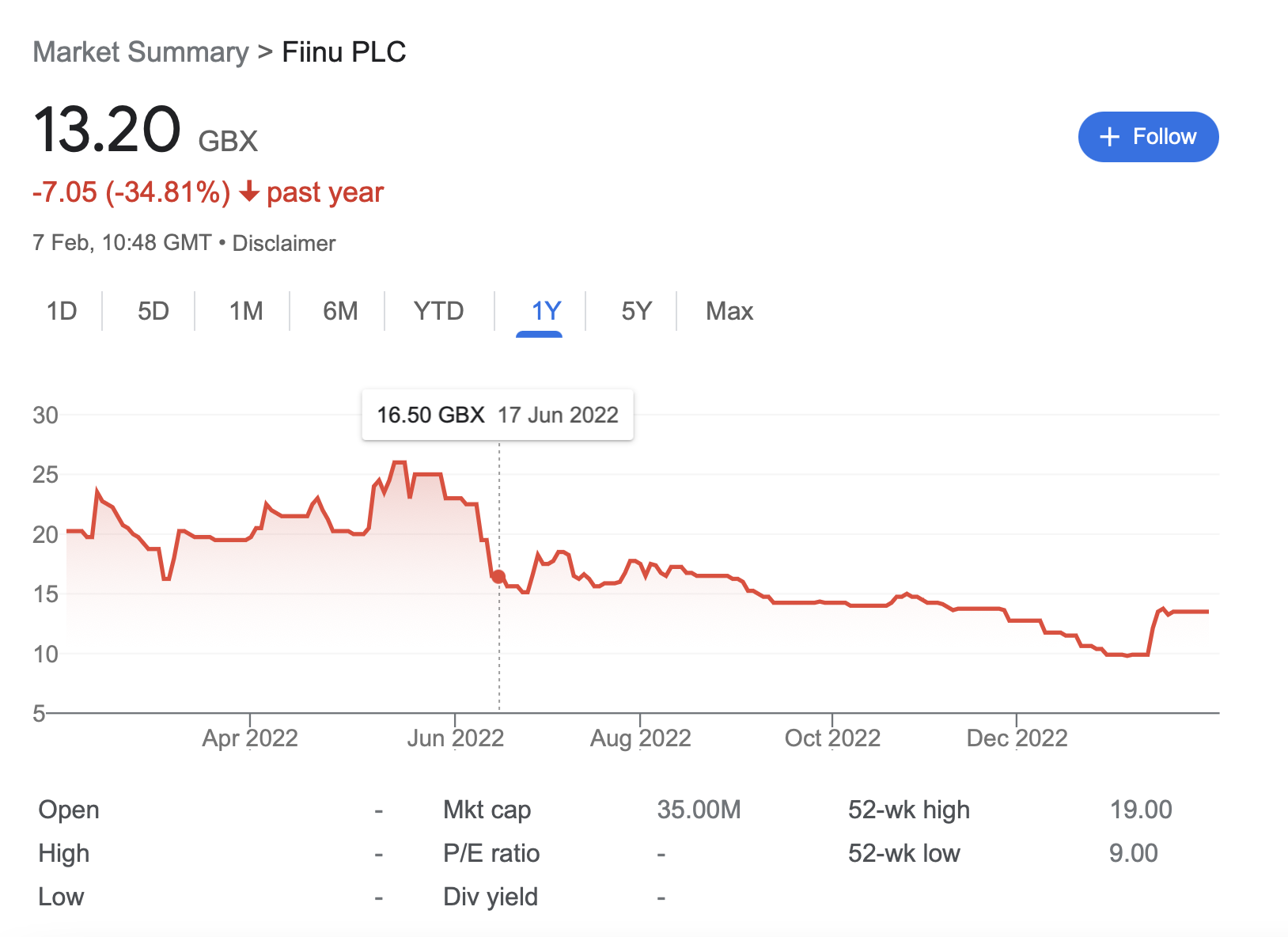
Fiinu launched its IPO mid-July with a valuation of circa £53 million (20p a share). In common with most tech-focused companies, the AIM company has fallen in value to circa £35 million just after launch. However, it’s risen by a third over the past month, with the volatility suggesting it remains in price discovery.
It’s worth noting that gaining its banking licence and launching the IPO was a five-year process. CEO Chris Sweeney argues that the company’s ‘unique Plugin Overdraft is the gateway to better financial inclusion and a welcome addition of a product made possible through Open Banking.’
Meanwhile, the founder, Dr Marko Sjoblom, believes the platform will ‘create a new market where unbundled overdrafts will increase financial fairness and freedom for everyone, everywhere.’ The company raised £14 million when it became public and expected to raise further funds by the end of the mobilisation period.
Recent developments
On 19 December, Fiinu announced that TransUnion will be ‘supporting Fiinu Bank to help enable its innovative overdraft solution, using TransUnion Open Banking capabilities and credit reference data.’ The Open Banking information will be used to check eligibility without impacting anyone’s credit score.
TransUnion director Stephen Wishart notes that ‘the use of TransUnion Open Banking capabilities, alongside our credit reference data, will provide a comprehensive view of the individual’s financial situation, helping Fiinu to assess the finance that’s right for the individual’s needs.’
Most recently, the FTSE AIM company provided an operational update on 26 January in advance of full year-financial results expected in April. Describing the ‘significant progress’ made since the IPO, the company listed a reel of achievements; signing a contract with core banking platform Tuum, hiring key management personnel, signing a contract with a decision engine services provider, and selecting a critical Payment Initiation Service Provider.
In addition, Fiinu has received regulatory senior management functions (SMF) approval for the CFO, chief risk officer, and chair of the board risk committee. As is the core banking platform configuration and testing, all key microservices to support new customer onboarding and payments are now completed. System integration testing is currently ongoing with support from contractor Maveric NXT to provide assurance testing.
And most importantly, the FTSE AIM company remains on target to ‘exit from mobilisation following the required capital raise and subject to regulatory approval’ in July 2023.
However, the bank needs to raise £35-40 million before it exits mobilisation. But confident it will achieve this in the set timeframe and promises to ‘provide further regular updates as the business plan progresses over the coming months.
Potential valuation
Before getting into the specifics, there are three general points to consider for a potential valuation.
First, the UK and the world are generally on the straits of tightening monetary policy, with the UK base rate at 4% and rising. This is sub-optimal for a fintech like Fiinu seeking to get finance on decent terms — and it will need further financing to become self-sustaining; however, retail deposits tend to be the cheapest form of loan-book funding, especially in comparison to wholesale funding.
Second, valuing a company on its potential is, by its very nature, an imprecise exercise with a wide degree of variance. Fiinu has a banking licence, an excellent business idea, and a solid roadmap to profitability. However, things do go wrong, and this is not a risk-free investment — capital risks, credit risks, interest rate risks, liquidity risks, operational risks, and even potential conduct risks are the common pitfalls. Fiinu is not immune to these problems.
The third point is that Fiinu has serious potential. Other fintechs which have spotted a lucrative gap in the market — including Monzo and Wise — have jumped to multi-billion-dollar valuations. Wise has unbundled international transfers from the personal current accounts and proven the model as its valuation is nearly £6 billion.
This could be a similar opportunity to get in on the ground floor for those with a healthy risk appetite. Getting a UK banking licence is no easy task — possibly the most significant hurdle — which has already been cleared.
Now for the details.
Panmure Gordon analysts have put together an excellent research note and extrapolated their opinions based on a realistic hypothetical future model.
Under their model, they expect that Fiinu will grow to 500,000 customers within five years of operation, breaking even in year three, becoming fully profitable in year four, and will have broken even in aggregate by the end of year five.
Breaking this prediction down, they expect 75,000 net new customers in year one, another 75,000 in year two, and then further scaling up in years three to five. Panmure assumes initial average lending of £300 per client, with each use of the Plugin Overdraft lasting for circa 120 days per year/10 days per month. In terms of pricing, it assumes a competitive 32bps.
However, as previously mentioned, Fiinu must find £35-40 million in equity funding in the next four months. Panmure estimates this will need to rise to £100 million based on ‘conservative base case assumptions over the first few years of operation.’ To put this in context, Monzo needed to raise over £450 million in the same period, which is still loss-making.
For perspective, more rapid growth or collaboration with other financial services companies will require more capital to scale up and ensure smooth customer access to credit. However, such an increased growth rate would act as proof of work to potential lenders; therefore, additional financing would be reasonably easy to access.
But under Panmures, many assumptions, including that the customer base grows to 700,000 customers by year 10 — which seems a reasonable target — a DCF valuation would suggest an implied value of £1.2 billion within the next decade.
I think the terms and sourcing of Fiinu’s required financing is the key hurdle to overcome. After that, one problem that the company may have understated is getting those first 75,000 customers in year one; they may be underestimating just how hard it is to get UK consumers on board with new products, especially credit products, even if it is in their own best interests.
My final comment is Fiinu’s future competition problem.
Fiinu is currently targeting customers excluded from arranged overdrafts by traditional banks who must now seek far more expensive finance elsewhere. Suppose Fiinu can demonstrate that it can profitably offer overdrafts to these excluded customers. In that case, banks may again offer these customers overdrafts on better terms.
Fiinu would then compete for customers with the multi-billion-dollar titans. However, this is a future problem, most likely for the 2030s rather than today.
And at 13.2p per share, Fiinu is a solid speculative FTSE AIM opportunity for 2023.
This article has been prepared for information purposes only by Charles Archer. It does not constitute advice, and no party accepts any liability for either accuracy or for investing decisions made using the information provided.
Further, it is not intended for distribution to, or use by, any person in any country or jurisdiction where such distribution or use would be contrary to local law or regulation.
TV programmes producer Zinc Media (LON: ZIN) says 2022 revenues beat recently upgraded estimates through organic growth and a better than expected contribution from recent acquisition The Edge. That should mean that the loss should be lower than the £1.4m forecast. Zinc Media has already secured £15m of revenues for 2023, compared with the full year forecast of £35.7m. There is £3.8m of cash. The share price jumped 15.6% to 96.5p.
Smart building software provider Smartspace Software (LON: SMRT) increased revenues by 36% to £7m in 2022-23. The loss fell and the company should be near to breakeven this year. More than two-thirds of revenues are recurring. Workplace optimisation and customers trying to reduce costs should help Smartspace Software. There are opportunities to sell other services to existing customers. The share price improved 14.3% to 48p.
Live Company Group (LON: LVCG) is creating a 50/50 joint venture with M Group, which will invest £630,000, called Live Company Japan KK. This will generate a licence fee of £100,000 for Live Company Group. The share price moved off its recent low by rising 13.5% to 2.1p.
Sportingbet founder Mark Blandford has joined online gaming company B90 Holdings (LON: B90) as a strategic adviser. Sportingbet started out on Ofex (now Aquis Stock Exchange) before moving to AIM in 2001 and then to the Main Market before being taken over by William Hill and GVC (Entain (LON: ENT)). Yesterday, £500,000 was raised via convertible loan note. The share price is 1.5% higher at 3.625p.
Further buying of shares by a director has helped the Unbound Group (LON: UBG) share price to recover. Non-exec Alastair Miller bought an initial 416,396 shares at 4.8p a share. Premier Miton previously cut its stake in the footwear retailer from 13.6% to 7.83%. The share price rose 9.37% to 5.25p.
Selling has hit coal miner Bens Creek (LON: BEN) shares There have been many trades worth between £100,000 and £900,000 at 18p a share and another worth £3.8m at 17.1p a share. The share price has slumped 18.8% to 19.5p.
Morses Club (LON: MCL) shares continue to fall ahead of the cancellation of the AIM quotation on 13 February. Asset Match will provide a matched bargains facility for the shares. They slipped a further 17.8% to 0.3p and that is an all time low.
In 2022-23, the profit of Sanderson Design Group (LON: SDG) was in line with expectations, but cash is lower than forecast. The interior furnishings supplier grew licensing revenues by 23% and this will help it meet the pre-tax profit forecast of around £12.7m, even though overall revenues were slightly lower than expected. Net cash was £15.2m at the end of January 2023, because inventory remains high. The share price fell 7.6% to 121.5p.
Founder Richard Mays has stepped down as a non-executive director of Prospex Energy (LON: PXEN). He says he is still committed to the long-term prosperity of the oil and gas company. He owns 1.4 million shares having sold 1.34 million shares at 14p each during January for tax-related reasons. The share price is 2.78% lower at 17.5p.
The FTSE 100 was a beneficiary of major oil results on Tuesday with BP echoing Shell in releasing surging profits for 2022 alongside increased returns to shareholders.
BP shares were 5% higher at the time of writing on Tuesday with Shell jumping on BP’s tailcoats and gaining 2%. The combination of both companies gains added a significant number of points to the index and helped the FTSE 100 higher by 0.5% to 7,879.
“BP may be enemy number one in the public’s eyes for its record profits, but its latest success has helped to drive up the FTSE 100, which in turn will benefit people up and down the country with exposure to UK stocks in their pension,” said Russ Mould, investment director at AJ Bell.
As the FTSE 100 bounces back from a soggy session yesterday, traders will be eyeing all time highs of 7,901 set on Friday last week.
UK Banks
UK banks were among the top risers as we approach quarterly updates from Lloyds, Barclays and Natwest. Lloyds is scheduled to release full year results 22nd February and Natwest’s and Barclays results are due 17th February and 15th February respectively.
UK banks have been benefitting from higher interest rates but investors will be watching closely for any provisions for bad debts caused by softer economic conditions.
Lloyds, Barclays and Natwest were trading between 1% to 1.5% higher at the time of writing.
With the banks and oil majors rising, there was notable risk-on tone to equity trade on Tuesday which also saw cyclical sectors such mining and the housebuilders gain.
“Over the past month or so, investors have become more optimistic that we’re near the top of the rate rise cycle, hence why you’ve seen higher-risk companies do well on the stock market,” Mould said.
“If this optimism turns out to be misplaced then we’ll likely see investors flock back to sectors where you can typically find value stocks such as banking, energy and tobacco. In a way, today’s movement on the FTSE 100 already reflects this investor thinking.”
The £94m capitalised Sanderson Design Group (LON:SDG) is a luxury interior furnishings company that designs, manufactures and markets wallpapers, fabrics and paints.
In its latest Trading Update the group reported strong performances from the Morris & Co. brand, licensing and North America were offset by the group’s withdrawal from the Russian market, and a small decrease in manufacturing revenue.
The company’s high-margin licensing activities performed very strongly in the year to end January 2023, with revenues up approximately 23% at £6.4m, buoyed by the signing of new agreements and the renewal or expansion of existing licensing arrangements.
Overall total revenue for the group for the last year was £112.0m (£112.2m), while the end-year net cash position was £15.2m.
The Business
The company derives licensing income from the use of its designs on a wide range of products such as bed and bath collections, rugs, blinds and tableware.
The group’s brands include Zoffany, Sanderson, Morris & Co., Harlequin, Scion, Clarke & Clarke and Archive by Sanderson Design. Its products are sold globally.
The group, which employs some 600 people, has showrooms in London, New York, Chicago, Amsterdam and Dubai.
Analyst Opinion – still rated as a Buy, looking for 205p
Matthew McEachran at Singer Capital Markets rates the group’s shares as a Buy, looking for 205p as his Target Price.
He goes for adjusted pre-tax profits of £12.7m (£12.5m), with earnings of 13.9p (13.0p) and a dividend of 3.69p (3.50p) per share.
His estimates for the current year now underway are for £116.1m sales and a slightly lower £12.0m profit, with earnings of 12.7p and a standstill dividend of 3.69p per share.
David Jeary at Progressive Research considers that the group managed to steer a steady course in uncertain times.
His estimates for the last year are for adjusted pre-tax profits of £12.7m, worth 14.3p per share in earnings.
He expects to review his 2024 estimates when the group reports its final figures in April.
Conclusion – treading water
The group’s shares at 131p are likely to tread water for a while yet.
The UK Investor Magazine was thrilled to welcome David Storm, Chief Investment Officer for British Isles and Asia at RBC Wealth Management.
David provides a comprehensive assessment of the global economy before discussing RBC’s approach to capital allocation.
We start with an exploration of the current macro environment and discuss how deglobalisation is impacting growth due to supply-chain disruptions and increasingly hostile trade relations.
This leads us into the inflationary environment and David explains why he thinks market expectations may be disconnected from reality as we move towards the end of the tightening cycle.
We finish with a look at specific asset classes and equity sectors gaining the attention of RBC’s Multi-Asset portfolio managers.
REACT Group, the leading specialist cleaning, hygiene, and decontamination company, reported a 78% lift in its revenues in the year to end September 2022, to £13.7m (£7.7m).
The group saw its adjusted EBITDA up 20.0% at £953,000 (£795,000).
The performance represents a strong like-for-like organic growth of some 17% enhanced by the £8.5m acquisition of LaddersFree in May 2022, which contributed to the second half of the financial year.
The Business
Momentum from the final few months of the previous year has continued into the new financial year, and despite the usual slow down across the festive period, the first quarter has delivered a record performance for the group.
The group reports three main areas of business; firstly, Contract Maintenance, where it delivers regular cleaning regimes, (such as in the healthcare, education, retail and public transport sectors); and secondly Contract Reactive, where it is the first responder to an on-call emergency response service operating under a formal contract or framework agreement, typically 24-hours a day, 7-days per week, 365-days of the year. Those two areas together are recurring in nature, having continued to grow at pace and represented some83% of revenue in FY22.
The third area is Ad Hoc, where REACT provides a solution to one-off situations outside a framework agreement, such as for fly tipping, void clearance, and decontaminations.
CEO Shaun Doak stated that:
“We are delighted to report a strong financial performance for the year. The acquisition of LaddersFree has been transformational as it continues to win new blue-chip clients.
The transaction has not only broadened the Group’s offering but has enabled the business to cross sell other business services into existing and new customers. This was evident in the recent new £800k contract win to provide services from all three segments of the business through a coordinated programme to a large fast-service food restaurant across all its sites in the UK.
Strong demand for the Group’s services has continued into the current year and as a result the Board is confident of the outlook for the business.”
Analyst Opinion – shares are a Buy looking for 1.5p Target Price
Greg Poulton at Singer Capital Markets has current year, to end September 2023, estimates for £20.0m (£13.7m) revenues and a trebling in its adjusted pre-tax profits to £2.1m (£0.7m). Reflecting the acquisition equity issue earnings per share are expected to stand still at 0.1p per share.
Conclusion – shares are undervalued
With its shares currently around 1.1p each they are trading on only a 7.8 times price-to-earnings ratio, which is undervaluing the group’s potential.