Mind Gym frameworks provide strong base

6

Learning and development products and services provider Mind Gym (LON: MIND) returned to profit in the six months to March 2022 following a loss in the second half of the previous year. New framework agreements underpin growth over the next 18 months.

There is an enormous opportunity for AIM-quoted Mind Gym in what is a fragmented market. The investment in new digital products helps to differentiate the company from competitors and win business.

In the first half, revenues were 11% ahead at £26.8m with US revenues growing by.20%, helped by currency movements. The ending of lockdowns meant that in-person delivery increased from 4% to 15%. Pre-tax profit improved from £17,000 to £641,000 and it should be much higher for the full year. That is despite higher amortisation charges on product investment.

There was a working capital outflow of £3.34m, which was predominantly down to a £3.49m increase in trade receivables. There is normally a first half cash outflow due to bonus payments and the first half outflow should unwind.

Capitalised development was £2.12m and total development spending is likely to rise as more products are developed. There was still £4.5m in the bank at the end of September 2022, plus an unused debt facility.

A £10m framework agreement has been won with an energy company which should generate revenues over the next two years. The timing of the revenues is not contracted, but there will be a second half contribution. Other new frameworks will also contribute.

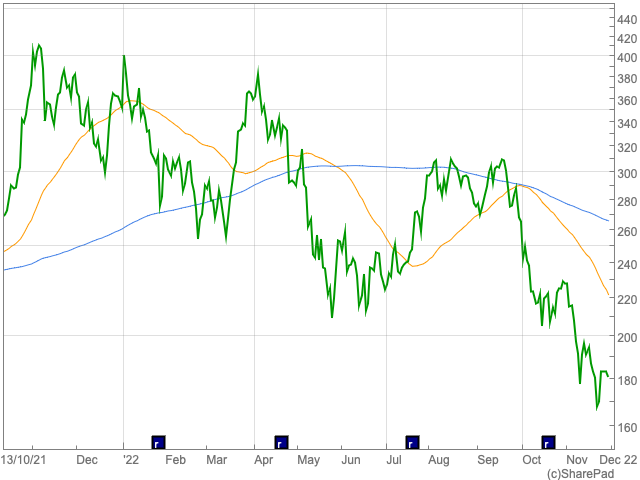
The share price has fallen by one-third this year to 92.5p, but strong progress has been made. Profit should start to grow from this year and the cash position will rebuild.

These stats point to a FTSE 100 Santa Rally in December

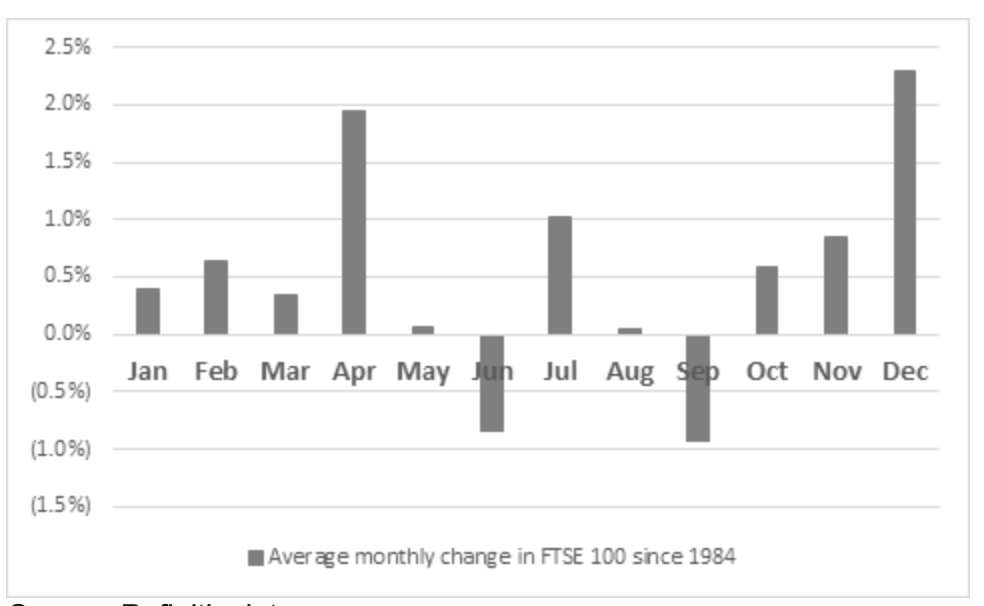
Statistics analysed by AJ Bell suggest December is historically the best performing month of the year and chances of a seasonal rally in the FTSE 100 are high.

A Santa Rally is always referred to by commentators as we move towards the end of the year, and for good reason. Since the FTSE 100 was established in 1984, the index has returned over 2% on average in December.

Indeed, the majority of December trading periods since 1984 have produced positive returns.

“If you want to know why markets talk about the Santa Rally, that’s why – because the numbers back it up. Thursday got the month off to a slow start but investors can be forgiven for hoping for a little seasonal cheer after the FTSE 100 has spent all year huffing and puffing to a rise of around 2% (albeit with dividends and in some cases buybacks on top),” said Russ Mould, AJ Bell investment director.

AJ Bell analysts compiled data on the best performing Decembers and compared to the following year’s performance. There have been very few negative Decembers since the FTSE 100’s inception in 1984 and all but one negative December was followed by a positive return in the following year.


FTSE 100
FTSE 100
YearPerformance in December (ranked)Performance in following calendar year
19878.4%4.7%
19937.9%(10.3%)
20106.7%(5.6%)
19896.4%(11.5%)
19976.3%14.5%
20165.3%7.6%
19995.0%(10.2%)
20174.9%(12.5%)
20214.6%2.6%
19844.3%14.6%
20094.3%9.0%
20053.6%10.7%
20083.4%22.1%
20203.1%14.3%
20033.1%7.5%
19913.0%14.2%
20062.8%3.8%
20192.7%(16.9%)
19862.6%2.0%
19922.4%20.1%
19982.4%17.8%
20042.4%16.7%
19961.5%24.7%
20131.5%(2.7%)
20001.3%(16.2%)
20111.2%5.8%
19950.7%11.6%
20120.5%14.4%
20070.4%(31.3%)
20010.3%(24.5%)
19880.0%35.1%
1990(0.3%)16.3%
1994(0.5%)20.3%
2015(1.8%)14.4%
1985(1.8%)18.9%
2014(2.3%)(4.9%)
2018(3.6%)12.1%
2002(5.5%)13.6%
Source: Refinitiv data, AJ Bell

Although a negative December is usually followed by a positive year, there is no real indiction of what will happen in the next year based on December’s performance.

“The Santa Rally is not certain to offer anything more than festive cheer because it does not seem to be a reliable indicator for the following year,” Russ Mould said.

HeiQ plans US expansion

9

Antimicrobial and textile odour control materials developer HeiQ (LON: HEIQ) has acquired the land and property of Chem-Tex Laboratories Inc in the US for $2.5m in cash and shares at 74.4p each. The share price fell 1.5p to 72.5p.

This property in North Carolina was previously leased, and it is the base for the development of speciality chemicals for flooring and textiles. The sellers are three trusts where the beneficiaries are HeiQ shareholders.

Securing the site will enable further expansion. The focus of manufacturing investment will be the US because of the availability of chemicals and the reduced exposure to rising energy prices. These factors have held the business back in Europe.

Group operating margin should improve after the purchase. In the six months to June 2022, revenues were $30.3m and the operating profit was £1.24m. Full year operating margins are expected to be around 7.5%.

AIM movers: Venture Life acquisition and ex-dividends

4

Venture Life Group (LON: VLG) is buying HL Healthcare, which owns Earol, EarolSwim and Sterinase, for £13m. The products generated EBITDA of £1.7m in 2021-22 and they should do better this year – £3m of the consideration is dependent on 2022-23 revenues. Venture Life is expected to make a 2022 pre-tax profit of £946,000 and that could improve to more than £4m in 2023. The share price jumped by 17.9% to 31.25p.

Facilities by ADF (LON: ADF) is acquiring Location One, which also provides services to the TV and film industry, for up to £8.9m. The initial cash payment is £4.5m. Facilities by ADF provides specialist vehicles, while Location One provides other equipment, such as parking foundations and generators. The two companies already work together. The deal is expected to improve 2023 earnings by 7% to 6.3p a share. The share price rose 14.6% to 63p.

Digital services provider TPXimpact (LON: TPX) continued the share price improvement started late on Wednesday. This follows the publication of interim results that were no worse than expected. The underlying pre-tax fell from £4.7m to £400,000 and the interim dividend was maintained at 0.3p a share. The full integration of past acquisitions to improve efficiency is continuing. A full year pre-tax profit of £5.45m is forecast, which would put the shares at 47.5p, up 18.8%, on ten times prospective earnings.

Professional adviser network DSW Capital (LON: DSW) improved interim pre-tax profit to £902,000 despite the additional costs related to being quoted on AIM. Demand for M&A and other services from small and medium-sized companies remains resilient and the licence income from the fee earners has increased from £1.16m to £1.63m on the back of a one-third rise in network revenues to £9.8m. The interim dividend is 1.76p a share. There was a 7.14% improvement in the share price to 127.5p.

Telecoms customer engagement software provider Pelatro (LON: PTRO) says the currency movements between the US dollar and Indian Rupee will lead to a shortfall in reported revenues this year. Along with other factors, this will reduce revenues by up to $800,000, although the currency movements will have a positive effect on costs that partly offsets the shortfall. EBITDA will be slightly below expectations. Some new clients are moving to a licence model, which means revenue will be recognised earlier.  The share price slumped 31.7% to 13.5p.

Education services provider Tribal (LON: TRB) continues to have problems with its Nanyang Technology University contract. Costs have increased and recognised revenues are lower than expected. That will reduce 2022 EBITDA by £9m and there will be a further shortfall of £4m in 2023. Contract wins have added £1.1m to annual recurring revenues. This knocked 27.5% off the share price leaving it at 40.6p.

Gensource Potash (LON: GSP) has raised $6m with $3m coming from the sale of units (one share and one warrant) at 15 cents each and the rest from an issue of flow through shares at 20 cents a share. The cash will be spent on the Tugaske project and exploration. The share price fell 28.6% to 12.5p.   

Weakening mortgage markets are hitting the revenues of Mortgage Advice Bureau (LON: MAB1) with October and November volumes 50% below expectations. Weak volumes are expected to continue into next year. The network members are reducing the number of advisers employed and new hiring has slowed. Market share continues to increase and it has reached 7%. The 2022 pre-tax profit will be slightly below the previous expectation of £28.9m, but there could be a one-quarter downgrade for 2023. The share price slipped 12.5% to 491.5p.  

Ex-dividends

AssetCo (LON: ASTO) is paying a dividend of 1.3p a share and the share price is unchanged at 65p.

Calnex Solutions (LON: CLX) is paying an interim dividend of 0.31p a share and the share price fell 2p to 165.5p.

CML Microsystems (LON: CML) is paying an interim dividend of 5p a share and the share price declined by 5p to 495p.

Croma Security Solutions Group (LON: CSSG) is paying a final dividend of 2.1p a share and the share price is down by 2.5p to 54p.

FIH (LON: FIH) is paying an interim dividend of 1.2p a share and the share price still rose 7p to 241p.

Michelmersh Brick Holdings (LON: MBH) is paying an interim dividend of 1.3p a share and the share price and the share price edged up 1p to 98.5p.

Marks Electrical (LON: MRK) is paying an interim dividend of 0.3p a share and the share price is unchanged at 76.5p.

Pan African Resources (LON: PAF) is paying a final dividend of 0.87p a share and the share price fell 0.39p to 17.37p.

Tatton Asset Management (LON: TAM) is paying an interim dividend of 4.5p a share and the share price improved by 3p to 473p.

YouGov (LON: YOU) is paying a final dividend of 7p a share and the share price declined 11p to 969p.


Cora Gold moving steadily higher

3

CORA GOLD (AIM: Cora) 4.4p Mkt Cap £13m has for most of 2022 been steadily moving from speculative exploration to producing gold, but the price is only just off its year’s low. The recent ‘grown-up’ news flow was Optimised Project Economics (OPE).

This technical report follows the announcement of Maiden Reserves and completion of a Definitive Feasibility Study  for its flagship Sanankoro Gold project  in southern Mali. There are a lot of numbers in the OPE, based on a gold price of US$1,750/oz) and Maiden Probable Reserve of 422koz @ 1.3 g/t Au. 

This extrapolates to a 53% IRR, a 1.22year payback and $234m Free cash flow for the life of the mine. There is significant potential 3x upside from Exploration Targets estimated to contain between 26.0 Mt and 35.2 Mt with a grade range of 0.58 – 1.21 g/t Au for a potential 1,370koz Au. This could be a 1-2m oz mine and so worth considerably more than its current market cap. Its long-term backers Lionhead confirmed continued support and is in discussions for a term sheet for up to US$30m for project financing which should further the progress. 

Housebuilders shrug of UK housing data as FTSE 100 gains

The FTSE 100’s housebuilders took a slowing UK housing market in their stride on Thursday with Persimmon, Barratt Developments, and Taylor Wimpey all rising on the day.

Housebuilding shares gained despite UK house prices falling 1.4% in the month to October as the pressures of a cost of living crisis and fallout from the mini-budget hit activity.

The FTSE 100’s housebuilders are down heavily this year after much of the bad news on UK housing was largely priced in before the market started to deteriorate.

“Housebuilder shares, already heavily beaten down this year, were higher on the Nationwide data and even estate agents like LSL Property Services and Foxtons were only a smidge lower. This shows how the market has already priced in a lot of bad news regarding the property market,” said AJ Bell investment director Russ Mould.

A Fed pivot?

The FTSE 100 started the day on the front following comments from the Federal Reserve chair that raised hopes the US central bank was considering slowing the pace of rate hikes.

After a year of sharp interest rate hikes, the Federal Reserve could be about to amend the trajectory of their rates hikes which current sees a terminal rate of 5% in 2023.

The prospect of easier monetary conditions will be welcomed by the markets who are facing a slowing global economy.

The S&P 500 was up around 3% overnight and the FTSE 100 was trading at 7,580 at the time of writing.

Mixed commodities

Commodity shares were mixed as investors attempted to gauge news flow in China and whether the authorities could be about to end their zero-covid policy.

The FTSE 100 miners were weaker after a strong couple of weeks, and Shell and BP fell on lower oil prices.

Investing in the Energy Transition with Triple Point’s TENT

The UK Investor Magazine was thrilled to welcome Jonathan Hick, Fund Manager at Triple Point Energy Transition (TENT), to the podcast for a deep dive into the UK energy markets and opportunity in the energy transition.

Regular listeners will remember the Q&A session from the Triple Point presentation at the UK Investor Magazine Virtual Investment Trust Conference in November and the insight Jonathan provided into the UK’s energy ecosystem.

In this Podcast we delve deeper into the regulatory environment and what recent changes mean for power generation assets and TENT’s portfolio.

Jonathan provides an overview of the TENT portfolio and his favourite assets. Jonathan also highlights technologies such as battery storage and green hydrogen as major opportunities for investors in the coming years.

Watch Triple Point Energy Transition’s presentation at the UK Investor Magazine Virtual Conference here.

5 Things Moving Markets 1st December

Jerome Powell hints at slower pace of rate hikes

Jerome Powell sparked a rally in US equities overnight after the Fed chair hinted the pace of US rate hikes could soon slow. Powell’s comments increased hopes of a ‘pivot’ in policy which would see financial conditions ease.

“Comments from the Fed chair might have suggested a slight breather from the pace of hikes we’ve seen more recently, but there were clear warnings that the Fed was committed to returning inflation to levels akin to longer term targets,” said Matt Britzman, Equity Analyst at Hargreaves Lansdown.

FTSE 100 gains

The optimism in US equities spilled over into the European session and the FTSE 100 rallied with European equities.

China economic reopening

Adding to trader’s optimism on Thursday was the prospect of the Chinese economy reopening. Reuters reported their sources told them the government were preparing changes to their Zero-COVID policy after a week of unrest. Chinese equities gained, as did the FTSE 100’s cyclical stocks.

UK house prices slide

UK house prices slid 1.4% month-on-month in October, the biggest drop since June 2020.

“The carnage wrought by the mini-budget may have tipped the property market over the edge. The delay in sales being completed means this is just a first glimpse of the horrors that may lie ahead, and it’s looking like the next few months could be something of a nightmare. Prices fell 1.4% in November, their biggest monthly drop in two and a half years,” said Sarah Coles, senior personal finance analyst, Hargreaves Lansdown.

The dollar falls

The dollar was weaker following the Federal Reserve Chair’s comments with GBP/USD approaching the highest level since early August and EUR/USD traders eyeing July highs.

FTSE 100 dividend shares to watch

The FTSE 100 has outperformed many major indices in November and will have likely helped the valuation of many UK investor’s portfolios.

While the capital appreciation will be more than welcome given the uncertain backdrop, there are still a number of FTSE 100 dividend payers that could be considered for an income as we move into 2023.

Legal & General pays a very attractive 7.4% dividend, even after rallying over 25% since lows in October. Legal & General was a major casualty of Kwarteng’s doomed mini-budget and felt the pressure of disruption in the bond market. At 200p, Legal & General was trading at the lowest levels since 2020 – and didn’t stay there for long.

Legal & General provided a reassuring trading update in October highlighting the impact on their business wasn’t anywhere nearly as bad as their share price suggested.

With Legal & General shares now at 255p, the stock is well below recent 310p highs and is fairly valued at 7.8x earnings.

GSK

It’s very difficult to get excited about GSK, formerly known as GlaxoSmithKline. But dividend payers shouldn’t really be that exciting. Glaxo shares have been stuck in a range for years. The stock bottoms around 1,200p-1,300p then rallies to the 1,800p region, before falling back. At 1,412p today, GSK shares are towards the bottom of this range and the 61.25p per share dividend promised for 2022 FY would mean a yield of 4.3%.

GSK is a quarterly dividend payer and tends to pay its largest dividend in the 4th quarter – which historically has had an ex-dividend date in February.

Persimmon

Persimmon is a high risk dividend play. It is likely to cut its dividend in the coming year, should the housing market slow as predicted by many experts. Last year’s dividend payouts would mean Persimmon yields 18%, but this should be ignored as Persimmon are very unlikely to pay this again in the coming year.

Nonetheless, Persimmon have been a fantastic dividend payer since the financial crisis and any weakness in the share price caused by an impending recession may be an opportunity to buy in anticipation of an economic recovery. Not for the faint of heart.

Are Tesla shares a ‘buy’ after a terrible 2022?

Are Tesla shares a buy after their sharp fall? The Tesla share price has cratered in 2022 and investors may be eyeing Elon Musk’s EV company as a potential bargain.

Tesla has been a favourite among investors positioning themselves in a stock that will benefit from the electric vehicle revolution, and push towards cleaner forms of fuel.

For years Tesla was the only real pure-play EV company and built a loyal base of investors. Tesla shares soared as a result. However, these lofty valuations were tested by traditional manufacturers entering the EV market in a big way, and Tesla shares very quickly looked expensive around $400. A global monetary policy tightening cycle meant their frothy valuation was no longer sustainable.

With Tesla shares more than halving since, the focus should now be on whether the current valuation is justified by Tesla’s earnings.

Tesla sales

Tesla is no longer a company that should be priced on what it may do years into the future. The company operates in a developed EV market which accounts for 17.8% of new car registrations in Europe, 22% of cars sold in China in October were electric.

Although Tesla is top selling EV brand globally, Tesla is not the top selling EV brand in China, the world’s largest auto market.

Tesla have been around long enough to establish a foothold in the market and should be judged by current sales activities. Year-on-year revenue growth of 56% in the third quarter is impressive, but significantly below the 80% growth recorded a couple of quarters ago.

Traditional car manufacturers – and new entrants – are materially increasing their EV sales and rapidly stealing Tesla’s market share.

Indeed, the extensive ranges of EVs manufactured by traditional car companies means it is also appropriate to make valuation comparisons to peers such as BMW, Volkswagen and Toyota. 

Tesla shares valuation

Volkswagen trades at 3.7x earnings, BMW at 3.1x and General Motors 5.9x. A very basic comparison to peers makes Tesla shares trading at $180 and 50x earnings seem expensive.

There is an argument Tesla’s premium is justified by their push into gigafactories, but it’s hard to justify the extent of the disconnect in valuations.

Tesla is a fantastic company, but Tesla shares will need to fall further, or see their sales increase dramatically, to become attractive.