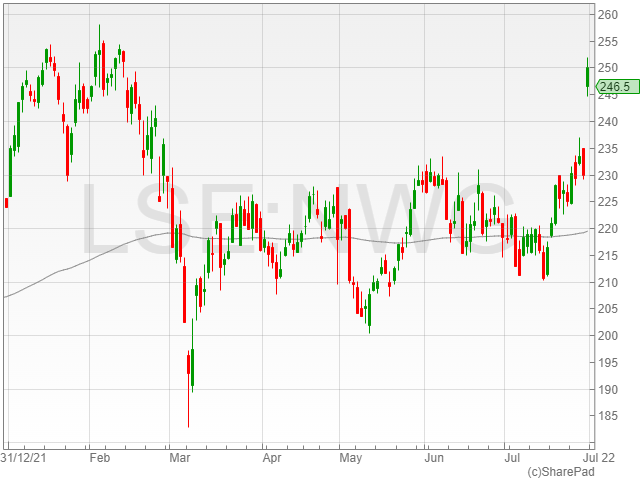
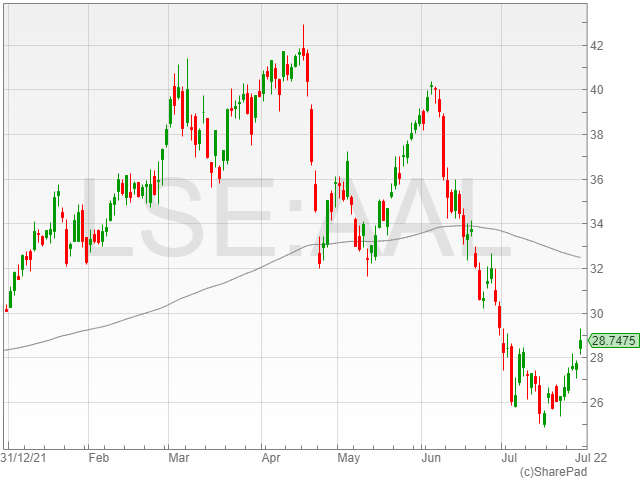
NatWest shares flew 6.8% to 245.8p in early morning trading on Friday in light of a pre-tax operating profit ahead of management expectations of £2.6 billion in HY1 2022.
The banking firm reported a return on tangible equity of 13.1% and a cost:income ratio of 58.3% compared to 67.6% the last year.
NatWest highlighted a Go-forward group income rise of £819 million, representing a 16.2% growth against HY1 2021, as a result of base rate increases and volume growth.
The company announced a bank net interest margin climb of 0.26% to 2.72% on the back of base rate rises.
Meanwhile, the group mentioned a 1.5% dip in other operating expenses in the Go-forward group to £50 million, alongside a HY1 operating profit before impairments rise of 53.5% to £2.7 billion.
NatWest further mentioned a net impairment release of £46 million in the Go-forward group, linked to low levels of realised losses across the company portfolio.
The company noted an expected FY 2022 income excluding notable items of £12.5 billion in the Go-forward group, with a NIM greater than 2.7%.
The firm highlighted its £3 billion investment over 2021 to 2023 as it intends to reduce Go-forward group operating expenses by 3% in 2022 and maintain broad stability in 2023.
The group said it expected to reach a return on tangible equity between 14% to 16% in FY 2023.
“Profit ahead of expectations: check. Big shareholder returns: check. Raised guidance: check. It all adds up to suggest that rising rates are helping to boost the profitability of the group,” said Mould.
“If Natwest can keep this sort of momentum up, the Government will be glad it extended the deadline for the final sale of its shareholding by 12 months to August 2023.”
“There will likely be significant obstacles along the way given the clouds hanging over the UK economy, but the business at least looks in decent shape to take on these challenges.”
NatWest confirmed a total dividend of 20.3p for the HY1 financial term, consisting of a dividend of 3.5p and a special dividend of 16.8p per share.
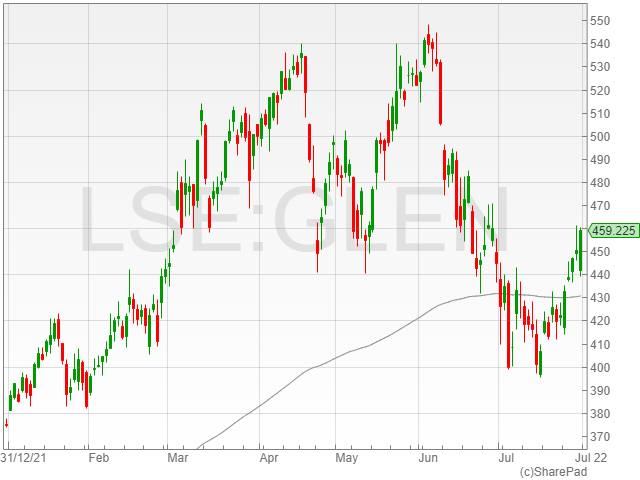
Glencore shares gained 2.1% to 458.9p in early morning trading on Friday, after the mining giant announced a mixed bag of production results in its HY1 2022 report.
The company highlighted a 40% growth in cobalt production to 20.7 kt from 14.8 kt, alongside a 21% rise in nickel to 57.8 kt compared to 47.7 kt year-on-year, reflecting Koniambo operating both production lines this year and Murrin stable operations compared to maintenance in the base period.
Glencore mentioned a 2% uptick in ferrochrome production to 786 kt against 773 kt on the back of consistent smelter performance, and a 14% growth in coal to 55.4 kt compared to 48.7 kt linked to higher attributable production from its Cerrejón acquisition in January 2022 of the remaining two-thirds of the operation.
However, the commodities firm also noted a 15% slide in copper production to 510.2 kt from 598 kt as a result of ongoing geotechnical constraints in Katanga, the basis change from the sale of Ernest Henry in January 2022, Collahuasi mine sequencing and lower copper units produced from the company’s zinc sector.
Glencore mentioned a 17% drop in zinc to 480 kt compared to 581.8 kt due to progressive reduction in its South American portfolio via disposals and closures, Covid-19 absences, sequence changes at Mount Isa and lower Antamina production.
The group also confirmed a 19% decrease in lead to 95.1 kt against 117 kt.
The company reported a 21% gold production decline to 334 koz against 423 kt and a 21% fall in silver to 12,579 koz compared to 15,984 koz in the previous year.
FY 2022 guidance
Glencore said its FY 2022 production guidance remained unchanged, with the exception of copper as a result of ongoing geotechnical constraints at Katanga.
“Our full year production guidance remains unchanged with the exception of copper, where the ongoing geotechnical constraints relating to Katanga’s open pit and continued management of higher levels of acid-consuming ore, largely account for the reduced guidance of 1,060kt (previously 1,110kt),” said Glencore CEO Gary Nagle.
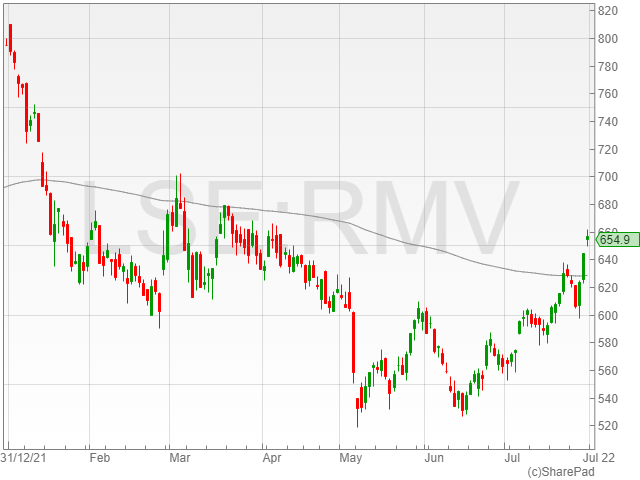
Rightmove shares were up 1.3% to 653.4p in early morning trading on Friday after the property search group confirmed a 9% revenue climb to £162.7 million in HY1 2022 compared to £149.9 million the last year.
Rightmove attributed its revenue to customers increasing their use of digital products to upgrade their packages.
“Our success during the first half of the year demonstrated the ongoing resilience of our customer base and the continuing love for and trust in our brand,” said Rightmove CEO Peter Brooks-Johnson.
“Despite the housing market cooling slightly, activity on our platform was significantly higher than in the pre-pandemic market of 2019, with home-hunters using Rightmove for 1.5 billion minutes every month.”
“Our continuous improvements and innovation have helped to increase engagement from home-hunters in tools such as sold prices, along with further investment from agents and developers as they continue to believe in the effectiveness of our digital products and tools to help them run and grow their businesses.”
FY guidance
The property hunting site currently expects ARPA growth in HY2 to broadly mirror pre-pandemic levels, exceeding previous FY guidance.
Rightmove said it projected phasing costs to be slightly weighted in HY2 and consistent with prior indications of between 25% to 26% to revenues.
The company added it was confident in meeting its market guidance for FY 2022.
“This is another decent set of results from Rightmove, helped by a housing market that has remained robust,” said Wealth Club head of equities Charlie Huggins.
“How long can that last with interest rates rising and inflation at a 40-year high? Only time will tell. However, even if the housing market stalls, there are reasons to think Rightmove could prove resilient.”
“The reality though is that Rightmove’s exceptionally dominant market position means estate agents simply can’t do without it. If the housing market goes into a tailspin, Rightmove will feel it, but probably a lot less than estate agents and housebuilders.”
Following the installation of new sorting equipment cashew production will start to increase, according to Cote d’Ivoire-based Dekel Agri-Vision (LON: DKL) and shelling machines are ready for installation. The cashew business should provide positive cash generation in the fourth quarter of 2022.
WH Ireland predicts that the cashew business could generate revenues of €12m in 2023 and double that level in 2024. The capital investment is almost complete.
Dekel Agri-Vision recently completed an oversubscribed bond drawdown, which was at a better interest rate than the previous issue. This is on the back of increasing revenues thanks to the strong palm oil price.
The first tranche of €6m was at an interest rate of 7.75% and the latest €9.2m has an interest charge of 7.25%.
Prices
There is a 24% increase in the average crude palm oil price to €1,013/MT in the first half. The price has eased off in recent months.
The palm kernel oil price is 83.6% higher at €1,454/MT. However, there has been less fruit to process due to a poor harvest. Crude palm oil conversion rate is improving on 2021 levels.
A small profit is forecast for 2022 before rising to €4.2m in 2023 with the increased contribution from the cashew business.
Net debt should fall to €30.3m by the end of 2022 and cash generation will help it to fall further in the coming years.
The share price has risen 0.4p to 3.2p. That means that the 2023 prospective multiple is eight, falling to five in 2024.
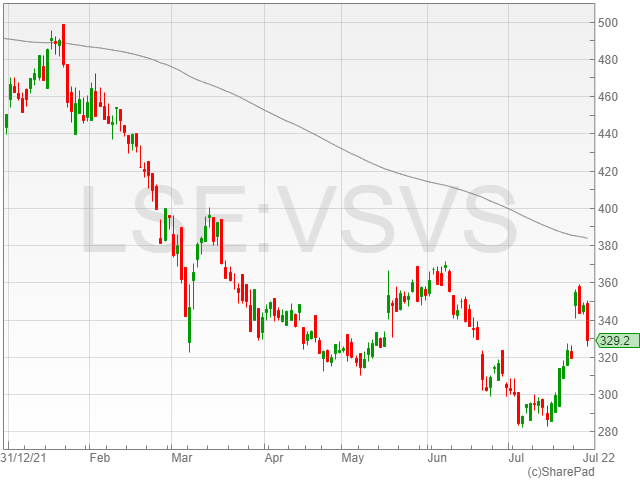
Vesuvius shares fell 4.2% to 329.8p in late afternoon trading on Thursday after the group caveated its relatively strong results with a warning that its market environment looked set to deteriorate over the coming months.
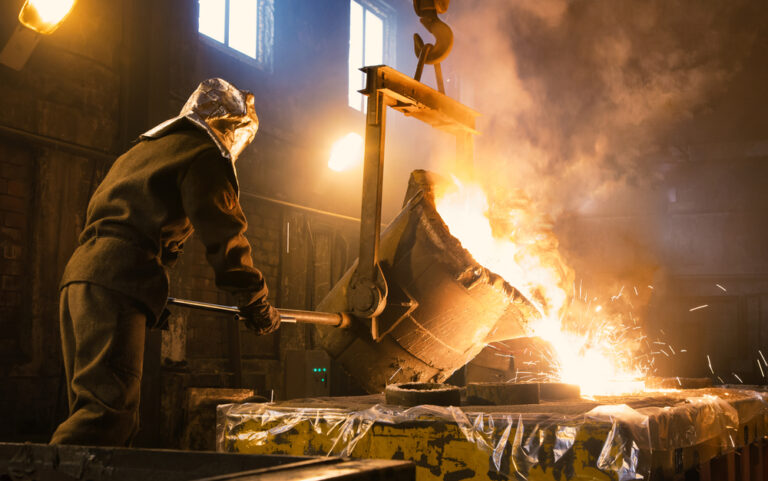
However, the metal flow engineering firm confirmed it expected its FY results to top the higher end of market expectations, as a result of its business model and optimistic HY1 figures.
Vesuvius reported a revenue climb of 26% to £1 billion from £808.1 million the last year, along with a 74% growth in adjusted EBITDA to £127.4 million from £73.3 million.
The group noted an operating profit surge of 79% to £122.3 million compared to £68.5 million, and a pre-tax profit increase of 78% to £116.7 million against £65.5 million the year before.
“Despite difficult market conditions, we achieved a record level of trading profit and profitability in the first half of 2022 thanks to the benefits of the restructuring of our manufacturing footprint over the past years and our continued investment in Research and Development,” said Vesuvius CEO Patrick André.
“These results confirm the long-term profitability potential of our activity under normal market conditions and the importance of our technology driven business model.”
“In the coming months, we expect a further deterioration of our market environment. Vesuvius is, however, well prepared to confront this temporary slowdown thanks to our lean, entrepreneurial and decentralised organisation. This, together with the positive results of the first half, make us confident that full year Group trading profit (EBITA) will be towards the top end of the range of current analysts’ expectations.”
The engineering company mentioned an 89% EPS rise to 30p from 15.9p year-on-year, alongside a dividend uptick of 5% to 6.5p compared to 6.2p in the previous year.
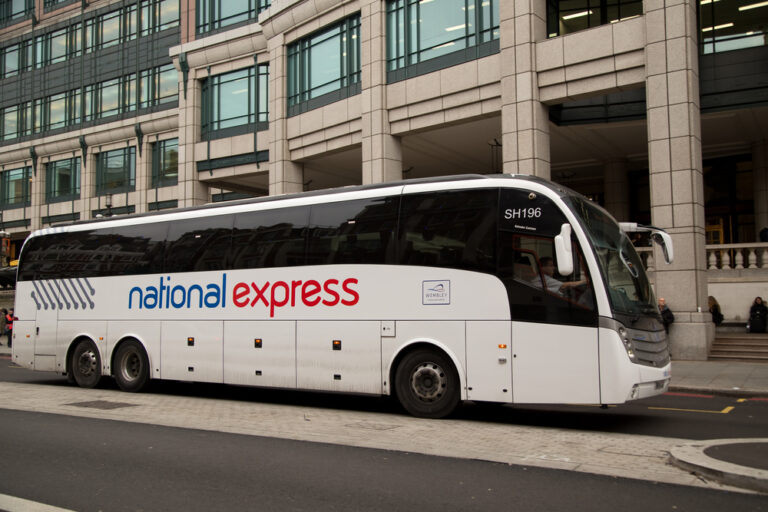
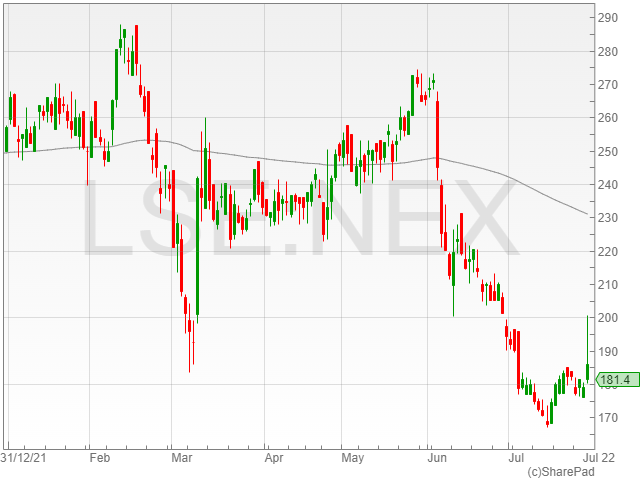
National Express shares increased 1.1% to 181.2p in late afternoon trading on Thursday after the travel firm announced a 33.6% revenue growth to £1.3 billion in HY1 2022 against £990 million in HY1 2021, representing its highest revenue in a decade.
The company reported an EBITDA spike of 54.3% to £197.8 million from £128.2 million the last year, alongside an underlying operating profit surge of 295.3% to £90.5 million compared to £22.9 million.
National Express swung to a pre-tax operating profit of £42.3 million against a loss of £26.1 million in the previous year, and a pre-tax profit of £20.5 million compared to a pre-tax loss of £50.2 million year-on-year.
The group confirmed an underlying basic EPS of 6.2p compared to a loss per share of 2.1p the year before.
“I am pleased to see momentum building across the Group, with strong growth in revenue, profit and cash in the first half,” said National Express CEO Ignacio Garat.
“The path ahead will not be without challenges. We believe, however, that we are well positioned in an inflationary environment; resilient to slowing economic growth; and are taking all the steps we can to mitigate the industry-wide shortage of School Bus drivers in the US.”
“Whilst mindful of these challenges we maintain our full year guidance and continue to anticipate reinstating a full year dividend in respect of FY 2022.”
Meta reported its second quarter of falling sales in Q2 2022, with its revenue missing market expectations in a crushing blow to the social media company.
The Facebook parent group also confirmed a weak forecast for Q3, noting the updated Apple iOS privacy policy and a weakened economic environment as factors which knocked down its income.
Meta announced a $28.8 billion revenue against the $28.9 billion expected, with an average revenue per user of $9.82 compared to the projected amount of $9.83.
The firm also highlighted a $2.46 EPS from the expected EPS of $2.59.
Meta commented its daily active users met expectations at 1.97 billion compared to the anticipated 1.96 billion, and its monthly active users hit 2.93 billion against the projected 2.94 billion.
The company said it expected a revenue between $26 billion to $28.5 billion in Q3, below the $30.5 billion analyst expectation and representing a slide of 2% to 11% year-on-year.
Meta shares were down 5.1% to 1,605c in early afternoon trading on Thursday.
The FTSE 100 saw one of the busiest days of the year for corporate results today, dipping 0.1% to 7,339.2 as Shell, Barclays, BAE Systems and ITV, among others, all reported.
Across the Atlantic, the US Federal Reserve hiked interest rates 0.75%, hitting the level expected by analysts for the last few weeks in a bid to fight soaring 9.1% inflation.
However, US Fed chairman Jerome Powell confirmed certain sectors of economic activity had started to soften, providing markets with hope that the coming interest rate decisions might show reason for optimism.
“On a super Thursday for corporate results the FTSE 100 made solid progress in early trading as the US Federal Reserve helped give global markets a boost overnight,” said AJ Bell investment director Russ Mould.
“It wasn’t so much what the Fed did, since a 75 basis point increase in rates was widely expected, as what it said in noting that some economic data had started to soften.”
“This gave investors at least a hint that it might start to ease its foot off the rate acceleration pedal a touch.”
The Dow Jones dipped 0.1% to 31,124, the S&P 500 fell 0.3% to 4,012.5 and the NASDAQ declined 0.7% to 12,530.5 in pre-open trading.
Anglo American
It was a busy day for the top companies on the FTSE 100, with Anglo American shares rising 3.2% to 2,864.2p after the mining giant beat market expectations despite its falling profits and revenues.
Anglo American revenues slid 17% to $18.1 billion in HY1 2022, with an EBITDA drop of 28% to $8.7 billion.
Additionally, the company slashed its dividend by a whopping 47%.
“Mining outfit Anglo American did better than expected. Although, like a high jumper in the early rounds of a competition, it was clearing a low bar as expectations had been successfully managed down by management ahead of time,” said Mould.
— UK Investor Magazine (@UKInvestorMAG) July 28, 2022
Schroders
Schroders shares gained 3.9% to 2,837p following a revenue climb to £1.4 billion, however its interim profits declined 16% to £312.8 million.
“Our returns from balance sheet activities were impacted with net losses on financial instruments and other income of GBP35.2 million,” said Schroders in a statement.
The firm attributed its falling profits to market movements related to the war in Ukraine and rising inflation levels.
The company maintained its dividend payment of 37p per share for the term.
Rentokil
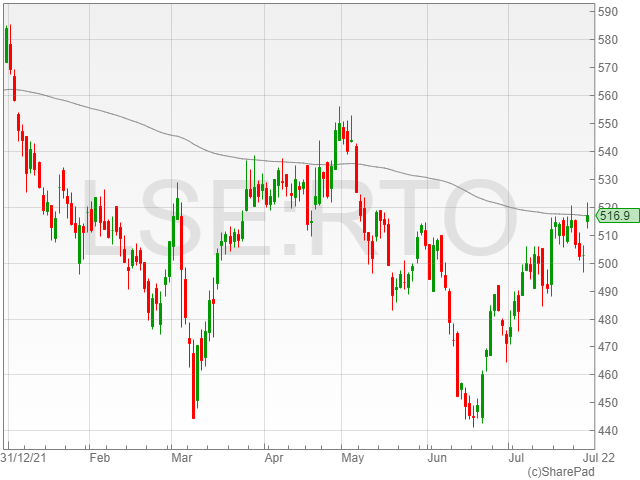
Rentokil shares were up 2.8% to 517p after the firm announced a 7.8% pre-tax profit growth to £161.9 million, and an 8.1% revenue increase to £1.5 billion.
The hygiene group confirmed a HY1 dividend of 2.4p per share, representing a 15% rise year-on-year.
“As a global operation that benefits from highly defensive product and service lines, the company is well placed to navigate macro-economic and geopolitical volatility,” said Rentokil CEO Andy Ransom.
“In the first half, the topline has sustained strong momentum. We’ve been successful in proactively managing cost inflation through pricing to protect margin, while continuing to drive margin improvements through delivery on our strategy.”
Shell
Shell shares gained 1.6% to 2,151.7p as the energy giant reported a shattering $11.5 billion profit in Q2 2022 against its $9.1 billion profit in Q1.
The oil and gas group announced a further $6 billion share buyback, scheduled for completion by Q3 2022.
“Shell’s accelerating its share buybacks after another quarter of bumper profit growth as the energy sector continues to ride high on the supply and demand imbalance caused by the crisis in Ukraine,” said Hargreaves Lansdown equity analyst Laura Hoy.
“Strong oil prices are driving Shell’s bumper performance and the group’s pledged to share more than 30% of the windfall with investors.”
— UK Investor Magazine (@UKInvestorMAG) July 28, 2022
Smith and Nephew
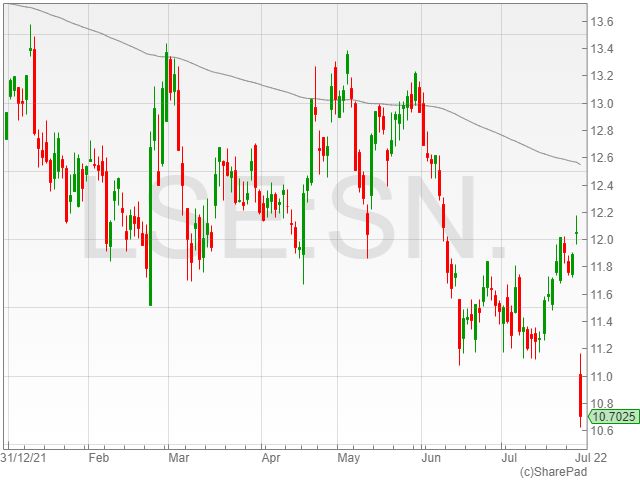
Smith and Nephew shares tumbled 11.4% to 1,066.2p after an 8.5% fall in pre-tax profit to $204 million.
The company also cut its guidance, with an expected trading margin decline to 17.5% from 18.5%, as a result of the “prolonged impact of the inflationary environment and continued external supply challenges.”
Airtel Africa
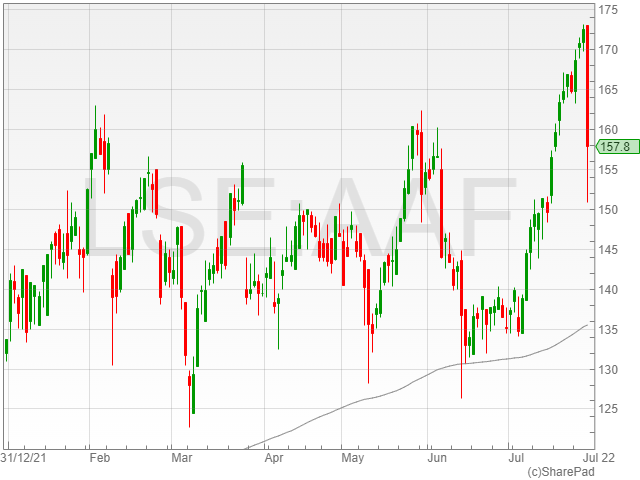
Airtel Africa shares plummeted 8.8% to 155.8p on the back of economic headwinds in its Q1 results, as inflation pressures suppressed margin progress.
Revenue grew 13% to $1.2 billion, while its EBITDA rose 15% to $614 million and margins increasing to 48.8% from 48%.
“As we flagged in our full-year announcement, this quarter we have faced headwinds from outbound voice call barring for customers who had not yet registered their National Identification Numbers in Nigeria and the loss of site sharing revenue in those OpCos where we recently sold towers,” said Airtel Africa CEO Segun Ogunsanya.
“Inflation is also having an impact on our cost base, particularly on energy costs, but our continued efficiency drives have ensured that we have still been able to increase our margins, albeit at a slightly slower rate.”
“We continue to target growth ahead of the market this year and, despite inflationary pressures, our continued focus on cost efficiencies should also support margin resilience.”
Aveva
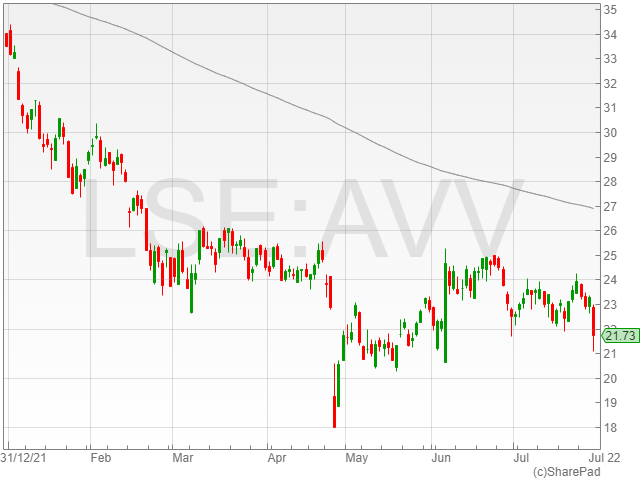
Aveva shares fell 6.5% to 2,177.5p in light of a revenue slide at a mid-single digit rate on the back of a decrease in upfront revenue recognition from perpetual licences.
However, the group’s outlook was positive, with a confirmed expected full year ARR climb of 15% due to strong end markets including energy, with a reliable sales pipeline for the remainder of the financial year.
BT
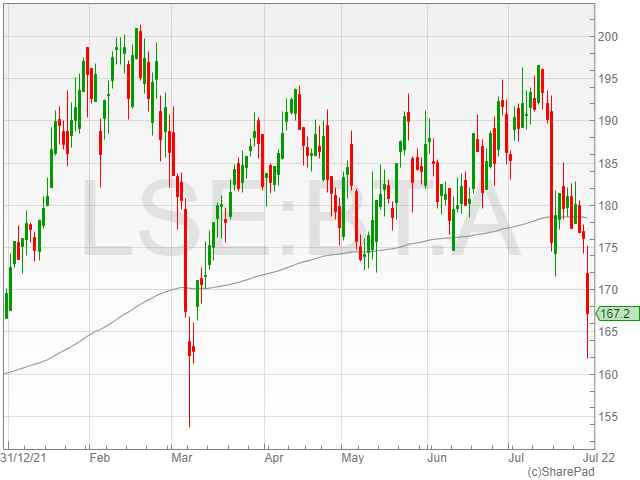
BT shares dropped 5% to 167.4p after a 10% slide in pre-tax profit to £482 million, on the back of increased depreciation offsetting EBITDA growth.
The telecommunications group reported a 1% uptick in revenue to £5.1 billion as a result of improved pricing and trading in its Consumer and Openreach segments.
“BT Group has made a good start to the year; we’re accelerating our network investments and performing well operationally,” said BT CEO Philip Jansen.
“Despite ongoing challenges in our enterprise businesses, we returned to revenue and Ebitda growth in the quarter.”
Centrica
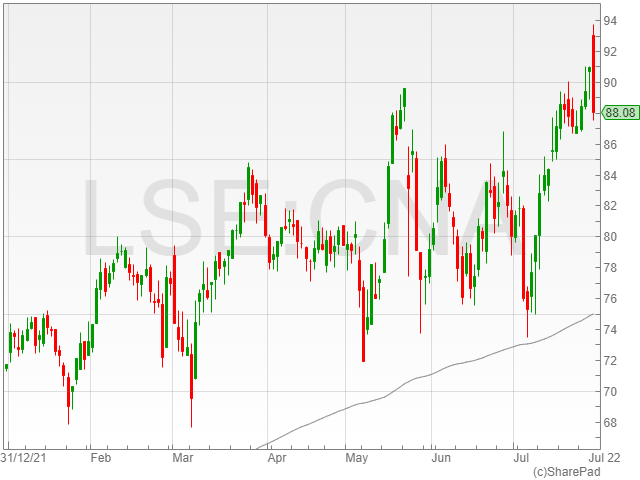
Meanwhile, Centrica shares fell 3.2% to 88p on the back of a HY1 loss of £1.1 billion compared to a profit of £907 year-on-year.
However, the firm saw a revenue climb of 49% to £10.3 billion, which was offset by a 90% surge in the cost of sales to £9 billion from £4.7 billion.
The company issued a dividend payment of 1p per share for the interim term.
“We intend to retain our historic policy of paying roughly a third of the full year dividend as an interim,” said Centrica in a statement.
Barclays
Barclays shares declined 3% to 152.8p as the banking group missed profit expectations with a pre-tax profit of £3.7 billion in HY1.
The firm struggled with the legacy consequences of its over-issuance of US securities earlier this year, which ate £1.5 billion out of its income linked to rescission offer losses, alongside the associated monetary penalty from the SEC.
“Barclays’ numbers were scarred by further damage caused by the structured products debacle in the US,” said Mould.
“The market is pretty unforgiving of banks at the moment. Investors are wary of their exposure to a weakening economic backdrop, despite any benefit they might be getting from rising interest rates.”
“So the last thing banks can afford is self-inflicted damage of the kind Barclays is enduring.”
Barclays profits miss expectations as £1.5bn US securities charges eat into incomehttps://t.co/qm0Y7yXdLA
— UK Investor Magazine (@UKInvestorMAG) July 28, 2022
BAE Systems
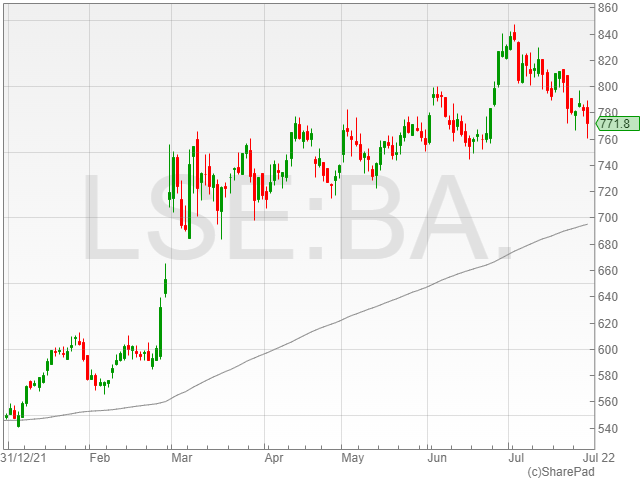
BAE Systems shares dipped 1.3% to 771.4p on the back of its interim profits taking an impact from its ship repair business.
The company’s pre-tax profits declined 32% to £779 million, despite a 4.3% growth in revenue to £9.7 billion after the group’s ship repair sector’s profitability was dented by the Covid-19 pandemic.
However, BAE Systems confirmed an optimistic outlook and reiterated its positive FY guidance.
The firm issued a dividend of 10.4p for the HY1 financial period compared to 9.9p the year before.
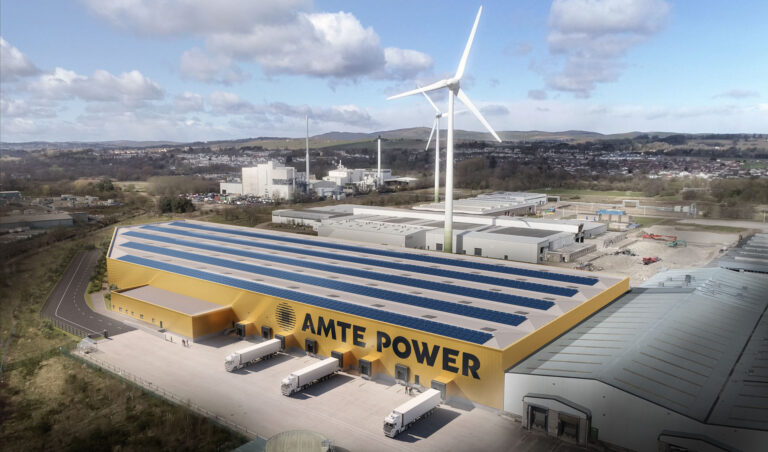
Lithium-ion battery cell technology developer AMTE Power (LON: AMTE) has chosen the site for a new 0.5GWh battery production facility. The share price jumped 32.3% to 86p. The facility will be in Dundee and could open in the third quarter of 2025. At full capacity, the facility could generate annual revenues of more than £200m. Scottish Enterprise and other funding bodies could contribute up to £190m of the cost of the facility. The rest will come from debt and equity. AMTE is developing three different battery cells with automotive battery cells the most advanced. AMTE raised £12.95m at 175p a share when it joined AIM in March 2021.
ATOME Energy (LON: ATOM) has entered into a front-end engineering design (FEED) contract for its proposed hydrogen production facility in Paraguay. The work relates to the adaptation of a substation and should be competed in September. The overall FEED contract still has to be awarded. The share price rose 17.9% to 99p.
Professional services provider Ince (LON: INCE) is raising £7m at 5p a share and taking on an additional £1.6m loan from its bank following the recent acquisition of broker Arden Partners. Ince has been operating at the limit of its debt facilities. There was a cyber attack which management estimates cost £4.9m. An insurance claim has been lodged for this amount, but that could take 12 months to settle. The total bank facilities will be £17m and insurance proceeds would be used to pay off loans. Annual cost savings of up to £5m are being targeted. Revenues are recovering, although Arden had a quieter than expected first half. The placing price is a 58% discount to the previous market price, which fell 52.1% to 5.75p.
Virgin Wines (LON: VINO) reported a 6% dip in full year revenues, although it increased its share of the online wine market from 6.1% to 8.4%. Revenues are still well ahead of levels in 2018-19, suggesting that Covid-related gains are being partially retained. Customer recruitment was up 37% in the fourth quarter. Forecast revenues have been trimmed and pre-tax profit is likely to be flat this year. The share price fell 7.6% to 67p, which is less than one-third of the 197p flotation price in February 2021.
Trackwise Designs (LON: TWD) has confirmed further delays in its electric vehicle contract, although it will receive compensation for these delays. The Stonehouse improved harness technology (IHT) facility will be fully up and running by the end of the year and there are additional contracts that could be won, although most would not reach significant volumes until 2024. Debt remains a concern, particularly in current markets. finnCap expects net debt to reach £14.5m by the end of 2022. Management is confident that it can secure hire purchase and other facilities to cover the additional finance. The uncertainty is likely to remain a drag on the share price, which fell 10.1% to 40p.
Bushveld Minerals Ltd (LON: BMN) says group vanadium production was 4% higher in the first half at 1,641mt, even though second quarter production fell. The full guidance is that production will be at the lower end of the current range of 4,200mt and 4,400mt. Annualised steady state production should reach more than 5,000mt by the end of 2022. First half weighted average production cash cost was 6% higher at $28.32/kg. The share price declined 8.6% to 5.65p.
Ex-dividends
Calnex Solutions (LON: CLX) is paying a final dividend of 0.56p a share and the share price fell 0.5p to 163p.
Quixant (LON: QXT) is paying a final dividend of 2.4p a share and the share price is unchanged at 149.5p.
Tristel (LON: TSTL) is paying a special dividend of 3p a share and the share price has risen 24p to 355p.
Anglo American shares gained 3.4% to 2,870p in late morning trading on Thursday, despite a HY1 2022 revenue fall of 17% to $18.1 billion from $21.7 billion year-on-year.
The mining giant reported an EBITDA drop of 28% to $8.7 billion compared to $12.1 billion, alongside a mining EBITDA margin decrease to 52% from 61%.
However, the sinking figures exceeded market expectations as Anglo American slightly rose over the pessimistic projections, albeit not by a large amount.
“Mining outfit Anglo American did better than expected. Although, like a high jumper in the early rounds of a competition, it was clearing a low bar as expectations had been successfully managed down by management ahead of time,” said AJ Bell investment director Russ Mould.
The company announced an EPS slide of 28% to $3 against $4.18 the last year.
Meanwhile, Anglo American slashed its dividend a whopping 47% to $1.24 compared to $3.31 the year before.