IAG share price bounces back from Omicron selling

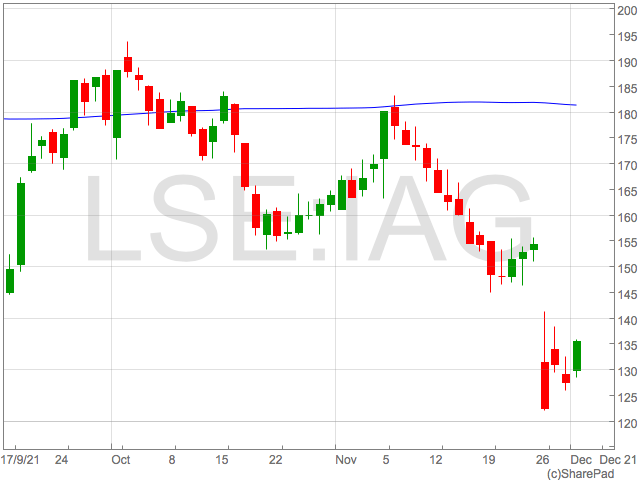
IAG shares have staged a recovery from the sharp sell off induced by the discovery of the Omicron variant.

The IAG share price was up over 6% on Wednesday as fears about the long term impact of Omicron subsided and investors stepped in to pick up IAG at knockdown price.

However, with IAG trading at 135p, there is still a long way to go to recover the losses recorded in the past three trading sessions.

At 135p, IAG is down 15% year to date, but 30% higher than when the vaccines were first announced November 2020.

Traders will be eyeing a short term close of the gap between 155p and the current price.

IAG Revenue

The drop in travel company shares was driven by the overarching fear that the sector could be again deprived of much needed revenue.

IAG recently revealed a 35% drop in Q3 passenger revenue to €3.1bn, down from €4.8bn in Q3 2020.

They also recorded a €2.6bn loss for the period as low passenger numbers continued to dog the airline.

This means sustained recovery in IAG shares will be dependent on the perception of both consumers and the market of how serious the new variant will be.

Many business heavily impacted by COVID-19, including airlines, had been hoping we were through the worst and were on a path through the pandemic.

“Will consumers dial back their festive plans? Will confidence about next year take another knock and prevent would be travellers from making that summer sun purchase? So much hope has been dumped squarely in the lap of this golden quarter and hope has a nasty habit of being dashed,” questioned Danni Hewson, AJ Bell financial analyst.

As highlighted by Danni Hewson, the key for IAG is now the summer trading period. Peer Easyjet released full year earnings yesterday and provided insight into how IAG may have been impacted by Omicron.

Easyjet said they were experiencing transfers of flights booked for Q1 but had seen promising signs for the summer.

Investors will hope this is also the case for IAG as poor H1 trading for the airliner will likely lead to further downside in the IAG share price.

Nationwide: UK house price growth 10% in November

The latest Nationwide House Price Index revealed a increase 10% in house prices in the year to November, surpassing the 9.9% increase recorded in October.

Some experts had predicted a slowdown after the end of the Stamp Duty holiday, but these predictions have once again been proved wrong.

 “Annual house price growth remained strong in November at 10.0%, marginally higher than the 9.9% recorded in October. Prices rose 0.9% in month-on-month terms, after taking account of seasonal effects. As a result, house prices are now almost 15% above the level prevailing in March last year when the pandemic struck the UK,” said Robert Gardner, Nationwide’s Chief Economist.

“There have been some signs of cooling in housing market activity in recent months. For example, the number of housing transactions were down almost 30% year-on-year in October. But this was almost inevitable, given the expiry of the Stamp Duty holiday at the end of September, which gave buyers a strong incentive to bring forward their purchase to avoid additional tax.”

The drop in transactions suggest prices are being pushed higher by a persistent lack of supply. Some industry participants feel this will persist into next year as home owners wait to put their homes on the market meaning prices a likely to remain elevated.

“According to the latest Nationwide HPI, average house prices have taken a slight jump to 0.9% month on month, or £2,367, which is the highest increase since May 2021. However, this does not mean prospective buyers should be pessimistic. It is likely that with Christmas coming demand has outweighed supply, as sellers look to hold putting their house on the market until after the new year,” said Ross Counsell, chartered surveyor and director at GoodMove.

Slowing Growth

However, the prospect of higher interest rates is likely to slow house price growth next year as property has surged way past earnings growth, decreasing the affordability of housing.

“Even if economic conditions continue to improve, rising interest rates may exert a cooling influence on the market. Indeed, house price growth has been outpacing income growth by a significant margin and, as a result, housing affordability is already less favourable than was the case before the pandemic struck,” said Robert Gardner.

Lloyds share price recovery derailed by Omicron variant and could provide buying opportunity

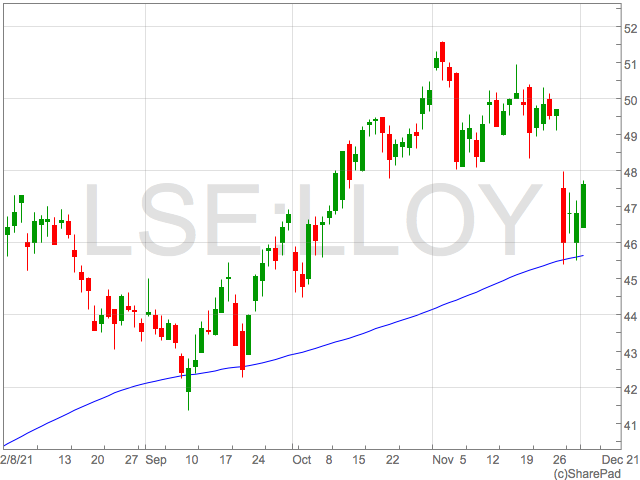
The Lloyds share price was trading a whisker away from 52-week highs last week on optimism the Bank of England would provide the higher rates needed to increase Lloyds’ Net Interest Margin.

However, fast forward a week and Lloyds shares are now well below recent highs as the market digests the impact of the new coronavirus variant, Omicron.

Following a raft of strong economic data, Lloyds shares had climbed higher on the anticipation the Bank of England would hike rates in December and was trading consistently above 50p.

Last week, we wrote with the prospect of a rate hike, Lloyds shares had the potential to break out and revisit pre-pandemic highs.

With the discovery of the Omicron variant, the Lloyds rally has been derailed in the short term, but it could be the opportunity investors are looking for to buy Lloyds shares for a longer term hold.

Fundamentally, nothing has changed for Lloyds. Inflation still persists and anny economic slowdown is likely to be brief.

This means a rate hike is still very much on the cards and demand for Lloyds products such as mortgages will remain robust. One would expect the impact of Omicron on Lloyds earnings to be minimal.

Early reports suggest Omicron to a be mild, however vaccine bosses have warned over the efficacy of current vaccines on the new variant.

This will lead to market volatility on further medical updates on Omicron and investors will continue to face sharp moves to both the upside and downside.

Lloyds shares

With Lloyds shares trading at 47.6p, they have a historical PE of 23x and forward earning multiple of 5.7x. A forward earnings would suggest Lloyds is undervalued, if the earnings forecasts are meet.

Indeed, if Lloyds shares were to trade at 15x these forecast earnings it would mean the Lloyds share price triples from here. This, however, is unlikely as earnings multiples haven’t been the most relevant valuation metric for UK banks over the past few years.

The market has priced UK banks consistently on a price-to-book basis. Lloyds currently has a price-to-book of 0.7 which is the highest of the FTSE 100 UK-focused banks.

Whilst this may make Lloyds shares seem expensive when compared to their peers, it also suggests the market has a higher opinion of the quality of Lloyds assets, such as loans and mortgages.

This will be key for the Lloyds share price because a high quality asset basis will deliver earnings growth in the future.

Easyjet, FTSE 100 Santa Rally and ECR Minerals with Alan Green

Alan Green joins the UK Investor Magazine Podcast for a delve into UK equities and key market themes.

We start with looking at the Omicron variant and the volatility impacting UK equities. There is a discussion around whether the volatility should be viewed as an opportunity.

As we start December there is always attention paid to the possibility of a Santa Rally. We look at the statistics behind a Santa Rally and what investors can expect based on historical performance.

Easyjet was one company heavily hit by news of the Omicron variant and released full year results in the midst of the panic. Shares were of course hit and we look at the merits of shares at current levels.

We also discuss Lexington Gold and ECR Minerals.

How the top performing UK Equity income fund picks stocks

Over three years, FP Octopus UK Multi Cap Income Fund tops the IA UK Equity Income Sector. What’s the secret to its success? Chris McVey, lead fund manager, explains his approach and what it can offer investors. 

Three years ago, we launched an equity income fund with a difference. 

Our idea was simple – to avoid packing the fund with the same stocks you’ll find in most traditional UK equity income funds. 

The fund launched at around the same time as I had my first child. Managing a young fund arguably has some parallels with having a young child. Both need constant attention, and both will take time before their personality becomes fully formed. 

Whilst the fund, thankfully, has not demonstrated any of my daughter’s two-year-old temper tantrums, since day one, we have had some incredibly challenging market conditions.

Brexit negotiations continue to rumble on, whilst a global pandemic has added to the mix. Extreme market volatility, uncertainty and widespread dividend cuts have all added to the fun. 

Less than ideal conditions for a fledgling fund. So how did it perform?

In the three years since it launched, FP Octopus UK Multi Cap Income has returned 69.8% placing it 53.5% ahead of the average fund return within the IA UK Equity Income sector.[1]


[1]Past performance is not a reliable indicator of future results. Source: Lipper to 26/11/21. Returns are based on published dealing prices, single price mid to mid with net income reinvested, net of fees, in sterling. Investment Association performance represented by the average fund performance of respective IA total return sectors.


Here’s how I did it. 

Too many eggs in one basket

Ten of the biggest FTSE 100 companies make up more than half of all UK dividends.[1]

If you look at most traditional UK equity income funds, they’ll usually hold these same stocks. 

This concentration could be a big problem for investors.

Firstly, you’ll be very exposed to the performance of just a few companies. And secondly, holding multiple income funds to provide diversification is unlikely to have the desired effect. 

Whichever way you cut it, the chances are you’ll remain over-reliant on these few large companies. If these companies don’t perform, neither do the funds you hold. 

You might be wondering, then, why all these funds are holding the same stocks. These income stocks pay out a large proportion of their earnings as dividends. In our view many of these companies were over-distributing over recent years. But what happens when they don’t? 

Big dividends are rarely matched by earnings growth

Large companies are popular with investors because they can pay out chunky dividends. These companies also know their investors typically hold shares specifically for the dividend, meaning they will focus on maintaining, or even growing it a little each year.

And while the average dividend per share growth has been strong for the ten largest FTSE 100 stocks pre Covid at more than 12%, what was concerning us was that the average earnings per share growth for the same companies over this period has been a meagre 3.3% per annum.[2]

Without growth in earnings, it’s harder for a business to sustain increases in dividends. It’s also more likely that such a company might need to cut its dividend in the event of a shock.

For example, in the pandemic many traditional UK income stocks cut their dividends, with pay-outs falling by 44% in 2020.[3]Whilst these dividend pay-outs are now recovering from these low levels, we don’t think that these stocks will be able to reinstate dividends back to pre-crisis levels any time soon.

The multi cap approach

The good news is there’s a way to limit your exposure to the big income stocks, without compromising on targeting an attractive income stream. 

Smaller and medium-sized companies can lie in a sweet spot of earnings growth, underpinning progressive dividend growth. Whilst the fund has around 25% of its holdings in companies larger than £1 billion, we have found that UK companies valued above £100 million, but below £1 billion, are often on a steady growth trajectory and can pay increasingly attractive dividends. These companies are the focus of our fund, despite them being largely overlooked by most traditional UK equity income funds.

To help, I’m backed by the Octopus Quoted Companies team. We are a 9 strong, highly experienced investment team with a proven performance track record. We attend over 850 company meetings a year to identify the best investment opportunities. The average tenure of the team is 12 years, and we manage over £2.9bn[4]across all our mandates including three funds: FP Octopus Multi Cap Income, FP Octopus UK Micro Cap Growth and the recently launched FP Octopus UK Future Generations fund. And, like three years ago, I have also just had my second child…

Investing in smaller companies can carry more risk

The value of an investment, and income from it, can fall as well as rise. Investors may not get back the initial amount invested. While smaller companies can offer benefits for an equity income portfolio, you must also consider the additional risk this involves. 

Please remember that investing in smaller companies can involve greater risk than may be associated with investing in larger, more established companies.

The share prices of smaller companies can fluctuate more in value than their larger counterparts. The shares may also be harder to sell.

Investment approach – Core and Satellites

The fund takes a “core and satellite” approach. The core is made up of companies that we believe can grow earnings and dividends ahead of the market. We’ll look for robust finances, superior prospects for profit growth, appropriate balance sheets and good earnings visibility. 

The satellite positions are designed with two key attributes in mind – income or growth. 

The income satellites are those companies potentially delivering superior, sustainable dividends albeit with lower near term growth characteristics. 

Whilst the growth satellites are expected to demonstrate exceptional growth opportunities albeit with lower near term dividend expectations. 

Our fund isn’t constrained by investing in any one part of the market. Instead, I look at every company and ask: 

  • Can it offer a dividend yield greater than the wider market?
  • Can it deliver faster than market earnings growth?
  • Can it deliver faster than market dividend growth?

Asking these questions helps unearth potential income stars of the future, long before other income funds would consider them. The key point is that each holding provides at least one of these three characteristics. 

We remain upbeat about the prospects for the FP Octopus UK Multi Cap Income Fund and I’d like to thank everyone who has invested with us so far.

As always, past performance can’t be used as a reliable indicator for future performance. However, we believe the fund with its solid and differentiated investment process, delivered by experienced management, will continue to deliver impressive risk-adjusted returns. 

‐END-

Risks to bear in mind

The value of an investment can fall or rise and you may not get back the full amount you invest. Smaller company shares are also likely to fall and rise in value more than shares in larger, more established companies listed on the main market of the London Stock Exchange. They may also be harder to sell. 

Our investments are not suitable for everyone. We do not offer investment or tax advice. Personal opinions may change and should not be seen as advice or a recommendation. Before investing you should read the Prospectus, the Key Investor Information Document (KIID) and the Supplementary Information Document (SID) as they contain important information regarding the fund, including charges, tax and fund specific risk warnings and will form the basis of any investment. The Prospectus, KIID and application forms are available in English at octopusinvestments.com. The Authorised Corporate Director (ACD) of these funds is FundRock Partners Ltd which is authorised and regulated by the Financial Conduct Authority no. 469278, Registered Office: 8/9 Lovat Lane, London EC3R 8DW. Issued by Octopus Investments Limited, which is authorised and regulated by the Financial Conduct Authority. Registered office: 33 Holborn, London EC1N 2HT. Registered in England and Wales No. 03942880. November 2021. CAM011582.


[1]Source: AJ Bell Dividend Dashboard 30/06/21

[2]Source: Factset, 24/06/21

[3]Source: Citywire, 28/09/2021 ‘Investors lose appetite for UK Equity Income’  

[4]Source: Octopus 31/10/21

Brickability revenues up 197%

0

Brickability revenues soared 197% to £223.5m amid the boom in construction.

The construction materials provider saw revenues jump in the six months to September 2021 from £75.3m a year previously.

Chairman, John Richards, commented: “As the housebuilding and construction market has continued to improve, all our divisions have benefitted from the increased demand which has resulted in a strong order book.

“Our strategy of bolt on acquisitions has enabled us to significantly expand our product offering, through the acquisition of Taylor Maxwell and Leadcraft, as well as, seeing the Group enter the renewable energy product space with the acquisition of HBS New Energies and UPOWA, a strategically significant sector for the Group moving forward, post-period,”

“We believe Brickability is well-positioned for the future, and that the scale and diversity of the business, will enable the Group to capitalise on opportunities in the market and further strengthen our positioning,”

Shareholders saw a payout of 0.96p per share.

Peel Hunt revenues dip

0

Peel Hunt has posted a dip in revenues and profits in the six months to 28 September.

The group’s revenues were down 23.4% from £93.2m to £71.4m, whilst pre-tax profits fell from £56.6m to £29.5m.

The broker said that results were in line with expectations after the “exceptional trading and heightened market activity” during the height of the pandemic.

Steven Fine, the chief executive, said: “We continue to grow our number of retained Investment Banking clients and have a healthy deal pipeline with  a strong balance of transactions.”

“We’re well-positioned to execute our growth plans, which include opening a  European office to support our growing distribution franchise across the continent. We remain on track to deliver on our budget for the year.”

Loungers posts strong results

0

Loungers has revealed strong results as Covid restrictions were lifted.

The group posted £102m in revenues for the six months to October 3 and pre-tax profits of £12.8m.

Nick Collins, chief executive of Loungers commented on the growth and prospect of vaccine passports, saying: “I don’t think certification would be likely to applicable for us but I have to stress that it is completely unworkable for everyone in the sector.”

“Not only that, it’s a massive violation of civil liberties. It shouldn’t be something we are talking about.”

The bar and restaurant group has 184 sites and plans on opening an extra 13 by April 2022.

New AIM admission: Gelion powers onto market

Battery technology developer Gelion focuses on stationary battery technology, but it has also developed additives for batteries used by vehicles. The unique zinc-bromide stationary battery technology does not use minerals from conflict zones, and they are easily obtained. Existing lead-acid battery factories can be used to manufacture these batteries.
The stationary battery market is expected to grow by 24% a year. Electric vehicle battery sales are expected to reach $125bn by 2030, which is annual growth of 18%.
Gelion shares ended the first day of trading at 150.5p. The potential is enormous...

FTSE 100 drops as Omicron-induced volatility returns

The FTSE 100 fell on Tuesday as fears around the impact of Omicron returned to markets following comments suggesting current vaccines may not be effective against the new variant.

In a broad risk-off move the FTSE 100 gave up 1% on Tuesday morning and European equities were also hit, whilst oil resumed a move to the downside.

85 of the 100 shares in the FTSE 100 were down at midday in London.

“The roller coaster ride has resumed on the financial markets with yesterday’s rally looking more like a break run between a double dip of losses,” said Susannah Streeter, senior investment and markets analyst, Hargreaves Lansdown.

“Investors are now strapping themselves in for a volatile ride anxious for any further news which could lift sentiment or send it plunging again, such as the comments from Moderna’s chief executive that current vaccines will struggle with Omicron because of the high level of mutations on the spike protein.”

“It’s not known just how less effective they may be, and the waiting game continues as scientists scramble to assess the new variant, but amid this state of uncertainty, nervousness is high.”

Volatility

Today’s volatility comes just a day after strong gains in shares on optimism the new variant would be milder than the Delta variant.

Without substantial data yet on the infectiousness of Omicron, markets are likely to remain volatile in the short terms as investors sell any signs of uncertainty.

Uncertainty is also impacting the behaviour of consumers; Easyjet released full year results and said it was already seeing passengers transfer flights booked for Q1.

Easyjet revealed the impact of Omicron alongside a £1.1 billion pretax loss, sending shares 3% lower.

FTSE 100 airliner IAG was also 2% weaker in a market with few gainers. One such gainer was Polymetal who benefited from risk aversion.