Boku earnings soar as mobile payments company sees 48% increase in monthly users

0

Boku cash balances increased to $62.7m

Boku (LON:BOKU) confirmed a 107% increase to $15.3m in its adjusted EBITDA as the mobile payments technology company released its results on Tuesday.

The firm announced its revenues at $56.4m, an increase of 20% in 2020, while its net pre-tax loss jumped from $1.3m to $17.3m.

The AIM-listed company said its loss was a result of a $20.8m goodwill impairment for its identity division.

Boku generated $11.5m in cash from operations before working capital changes, rising from $6.1m, while its closing cash balances increased to $62.7m from $35.6m in 2019.

The mobile payments company saw a 48% increase in its monthly active users for payments to 28.8m, including 4.6 million users from Fortumo. Its total payment volume rose to $6.9bn in 2020, from $5bn in 2019.

Jon Prideaux, chief executive of Boku, commented: “Boku performed strongly in 2020 with revenues up and Adjusted EBITDA more than doubled compared to 2019, driven by the performance of Boku Payments but the central fact of 2020 was COVID-19.”

“It has changed the way that we work and live and had an adverse impact on our Identity business, requiring its value to be re-assessed. Restrictions have affected the way that we travel, communicate and get entertained. Coronavirus has depressed spending, but that spikey ball of RNA has also changed the things we buy and the way we pay.”

“Industries dependent on face-to-face contact have been decimated. Some – hospitality, for example – will bounce back when restrictions are released, but for others, the pandemic has accelerated pre-existing trends. It turns out that many people didn’t really like driving into town to go shopping and for many types of goods the switch to online will be permanent.”

“The way we entertain ourselves has been changing for a while. CDs have been cleared from the shelves and DVDs sent to the car boot sale, as we switch to digital consumption. Games, especially mobile games, were already growing rapidly pre-COVID-19.”

Shanta Gold reports ‘promising’ results across assets

Shanta Gold sees potential for upgrading the existing resource estimate at Luika

Shanta Gold (LON:SHG) confirmed encouraging drilling results from 22-hole programmes at the New Luika gold mine in Tanzania, the West Kenya project and the Singida gold project.

Drilling at Luika at hole CSD206 intersected 9.29 m grading 11.27 g/t Au from 441 m, incl. 4.88 m at 20.07 g/t Au. The company is targeting the inferred resource extension of the westerly plunging deposit at Luika with attractive potential for upgrading the existing resource estimate.

Additionally, high-grade intersections were also found in early holes at the West Kenya project, where one hole at Isulu intersected 2.00 metres at 15.9 g/t gold and one at Bushiangala intersected 22.9 metres at 4.81 g/t gold.

The AIM-listed company will continue drilling at the West Kenya project will during 2021 focusing on upgrading the inferred resource at Isulu and Bushiangala to the indicated category.

At the Singida gold project in Tanzania, drilling identified a potential new hanging wall zone that is richer than the main zone at Cornpatch West.

Eric Zurrin, chief executive at Shanta Gold, commented on the company’s results:

“Early drilling results have been positive across all three assets including one of the best holes drilled at the Luika deposit over 162 holes drilled in its history.”

“At the West Kenya Project, we intersected visible gold at Isulu, while Bushiangala has returned a very wide and high-grade zone over 23 meters.”

“The Singida Project remains underexplored, particularly for a greenstone deposit, and drilling has illustrated a potential new hanging wall zone that is richer than the main zone at Cornpatch West. These drilling results have the potential to increase the size of mineable resource at Cornpatch West.”

“Exploration remains core to delivering future value and growth within our portfolio to support long-term sustainable returns to shareholders. Today’s announcement covers 7% of total drilling metres planned in 2021. I look forward to providing ongoing exploration updates throughout the course of this year.”

Why the Lloyds share price now looks unattractive

1

Lloyds share price (LON:LLOY) took a hit during 2020, but despite making a recovery, investors could be tempted to look elsewhere in the coming months.

Lloyds Earnings

The bank announced in February that its pre-tax profit fell by over 72% to £1.2bn, while loan losses totalled £4.2bn during 2020. Lloyds’ profit could be further impacted if low interest rates remain, narrowing the difference between the rate the bank offers borrowers and savers.

Lloyds has a price-to-earnings ratio of 25.8. While it could be a signal of the market’s expectations of higher earnings going forward, it does make the Lloyds share price seem expensive. The bank’s price-to-NAV ratio is currently 0.6. With Lloyds trading below a Price-to-NAV of one, it suggests the market doesn’t have a high degree of confidence in the current health of banking assets such as loans and mortgages.

Lloyds Share Price

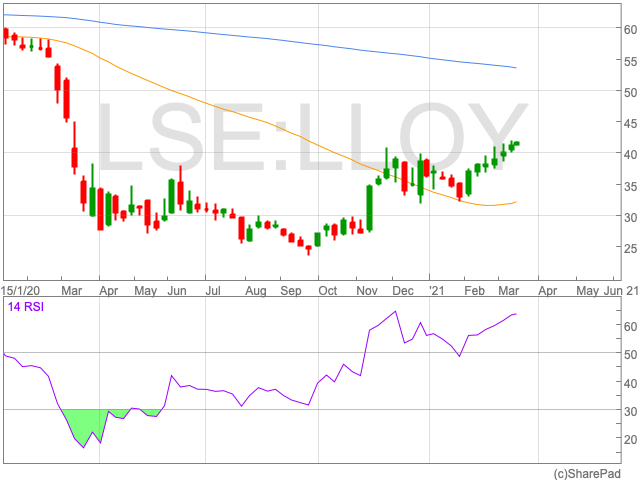
Since February the Lloyds share price moved from below 35p per share to above 40p per share. It also moved away from its 50-day moving average, as the 200-day moving average continues to trend to the downside. Over time the moving averages are expected to converge as the 50-day moving average acts as a magnet for the Lloyds share price. This means Lloyds shares could retrace over the coming months.

Lloyds RSI, as seen below, was knocking on 70 at the end of 2020 and again during March. This suggests that Lloyds shares are overbought which could mean a sell-off in the near future. From March through to April, Lloyds’ RSI was below 30, meaning its shares were underbought. The bank’s share price has risen since then.

Lloyds Share Price, moving averages and RSI

Lloyds Dividends

Lloyds confirmed a final dividend for 2020 of 0.57p after shareholder payouts were cancelled in 2019. The dividend is well down on 2018 and 2017 when it was 2.14p and 2.05p respectively. In comparison, Natwest confirmed in February that it paid its shareholders 3p per share.

These dividends are a long way off the yields investors had become accustomed to prior to the pandemic. Due to ongoing guidance from regulators, payments to investors may remain tepid in the short-term. The bank’s dividend is historically a big pull factor for investors. At the current rate they could be tempted to look elsewhere.

Are Unilever shares a good buy?

0

Unilever Shares Decline After Strong Rally

In March 2020, when many companies saw downturns due to the pandemic, Unilever shares (LON:ULVR) were valued at 3,854p per share. By the end of August they were up by nearly 35% to 5,196p.

However, as the road to recovery became more apparent, investors began looking towards more “exciting” high-growth stocks.

Investors deserted Unilever for cyclical companies such as miners, where they anticipated higher returns as the economy bounced back from the coronavirus pandemic. In February 2021, Unilever shares had fallen to 3,733p per share.

This has caused the Unilever share price to fall well below its 50-day (yellow) and 200-day (blue) averages, as seen below. In addition, the company’s RSI is at the 40 level having dipped to 30, suggesting its shares may be oversold.

These technical analysis indicators could point towards the possibility that the Unilever share price is set to reverse recent declines in the coming months.

Dividends

Unilever’s dividend remained in place throughout 2020, rising in line with yearly increases. The total dividend for the year came in at €1.73 per share, up from €1.66 and €1.58 in 2019 and 2018. The company held its dividend at 2.9%, while confirming its intention to pay a growing dividend moving forward.

A Stable Option

In the event of a downturn, investors seek “defensive stocks” in their portfolio to help weather the storm. Unilever, a company which sells an assortment of home care and personal care products, is well positioned to maintain its revenue levels during periods of uncertainty.

While some Unilever products – food services and ‘prestige beauty’ – took hits during the pandemic, many, such as household care and cleansing, showed resilience. Unilever’s turnover fell by only 2.4% during 2020, mainly due to the impact of adverse currency fluctuations, while its underlying sales growth was 1.9%, showing the company’s resilience. Over the same period, Unilever’s underlying operating profit decreased 5.8%, but increased by 0.7% at constant exchange rates.

FTSE 100 pushes towards 6,800 as pound weakens

0

The FTSE 100 edged up to 6,794 on Tuesday morning trading as the pound weakened against other currencies.

“As sterling weakened against dollar and euro alike – cable felt half a percent, while the pound shed 0.4% against its single currency rival – the FTSE 100 was free to push back towards 6,800,” says Connor Campbell, financial analyst at Spreadex.

“A strong finish to trading in the US overnight and robust trading in Asia helped give the FTSE 100 a lift on Tuesday, shaking off any hangover from the day before and framing the day’s narrative around whether the index can regain the 6,800 mantle it briefly attained on Monday,” added AJ Bell investment director Russ Mould.

As inflation concerns somewhat ease, attention will turn to the UK vaccine roll-out in the hope of a return to normality.

FTSE 100 Top Movers

AstraZeneca (3.5%), Rolls-Royce (3.01%) and British Land Co (2.85%) headed up the the FTSE 100 at the time of writing on Tuesday morning.

At the other end of the FTSE 100, Anglo American (-2%), Natwest (-1.74%) and Burberry (-1.28%) are the day’s biggest fallers so far.

Greggs

Greggs reported its first loss in 36 years during 2020 as sales dropped by a third following nationwide lockdown measures. The board of the Newcastle-based company confirmed a pre-tax loss of £13.7m in 2020 with sales dropping from £1.17bn in 2019 to £811.3m.

Greggs also said that the beginning of 2021 had been challenging for the baker. Over the same 10 week period in 2019, before lockdowns came into full affect, sales are down by 28.8%.

Antofagasta

Antofagasta on Tuesday confirmed a 6% rise in its net profit during 2020 as well as raising its dividend for 2020. The mining giant’s net profit reached $893.9m, up from $843.1m in 2019. Lower costs and stronger prices more than offset a fall in copper production levels.

Antofagasta’s EBITDA increased by 12% to $2.74bn ahead of analysts’ expectations of $2.7bn. The FTSE 100 company announced a final dividend of 48.5 cents per share, bringing the full-year number to 54.7 cents, and up from 50.9 cents in 2019.

STV Group profits plummet despite record viewing figures

0

STV Group most watched peak-time channel in Scotland

STV Group (LON:STVG), the Scottish media company, confirmed its profits fell by 65% during 2020, despite achieving record viewing figures.

The firm said that its pre-tax profit had dropped from £19m to £6.7m in 2020.

STV also announced the viewing figures for its channel rose by 14%, while on its catch-up service, its audience grew by 83%.

STV remains the most watched peak-time channel in Scotland, ahead of BBC1 by more than 10%, according to the company.

Shares in the company were up by 5.17% on early Tuesday morning trading to 341.80p per share.

Simon Pitts, chief executive of STV Group, commented on the company’s results and the strategies employed by the group:

“STV is coming through the pandemic with confidence. With profit and net debt materially better than expectations, the 2020 financial results we are confirming today are testament to the strength of our business and the commitment and creativity of our people in what has been an extraordinary 12 months.”

“We enjoyed record audience growth in 2020, with TV viewing up 14% and online viewing up 68%, the biggest gains of any UK broadcaster, and were also able to accelerate delivery of our strategy. Our advertising Growth Fund enabled us to attract 91 new Scottish advertisers, we bolstered our successful digital content strategy with a further 1200 hours of content, and we launched our streaming service STV Player across the UK for the first time meaning it is now available in over 17m homes. STV Studios also secured 19 new programme commissions, the largest number ever, as it looks to establish itself as the UK’s leading nations and regions producer.”

“We took proactive steps to conserve cash and raise capital from shareholders and, combined with better than expected trading, we now have a significantly strengthened balance sheet as we look to invest £30m in the next phase of our strategic growth, targeting at least 50% of our operating profit from outside traditional broadcasting by 2023. With an improved financial position and good growth prospects the Board has also recommended a return to cash dividend payments and a final dividend of 6p per share, giving a full year dividend of 9p per share for 2020.”

Greggs slumps to first loss in 36 years

0

Greggs to open 100 new shops in 2021

Greggs (LON:GRG) reported its first loss in 36 years during 2020 as sales dropped by a third following nationwide lockdown measures.

The board of the Newcastle-based company confirmed a pre-tax loss of £13.7m in 2020 with sales dropping from £1.17bn in 2019 to £811.3m.

Greggs also said that the beginning of 2021 had been challenging for the baker. Over the same 10 week period in 2019, before lockdowns came into full affect, sales are down by 28.8%.

While the company does not expect too see a return to profit until 2022, it has committed to opening 100 new stores this year.

Ross Hindle, Analyst at Third Bridge, commented on the bakery’s resilience, while outlining concerns for the company beyond lockdowns.

“Greggs is more resilient than many of its food-on-the-go competitors. The Group has deeper pockets than most of its peers and with only 1 in 8 stores in city centres, Greggs hasn’t been burnt by lockdown in the same way as businesses like Pret a Manger have.”

“But Greggs does face a more existential crisis. The big question is how compatible Greggs will be with the UK’s post-lockdown preferences for frugality and healthier eating. Just as Covid has changed how we use tech’, so months at home have reframed how many of us think about what we eat and spend. Whether vegan sausage rolls tempt consumers into old habits, or we begin to baulk at costly coffees, only time will tell.”

Greggs’ share price jumped by 4.71% on early Tuesday morning trading to 2,314p per share.

Roger Whiteside OBE, chief executive of Greggs, commented on the bakery’s results and outlook:

“Greggs has made a better-than-expected start to 2021 given the extent of lockdown conditions and is well placed to participate in the recovery from the pandemic. It has a clear strategy to extend its digital capabilities and to grow further in new locations, channels and dayparts. These opportunities will benefit all of its stakeholders in the years to come.

“In a year like no other I believe that the Covid crisis has in many ways demonstrated the strength of Greggs. It has shown the resilience of our business model, but most of all the strength of our people who have worked hard throughout to maintain an essential service providing takeaway food to customers unable to work from home, many of whom were themselves key workers. I would like to take this opportunity to thank all of our people, who can be proud of the part we played in our nation’s time of need.”

Antofagasta posts higher profit as copper prices surge

0

Antofagasta full-year dividend at 54.7 cents per share

Antofagasta (LON:ANTO) on Tuesday confirmed a 6% rise in its net profit during 2020 as well as raising its dividend for 2020.

The mining giant’s net profit reached $893.9m, up from $843.1m in 2019. Lower costs and stronger prices more than offset a fall in copper production levels.

Antofagasta’s EBITDA increased by 12% to $2.74bn ahead of analysts’ expectations of $2.7bn.

The copper miner announced a final dividend of 48.5 cents per share, bringing the full-year number to 54.7 cents, and up from 50.9 cents in 2019.

Antofagasta also confirmed its copper production guidance of 730,000 metric tons to 760,000 metric tons for 2021 at a net cash cost of $1.25 a pound.

Copper and gold prices climbed about 25% last year, with copper currently trading near 10-year highs at around $9,100 a tonne on rebound in demand in top consumer China.

Iván Arriagada, chief executive at Antofagasta, commented on the company’s results:

“The year has been challenging, but we have successfully kept our people safe and healthy, achieved our production and exceeded our cost targets, and increased EBITDA by 12.3% to $2.7 billion, yielding a 53% EBITDA margin. I am proud of how everyone at Antofagasta has worked together and adjusted to overcome the year’s challenges,” Arriagada said.

“Our resilient operations performed well with high levels of throughput and our Cost and Competitiveness Programme delivered benefits of $197 million, nearly double the targeted amount. Our balance sheet strengthened even further.”

“Full year copper production was 733,900 tonnes and net cash costs were $1.14/lb, reflecting the company’s agility in changing operating conditions.”

“In 2021, we will continue to focus on our safety and operating performance, and we expect copper production to be 730-760,000 tonnes at a net cash cost of $1.25/lb as ore grades increase at Centinela Concentrates and our operating efficiency remains high.”

“We are delighted that 100% of our mining division’s electricity consumption in 2022 will be from renewable sources.”

FTSE 100 listed mining blue chip, Antofagasta, watched its shares rally during November trading, as the company announced that two of its projects would be committed to the Copper Mark.

AIM new admission: In The Style

Online fashion retailer In The Style got off to a strong start on AIM with the share price increasing from the 200p placing price to 237p. Recent trading has been exceptionally good as high street competitors were hit by the lockdown and consumers moved online.
Existing shareholders raised £46.8m from share sales. After expenses there was £9.1m raised by the company. This will finance further expansion including a new warehouse.
This is a predominantly UK business with most of the products made in the UK or China. Customers are added through deals with celebrities and online influencers, altho...

ActiveOps plans AIM flotation

Management process automation software developer ActiveOps plans to join AIM later in March. No new money is being raised because there is cash in the bank following a disposal last year. A valuation of more than £100m has been suggested.
ActiveOps develops back office workforce optimisation software that provides timely, accurate information and its main platform is called Workware+. The core customer base is financial services companies. This is a SaaS-based business. There are offices in the UK, US, South Africa, India, Ireland and Australia.
Calculus Capital has a 29.3% stake in ActiveOps,...