Barclays share price dives despite positive results

0

Barclays Share Price

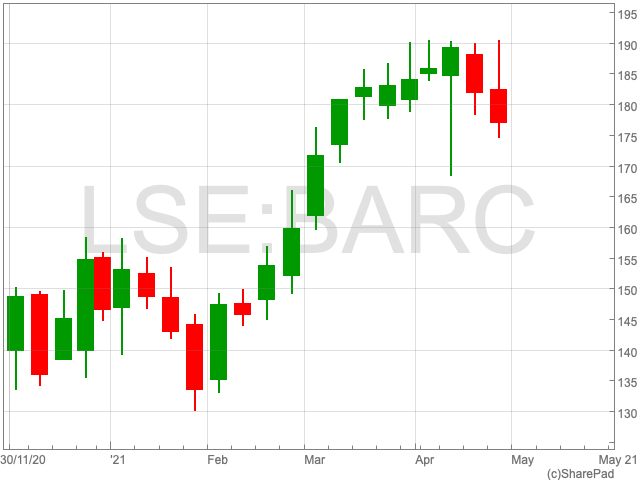
The Barclays share price (LON:BARC) dived by 6% on Friday as the FTSE 100 bank released its quarterly results. The dip follows what has been steady growth since the beginning of the year, which it began at 143.52p. Now, it is at 177.5p, around the same level it was at when the major bank’s share price crashed in February 2020. While there was good news within Barclays’ recently published results, the fall in its share price shows a level of distrust from investors.
Results

Barclays confirmed on Friday that its profit before tax reached £2.4bn during the first three months of the year, well up from £923m over the same quarter the year before. Barclays well exceeded average forecasts from analysts who predicted a pre-tax profit of £1.76bn. It was the bank’s highest quarterly profit in ten years, as well as being three times higher than they were during the same period a year before.

“Since the early days of the pandemic last year, our diversified business has demonstrated the resilience critical to ensuring Barclays’ financial integrity,” Jes Staley, chief executive of Barclays, said in a statement.

While other banks, including Natwest, received a lift by releasing cash from loss provisions, amassed during the pandemic, Barclays decided against doing the same thing. The bank added £55m to its credit provisions in the quarter, compared to expectations of a credit impairment of just over £500m.

“As we enter the next phase of this pandemic, we remain resolute in our commitment to support the economic recovery,” Staley said. “From our spend data, which captures UK economic activity across our cards and acquiring businesses, we are already seeing encouraging early signs of recovery in some sectors, including those hit hardest by the crisis.

“While evidence of recovery is encouraging, we have continued to take a cautious view of the impact of the pandemic on the business.”

The overriding message from the bank’s CEO is that the UK is on the verged of the largest economic boom since the post-World War Two era. However, it is possible that investors anticipated the optimism based on the generally positive outlooks coming from the UK’s major banks, and other factors. This could help to explain why the share price fell on today’s news.
Rolls-Royce Share Price: awaiting government announcement on travel

0

Rolls-Royce Share Price

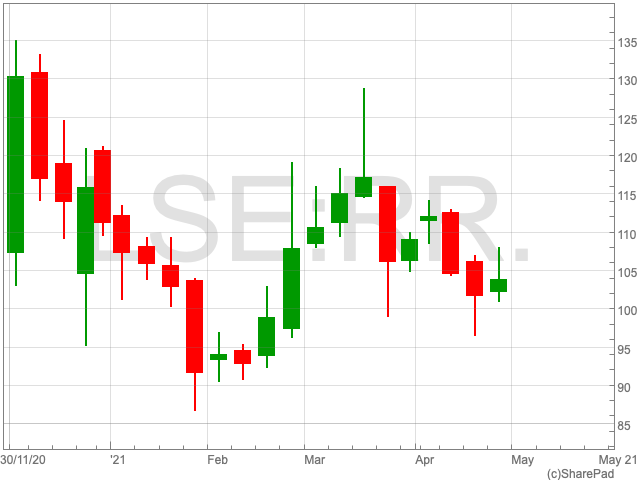
The Rolls-Royce share price (LON:RR) is at the same level at which it began 2021, as it remains unclear what the immediate outlook is for the engineering company. Following a strong push from February through to March, shares in the FTSE 100 company have fallen back to 103.72p. As one of the largest aircraft manufacturers in the world, Rolls-Royce has been significantly impacted by the ongoing pandemic. While UK Investor Magazine reported two months ago that its outlook could depend on the airline industry, many questions remain unanswered, as despite a positive roll-out of vaccines in the UK, other parts of the world have not fared so well.

Finances

The Covid-19 pandemic had a severe impact on Rolls-Royce’s performance and near-term outlook. However, the company took solid measures to protect its balance sheet over the longer-term. The company strengthened its liquidity to £9bn and protected its financial position with £7.3bn of new debt and equity, while it launched a programme to raise at least £2bn from disposals.

Rolls-Royce has also made progress on its restructuring programme, removing 7,000 positions during 2020. Looking ahead, Rolls-Royce is aiming for its free cash flow to turn positive during H2 of 2021, and at least £750m during 2022, although these targets depend on the speed of the recovery, as well as the ongoing restructuring plan.

“The impact of the COVID-19 pandemic on the Group was felt most acutely by our Civil Aerospace business. In response, we took immediate actions to address our cost base, launching the largest restructuring in our recent history, consolidating our global manufacturing footprint and delivering significant cost reduction measures. We have taken decisive actions to enhance our financial resilience and permanently improve our operational efficiency, resulting in a regrettable, but unfortunately very necessary, reduction in the size of our workforce,” said chief executive Warren East.

Rolls-Royce has taken decisive action to tighten up its balance sheet to see the company through challenging market conditions, however, it could still do with some positive economic news.

Airline Industry

The slower pace of the vaccine rollout in the EU, a spike in infections in mainland Europe and the emergence of new variants has complicated the picture for Rolls-Royce. There is a real risk that the company will not get the summer it was hoping for, according to AJ Bell investment director Russ Mould.

“The risk, and one being increasingly acknowledged by Government ministers, is this summer is even worse than last for the travel space as the UK keeps restrictions in place to avoid undermining its hard-won success with the vaccine,” Mould said.

Nonetheless, governments across the world are doing their best to give hope into the airline industry. In Britan, proposals to permit travel to certain countries from May 17 received backlash for the caveat that travellers must undergo costly PCR Covid tests. The plans follow another week of uncertainty for a sector that lost $118.5bn in 2020, the worst year in aviation history, with downgraded passenger forecasts for a number of airlines.

Barclays chief predicts biggest economic boom since the 40s

0

Barclays quarterly profit nearly triples

The UK is on the verged of the largest economic boom since the post-World War Two era, according to the chief executive of Barclays Jes Staley.

Staley’s positive outlook came as the FTSE 100 bank confirmed its profits for the first quarter of the year had more than doubled compared to the year before to £2.4bn.

“We estimate the UK economy will grow at its fastest rate since 1948. That’s pretty spectacular,” he said.

The vaccination roll-out, as well as pent-up savings, will be the biggest drivers of the recovery.

Staley said that an additional £200bn is being held in customer and company bank accounts which means that the UK, along with America, is likely ti see some of its most rapid growth in decades.

The rise in Barclays’ profits was largely down to increased optimism over how its loans would be repaid.

Around this time in 2020 Barclays put aside around £2bn as an insurance in the event that borrowers would default on their debts, however, they are now setting aside £55m in a show of increased confidence.

“It may be boom time for the UK economy according to Barclays chief executive Jes Staley but not for the company itself judging by the reaction to its latest trading update,” says Russ Mould, investment director at AJ Bell.

“The decision not to adjust its previous bad debt estimates, unlike most of its peer group, appears to have spooked the market along with a patchy investment banking performance and a cautious view on costs as Barclays looks at reducing its physical footprint.”

“Less of us seem to be splurging with our credit cards in lockdown judging by the performance of Barclaycard, perhaps because of belt tightening on one side and on the other because some people have built up a cash buffer and therefore don’t need to use credit at a time when there’s less to spend on.”

Jangada Mines: exponential growth potential in Vanadium, Titanium and Iron Ore

Jangada Mines (LON:JAN) operates in Northern Brazil and is undergoing the development of a number of projects focused on Vanadium, Titanium and Iron Ore.

Brian McMaster, Executive Chairman of Jangada Mines, details the latest progress of the company and outlines what investors can expect from the company for the rest of the year.

Having conducted initial preliminary economic assessments, Jangada is now working towards further tests that could see expansion to their resources.

There is also consideration paid to the roadmap for production and comparisons made to other companies operating in the area.

FTSE 100 not up to much as Europe stays in the green

0

With no data of its own to deal with, the FTSE 100 wasn’t up to much, rising 0.1% to 6,970, after failing to hold at 7,000 on Thursday. On the final day of the month the European markets erred on the positive, after stumbling at yesterday’s close.

“News that the German economy contracted faster than forecast – shrinking by 1.7% in Q1 against the expected 1.5% – failed to stop the DAX climbing 0.4%. Though that’s in large part due to the size of yesterday’s pullback,” said Connor Campbell, financial analyst at Spreadex.

“If estimates are accurate, the Eurozone as a whole is set to have contracted by 0.8% in Q1, quickening the pace of its problems when compared to the -0.7% seen in the fourth quarter of 2020,” he added.

“Potentially set to disrupt these fragile gains, the Dow Jones is heading for a 0.2% drop when trading starts Stateside. That’d knock the index back below 34,000 after it clawed its way above that key level last night,” Campbell says.

FTSE 100 Top Movers

Smurfitt Kappa (4.35%), AstraZeneca (4.14%) and British American Tobacco (2.4%) are the top risers on the FTSE 100 two hours into the day.

At the bottom on Friday, as the week draws to a close, is Barclays (-5.7%), Anglo American (-2.08%) and Flutter Entertainment (-1.87%).

AstraZeneca

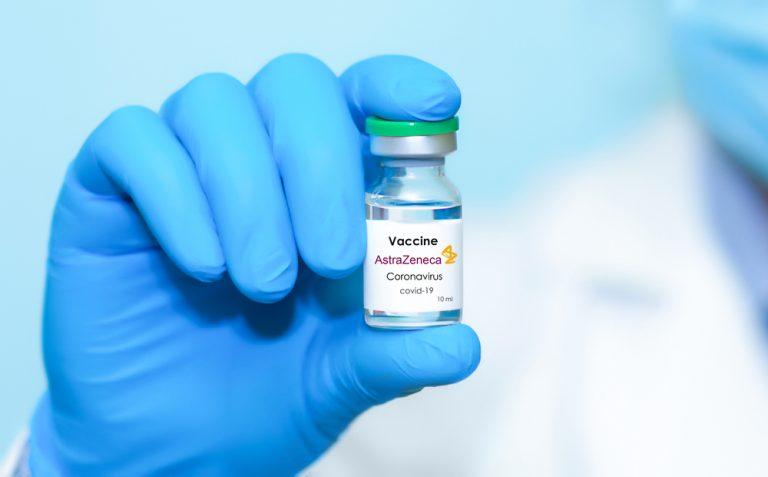
AstraZeneca earned $275m in revenue in Q1 from its Covid-19 vaccine, which it is not making a profit from, as sales of its cancer drugs and growth in emerging markets allowed the pharmaceutical company to surpass its expectations.

The FTSE 100 drugmaker confirmed it revenue grew by 15% during the first quarter of 2021, as its post-tax profit climbed from £750m to £1.56bn.

UK House Prices

UK house prices grew in April at the quickest rate in over 15 years, research by Nationwide has revealed. Compared to the month before, the average house price was up by 2.1%, which is the biggest increase since early 2004.

Year-on-year house price growth rose to 7.1% in April compared to 5.7% in March, as property values reached a record high of £238,831.

AstraZeneca makes $275m from sales of vaccines

0

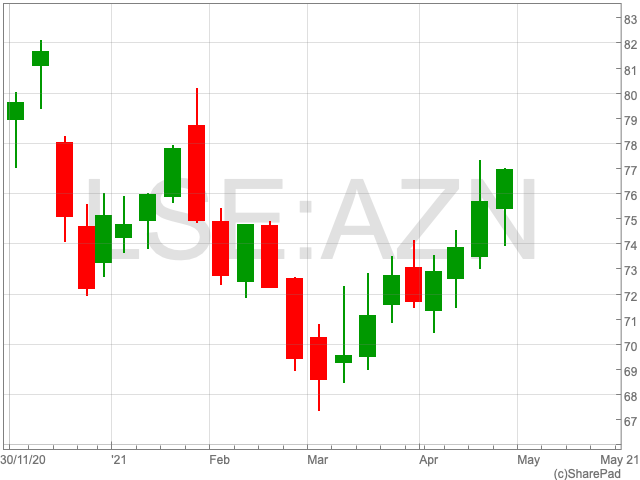
AstraZeneca share price up by over 4%

AstraZeneca (LON:AZN) earned $275m in revenue in Q1 from its Covid-19 vaccine, which it is not making a profit from, as sales of its cancer drugs and growth in emerging markets allowed the pharmaceutical company to surpass its expectations.

The FTSE 100 drugmaker confirmed it revenue grew by 15% during the first quarter of 2021, as its post-tax profit climbed from £750m to £1.56bn.

AstraZeneca confirmed $275m of sales after it delivered nearly 70m doses across the world, as the vaccine roll-out picked up momentum. This figure is way up from $2m in Q4 of last year.

Pascal Soriot, AstraZeneca’s chief executive, said the strong performance came in the face of a number of challenges faced due to the pandemic. “We delivered solid progress in the first quarter of 2021 and continued to advance our portfolio of life-changing medicines,” he said. “We expect the impact of Covid to reduce and anticipate a performance acceleration in the second half of 2021.”

The AstraZeneca share price is up by 4.29% at mid-morning trading. Year-to-date the company’s stock is up to 7,713p, from 7,422p, an increase of just under 4%.

April sees biggest monthly rise in UK house prices since 2004

0

Property values reached a record high of £238,831

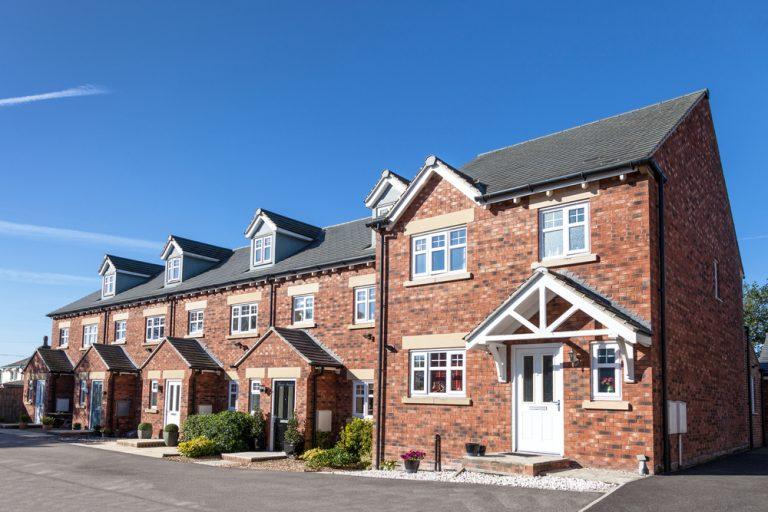
UK house prices grew in April at the quickest rate in over 15 years, research by Nationwide has revealed.

Compared to the month before, the average house price was up by 2.1%, which is the biggest increase since early 2004.

Year-on-year house price growth rose to 7.1% in April compared to 5.7% in March, as property values reached a record high of £238,831.

According to Nationwide, UK house prices have increased by £15,916 over the past year.

Nationwide chief economist Robert Gardner said: “Just as expectations of the end of the stamp duty holiday led to a slowdown in house price growth in March, so the extension of the stamp duty holiday in the Budget prompted a reacceleration in April.

“However, our research suggests that while the stamp duty holiday is impacting the timing of housing transactions, for most people it is not the key motivating factor prompting them to move in the first place.”

Gardner added: “Housing market activity is likely to remain fairly buoyant over the next six months as a result of the stamp duty extension and additional support for the labour market included in the Budget, especially given continued low borrowing costs and with many people still motivated to move as a result of changing housing preferences in the wake of the pandemic.”

Amazon profits surge as pandemic shifts consumer behaviour

0

Amazon income more than tripled to $8.1bn

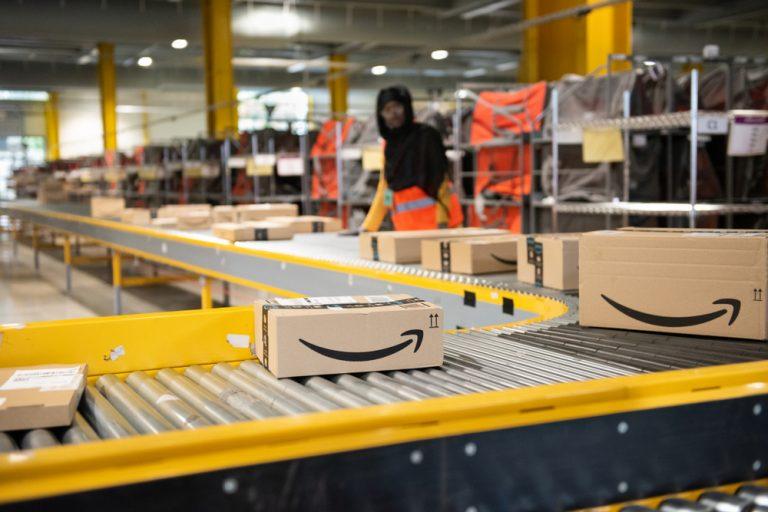
Amazon (NASDAQ:AMZN) has confirmed its sales have exceeded $100bn for the second quarter in succession as it continues to benefit from the pandemic.

With consumers across the world increasingly shopping online, streaming videos and working from home, as their behaviour has shifted during lockdowns, Amazon has reported net sales of $108.5bn for the first quarter of the year, up by 44% from the same period a year before.

Amazon’s income more than tripled to $8.1bn, as its share price rose by 3% to a record above $3,590 in after-hours trading.

“There is little to indicate a slow down in Amazon’s growth,” said Daniel Newman, analyst at Futurum Research. “Its businesses across the board, ecommerce, cloud, advertising, devices, are all seeing growth and I expect this to continue into the next quarter.”

Nearly 50% of Amazon’s operating income of $4.2bn came from its cloud division Amazon Web Services (AWS). AWS’s revenue has grown by 32% year-on-year.

Jeff Bezos, the founder of Amazon, has said that he will be stepping down and instead will take on the roll of executive chair. Andy Jassy, chief executive of AWS, will replace Bezos, while the company gave no update on when the succession will take place.

Amazon is expecting its sales to continue too rise, even as lockdowns come to an end, as the company’s guidance suggests revenue somewhere between $110bn and $116bn for the current quarter.

Amazon will spend $1.5bn on coronavirus related procedures within its logistics, and the company believes its net income will be between $4.5bn and $8bn this quarter.

Prime Video has been used by 175m Prime members over the past year, with “streaming hours” up 70% year-on-year.

J. Stern & Co.’s Christopher Rossbach said of the record haul:

“Amazon has continued its extraordinary growth, with revenues well in excess of $100bn again this quarter, which equates to over $13,000 a second. This is another significant milestone as the company continues to break records, and with over 200m Prime households now, the company is entering a new paradigm.”

Revolting shareholders: Scottish remuneration policy rebellion

Shareholders in STV Group (LON: STVG) have not been totally supportive of the media company’s remuneration policy. A shareholder vote on the policy happens every three years. One-quarter of the votes cast were against the directors’ remuneration policy, which is up from one-fifth three years earlier.
However, the vote against the directors’ remuneration report was 1.92%, down from 16.1% against the resolution at the previous AGM.
Management says that it consulted with the largest shareholders ahead of the latest AGM and the policy was revised. STV currently pays 20% of the chief executive’s sa...

Shell share price rises as company lifts quarterly dividend by 4%

0

Shell Share Price

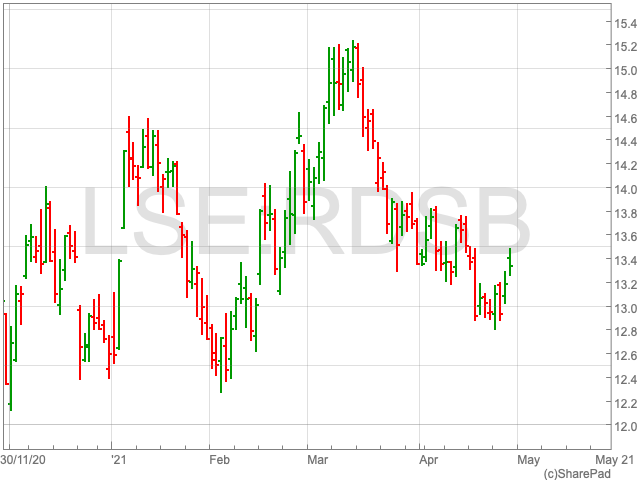
The Shell share price (LON:RDSA) is up by over 1% on Thursday as the Anglo-Dutch company announced its results for the first quarter of the year. This follows a sharp decline, from early March through to late April, when the company’s stock tumbled from 1,584p per share to 1,355p, a fall of 17%. It is a continuation of what has been a volatile year for the oil giant which has struggled to recover from a dramatic fall at the beginning of the pandemic.

Q1 Results

Shell announced on Thursday that its profits rose during Q1 as the oil giant showed signs of recovery from the pandemic-induced downturn through a resurgence in energy consumption and prices. Profits at the Anglo-Dutch FTSE 100 company increased by 13% to $3.2bn compared to the same period the year before. The oil industry more generally is in the early stages of a recovery following the damage caused by Covid-19, which made energy companies tighten their spending and reduce costs.

As a result, Shell made the decision to increase its quarterly dividend by 4% thanks to its improvement in trading. It is the second increase since the company cut its payout, for the first time since the second world war, by two-thirds at the beginning of last year due to the pandemic.

Oil

The immediate outlook for the Shell oil price is dependent on the price of oil. “Market sentiment was dented on worries that a surging number of COVID-19 cases in some countries, especially in India, will slash fuel demand,” said Kazuhiko Saito, chief analyst at commodities broker Fujitomi Co. This caused the price of oil to fall on Monday as Covid-19 cases surged India, one of the world’s biggest oil importers. However, Brent crude futures is up 2.5% to $68.72 on Thursday, while West Texas intermediate (WTI) crude futures are up by 2.25% to $65.11 a barrel.

The technical committee of the OPEC+ has forecast global oil consumption to rebound by 6m bbl/day this year, according to delegates who attended the panel. US benchmark crude futures are up more than 6% so far this month amid signs of a consumption recovery in some parts of the world. However, if the anticipated global economic recovery doesn’t arrive then it could spell trouble for Shell.