


Gold slumps to a near nine-month low following non-farm payroll figures

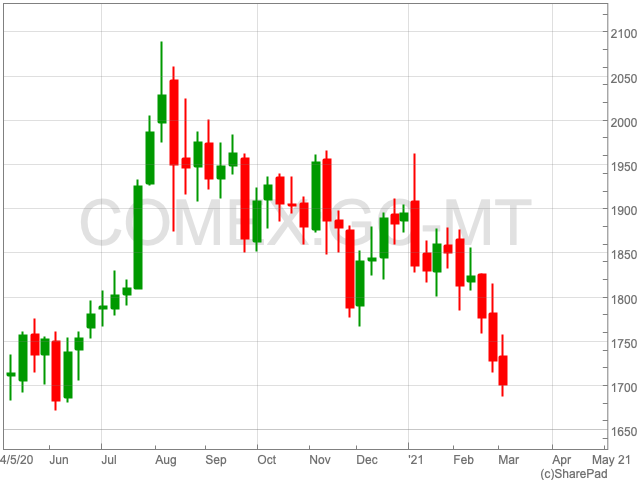
Gold trading below $1,700
Gold prices dipped below $1,700 on Friday as US non-farm payroll figures surpassed expectations.
America added 379,000 jobs in February, significantly more than the 180,000 forecasted by economists.
The market for the precious metal fell under pressure ahead of the employment statistics and lost ground in the immediate aftermath. The last time gold traded below $1,700 was in June 2020, just under nine months ago.
In addition to better than forecasted job growth in February, the unemployment rate fell to 6.2%, from 6.3%.
The precious metal’s price has also been dented recently by rises in US bond yields and increasing optimism around an economic recovery.
“We see the rising bond yields as a sign of economic optimism, which has also prompted investors to sell some of their positions,” said Carsten Menke of Julius Baer.
The precious metal is also facing pressure from cryptocurrencies such as bitcoin, otherwise known as “digital gold”.
Nasdaq jumps up in line with strong US employment numbers
Nasdaq recovers slightly from a tough week
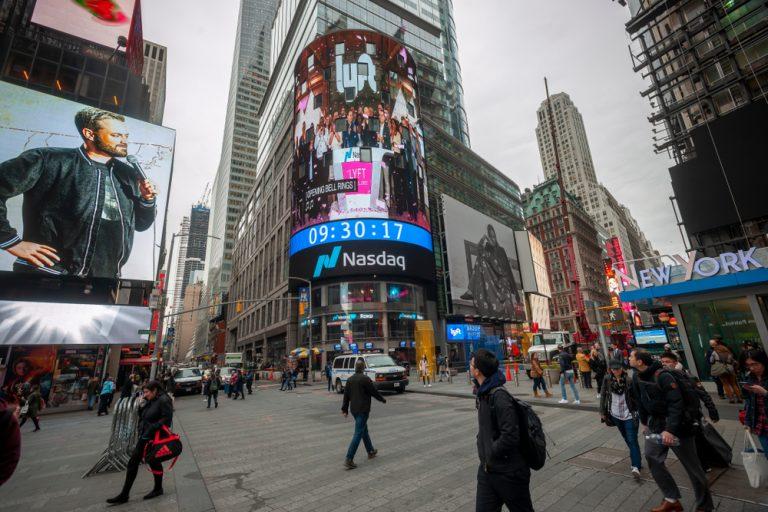
Nasdaq opened 1.04% up today at $12,856.12 following news of US non-farm payroll figures exceeding expectations. US employment figures outperformed economic forecasts for February, as 379,000 jobs were added to the economy.
Robert Alster, CIO at investment management firm Close Brothers Asset Management, praised the progress of the US economy since the current President’s inauguration.
“Nonetheless, Biden’s pledge for all US adults to have received the vaccine by the end of May, a drop off in coronavirus cases, and tentative relaxation of restrictions all bode well for a continued improvement in the employment numbers.”
“A further boost will be given once the $1.9tn Covid-19 stimulus bill reaches the Resolute desk. With the injection of the vaccine and cash, the President will be hoping he can get the US economy back on the front foot.”
It follows a week of downward movement following the sell-off of technology stocks which came about as a result of the news of rising bond yields. Stocks in Apple, Tesla and Amazon dropped by $1.6tn since the index’s closing high on 12 February 2021, according to an analyst from S&P Global Market Intelligence.
Nasdaq Top Movers
Cisco Systems (3.15%), Fiserv (2.10%) and Micron Technology (1.69%) were the top movers on the index at early morning trading.
At the bottom end of the New York exchange, Okta (-3.81%), Tesla (-2.99%) and Costco (-2.16), are the day’s biggest fallers so far, as Elon Musk’s company continues its recent slump.
Coinbase
Nearly a decade after its founding, Coinbase, a trading platform for crypto buyers, is set to go public as the company has has been valued around $100bn.
The company, which will be listed on the Nasdaq exchange, earned revenue of $1.3bn in 2020, up from $534m in 2019, while recording a profit of $322m in 2020, following a $30m loss the year before.
Ark Innovation ETF
Ark Invest’s famous Innovation ETF saw its gains for 2021 wiped out this week as rising US bond yields resulted in a sell-off of a number of Nasdaq companies. The fund’s top five holdings – Tesla, Square, Roku, Teladoc and Spotify – lost on average 17% over a one month period.
US non-farm payroll surges past expectations in February
US non-farm payroll figures show unemployment at 6.2%
US non-farm payroll figures significantly outperformed expectations for February, as 379,000 jobs were added to the US economy.
The figure surpassed the expected amount of 180,000, as well as exceeding January’s increase of 160,000, which was revised up from the originally reported 49,000 figure reported a month ago.
The December number was also revised to 306,000 from 220,000.
Unemployment is now at 6.2%, down from 6.3% in January, and well below April’s peak high of 14.7%.
A majority of the jobs (355,000) came from the leisure and hospitality sector, as dining restrictions were eased in parts of the country.
While healthcare, manufacturing and retail saw 46,000, 21,000 and 41,000 jobs added respectively.
Year-on-year, 8.5m fewer Americans are in work compared to February 2020.
Robert Alster, CIO at investment management firm Close Brothers Asset Management, praised the progress of the US economy, while drawing attention to underlying factors at play in the US labour market.
“The dramatic increase in nonfarm payroll figures is a sign of progress as Biden completes his sixth week in office. However, it comes after a relatively weak ADP reading for private payroll figures earlier in the week, painting a picture of a labour market of two halves.”
“Wage inflation remained steady – growth looks somewhat unlikely as lower-paid workers re-join the payrolls in the coming months as hospitality and retail sectors open up.”
Alster suggested the news is a continuation of a recent trend of economic optimism since Biden was inaugurated.
“Nonetheless, Biden’s pledge for all US adults to have received the vaccine by the end of May, a drop off in coronavirus cases, and tentative relaxation of restrictions all bode well for a continued improvement in the employment numbers.”
“A further boost will be given once the $1.9tn Covid-19 stimulus bill reaches the Resolute desk. With the injection of the vaccine and cash, the President will be hoping he can get the US economy back on the front foot.”
Vietnam’s COVID-19 Vaccine Plans Come Into Focus
Sponsored by Vietnam Holding. Photo Credit: Michael Tatarski
Vietnam’s COVID-19 Vaccine Plans Come Into Focus
While the Vietnamese government’s response to the pandemic has been among the most effective in the world over the last year (see below), their strategy regarding an eventual vaccination campaign is now becoming clear. The Prime Minister has now requested vaccinations to commence.
As recently as mid-January, it wasn’t clear when the country would receive any vaccine doses.
Then, a huge outbreak hit the small northern province of Hai Duong, with cases eventually recorded in over a dozen cities and provinces, including Hanoi and Ho Chi Minh City.
Leadership has responded by dramatically speeding up the vaccine delivery timeline, and also the scale of their purchases. However, for now, there is no indication of how this vaccination drive will impact ongoing inbound flight restrictions.
On the morning February 24, 117,600 doses of the Oxford/AstraZeneca (AZ) vaccine arrived on a Korean Air flight from Seoul at Tan Son Nhat Airport in Ho Chi Minh City.
These doses are part of the government’s agreement to buy 30 million doses from AstraZeneca, an agreement announced weeks ago with what was then a vague timeline.
Now, the Ministry of Health is saying that 150 million doses of COVID-19 vaccines will reach Vietnam in seven batches either by the end of this year or early 2022.
Initial timelines estimate that another 1.5 million AZ doses will arrive by the second quarter; 1.2 million through the COVID-19 Vaccines Global Access (COVAX) program and 363,000 purchased directly from AZ. Remaining frontline workers (500,000 people) will receive these doses, along with diplomats (4,080 people), customs and immigration officers (9,200 people) and just over 1 million members of the military.
8.2 million more AZ doses will be purchased and delivered within Q2, covering remaining military personnel, public security police officers (304,000 people), teachers (550,000 people), and people over 80 years old.
In Q3, 10.9 million AZ doses are expected, 3.6 million from COVAX and 7.32 million directly from AZ. These will be for anyone else over 80, essential service providers, and people with chronic diseases.
Through early 2022, 14.4 million more AZ doses will be distributed for remaining people with chronic illnesses.
By the end of this year or early next year, COVAX will supply 25.2 million doses intended for the chronically sick who haven’t already been vaccinated and people aged 65-80.
The remaining 90.5 million vaccine doses will come from to-be-determined foreign and domestic vaccine producers through the first half of 2022 for the rest of the 65-80 population and people over the age of 18 not covered by previous batches.
That last batch is the most uncertain, as local media has simply said that the government is still in talks with Pfizer and other foreign vaccine companies, as well as Russia for the Sputnik vaccine – though we do know that two Vietnamese companies expect to have functioning vaccines sometime this year.
If all of this goes to plan, that would mean 75 million out of 97 million people in Vietnam would be vaccinated by the middle of 2022.
The big question for people outside of Vietnam is how all of this will impact international flight restrictions, and on that there is still no clarity. It’s clear at this point that the Vietnamese government will be exceedingly cautious in reopening the border, and even with this good vaccine news, hopeful foreign visitors shouldn’t expect major changes anytime soon.
There is increasing interest in Vietnam particularly with increased political risk in other parts of ASEAN (Thailand and Myanmar). Vietnam has shown its mettle during the pandemic year, which was also the year in which it successfully chaired ASEAN, hosted several foreign leaders and inked several key trade agreements. The short term risk in 2021 was the spread of new Covid variants, which Vietnam so far has evidenced a strong grip on. If Vietnam’s vaccine rollout can be successfully implemented, then 2021 could well be a breakthrough year for Vietnam.
Let’s remind ourselves how Vietnam became the Pandemic Winner:
One. Fight Ambivalance
In early 2020, the UK Government was quoted as saying the Coranavirus thrives on ambivalence, which unfortunately was in abundance in the more supposedly ‘developed’ markets. The leadership in the UK was distracted at the end of January by ‘getting Brexit done’, and according to UK media, even during the weeks that followed, its Prime Minister was unable to attend key Cobra meetings where the virus was being discussed.
Vietnam’s government, on the other hand, took quick and resolute action during the largest national holiday in the year – the Lunar New Year ‘Tet’ holiday – in late January. Vietnam has rightly won many new admirers for how its policymakers acted, and the country has emerged from the pandemic with a high level of credibility.
Two. Have a common enemy
Vietnam’s leaders at the national and provincial level, and the people in the urban and rural community, had a clear common sense of purpose: defeat the coronavirus. This meant being willing to sacrifice some liberties, and to adopt measures such as mask-wearing when there were (and bizarrely, remain today) detractors in the ‘western world’ to the use of face-coverings. The use of propaganda art, in conjunction with traditional media and social media (including TikTok) focused the communities on fighting the unseen enemy and defeating it fairly resolutely.
Three. Rally around a common cause
The UK had a few rallying points during its battle with the early phases of the Coronavirus. One was the indefatigable (and now deceased) Captain Sir Tom Moore who chose to mark his 100th birthday by walking round-and-round-the-garden to raise money for the National Health Service, raising 33 million pounds more than his target. The NHS also featured in a regular collective gathering of ‘clapping’, an idea – like quarantine itself – imported from Italy.
Vietnam’s rallying point was rather more unusual. A 43-year-old Motherwell supporter who flew a plane to Vietnam for Vietnam Airlines, and brought more than passengers with him. He inadvertently caused a cluster of infections in a popular bar in Ho Chi Minh City’s District 2. He became very sick, and his lungs became like sacks of cement, putting him at death’s door, and with a real chance of being Vietnam’s only Covid-19 fatality. He spent close to 100 days in an ICU, much of it in a coma, where he received excellent healthcare. Known as ‘Patient 91’ the Vietnamese population rallied to his support, with several people even offering to be lung-donors to save the life of the British pilot. Thankfully he made a full recovery and is now safely back in Scotland. He said that he would have died anywhere other than Vietnam.
Vietnam kept its track record of zero deaths for several months, with long periods without any community-spread cases. Even now, a year on, Vietnam has recorded less than 40 deaths from the Coronavirus. It has also managed to keep its economy open for most of the year, as a result enjoying the highest growth rate in the world for 2020.
Vietnam Holding held a webinar on 26th February hosted by its investment manager Dynam Capital, outlining its vision for the next five year trends in the growth market of Vietnam. The Webinar recording is at https://vimeo.com/518007876#t=9s
Hear more from Vietnam Holding at the UK Investor conference on 23rdMarch.
EasyJet share price: all set to capitalise on a return to travel
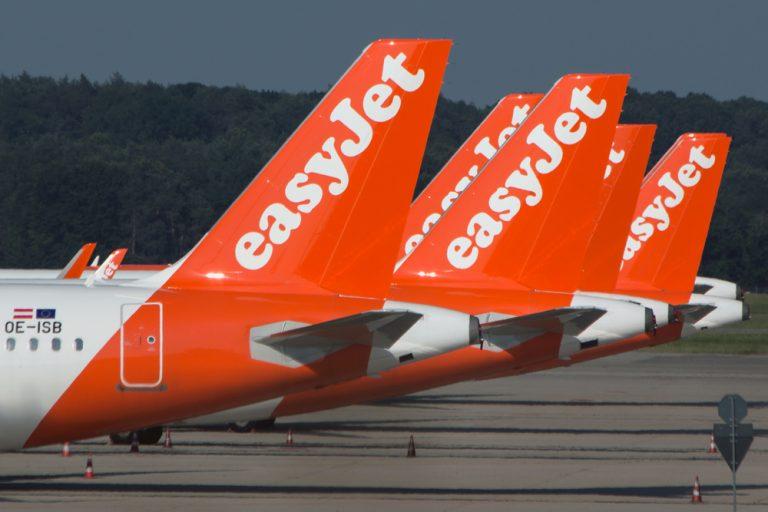
EasyJet Share Price
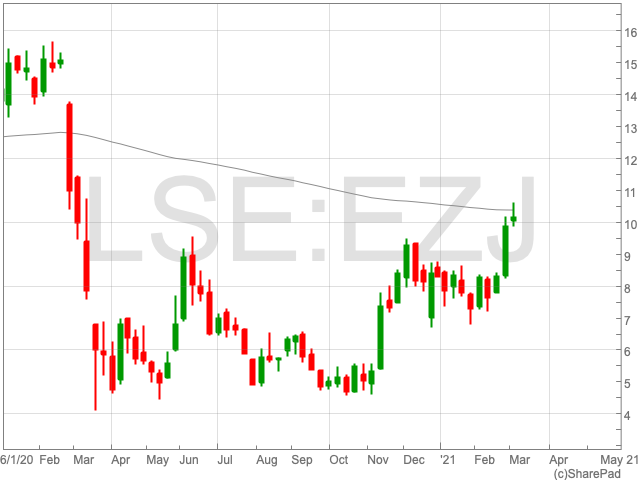
EasyJet’s share price sat at 1,508.50p in February 2019 before news of global travel restrictions caused a fall to 475p per share at the beginning of April. However, the airline has gained ground since, climbing back up to 1,014.50p per share, particularly in recent weeks, as the government outlined plans to lift restrictions. Since the beginning of 2021 EasyJet’s share price is up by 32%.
Potential for Growth
In February, the Prime Minister announced a four-stage plan for easing lockdown measures in the UK, with a return to international travel proposed for 17 May. The date, just before the beginning of the summer holiday season, unleashed a surge of pent-up demand, as EasyJet reported a dramatic rise in the number of holiday bookings.
Chief executive of easyJet, John Lundgren, commented on the figures: “We have consistently seen that there is pent-up demand for travel and this surge in bookings shows the signal from the government that it plans to reopen travel has been what UK consumers have been waiting for.”
In addition, the UK airline raised €1.2bn worth of seven-year bonds at the end of February at a yield of 1.875%.
“Monday’s announcement was incredibly helpful but, this was opportunistic on the back of recent market conditions irrespective of [the] announcement,” said Mark Lynagh, co-head of Emea debt markets at BNP Paribas, who worked on the deal. He added that this “plays into the optimism around the recovery that we’re going to see and there is a view that low-cost carriers like easyJet are well placed to benefit from that”.
Risks
EasyJet reported a £1.3bn loss towards the end of 2020, down from a £430m profit the year before. Even if the airline industry does recover, it could be a long road back for EasyJet, as many of its costs have remained constant throughout the pandemic.
Otherwise, there is the question of if and when travel can return to normal. Even once most people have received a vaccine jab, if the disease lingers, then international travel could be restricted beyond May 17.
“The challenge is to find a way to live with it without keeping huge restrictions in place,” says Azra Ghani, professor of infectious disease epidemiology at Imperial College London.
ESG trend lifts global ETF industry to $8trn

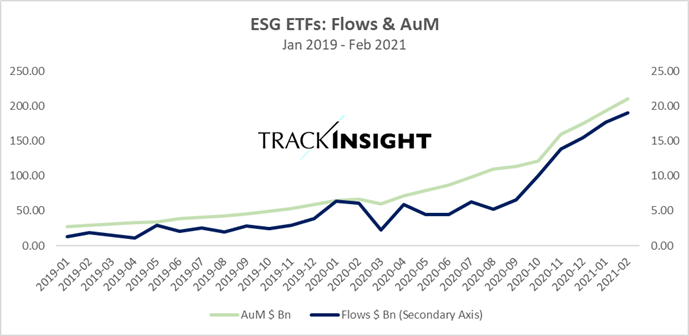
ESG ETFs see new high of $210bn assets under management
ETFs (Exchange-Traded Funds) have reached a record high of $8trn assets under management (AuM) as investors scour the market for options that meet ESG (environmental, social and governance) standards.
This is according to data collected in February by trackInsight, a global Exchange-Traded Funds analysis platform.
Funds listed in North America saw over $95bn flow in last month, nearly a 50% increase month-on-month. 3,200 ETFs are now listed on North American exchanges with $5.9bn in AuM.
February was the single large month in history for ESG funds, which saw $19bn coming in, to reach a new high of $210bn.
Bitcoin ETFs also reached record highs in February with nearly $0.25bn flowing in. Bitcoin is tracked via ETFS by $4.5bn worth of assets, a small but increasing portion of its $1trn market cap.
In contrast, Gold funds lost their lustre over February as flows went negative, losing $5 Billion for a total of $186 Billion of AuM. However, Cannabis ETFs made up seven of the top ten best-performing funds this year.
Anaelle Ubaldino, head of research and investment advisory at TrackInsight, commented on the company’s findings:
“The flexibility of the ETF wrapper means that an ever-increasing range of ideas, from actively managed strategies to ESG and thematic investments like disruptive tech and Bitcoin, are now easily available to all investors, and many are taking the opportunity to gain exposure to asset classes and strategies that were previously unavailable to them.”
“However, the proliferation of choices, not just in areas like ESG or Bitcoin, but across ETFs in general means investors are faced with a paradox of choice. So investors must do their homework and look beyond the headlines and media hype when picking an ETF as products that are similar on the surface may be very different when you look under the hood.”
FTSE 100 in the red as rising bond yields provide continued cause for concern
FTSE 100 could benefit again from rising oil prices
FTSE 100 is down 0.53%, by 35 points, during morning trading on Friday. The index is down to 6,615.82 points as a knock-on effect of a sell-off in America brought about by a rise in US bond yields.
“After Fed chair Jay Powell’s comments last night, that the Fed was focussed on its dual mandate of unemployment and inflation, and that the central bank was a long way from meeting either, would under normal circumstances, have been enough to assuage market concerns about a premature tightening of policy,” commented Michael Hewson at CMC Markets.
“By not specifically referencing or expressing concern over the recent move higher in longer term US yields, and looking to hold the markets hand, it was perhaps not surprising that the bond sell-off continued, however whether the sell-off is sustained is a different matter entirely.”
FTSE 100 Top Movers
The Asia focused banks, Standard Chartered (2.84%) and HSBC (1.75%) and supermarket giant Sainsbury (1.48%) led up the index during the morning session.
London Stock Exchange Group (-5.87%), Scottish Mortgage Investment Trust (-5.15%) and Admiral Group (-3.17%) are the biggest fallers on the FTSE 100 so far.
ConvaTec
ConvaTec, the medical technology company, confirmed a rise in full-year revenue along with a fall in earnings during 2020. For the year ending in December 2020, ConvaTec’s revenue increased by 4% to $1.89bn, while pre-tax earnings fell by 1.1% to $350m.
According to a statement by the FTSE 100 company, ConvaTec’s performance during 2020 was driven by strong growth in the Infusion Care and Continence & Critical Care businesses, offsetting limited growth in Ostomy Care and a decline in Advanced Wound Care.
Triple Point Social Housing REIT
Triple Point Social Housing REIT recorded an operating profit in 2020 of £30.2 million, up from £26.9 million the year before.
The profit came in addition to the company acquiring 58 properties (400 units) during the year at a total investment cost of £78.9 million. The trust’s total investment portfolio now stands at 445 properties.
Oil Prices
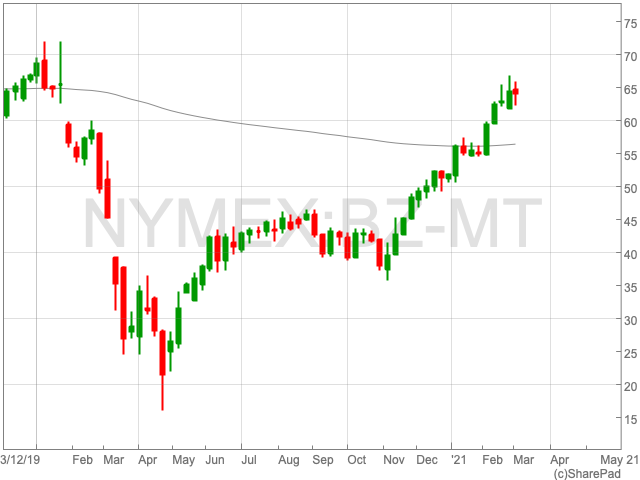
Oil prices have climbed to a 14-month high as Brent crude oil reached $67.85 per barrel today, its highest level since January 2020. West Texas Intermediate is up to $64.8 per barrel on Friday morning.
In the UK, the FTSE 100 has benefited from strong performances from oil companies in recent weeks, in addition to mining firms, relying on both sectors for gains.
Oil prices climb to 14-month high

Opec and allies to restrict oil supply during April
Oil prices have climbed to a 14-month high as Brent crude oil reached $67.85 per barrel today, its highest level since January 2020.
West Texas Intermediate is up to $64.8 per barrel on Friday morning.
The news came as Opec and its allies made the decision to restrict supply during April amid uncertainty around the economic recovery from the pandemic.
Prince Abdulaziz bin Salman, the Saudi Arabia’s oil minister and son of King Salman, warned against complacency over the commodity’s recovery.
“Let us be certain that the glimmer we see ahead is not the headlight of an oncoming express train,” he said, as a meeting of oil ministers began. “The right course of action now is to keep our powder dry, and to have contingencies in reserve to ensure against any unforeseen outcomes.”
bin Salman stated that he favoured a more cautious approach moving forward.
“When you have this unpredictability and uncertainty [I believe in] taking things in a more precautionary way.”
The news has prompted analysts to raise their price forecasts for the commodity. Goldman Sachs raised its forecast to $75 per barrel, up $5 per barrel, for Q2 of 2021, and $80 in Q3.
Having reached an all-time low in April 2020 due to worldwide lockdowns, oil has climbed back to its pre-pandemic level.
The price of oil is looked to as a barometer of activity as the world economy continues to cope with the ongoing coronavirus pandemic.
After worldwide lockdowns first came into effect in early 2020, oil prices plummeted into negative territory. Producers who did not have adequate storage capacity, were paying buyers to take the commodity off their hands.
In the UK, the FTSE 100 has benefited from strong performances from oil companies in recent weeks, in addition to mining firms, relying on both sectors for recent gains.
“Between them they provide a fifth of the index’s market capitalisation and are forecast to provide 31% of total profits and 28% of aggregate dividends in 2021,” according to Russ Mould, investment director at AJ Bell.