Over 40% of employees make mistakes leading to cybersecurity breaches

1
According to a new report by Email security company Tessian, some 43% of employees made mistakes which had resulted in cybersecurity repercussions for themselves or their company. The report, titled ‘The Psychology of Human Error’, was carried out in April on a total of 2,000 participants from the UK and US, to reveal the effects of stress, distraction and workplace disruption on people’s tendency to make errors at work.

The report also found that 20% of companies had lost customers following an instance of emails mistakenly being sent to the wrong recipient, with these details containing either irrelevant information or at worst, potentially sensitive information. Tessian said that as much as 58% of employees surveyed admitted to making this mistake at some point, with 10% saying they had lost their job as a result of making such an error.

Additionally, a quarter of respondents admitted to having clicked on a phishing email at work. These type of mechanisms are commonly used by scammers, seeking to ‘phish’ or steal data from the email recipient, often including financial and personal details. Interestingly, instances of mistakenly opening phishing emails were most common in the tech sector, with 47% of employees in the field admitting to having clicked on a phishing email.

Why are these mistakes so common?

Though the reasons these mistakes happen are likely numerous, Tessian’s report focused on psychological factors which may have contributed to lapses in staff focus. The number one reason cited for potentially cybersecurity jeopardising mistakes was employees being distracted, with 47% of employees stating that distraction was the main reason they’d fallen for a phishing scam, while 41% cited distraction as the reason for emails sent to the wrong recipient. Contrary to many of the more positive cases in favour of flexible work arrangements, some 57% of respondents said they were more distracted when working from home, which would lead us to wonder whether the impact of employee mistakes have been even more acute during lockdown.

Other factors which caused staff to click on scam emails include 43% of respondents initially perceiving phishing emails to be legitimate, with 41% saying that scam emails appeared to be sent from senior executives or well-known brands.

The final issue discussed in the report was fatigue. With the stress and hassle of reconfiguring work arrangements and lifestyles to lockdown life, some 44% of respondents stated that fatigue contributed to them sending emails to the wrong person. Speaking on the findings, Standford University Professor and expert in social dynamics, Jeff Hancock, commented:

“Understanding how stress impacts behaviour is critical to improving cybersecurity. This year, people have had to deal with incredibly stressful situations and a lot of change. And when people are stressed, they tend to make mistakes or decisions they later regret. Sadly, hackers prey on this vulnerability. Businesses, therefore, need to educate employees on the ways a hacker might take advantage of their stress during these times, as well as the security incidents that can be caused by human error.”

Other factors outside of psychological strains included biological characteristics. The report found that staff aged 18-30 were five times more likely to have made mistakes which may have compromised tehir company’s cybersecurity, than employees over the age of 51. Further, Tessian also found that male employees were twice as likely to fall for a phishing scam than their female counterparts, with 34% of male employees clicking on a data-stealing email versus 17% of female staff.

The alarming regularity of poor cybersecurity

Instances of high profile cybersecurity breaches seem to make their way into the news cycle on an uncomfortably regular basis for many consumers. Should the move to a more tech-integrated society continue at its current high pace, companies will need to convince their users that online solutions don’t come with inherent risk attached to them.

Speaking on how online security can be improved on an institutional level, Tessian CEO, Tim Sadler, commented:

“Cybersecurity training needs to reflect the fact that different demographics use technology and respond to threats in different ways and that a one-size-fits-all approach to training won’t work. It is also unrealistic to expect every employee to spot a scam or make the right cybersecurity decision 100 per cent of the time, especially during these uncertain times.”

“To prevent simple mistakes from turning into serious security incidents, businesses must prioritise cybersecurity at the human layer. This requires understanding individual employees’ behaviours and using that insight to tailor training and policies to make safe cybersecurity practices truly resonate for each person.”

Kingfisher share price jumps 10pc on strong sales

0
Kingfisher (LON: KGF) reported strong sales on Wednesday, leading to the B&Q owner to forecast a rise in half-year profits. For the quarter to 18 July, the group reported a 21.6% rise in like-for-like sales compared to the same period a year previously. Kingfisher started reopening stores across the UK and France from mid-April, whilst its click-and-collect and home delivery meant that online sales were consistently 200% higher in May and June. The company said in a statement: “Our top priority remains ensuring the health and safety of our colleagues and customers, serving our markets as a retailer of essential goods, and protecting our business for the long term.” “The operational and financial actions we have taken, together with the strong demand for home improvement we are currently seeing, give us a sound footing in the current crisis and beyond,” it added. “While we are entering the second half with a favourable trading backdrop, second half visibility remains low given uncertainty around COVID-19 and the wider economic outlook.” Whilst many businesses are announcing wide-scale redundancy plans and axing jobs, Kingfisher said last month that they plan to hire 3,000 to 4,000 employees to cope with the surge in online demand. Half-year results for the group will be shared in September. The Kingfisher share price (LON: KGF) is trading +10% at 247.70 (0855GMT).

Fintech usage jumped over 50% during lockdown

3
London-based fintech company Yobota commissioned an independent body from the Market Research Society to survey 2,000 UK consumers on their usage of financial technology services during the lockdown period. The research illustrated, first and foremost, that 64% of those surveyed had relied upon fintech to manage their finances between March and June, which was up from 42% pre-lockdown – representing an increase of over 50%. One in three consumers also said that the lockdown had exposed them to the range of technological solutions on offer for financial management tasks, with 42% planning to use fintech products ‘much more’ than they previously had, even as bank branches reopen.

How are we using fintech?

Despite the increasing range and sophistication of online financial tools, most UK adults still prefer to use fintech for menial online banking tasks, with 88% using their apps to check their accounts and 80% transferring money. This compared to 35% who had used virtual offerings to withdraw funds out of an investment and 27% who had used online tools to shop around for new financial products. Also worth noting, is the 21% who secured new financial products – such as credit and debit cards – without ever speaking to a human.

A fintech-enabled future?

With the UK, and specifically London, being home to many of the world’s new fintech entrants, the rising use of these products by British consumers seems like a natural occurrence. Some 15% of people said they had been frustrated by their bank’s poor technology offerings, while this figure rises to 28% between the 18-34 age bracket. Underlining the importance of these tools going forwards, 47% of respondents said that tech offerings were now a ‘key consideration’ when choosing a financial service provider. Not only will fintech become more prevalent as the quality and scale of services improves, but also as trust increases. Many consumers are still sceptical about carrying out sensitive transactions online, so the fast rise of fintech – still in its relative infancy – should tell us all we need to know about its potential to become the predominant form of banking in the future. Aside from benefiting over time from a younger generation that are comfortable living more tech-integrated lives, companies know that tightening up security while increasing convenience, will be the key to making fintech a more integral part of modern life.

Polymateria receives £15m boost for roll-out of its Biotransformation technology

3
Polymateria, a business specialising in biodegradation and composting, announced on Tuesday that it had received £15 million in funding from impact investing platform Planet First Partners, to fund the roll-out of its plastic Biotransformation technology. The Biotransformation technology is designed to trigger a chemical conversion which attacks the crystalline and amorphous region of the plastic’s polymer structure. This then turns plastic waste into a wax-like substance, which the company sai dis no longer harmful to the environment. From this point, the wax is mineralised by naturally occurring bacteria and fungi, with the resulting films and rigids able to fully biodegrade within two years, leaving behind no microplastics. In addition to these claims being supported by third party scientists, external researchers also confirmed that Polymateria’s Biotransformation tech can biodegrade the most common form of plastic waste within a year. Alongside today’s investment from Plant First Partners, PLP head Frédéric de Mévius will also join the Board of Polymateria. Another notable addition to the Board is former M&S CEO Marc Bolland, who won ‘World Sustainable Retailer’ of the year three times while acting as CEO of the supermarket giant. Speaking on the announcement, PLP’s Frédéric de Mévius stated: “We evaluated many technologies in this space and recognised Polymateria’s as completely unique technology, underpinned by third party testing and data and, by design, with great potential to scale up quickly without significant capital cost to industry.” “Biodegradable solutions have faltered in the past, largely due to the creation of microplastic, lack of compatibility with recycling systems and confusion from consumers around the recycling of packaging Niall Dunne, CEO at Polymateria, added that the problems traditionally faced by biodegradable solutions include the creation of microplastics, lack of compatibility with recycling systems and confusion from consumers around the recycling of packaging. He believes the Polymateria technology technology resolves all three of these issues. He added on today’s investment: “Our team is already benefitting from this investment and wealth of experience, and we’re excited to move forward at pace to deliver on our plans for exponential growth to tackle the fugitive plastic crisis.”  

Will UK borrowing highs lead to new austerity measures?

UK government borrowing between April and June has jumped to £127.9bn, the highest amount since records began in 1993. In order to combat the effects of the Coronavirus pandemic, borrowing in the first quarter of the 2020-21 financial year was more than double than the entire previous year. Last week, finance minister Rishi Sunak set out further spending plans of £30bn, to encourage employers to continue hiring workers after the furlough scheme is set to end in October. “The best approach to ensure our public finances are sustainable in the medium-term is to minimise the economic scarring caused by the pandemic. I am also clear that, over the medium-term, we must, and we will, put our public finances back on a sustainable footing,” he said. Due to the high levels of government borrowing, there is a possibility that Sunak could use the Autumn budget to launch new austerity measures of raise taxes to combat the unsustainable trajactory of UK public finances. Resistant to comment on future tax changes, Sunak did say last week: “Fundamentally we don’t tax our way into prosperity. We want people to share more of their own money. But we also have a lot of demands on public services, and they need to be funded.” The Centre for Macroeconomics (CfM) has carried out research with leading economists and found that there was a little concern of future deficit. Gerard Lyons, a senior fellow at the thinktank Policy Exchange, said new rounds of austerity would be a mistake. He said: “The idea should be to reduce the deficit over time through a pro-growth strategy. A rising budget deficit acts as a shock absorber during this crisis and we should be grateful for it.”

NextGen Nano: Next Generation of Nanotechnology

Sponsored by NextGen Nano NextGen Nano is a high-tech company with a focus on the empowerment of the individual. By decentralising power generation from governments and traditional grids, we are striving to have a deliberate positive environmental impact, whilst reducing reliance on pollutants and finite materials. NextGen Nano has developed benchmark IP that may hold the key to advancements in the decentralising of energy, in line with recent Government CO2 emission and climate policy goals. Download the investor presentation here Our breakthrough technology replaces existing solutions (fabricated with pollutant, finite materials) with earth-friendly biopolymers. This breakthrough enables NextGen Nano to develop solar cells that produce energy with unrivalled efficiency at a far lower cost than existing hardware. This technology allows robust, transparent cells to be applied to flexible surfaces, thus making it more usable and cost-effective than ever before, as well as practical for multiple potential real-world applications. The company is headed by DR Franky So. Dr Franky So holds 80 issued patents and has published more than 160 peer-reviewed articles. He is the editor-in-chief of the journal Materials Science and Engineering Reports and serves as an associate editor for IEEE Journal of Photovoltaics, IEEE Journal of Display Technology, SPIE Journal of Photonic Technology and Organic Electronics. Franky is the former head of the OLED research group at Motorola, where he was named a Distinguished Innovator and Master Innovator. He is a Lecturer of the IEEE Photonics Society, a Charter Fellow of the National Academy of Inventors, and a Fellow of IEEE, OSA and SPIE. In 2015, he joined the Department of Materials Science and Engineering at the North Carolina State University, where he is currently the Walter and Ida Freeman Distinguished Professor. Download the investor presentation here Article written and sponsored by NextGen Nano

Over a quarter of City’s finance teams not returning to the office this month

1
Despite the prime minister’s proposal of a “significant return to normality” by Christmas, it appears many businesses aren’t planning a rapid return to the old normal. Many are either streamlining their divisions, or in the case of finance teams, few provisions have been made for a return to the office in the near future. Boris Johnson stated on Friday that the onus would be on employers to bring their staff back to work safely from August 1, but despite this, it appears most City firms aren’t raring to get back to the old way of doing things. Of it’s 6,000 London staff, Goldman Sachs has only returned 800 to the office, while fewer than 2,000 of JP Morgan’s 12,000 workforce are back to normal.

According to research performed by accounting and consultancy firm, Theta Financial Reporting, over 26% of Brits surveyed say their company’s finance teams will not be returning to the office with other staff this month, and will now work at home for the majority of the time. It added that 24% of those surveyed said that their employer hadn’t explored any flexible working options to help staff return to work.

It continued, stating that 70% of City-based staff now feel uncomfortable commuting to work via public transport, with these people also saying that journeys to and from the office will become one of the most stressful parts of the day. Also, according to the company’s research, some 29% of business leaders said they had permanently streamlined their team in response to the COVID pandemic, with many finding certain roles to be unnecessary luxuries. The company are in favour of flexible working arrangements, and said that its research illustrated a lack of desire to return to pre-pandemic working conditions. Speaking on the report, Theta Financial Reporting Founder and Managing Director, Chris Biggs, commented:

“This research demonstrates the clear desire for people both in the Capital and finance teams not to return to their pre-COVID working environments, regardless of the calls from the Prime Minister to return to normality before Christmas.”

“Many businesses have adapted to working away from the office and with so many people caring for vulnerable relatives, friends and children, it seems people do not want to return in July or August, despite the easing of lockdown restrictions. This will have a significant impact on how our workplaces will look beyond lockdown.”

“From the commute to boosted productivity when working from home, there are numerous benefits to flexible working that this period has uncovered for millions of employers and employees alike. Business leaders would do well to realise this and adapt now to pivot their business, remove unnecessary overheads and plan for a post-COVID future.”

The future of potential work-from-home or home-office hybrid arrangements has already been an issue widely discussed during lockdown, and it will be interesting to see whether some of the suggestions made will come into force or simply fade away as a passing fad. For now, though, it is important that whatever working arrangements are in place encourage both the greatest extent of staff safety, and productivity.

Instem shares rally on successful fundraise and revenue spike

Provider of IT services to the global life sciences market, Instem (AIM:INS) saw its shares rally on Monday as it announced a successful half-year of trading. The company stated that it, “[…] continued to perform well across all areas of the business despite the wider backdrop and macro impact of COVID-19.” It added that trading was in line with its board’s expectations, with revenues bouncing by around 20%, and like-for-like revenues – excluding acquisitions – rising 12% year-on-year for the first half. Instem said that its cash generation remained strong, with its cash position at period-end standing at £9.1 million, up from £6.0 million on-year.

It continued, noting that it raised £15.75 million in its ‘oversubscribed’ fundraise, which was approved by shareholders on the July 16 and completed post-period-end. With the proceeds of the fundraiser, the company said it had identified ‘substantial’ targets, and would focus on adding bolt-on acquisitions.

Instem stated that it had suffered a setback with its inability to undertake client site based professional services and secure new software licences in the academic segment. However, the period also yielded positive news, with recent acquisition Leadscope trading stronger than anticipated.

Instem response

Commenting on the results, CEO Phil Reason, stated: “Trading during the Period highlighted the resilience of our operations and the dedication of the entire Instem team as the Company continued to grow despite the COVID-19 backdrop. We have been delighted to directly contribute to our clients’ COVID-19 vaccine and therapy-related R&D activities and remain committed to prioritising these efforts over the second half. Following completion of the fundraise, we also aim to drive revenues and margins as we look to further consolidate the market.”

Investor insights

Following the update, Instem shares rallied by 1.32% or 6.00p, to 460.00p per share 20/07/20 12:34 BST. This is far ahead of its year-to-date nadir of 375.00p on March 25, but below its 530.00p high on June 3. The company’s p/e ratio currently stand at 23.52.

Sour start for FTSE 100 amid brewing UK-China tensions

0
The FTSE 100 index (INDEXFTSE:UKX) opened on a sour note on Monday morning, sinking to a low of 6225.11 points at BST 08:25 on the back of slow progress at the EU rescue deal summit and ongoing tensions between the UK and China over Hong Kong and allegations of abuse against Uighur Muslims.

EU nations struggle to reach a rescue deal

European markets have so far been toiling with the news of a potential €750 billion bail-out from the European Union to help offset the coronavirus-induced economic depression. City A.M. reported earlier today that the so-called ‘frugal four’ – the Netherlands, Austria, Denmark and Sweden – had been withholding confirmation on the deal, citing concerns that the proposed grants were too generous to the debt-racked Southern countries. An agreement was reportedly reached in the early hours of Monday morning following three days of tense talks, on the condition that €390 billion of the emergency fund be distributed as grants – a notable decrease from the EU’s initial proposal of €500 billion. Still, Dutch Prime Minister Mark Rutte dampened hopes of a sealed deal just yet, stating: “We are not there yet, things can still fall apart. But it looks a bit more hopeful than at the times were I thought last night that it was over”. Talks are set to continue on Monday afternoon, with Austrian Chancellor Sebastian Kurz offering a slightly more optimistic comment: “Tough negotiations have just come to an end and we can be very satisfied with today’s result. We will continue in the afternoon”. Even with a hefty EU bail-out set to give European economies a much-needed boost, the FTSE appears to have latched onto the initial reluctance of the ‘frugal four’, although it is not the only concern for London’s blue chips at the start of the week.

Tensions brew between the UK and China

The ongoing spat between the UK and China over Hong Kong has continued to escalate over the past few days, with the BBC reporting that Foreign Secretary Dominic Raab is expected to suspend the UK’s extradition treaty with Hong Kong at an announcement in Parliament later today, severing a decades-long arrangement with Beijing. Footage released to the public over the weekend – allegedly showing evidence of the reported mass abuse and incarceration of Uighur Muslims – was strenuously denied by China’s ambassador to the UK, Liu Xiaoming, in an interview with the BBC yesterday. The images, which appear to show Uighurs being forcibly blindfolded and led onto trains, have since been verified by Australian intelligence. While Xiaoming dismissed talks of concentration camps as simply “fake”, and Foreign Ministry spokesman Wang Wenbin challenged allegations of forced sterilisation of Uighur women as “nothing but lies”, tensions between the UK and China look set to simmer for some time yet, and have kept the FTSE decidedly in the red throughout Monday morning as the index struggles to buoy itself. Chinese markets nonetheless appear to be unfazed by the allegations, with the SSE Composite Index (SHA:000001) up by 3.11% to 3,314.15 points at GMT+8 15:00.

Some good news from big pharma

Despite all the concerns over the EU and China, reports that UK-based drug developers Synairgen (SYN:LON) have discovered a potentially life-saving treatment for coronavirus patients has injected a good dose of optimism into market sentiment, helping to lift the FTSE up to 6,254.73 by midday – still down by 35.57 points though. The company’s shares have soared on the back of the news, up by 497.26% to 218.00p at BST 12:21.

Synairgen share price jumps over 380% on positive COVID-19 treatment results

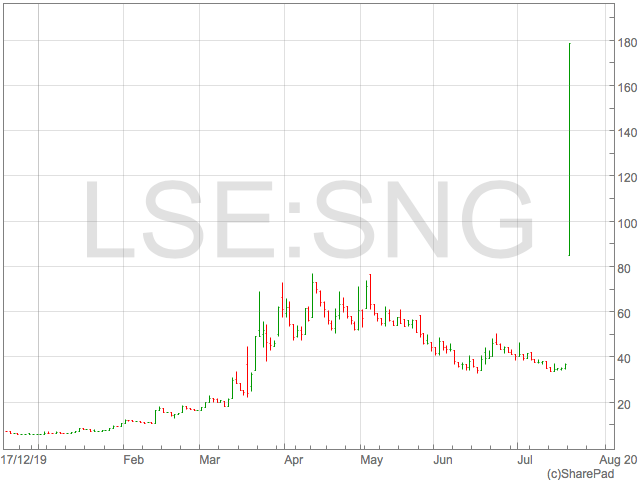
Synairgen shares (LON:SNG) rocketed over 380% on Monday morning after the AIM-listed company released positive results from a trail of a COVID-19 treatment. The trial involved Synairgen’s SNG001 which was directly delivered to the lungs via nebulisation to help promote the bodies own immune response to the COVID-19 virus. Synairgen found that those given SNG001 during the trail were 79% more likely to recover than those that were given a placebo. In particularly encouraging findings, of those given a placebo drug, three people sadly died, but of the group given Synairgen’s SNG001, there were no deaths recorded.   “We are all delighted with the trial results announced today, which showed that SNG001 greatly reduced the number of hospitalised COVID-19 patients who progressed from ‘requiring oxygen’ to ‘requiring ventilation’,” said Richard Marsden, CEO of Synairgen. The Synairgen CEO also pointed to positive results relating to the recovery of patients to a level of fitness similar to before they caught COVID-19. “It also showed that patients who received SNG001 were at least twice as likely to recover to the point where their everyday activities were not compromised through having been infected by SARS-CoV-2.” “In addition, SNG001 has significantly reduced breathlessness, one of the main symptoms of severe COVID-19. This assessment of SNG001 in COVID-19 patients could signal a major breakthrough in the treatment of hospitalised COVID-19 patients. Our efforts are now focused on working with the regulators and other key groups to progress this potential COVID-19 treatment as rapidly as possible.”

Synairgen share price

The Synairgen share price rose a bumper 380% to 177.5p in mid morning trade on Monday, meaning the shares were up over 2,900% in 2020 alone. Synairgen shares traded as low as 5.8p in December 2019. Whilst current Synairgen investors will be cheering today’s jump, the move will be particularly painful for prior investors in Neil Woodford’s equity fund. Woodford had held the stock in the Woodford Equity Income Fund, but liquidators sold the Synairgen holding at a significant discount to the market price last month.