
Cairn Energy swing to profit across 2019

Cairn Energy PLC (LON:CNE) have swung to a profit in their recently ended financial year – which rounds of an excellent year for the firm.
The oil exploration firm noted that its’ strong production performance drove the update published today.
Cairn said that their pretax profit totaled $119.5 million across 2019 – this sees a massive improvement on the loss of $1.21 billion posted in 2018.
Looking at revenue, this also rose from $410.3 million to $533.4 million – which should certainly spark investor confidence.
Across 2018 – the FTSE 250 listed firm noted that it expects net production to be between 19,000 and 23,000 barrels of oil per day in 2020.
Simon Thomson, Chief Executive Officer, Cairn Energy PLC said:
“Cairn’s strong operational performance in 2019 was delivered through production and cash flow generation at the top end of guidance and the Group ended the year with an increased net cash position and undrawn debt facilities.
A significant milestone was achieved in Senegal with a Final Investment Decision taken for the Sangomar development. Reserve additions were made in both Senegal and the North Sea and the Company encountered exploration success alongside Eni in Mexico.
The sale of Cairn’s Norwegian business, combined with exits from exploration positions in Ireland and Nicaragua, demonstrate continued focus on capital allocation as the company seeks to generate further value for shareholders on a sustainable basis.”
DFS shares dip as interim results affected by ‘challenging environment’
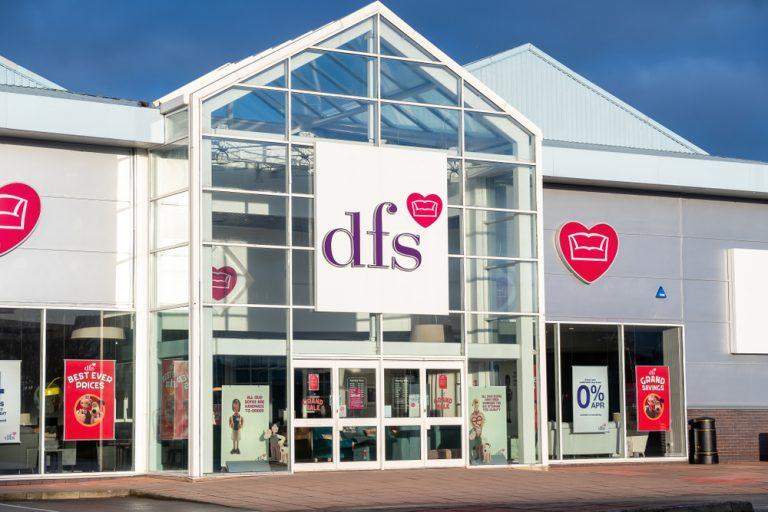
DFS Furniture PLC (LON:DFS) have seen their shares dip following the announcement of their interim results.
The homeware provider said that its’ profit within the first half had dropped, however they had seen an ‘encouraging’ start to the second half.
Shares in DFS Furniture trade at 202p (-3.11%). 10/3/20 10:07BST.
Across the half year period, which ended on December 29 – DFS said that pretax profit totaled £15.9 million.
Notably, revenue also dipped 5.7% to £488 million from £517.6 million.
DFS were quick to say that challenging market conditions and wider macroeconomic challenges affected results, as consumer confidence was still fragile.
’Trading performance in the first half of our financial year reflected not only the strength of the comparative period but also the challenges of a market environment that saw political uncertainty and low consumer confidence levels feeding through into lower footfall.
We mitigated some of the footfall decline by converting a higher percentage of customers, particularly in DFS and Sofology, relative to the prior year and by growing our Group online revenues. However, these trading conditions have ultimately fed through into our results for the first half.’
Online Growth was strong for DFS, as sales rose 4.5% from £112 million to £117 million.
On a slightly better note for shareholders, the firm left its interim dividend flat at 3.7p per share.
Tim Stacey, Group Chief Executive Officer said:
“We continue to make progress on our strategic agenda focused on driving the DFS core business, further developing our Group platforms and setting Sofology up for future growth. Despite the challenging retail environment, and excluding some isolated systems disruption in Sofa Workshop, our performance over the first half has been as expected, given the exceptional prior year comparative driven by latent demand. In particular we have seen a good performance by the DFS brand in driving conversion and margins and continued online sales growth.
Trading in the second half for the Group has also started satisfactorily with performance in the DFS brand particularly encouraging, with order intake growth year-on-year and good gross margins”.
DFS also added that the firm will not speculate on its’ full year performance due to the recent coronavirus outbreak.
The firm noted that their supply chain should remain steady across the rest of the financial year, and recent changes in trading have only been noted recently.
“However, given the uncertainty as to how the current COVID-19 situation will develop it is not possible to give guidance with any certainty for the full-year out-turn. At present we believe our supply chain position should normalise before the financial year end, and it is only in very recent days that we have observed any change in consumer footfall to our showrooms.
While any disruption to order intake over the key trading periods of Easter and the May Bank Holidays is likely to impact our financial year 2020 results, it is reasonable to believe this may ultimately be transitory in nature; following periods of subdued demand we typically see much of that latent demand returning.
Notwithstanding the uncertain short-term outlook, we remain confident in the Group’s financial strength and relative track record of performance in all environments. Furthermore, we believe our leading market position will allow us to drive long term attractive value creation for our shareholders.” – Stacey concluded.
DFS see mixed start to 2020
In January, DFS updated the market by giving shareholders a pre-warning on their interim results. The firm said that interim sales fell, however they reiterated the fact that they expect full year results to be in line with expectations. The company said forecast profit before tax and brand amortisation for the financial year ending June 28 remains in line with market expectations at £51.2 million, up from £50.2 million in financial 2019.Global equities destroyed by oil price crash and coronavirus fears
Global equities were obliterated on Monday as oil prices sank and fears of a coronavirus induced recession led to one of the worst days for equities in history.
The FTSE 100 opened down over 7% and the selling continued sending London’s leading index to one the worst day since the financial crisis.
Front month WTI Oil was down 30% in the Asia session overnight after Russian President Putin took aim at the US shale gas industry and Saudi Arabia.
Putin raised fears of an oil price war as he rejected OPEC proposals to cut oil production.
While this takes on the Saudis in a scrap for market shares, the US oil industry will likely be the ones that suffer.
Many shale gas operations simply cannot produce oil profitably at such low levels.
This, however, was not of great concern to Donald Trump who pointed to the lower petrol prices consumers would enjoy.
In addition to the fall out of Putin’s moves, the rise of coronavirus increased chances of a coronavirus Despite sharp declines being followed by some interest in buying, some analysts were sceptical of the bounce being sustained.Good for the consumer, gasoline prices coming down!
— Donald J. Trump (@realDonaldTrump) March 9, 2020
There is an awful lot of bargains out there now. But suspect most of them will become even better bargains in coming weeks.
— Chris Beauchamp (@ChrisB_IG) March 9, 2020





FTSE hit as commodities stocks dip on Russia-OPEC loggerheads

Today Brent Crude was down 7% to $46.25 per barrel, a $25 price cut from the first week of 2020, and representing its lowest price since mid-2017. This came on the back of fresh talks between OPEC and Russia, on potential production cuts, with Russia apparently refusing to agree to a deal. The effect this has had in real terms, has been another hit to already-flustered commodities stocks, with knock-on effects to oil-laden indexes such as the FTSE.
The FTSE fell to post-Brexit referendum levels, closely followed by its European peers falling around 4%, while the Dow Jones fell by around 2% – after receiving a better-than-expected nonfarm jobs report.
Speaking on OPEC, Russia and commodities, Spreadex Financial Analyst Connor Campbell stated:
“There was no solace to be found this Friday, the session getting increasingly ugly as a deal between OPEC and Russia failed to materialise.”
“With the Russians reportedly refusing to agree to the latest round of production cuts, Brent Crude lost its head, [with oil down] 7% to $46.42 per barrel. That’s its worst price since mid-2017, and close to $25 dollars a barrel off the levels struck in the first week of the year.”
“Understandably the commodity-heavy FTSE was hit hard. As BP (LON:BP) and Shell (LON:RDSB) lost 4.4% apiece, the FTSE dropped 260 points, sinking to 6450 – a price last seen in the weeks after Britain voted to leave the EU. Further harming the UK index was a nasty 9% decline from Anglo American – the worst of an already bad set of mining stocks – and a sharp 0.7% rise from cable.”
“Like the pound, the euro took advantage of the dollar’s weakness, climbing 1.2% to cross €1.133. This as a collapse in US government bond yields left the dollar facing its worst week is around 4 years.”
“The euro’s gains also did a number on the Eurozone indices. The DAX lost 420 points as it fell to 11550, while the CAC shed 4%, taking it to 5150.”
“Though not quite as dramatic as its European peers – it was aided by a better than forecast nonfarm jobs report – the Dow Jones nevertheless lost 2%, slipping back to 25650. That is, however, still a bit higher than the sub-25000 lows struck earlier in the week.”
Brexit related holiday home buying an uncertainty only in 2021

British people are known for buying property in other European countries like Spain and France for a plethora of reasons. Some want to be as close as possible to a selection of the world’s finest wines in Bordeaux or Alsace. Others are happy to trade the often-dreadful British weather for the rocky backdrop and nightlife that Ibiza is famous for.
The process of foreigners buying property across Europe was made simple thanks to arrangements under the European Union. But now that Brexit is signed into law and became official in January 2020, many people are unsure if the foreign real estate environment will be as friendly to invest in.
Travel Changes In 2021
British holiday-goers will see zero near-term change to how they travel across Europe due to a pre-agreed transition period prior to Brexit becoming official. However, this will expire at the end of 2020 at which point there will likely be changes to how British people travel.
As part of some of the pre-Brexit negotiations, all parties agreed British people won’t need to acquire a visa to enter Europe, and vice-versa. The most likely outcome will consist of British people requiring a European Travel Information and Authorisation Scheme (ETIAS). The good news: this will likely cost a mere seven euros for a pre-travel authorization period of three years and this documentation can be applied for online.
Now that it is abundantly clear British people will be able to freely travel across Europe, let’s explore if a holiday home represents a suitable investment.
How To Exchange Pounds To Buy A Home
British residents who earn their living in pounds will need to transfer their money to euros if they are buying a holiday home inside the Eurozone. Most foreign sellers would be happy to accept pounds for a real estate transaction but at a hefty premium.
Online platforms like XE.com specialises in property purchases and can handle the first step of buying a home: exchanging British pounds for euros. These types of platforms are also known for offering competitive exchange rates, especially on six- or seven-digit transactions. Consumers who exchange pounds for euros through online money transfer services could often do so below the interbank rate. The ability to save even a fraction of a pound can add up to a lot of money in a multi-million-pound transaction.
Online money exchange platforms surged in popularity in the early 2010s as consumers grew tired of the old and outdated traditional banking system known for adding extra fees. XE.com alone handles more than $75 billion in transactions throughout the world.
The process of transferring 1 million pounds to euros is as simple and straightforward as transferring 100 pounds. A client can set up an online account with one or several money transfer services and have it linked to a bank account of their choice. The client also needs to establish an end destination for the euros. If they have a bank account in their own name in France or elsewhere, the funds can end up there. Alternatively, the client can instruct the money transfer service to send euros to a notary or directly to the seller of a home.
The entire process from start to finish can be completed in around four business days. But the ultimate length could be delayed a few days if an intermediary bank is involved in the process behind the scenes.
The opposite side of the transaction remains the same. Suppose a holiday homeowner decides to rent their property when it is not in use and collects revenue in euros. Online money transfer services can just as easily accept euros to be converted to pounds so it can be deposited directly to a British bank, also at a rate that is likely more competitive than traditional banks.
Importance Of Money Transfer Services
As such, the money transfer companies thrive off thousands of real estate transactions occurring each year. From April 2017 to April 2018, British people bought 8,500 units in Spain alone. One out of five prime real estate purchases in France is conducted by British people. Nearly every single one of these transactions requires the use of money transfer services with the rare exception occurring when a British person already derives their income in euros.
In the event that foreign real estate deals involving British people slow down in the post-Brexit world, the financial impact on the money transfer industry could be large. Since money transfer services earn themselves a commission on each exchange, the industry could stand to lose millions of pounds. The opposite holds true that if vacation buying activity increases, money transfer services would see more business and can potentially pass along incremental savings to customers.
Regulatory Changes Unlikely
Spain and most European countries have minimal restrictions on foreign ownership as it represents a form of outside investment in the country. But what happens in 2021 and beyond remains a giant question mark.
If the British government and its European counterparts sign a tax treaty it will likely signal the current status quo will remain unchanged. The U.K. and Spain already have tax treaties that cover income tax, but there is no tax treaty-related to inheritance tax,according to Keystone Law.However, the U.K. government will factor into account any inheritance taxes paid to Spain when it comes time to filing with HMRC, the U.K. department responsible for the collection of taxes.
If there is no signed tax treaty on the books, British citizens may be subject to identical taxes other non-EU nationals pay, including income tax. This would need to be factored into any and every investment decision made ahead of any sort of confirmation a treaty will be enacted.
How To Make A Profit
Generally speaking, a British investor who bought a home in Europe can realize a profit in one of two ways. First, and perhaps most obvious, the value of real estate appreciates over time.
France, in particular, is known for soaring real estate prices as demand for homes far outpaces the available supply. Data fromParis’ association of notariesshows the average selling price in the most sought after region, the Sixth Arrondissement, rose from 11,300 euros a square meter in 2015 to 14,000 euros by January 2019. Similar data from what is considered to be the most affordable region, the 19th Arrondissement, the average sale price jumped from 6,500 euros a square meter to 8,350 euros a square meter over the same time period.
Investors can also walk away from a real estate transaction with a profit if the British pound appreciated in value, or the euro depreciates. This is based on simple math: suppose a British investor paid 1 million pounds (1.203 million euro) for a house in France. If the same house is sold for the exact same 1.203 million euro but the British pound appreciates by 10%, well, their 1.203 million euros will be worth 1.1 million pounds.
The Bottom Line
Investing in foreign real estate or buying foreign property has an intangible value attached to it. Families will make long-lasting memories in some of the most beautiful regions of the world. And the best part is they can claim to do so in their own home — not a hotel or someone else’s property that was borrowed for a weekend.
So while Brexit does bring some uncertainty in 2021 and beyond, the current worst-case scenario consists of British people having to sign up for a few forms and wait in a non-EU passport line. But this can all change rapidly and anyone buying an investment home will need to pay close attention to any new developments.
Why is the 3.1% pay rise for MPs so insulting?
The Independent Parliamentary Standards Authority announced on Thursday that MPs would be receiving a 3.1% pay rise to £81,932, effective from 1 April.
The 3.1% bounce follows a 2.7% increase in 2019, a 1.8% rise in 2018, 1.4% for 2017, 1.3% in 2016 and a significant jump from £67,000 to £74,000 in July 2015. The key for many, perhaps, is that the increase is far ahead of inflation, with the CPI up by only 1.8%.
We’ve been told that pay rises are pegged against the change in average weekly earnings in the public sector for October, and that MPs will be receiving additional expenses to cover staff costs.
Attempting to justify the decision, IPSA interim chair Richard Lloyd said:
“Our review of MPs’ staffing budgets in 2019 found demands on MPs’ offices were high, with staff doing difficult and stressful casework with constituents on a very wide range of problems.”
“There was often high staff turnover, with salary levels below comparable roles elsewhere, based on independent benchmarked evidence.”
“In many MPs’ offices, relatively little time or money was spent on staff training, wellbeing and development.”
“As a result, we have provided additional funding in MPs’ 2020-21 staffing budgets for staff training and welfare, security, and changes to the salary bands and job descriptions for MPs’ staff to bring them into line with the jobs they actually do.”