Jub Capital wants to scupper the sale of the Congo oil and gas interests of AIM-quoted Anglo African Oil and Gas (LON: AAOG) to Zenith Energy (LON: ZEN).
Jub does not want Anglo African to sell its interest in the Tilapia oilfield in the Republic of Congo to Zenith and agree a £500,000 facility from RiverFort. Instead it offers to provide additional funding for the company.
Jub was a major shareholder in Anglo African when it floated but it no longer has a declarable interest. Align Research, which has written research on the company is also behind the proposals.
Zenith deal
Zenith agreed to a...
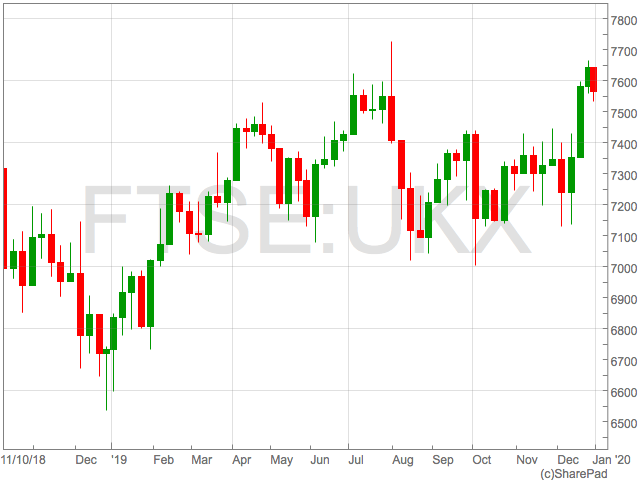
FTSE 100 rises 12% in 2019 but underperforms US and European indices
The FTSE 100 has closed 2019 up 12% following a Santa’s Rally through December.
Despite posting a fairly respectable gain of 12%, the FTSE 100 lagged behind major indices in Europe and the United States.
The German Dax rose 25% while the French CAC 40 added 26% in 2019.
In the United States, where markets are set to close later tonight, the Dow Jones is on for a 22% gain while the market capitalisation-weighted S&P 500 is heading for a 28% gain.
Factors such as a strengthening pound, uncertainty over Brexit and a disappointing years for oil companies BP and Shell, who account for a large proportion of the FTSE 100, can be attributed to the FTSE 100’s underperformance in 2019.
Shaking off wider concern over the health of the high street, sportswear group JD Sports was 2019’s highest rising FTSE 100 share with a rise of 140%.
Aveva plc, an Information Technology group specialising in Cloud, IoT, AI and Virtual Reality solutions, was the FTSE 100’s second highest riser posting gains of 91%.
Both of the two top FTSE 100 risers had been promoted to the FTSE 100 from the FTSE 250 during 2019.
It was a close race to the bottom of the pile with Centrica and NMC Health down 34% and 35% respectively.
Centrica was set to take the crown of 2019’s worst performing share we it not for a short selling attack on NMC Health. Muddy Waters highlighted potential accounting irregularities at the middle eat focused health care group in late December which saw the group’s share price destroyed after which, up until that point, had been a relatively good year for them.
Of course NMC Health and Centrica are the FTSE 100’s worst performers in 2019 because they remain in the index, companies such as easyJet, Hikma Pharmaceuticals an Wood Group had been relegated to the FTSE 250 early in the year after a period of share price pressure.
The Winners & Losers
Shaking off wider concern over the health of the high street, sportswear group JD Sports was 2019’s highest rising FTSE 100 share with a rise of 140%.
Aveva plc, an Information Technology group specialising in Cloud, IoT, AI and Virtual Reality solutions, was the FTSE 100’s second highest riser posting gains of 91%.
Both of the two top FTSE 100 risers had been promoted to the FTSE 100 from the FTSE 250 during 2019.
It was a close race to the bottom of the pile with Centrica and NMC Health down 34% and 35% respectively.
Centrica was set to take the crown of 2019’s worst performing share we it not for a short selling attack on NMC Health. Muddy Waters highlighted potential accounting irregularities at the middle eat focused health care group in late December which saw the group’s share price destroyed after which, up until that point, had been a relatively good year for them.
Of course NMC Health and Centrica are the FTSE 100’s worst performers in 2019 because they remain in the index, companies such as easyJet, Hikma Pharmaceuticals an Wood Group had been relegated to the FTSE 250 early in the year after a period of share price pressure. Cannabis investment vehicle Greencare joins NEX
Greencare Capital (LON: GRE) has joined the NEX Growth Market as part of its strategy to become a consolidator in the European market for cannabis-based products. Greencare has already identified its first investment and it could be secured in the near future.
Greencare is capitalised at £3m at the subscription price of 25p a share. It could not have joined AIM as an investment vehicle because it did not raise enough cash, but NEX is a good market for Greencare because it already has cannabis-related investment companies and businesses. NEX can be a stepping-stone onto another European market.
The board includes Guy Winterflood, who is chairman of Hempflax, which is one of the largest growers of hemp for industrial use.
Cannabis in Europe
European countries are at differing stages when it comes to legalisation of the use of cannabis. Italy legalised medicinal cannabis in 2013 and Germany did the same in 2017. Portugal legalised a range of medicines in 2018 and the Netherlands allows medicinal cannabis to obtained via prescription. The UK is starting to loosen the laws on medicinal cannabis and France is evaluating its position. Greencare intends to make acquisitions in countries where there is already well-developed legislation and regulation. It will assess opportunities in production, research and distribution in both cannabis and hemp sectors. It is not interested in recreational cannabis. That suggests that Italy and Germany are likely to be prime targets to provide a base for the business. UK-registered cannabis-related companies such as Greencare have to be careful that they are acting within the UK laws when acquiring and operating businesses even if they are not based in the UK. The initial focus is likely to be the wellbeing sector of the cannabis market. It is easier and more straightforward to launch products than it is for medicinal and pharmaceutical products. Longer-term, Greencare wants to have interests in a range of cannabis businesses,Investments
The first investment is likely to be in a distribution business that has a leading position in one of the larger European market. The company has exclusive distribution activities covering 30,000 points of sale and that could increase to 45,000. This is a consumer-focused business. The plan is to acquire an initial 10% stake via share investment and convertible loans. Due diligence is being carried out and the investment could be made early in 2020. There are other smaller opportunities that are being assessed.Cash
Greencare raised £514,000 at 25p a share. This equates to 17.1% of the company. The rest of the shares were issued at 1p each, raising £100,000. The pro forma NAV is just over 4p a share. The largest shareholder is E Value One with 66.3%. This company is owned by Dominic White. He is chief executive of AIM-quoted KCR Residential REIT (LON: KCR) and was chief executive of Energiser Investments (LON: ENGI). Dominic White is also chairman of fellow NEX company Eight Capital Partners (LON: ECP), which has a 21.2% stake. It acquired 1.5 million of its shares at 1p each and 1.06 million at the subscription price – just over 50% of the subscription shares. The original 1.5 million shares are part of a lock-in along with the E Value One stake and these shares will not be sold in the 12 months following the flotation. Anyone buying the other 1.06 million shares will have to hold them for the rest of the first 12 months. The total investment by Eight Capital Partners is £280,000 with an average cost of just over 11p a share. Eight Capital Partners also owns Epsion Capital, which is Greencare’s broker Greencare will have just over £500,000 in the bank after expenses. That will finance due diligence on the initial investment and other costs. All the shareholders and corporate adviser Cairn have warrants exercisable at the subscription price. That could raise an additional £450,000. Greencare’s main reason for joining NEX is to raise capital to expand and given the significant opportunities it has it will undoubtedly be issuing more shares for cash or to the sellers of the businesses it acquires. The market price is currently 25.5p (a bid/offer spread of 23p/28p). There have been no deals yet.Five predictions for 2020
GBP/USD hits 1.200
Having violently unwound the pre-election melt up in just a couple of trading sessions, we see GBP/USD continuing it’s decline through 2020.
A combination of weaker UK data and flight to safety of the US dollar will be the biggest drivers, notwithstanding any unforeseen shocks from a disorderly Brexit.
Gold rallies to $1800
2019 was a stellar year for gold and this is likely to continue into 2020 as geopolitical risk remains elevated.
In addition, the Federal Reserve is considering letting inflation run past its 2% target rate and while Donald Trump is in power we’re unlikely to see any meaningful tightening cycle leading to a more subdued dollar.
UK Small Caps outperform the FTSE 100
The FTSE 100 is very fairly priced going into 2020 and it’s hard to see a scenario where London’s leading index provides significant upside in 2020.
By contrast, London’s small cap indices, including the AIM market, have been unloved for many years and there are numerous hidden gems presenting excellent value.
Brent Oil price crashes to $45
Now the Saudi Aramco is out of the way, Saudi Arabia has less reason to keep oil prices high and OPEC are unlikely to implement much more in the way of supply cuts.
The global economy is also set for slower growth in 2020, reducing demand for oil.
Adding to downside pressure in the oil price is the march higher in US shale production which will likely see the US become a net exporter in 2020.
Impact investing goes mainstream
ESG is now fully embedded into the investor mind set at an institutional level but in 2020 we see this filtering down to the investment decisions of private investors in a big way.
Impact investing is far more than allocating a portion of your portfolio to renewable energy projects. 2020 will see a major turning point in value creation by businesses actively making a positive impact towards the UN’s 17 Sustainable Development Goals.
Director of RIFT Research and Development comments on Queen’s Speech
The Queen gave her speech yesterday in which the government revealed its plans for the year.
It was announced in the speech that there will be an increase in tax credits available to companies through the Research and Development scheme.
Sarah Collins, Director of RIFT Research and Development Ltd, has provided a comment on the announcement.
“We are delighted to hear Her Majesty specifically mention R&D Tax Credits in her speech this morning and that our new Government has committed to increasing R&D tax credits to help innovative businesses thrive,” the Director said.
“Although the R&D tax credit regime is still lesser known than SEIS and EIS and Entrepreneur’s Tax Relief, it is a relief that benefits UK business to the tune of over four billion pounds each year and can be worth hundreds of thousands of pounds to those companies investing in tech, research and new ways of working. ” Sarah Collins continued.
“At RIFT, we believe it’s important to help those operating within agriculture, fintech, construction, property, retail, insurance and start-ups generally, to receive some much needed financial help from the taxpayer in return for their forward thinking.”
Sarah Collins added: “It’s fair to say that the starting pistol has been fired by Boris Johnson and if there was ever a doubt with regard to his previous ‘F*** business’ comments, he is clearly determined to reverse such an attitude. In fact, it would seem he’s now more ‘for business’ than ‘f*** business’.”
With last week’s general election out of the way, UK politics can turn its attention back to resolving the Brexit induced political and economic uncertainty to hit the nation.
Elsewhere this week, the Bank of England decided to keep interest rates on hold at 0.75%.
The President of Stenn Group provided a comment on the announcement, insisting that Boris Johnson’s win provides the nation with the “much-needed solidity” it has been craving.
Study finds how generous parents are at Christmas
A study has found that generous parents plan to buy their children’s entire wish list and more this Christmas.
Indeed, a study of 2000 parents of 5-16-year-olds revealed that the average child has requested nine presents, but their parents intend to splash out and buy them at least twelve gifts.
Over a fifth said that technology takes up the majority of their child’s wish list.
Other popular gifts to be found on children’s wish lists are console games, mobile phones and smart watches.
Commissioned by Alcatel, the study also revealed that a tenth of kids are hoping for a gaming chair or smart speaker.
Technology themed gifts can be found on the wish lists of children as young as seven years of age.
“It’s clear from the results tech gifts are sought after by all ages and this can be a big expense for parents, especially if they have more than one child asking for similar products,” William Paterson from Alcatel commented.
“We believe technology should be accessible to all and if children are asking for tablets, or handsets at a young age, parents shouldn’t have to worry about breaking the bank,” William Paterson continued.
“It’s interesting to see parents are buying more gifts than asked for, but spending less, showing that presents don’t have to be ridiculously expensive.”
According to the study, three quarters of parents try to stick to a budget for their child’s gifts, but 84% said that they have exceeded this budget in previous years.
“It’s too expensive” is among some of the most common reasons parents give their children when they do not receive everything they have asked for. “Santa couldn’t find it” and “it was sold out” are also used as excuses.
With less than a week left until Christmas, the day to exchange gifts is approaching fast. However, there are plenty of initiatives to help you do good this festive season.
President of Stenn: Boris to provide UK with “much-needed solidity”
News emerged only yesterday that the Bank of England has decided to keep interest rates on hold at 0.75%.
With last week’s general election out of the way, UK politics can now turn its attention back to resolving the Brexit induced political and economic uncertainty to hit the United Kingdom.
Dr Kerstin Braun, President of Stenn Group, which is an international provider of trade finance head quartered in London, has provided a comment on the Bank of England’s decision to hold interest rates.
“Boris Johnson’s win provides the much-needed solidity the UK has been craving. Businesses can begin to see their future and now Brexit is confirmed to go ahead, The Bank of England needs to keep the economy steady as we navigate Britain’s exit from the EU. But a prolonged period of low growth, low inflation, and low interest rates will limit the Bank’s ability to create stimulus when needed.”
“It’s unlikely trade will be decided until the end of 2020 so it’s vital UK firms start investing again as they exit Brexit limbo. This is critical for long-term growth. With Europe mired in low growth and a modest global economic outlook for 2020, global demand will be weak as companies rev up their engines. The recovery will be slow, with GDP growth estimated to be 1% in 2020,” the President of Stenn Group continued.
Dr Kerstin Braun said: “The UK economy has been flatlining this year, but the pound surged to its largest amount in a decade after a clear majority was announced, and it’s expected Sterling could rally next year to a pre-referendum level of $1.45. We expect consumer spending to pick up gradually, but with elevated levels of household debt, the consumer can’t keep the economy afloat forever. Unemployment is down but wages aren’t keeping pace.”
Regency Mines reflect on tough financial trading year
Regency mines Plc (LON:RGM) have seen their shares plummet on Friday after the firm reflected on what was a tough year.
Regency Mines plc is a small cap natural resource exploration and development listed company on the Alternative Investment Market of the London Stock Exchange Ltd in London.
The firm reflected back on what seemed to be a modest year for the firm, as it reported a widened loss in its recently ended financial year.
The company reviewed the financial year by saying it was “difficult and disappointing”.
The firm yesterday said that it will be buying out the remaining shareholders in its UK energy storage business, Allied Energy Services business.
These shareholders hold a 20% stake in Allied Energy, where as Regency Mines hold an 80% stake.
For the sale of the remaining 20%, the minority shareholders will be issued 2.5 million shares in the company, following the 1 for 100 share consolidation, which is expected to take place on Tuesday next week.
For the financial year, Regency reported a pretax loss of £2.6 million which was widened from £1.5 million the year before, a stat that will worry shareholders.
The firm said that this was mainly due to a one-off gain of £1.5 million from a disposal in the 2018 financial year, more than offsetting higher impairment charges.
Additionally, the loss was widened due to a written of investment in joint venture firm Mining Equity Trust LLC which was unable to continue coal production in the US due to a shortage of funds.
There was also the write-off of the company’s investment in White Car Ltd, which entered voluntary liquidation in June, and funding constraints limiting progress in the Dempster vanadium project in the Yukon, Canada.
Regency speculated that it expects to end 2019 with firmer foundations, following proposed fundraising, debt restructuring, share consolidation and change in board.
All these strategies however will be approved at their general meeting next week.
Shares of Regency Mines plummeted 14.13% on the announcement to 0.032p. 20/12/19 11:12BST.
Regency’s Share Placing Plan
The firm announced at the start of December that it would be conducting a share placing plan as part of a company restructuring program.
Regency has proposed to raise £831,000 via a placing of 3.02 billion new shares at a price of 0.0275p each. Alongside the placing, an additional 530.0 million shares, representing obligations of £145,785, have been issued to Red Rock Resources PLC (LON:RRR) in “full extinguishment of outstanding obligations”.
The share placing plan meant that the company will have 8.69 billion shares in current issue.
Regency also said that C4 Energy Ltd, a UK incorporated private company, part controlled by proposed new chair James Parsons, has secured an option to acquire Regency’s remaining debt.
Regency concluded that partial conversion of f promissory notes will result in the issue of 2.60 billion shares, while holders of £281,113 in outstanding convertible loan notes have agreed to convert these into 1.02 billion shares.
Certainly, this has been a tough time for Regency Mines, and shareholders will hope that 2020 can bring some good results following pledges to overhaul operations and management.