
Ashmore Group shares fall amid “modestly negative” investment performance

Ashmore Group shares (LON:ASHM) fell on Tuesday after the company said its investment performance was “modestly negative” in q2.
Assets under management were up by 0.4% to £76.7 billion at the end of December from £76.4 million in September.
This was as a result of net inflows of $0.5 billion mitigating a negative investment performance of £0.2 billion.
According to the trading update, Ashmore said that ‘net inflows were delivered in the corporate debt, blended debt, equities, multi-asset and overlay/liquidity themes.’
Meanwhile there was a ‘small net outflow’ in the local currency theme, whilst external debt and alternatives themes remained flat during the quarter.
As a result, the company said investment performance proved ‘modestly negative’ for the period.
“Despite the more challenging markets experienced for much of 2018, client flows remain resilient reflecting investors’ very low allocations to emerging markets and recognition of the value available,” commented chief executive Mark Coombs.
“The effect of tax-related stimulus on the US economy and its support for the US dollar started to fade towards the year end, removing the main headwind for emerging markets outperformance.
“The reduction in emerging markets asset prices despite improving economic growth suggests underweight investors will continue increasing allocations to emerging markets, and a return to the positive market trends experienced in 2016 and 2017.”
Shares in Ashmore are currently -2.63% as of 11:44AM (GMT) as the market reacts to the update.
Persimmon annual profit set to be “modestly” ahead of market

Persimmon announced on Tuesday morning that it expected its annual profit to be “modestly” ahead of current market expectations.
Total group revenue was 4% higher than the year earlier, coming in at £3.7 billion. This compares to the £3.6 billion figure in 2017.
New housing revenues increased by 4% to £3.55 billion.
Additionally, legal completion volumes increased by 406 new homes, a 3% increase to 16,449, including private sales of 13,341 new homes.
Average selling price was roughly £215,560 for the year ended 31 December 2018. This price is 1% higher than the £213,321 recorded in 2017.
“The UK housing market has continued to benefit from robust employment levels, low interest rates and a competitive mortgage market, which has supported confidence and customer demand across the regions,” the house building company said.
The company has said that expects its pre-tax profits for 2018 to be “modestly” ahead of the current market consensus. Persimmon has benefited from the new developments opened throughout 2018.
The company concluded with a reflection on the current UK housing markets and the current economic uncertainty surrounding the UK’s departure from the European Union. Indeed, Brexit uncertainty has pushed UK house prices to a six-year low, as reported by Reuters.
“As we look forward to the 2019 spring season Persimmon is in an excellent market position. Whilst the future performance of the UK economy is currently subject to increased levels of uncertainty the Group is well positioned with its strong outlet network together with the availability of a range of attractive house types at affordable prices across the regions of the UK, supported by a high quality land bank and conservative financial structure.”
“We will give an update on our assessment of the housing market over the early weeks of 2019 when we announce our results for the year ended 31 December 2018 on Tuesday 26 February 2019.”
Amid a difficult climate for the UK property market, we took a look at whether London house prices would recover in the year ahead.
At 10:18 GMT today, shares in Persimmon plc (LON:PSN) were trading at -0.4%.
Gym group shares drop on weakened adjusted earnings

The Gym Group announced its pre-closure trading update for 2018 on Tuesday morning. Adjusted earnings are expected to be weakened from a lower opening programme and the impact associated with outlet conversions from its Lifestyle Fitness acquisitions. Shares in the group dropped by almost 5.5% this morning on the back of the announcement.
Total revenue has grown 35.6%, increasing to £123.9 million for the year ended 31 December 2018.
Year-end net debt was recorded at £46 million as a result of the easyGym acquisition and investment in 17 new openings.
The company has released an expected full year adjusted earnings for 2018 to be roughly £37 million.
In 2017, the company opened a new 16,000 square feet outpost on White Hart Lane, just moments from Tottenham Hotspur FC’s new stadium.
CEO of The Gym Group, Richard Darwin, commented on the announcement:
“The Gym Group continues to deliver strong, profitable growth whilst also establishing the platform for a bigger business in the future. The pace of expansion was significant in 2018: we opened 17 new gyms, converted the acquired Lifestyle sites, acquired easyGym and over the last 30 months have doubled the number of gyms in our estate. We have recently reached the milestone of 750,000 members, demonstrating the ongoing appeal of our business model.”
“Looking forward we have a good pipeline of new sites and expect to open a further 15-20 gyms in 2019. We are well placed to continue to generate high levels of growth whilst maintaining strong returns on capital. We are confident that in 2019 we will continue to develop and build the business to deliver another year of profitable growth for shareholders.”
The group reported that its total year-end membership numbers were ahead by 19.3%, to 724,000. This figure compares to the 607,000 recorded in December 2017. Additionally, it posted its average members of 693,000, which is up 31.2%.
Elsewhere on the stock market today, Boohoo revised its full-year sales outlook following a strong Christmas sales period.
At 09:48 GMT today, shares in GYM Group plc (LON:GYM) were trading at -5.42%.
Flybe shares remain low on improved deal
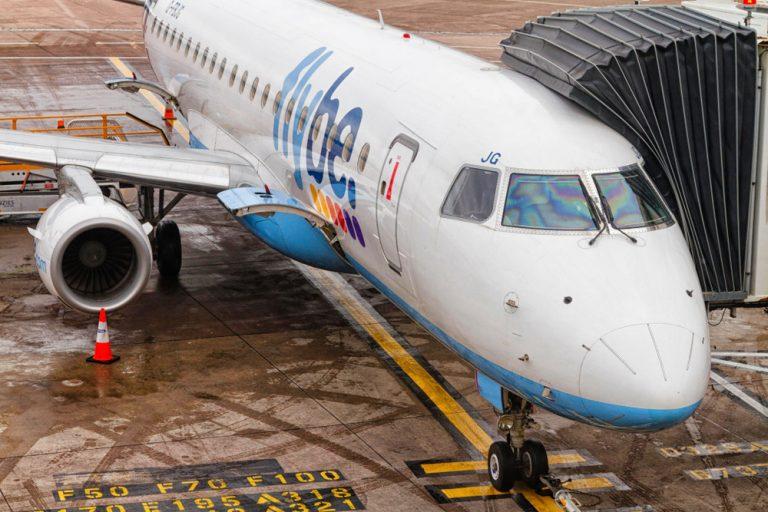
Flybe announced on Tuesday that it had reached an agreement with Connect Airways to sell its main trading company, Flybe Limited, and digital Flybe.com for £2.8 million. Shares in the company have crashed by over 43% during Tuesday trading on the back of the announcement.
Moreover, Flybe announced that it has agreed on a revised bridge facility of up to £20 million to provide funding to Flybe Limited. £10 million of this fund is set to be released today to support the airline. Furthermore, a range of improved agreements with banks has also been pursued in order to improve liquidity.
On Friday, the company was offered a deal between Virgin Atlantic, Stobart Aviation and US private equity firm Cyrus Capital Partners.
Flybe announced that shareholders will not be given the chance to vote on the deal.
David Madden, an analyst at CMC Markets, told the Evening Standard: “The sale of assets and the bridge loan give the company some much-needed breathing space.” In October last year, the airline released a profit warning. The profit warning was announced following declining consumer demand, higher fuel prices and a weakening British pound, according to Reuters. Indeed, the airline had been suffering from lower consumer demand for British and European travel. When combined with increasing fuel prices and a decreasing sterling value, the airline’s performance was considerably damaged. The rescue deal comes following the collapse of Monarch and Primera Air. For Monarch, hundreds of thousands of people lost bookings with the airline. As for Primera Air, all operations were ceased in October, leaving passengers stranded abroad following its prompt closure. Flybe is a British airline based in Exeter, England. It is the largest independent regional airline in Europe. Its estimated carry is roughly 8 million passengers per year, operating between 81 airports across the UK and Europe. It offers 210 routes across 15 countries. At 13:46 GMT today, shares in Flybe Group plc (LON:FLYB) were trading at -43.20%.Boohoo rallies over Christmas, full-year sales outlook updated
Boohoo group announced on Tuesday that it has updated its full-year sales projection. This upgrade is following a strong set of sales over the Christmas shopping period.
For the four months ended 31 December, Boohoo group revenue increased by 44% compared to the same period a year earlier. Gross margins were up 170 basis points to 54.2%.
Full-year group revenue has been updated to fall between 43%-45%. This is above the previously predicted guidance of 38%-43%. Adjusted earnings (EBITDA) was previously guided between the range of 9%-10%, however this has been lowered to 9.25%-9.75%.
The group also posted a strong balance sheet with net cash of £189 million.
Boohoo started as boohoo.com, an online fashion brand targeting young customers.
As for its brands, PrettyLittleThing brought in a revenue of £144.2 million, which is up 95%. Year-to-date revenue is £312.8 million, a 114% jump. Gross margin for the four months is up 56.4%, climbing 110 basis points.
Nasty Gal, another of its brands, bought in £20.6 million, a 74% increase. Year-to-date revenue is £38.3 million, up 89%. Gross margins for the four months is recorded at 54.4%.
The boohoo brand bought in the highest revenue of £163.5 million, increasing 15%. Year-to-date revenue is £372.5 million, rising by 15%. Gross margins for the four months is 52.2%, an increase of 150 basis points.
Boohoo is not the only fashion brand to post strong sales over the festive period.
Luxury brand Ted Baker rallied following a strong Christmas trading period, as did Joules and Selfridges. Elsewhere in the fashion sector was not so positive, with brands such as Footasylum suffering over Christmas. The joint CEOs, Mahmud Kamani and Carol Kane, commented on the adjusted profit guidance: “We are delighted to be reporting yet another great set of financial and operational results and would like to say a very big thank you to all our team and customers. We remain firmly focused on continuing to provide our customers with great fashion at unbeatable value. The global growth opportunity is significant and we will be addressing it in a controlled way – investing in our proposition, operations and infrastructure to capitalise on the opportunity.” At 08:56 GMT today, Boohoo Group plc (LON:BOO) shares were trading at -2.2%.Dechra reports “strong” trading, shares rise

Dechra Pharmaceuticals (LON: DPH) has reported an 18% rise in revenue in the six months to 31 December.
The veterinary drugmaker said in an update on Monday that trading had been “strong” for the second half of 2018.
“We are pleased with the group’s trading in the period. Dechra continues to deliver above market revenue growth in our existing business and in our acquisitions, in line with the board’s expectations,” said Ian Page, the chief executive.
Shares edged up by 0.8% after the announcement. They are currently trading +1.05% at 2.306,00 (1349GMT).
The company also said that it expects Brexit contingency plans to be completed before the UK will leave the EU on 29 March.
When the group announced plans to carry out contingency plans in September, which would cost around £2 million, shares in the group tumbled over 20%.
London Property: Will house prices recover in 2019?

New data from Project Etopia has revealed that house prices fell in 85% of London’s boroughs.
Amid a difficult time for the UK property market, prices in the capital have slumped by an average of 7.6% over the past year.
The past year was the second year running that house prices in London fell, where in the 12 months to December, house prices in the capital fell by 0.8% to £466,988. House prices fell 0.5% in 2017.
“Brexit has smashed property market sentiment to smithereens. Buying and selling property requires confidence but confidence, as we edge closer to Brexit, is close to zero. For countless prospective buyers, Brexit has put everything on hold,” said Jonathan Samuels, who is the chief executive of Octane Capital.
“Borrowing rates may be low and the jobs market strong, but a deep undercurrent of uncertainty is causing the vast majority of people to sit on their hands. It’s about as good a buyers’ market as it could get,” he added.
Out of the 32 London boroughs, only five saw an increase in property prices and transactions, including the City of London.
The boroughs experiencing the worst falls were Tower Hamlets (22.5%), Westminster (14.4%) and Croydon (14.5%).
“Falling transaction levels in a city like London, where affordability is a critical problem, is a sign of a sick housing market that refuses to adjust,” said Joseph Daniels, the chief executive of Project Etopia.
“Options for those seeking to buy at fair value are thin on the ground. Sellers have been encouraged to see their home as a piggy bank because of the UK’s boom-and-bust property cycle.”
“Vendors need to moderate their expectations but more importantly, policymakers must start building a meaningful number of new homes so the accumulation of wealth ceases to be the market’s main driver in the long term.”
House prices are expected to increase again, although this is expected to take up to 18 months.
Debenhams may close a further 40 stores
Debenhams is reportedly planning to close 90 stores, according to the Daily Telegraph.
The struggling department store may axe 10,000 jobs as the chain battles against plunging profits and sales.
Shares in the group have fallen 90% over the past year and the chain reported a £491.5 million loss in October.
The department store already planned to close 50 stores over a five-year period, which was announced in November. A further 40 stores may be planned to close, which should “address the structural challenge and drive profitable growth”.
The news comes just days after scandal amid the board, where Mike Ashley voted against the chief executive and chairman of Debenhams, who were both ousted.
“The board believes that it is in the best interests of Debenhams plc that the executive team remains fully focused on delivery of the plan. In the meantime, the board remains open to constructive suggestions from shareholders that are in the interests of the business as a whole,” said the group in a statement.
Sports Direct (LON: SPD) owns almost 30% of shares in Debenhams.
Shares in the department store (LON: DEB) are down 7.57% (1102GMT).
New Look reveals restructuring plan, saving £1bn
New Look has announced a restructuring program that will cut debt by £1 billion.
The debt will be reduced from £1.35 billion down to £0.35 billion through a debt-for-equity swap proposal.
The retailer, which is owned by Brait, also plans to raise £150 million by issuing new bonds.
“Today’s agreement represents a critical step in our turnaround plans and lays the foundations to secure the future and long-term profitability of New Look by materially deleveraging our balance sheet and providing us with the financial flexibility to better attack our future,” said Alistair McGeorge, the executive chairman.
“Over the past year we have made significant progress with our wider turnaround plans to rebuild our position in the UK womenswear market and recover the broad appeal of our product whilst implementing significant cost savings and efficiencies.”
“However, it has been clear for some time that the Group’s existing level of indebtedness has been constraining our ability to accelerate our turnaround plans and would continue to limit our growth in the future.”
“Therefore, today marks an important milestone for the business, our colleagues, our suppliers and all our other stakeholders. A materially delevered balance sheet and a more flexible capital structure will allow us to better navigate the challenging market environment and create a stable operating platform so that we can achieve further progress against our turnaround plans.”
“Upon completion of the restructuring, our focus will be to enhance profitability by continuing to provide fantastic product for our customers, building brand equity and grasping new market opportunities,” he added.
New Look is closing 85 stores in the UK this year, whilst it is also negotiating the future of a further 13 stores with landlords.
Sales in December fell by 5.7%.
Shares in the South African investment firm Brait (JSE: BAT) are currently trading down by 6.22% (0946GMT).
Quiz issues profit warning, shares tumble 30%

With a weaker demand over Christmas, Quiz has issued its second profit warning in three months.
Down from the previous estimates of £11 million in October last year, the fashion retailer now expects 2019 profits to total £8.2 million.
Following the announcement, shares in Quiz tumbled 33%.
Tarak Ramzan, the group’s chief executive, said: “Against the backdrop of challenging trading conditions over recent months, Quiz has delivered further revenue growth over the Christmas period driven by the performance of our own websites. However, the growth and the margin achieved have been below our initial expectations.”
“Management’s utmost priority remains achieving further growth for the business and improving profitability in the future,” he added.
Quiz is a Glasgow-based retailer and has 70 stores and 148 concessions across the UK. The group also has stores in Ireland, Saudi Arabia, United Arab Emirates, Malaysia, Singapore, Cyprus, Egypt, Georgia and Pakistan.
Quiz floated on the Aim market in July 2017, where it attracted over £100 million from investors.
“Quiz became the latest High Street casualty as its shares plummeted on a profits warning. Overall performance isn’t bad at all – sales rose more than 8.4%, led by a 34.1% jump in online revenues. High Street sales held up ok, rising 1.6%,” said Neil Wilson, who is an analyst at Markets.com.
“But we got a bad profits warning. It looks like discounting is really killing retailers. There is just no way they can pass on higher costs by raising prices. Consumers are simply not prepared to pay more. The discounting vicious circle means shoppers are now expecting big price reductions. Margins at Quiz are like others coming under a lot of pressure from heavy discounting,” he added.
Shares in the fashion retailer (LON: QUIZ) are currently trading -29.73% (1110GMT).