
Barclays fined $15m over whistleblower controversy
Barclays (LON:BARC) has been hit by a $15 million penalty by a New York regulator over attempts by its chief executive to unmask a whistleblower.
The New York State Department of financial services investigation concluded that Barclays had violated local and banking law regarding whistleblower procedures.
The fine relates to a scandal back in 2016, when chief executive Jes Staley attempted to name a whistleblower, prompting the launch of a series of investigations against the bank.
“Whistleblowers are vital to uncovering and addressing intentional wrongdoing,” commented Maria Vullo, New York department of financial services superintendent.
She added: “DFS’s thorough investigation uncovered actions at the top that exposed the bank to risk and created an atmosphere in which employees might doubt that it was safe to escalate issues of concern to the bank.”
The fine follows a £642,430 penalty dealt by the UK’s financial watchdog, the Financial Conduct Authority (FCA) to the bank.
Back in August, Barclays reported a fall in its half-year profits as legal and litigation costs relating various controversies dragged down revenue.
Pre-tax profits fell from £2.3 billion to £1.6 billion after the bank were forced to payout £2 billion, including costs relating to a £1.4 billion settlement.
This latest penalty marks one of many fines in recent years, including compensation relating to PPI and investigation by the Serious Fraud Office (SFO) into a loan given to Qatar back in 2008.
Shares in Barclays are currently +0.45% as of 12:26PM (GMT).
TechFinancials harnesses Blockchain to enter the Diamond trading and ticketing market

TechFinancials (LON:TECH) are propelling their transformation with the launch of two Blockchain based ventures in CEDEX, a diamond trading platform, and NewCo, a sports venue ticketing solution.
TechFinancials are a Fintech software provider and the recent developments bolster their portfolio of global trading solutions and signals growth into new markets.
The announcements came after the company released interim results that highlighted the transformational nature of 2018 for TechFinancials.
The group posted revenues fo $3.78m for the first half, down 46% for the same period a year prior.
Despite a disappointing first half, the group is well positioned for further investment with a cash position at the end of the first half of US$2.86m.
New blockchain trading technology business produced revenues of US$1.3m (H1 2017: $0).
TechFinancials (LON:TECH) has recently received a $1.7m dividend pay-out by DragonFinancials, their 51% owned subsidiary operating a trading platform targeting the Asia Pacific Region.
CEDEX
The CEDEX platform allows investors to invest and trade in diamonds as they would any other financial asset class. The platform harnesses Blockchain technology to give investors the power to trade diamonds with the liquidity and transparency not previously seen in the market. TechFinancials has a 2% interest in CEDEX Holdings, the holding company of the CEDEX exchange. TechFinanicals have an option to acquire a further 90% of CEDEX Holdings. CEO Asaf Lahav commented on the launch: “We are delighted to have played a pivotal part in the launch of the first blockchain-based diamond exchange in the world. This milestone achievement is testament to the innovative capabilities of both CEDEX and TechFinancials to build a new, ground breaking platform and we look forward to updating the market on its progress in due course.”Footies
Signalling TechFinancial’s growth into new markets, the group have signed a binding agreement with Footies to create NewCo, a sports ticketing solution to control revenue loss in the secondary ticket market. The secondary ticketing market has been the subject of scrutiny this year as event organise attempt to reduce over inflated prices of tickets being sold in the secondary market. NewCo’s solution will provide a Blockchain-based solution to provide greater control over the path of tickets once issued to produce economic benefits from both the issuers and fans. NewCo will be led up by ex-CEO of Liverpool Football Club, Ian Ayre who has been appointed chairman. Ian Ayre commented: “I am delighted to be involved in the establishment of such an exciting and innovative company in partnership with TechFinancials. There is huge demand for the secondary ticketing market in the sporting industry to be revolutionised in order to make it fully transparent and to make sure that a fairer deal is ensured for both the venues and the customers. For years, both of these parties have suffered at the hands of ticket touting, and we aim to solve this by making it a more secure and stable market. “Supported by TechFinancials’, I look forward to developing and growing the business to transform the way organisations handle their events more effectively, for the benefit of all involved in the ticketing process.” TechFinancials will have a 75% stake in NewCo with Footsies holding 25%. Half Year Results
The announcements came after the company released interim results that highlighted the transformational nature of 2018 for TechFinancials.
The group posted revenues fo $3.78m for the first half, down 46% for the same period a year prior.
Despite a disappointing first half, the group is well positioned for further investment with a cash position at the end of the first half of US$2.86m.
New blockchain trading technology business produced revenues of US$1.3m (H1 2017: $0).
TechFinancials (LON:TECH) has recently received a $1.7m dividend pay-out by DragonFinancials, their 51% owned subsidiary operating a trading platform targeting the Asia Pacific Region. 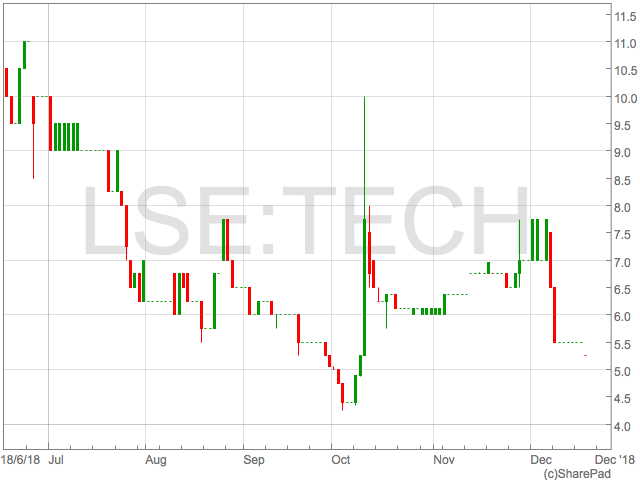
Bushveld Minerals rallies after last week’s dip

In what has been a story with a bullish long-term outlook, Bushveld Minerals Limited (LON:BMN) shareholders will be reassured by news of share prices recovering from a dip last week.
For those unfamiliar with the firm, Bushveld is a mineral development company that focuses on vanadium, titanium, phosphate, tin and thermal coal extraction and centres its exploration in South Africa and Madagascar.
The company are among the forerunners that currently sit in the spotlight of keen forums of traders, with the last few days seeing a sharp recovery and return to form for what -until last week – seemed like an unassailable rise.
Bushveld have enjoyed success off the back of a boom in vanadium prices, which are at their second highest level since the turn of the century – with only a marginal spike needed to see prices equal a four-decade high. While the last boom came off the back of speculative resource grabbing with the boom of the Chinese economy, this spike applies more specifically to vanadium, and has scope for long-term growth. While much of the vanadium demand in recent years has been attributed to climbing demand for steel, forecasts state that a significant portion of future demand will be made up of increased demand from energy storage players, particularly regarding the development of the vanadium redox flow battery.
What Bushveld have managed to do is seemingly time the set-up of its own energy storage subsidiary – Bushveld Energy – to perfection. The recent vanadium supply deficit looks set to continue into the new year, putting further upward pressure on the price of limited vanadium resources, which are forecast to be in growing demand in coming months.
In the last two years, Bushveld’s share price has increased by 500% and its value has increased by a factor of ten – its base in South Africa and acquisition of Vametco mines earlier this year gives it a position of primacy, with a 4% stake in the global vanadium market.
Going forward, Bushveld will undoubtedly hope to capitalise on a potentially lucrative market with a sizeable stake in a resource in short supply. The company’s share prices are currently trading at 48.22p, up 5.99% or 2.72p in morning trading. In their most recent update, SP Angel analysts reiterated their ‘Buy’ stance on Bushveld stock.
FCA fines Santander £32.8m for “serious failings”
Santander has been fined £32.8 million by the Financial Conduct Authority for “serious failings” in passing on the money of the deceased to family members.
Following an investigation into the lender, the FCA found that in some cases the bank has kept the money for multiple years and has failed to transfer an estimated £183 million.
“These failings took too long to be identified and then far too long to be fixed,” said Mark Steward, the executive director of enforcement at the FCA.
“To the firm’s credit, once these problems were notified to the board and senior management, they were fixed properly and promptly. But recognition of the problem took too long. Firms must be able to identify and respond to problems more quickly especially when they are causing harm to customers.”
Over 40,000 customers have been affected by the bank’s failings, which failed to its probate and bereavement process between 1 January 2013 and 11 July 2016.
The chief executive of Santander (BME: SAN) said: “Santander is very sorry for the impact these failings have had on the families and beneficiaries affected.”
“We have now transferred the majority of customer funds and made significant improvements to our whole probate and bereavement process, ensuring we provide both a sensitive and efficient service to our bereaved customer representatives and those who are managing the estates of people who have passed away,” he added.
Santander warned in October that Brexit will have “significant” impacts on results. The group’s net profit fell 8.8% year-on-year in the second quarter of this year.
“There remains significant uncertainty as to the respective legal and regulatory environments in which we and our subsidiaries will operate when the UK is no longer a member of the EU,” said the bank about Brexit impacts.
“This uncertainty, and any actions taken as a result of this uncertainty, as well as new or amended rules, may have a significant impact on our operating results, financial condition and prospects.”
Angus Energy dips with suspension of well tests

Angus Energy (LON:ANGS), among other hydrocarbon suppliers, have seen their share price fall in morning trading but are optimistic about commercial flow tests of their new ventures.
Angus Energy is an independent onshore hydrocarbon production and development firm, focusing on accruing and monetising assets in the UK. All of the company’s flow from the same reservoir in the Weald Basin between the South Coast and just South of London.
The AIM-listed company have seen a dip in morning trading as Managing Director Paul Vonk delivered a matter-of-fact update through the RNS this morning. With a more positive long-term outlook, the firm announced that it has commenced the flow test programme of the Brockham Oil Field, having previously announced the venture. However, today’s hit came as the company added the caveat that these tests would be temporarily suspended over the Christmas period, with a grace period spanning from the 23rd of December of this year to the 7th of January 2019.
Alongside its conventional oil fields at Brockham and Lidsey, Angus has a 12.5% in the Holmwood Licence and a 25% interest in the Balcombe Licence.
For the latter, Mr Vonk was positive in an interview in October, stating that the results for the Balcombe venture had exceeded prior expectations, with seven-day test results bearing yields of 850 bpd and later 1600 bpd – with some of that volume being water which entered from a later fracture which Mr Vonk said could be resolved.
In the first three hours of trading, Angus Energy shares were dipped 15% or 1.93p to 10.96p, after shares rallied last week.
Flybe shares rise amid Virgin Atlantic takeover talks

Flybe shares (LON:FLYB) rose on Wednesday after Virgin Atlantic confirmed it was continuing talks with the airline regarding a potential takeover.
Last month, Flybe announced it was considering its options, including placing itself for sale following the issue of several profit warnings for the year.
The low-cost airline has come under pressure in recent years amid rising fuel prices and pound sterling volatility all impacting profits.
News of the potential takeover by Virgin first hit the headlines back in November, when a Virgin spokesperson confirmed the speculation.
A Virgin spokesperson said at the time: “Virgin Atlantic notes the recent media speculation related to Flybe. Virgin Atlantic has a trading and codeshare relationship and confirms that it is reviewing its options in respect of Flybe, which range from enhanced commercial arrangements to a possible offer for Flybe.
“Virgin Atlantic emphasises that there can be no certainty that an offer will be made nor as to the terms of any offer.”
Virgin Atlantic was founded by British billionaire Richard Branson, who is currently focusing his attention on his Virgin Galactic spaceflight venture.
It currently codeshares with Flybe as well as US airline, Delta Airlines. Delta currently owns a 49% stake in Virgin Atlantic.
Last July, Virgin Atlantic announced it had agreed to sell a 31% stake to Air France-KLM, as part of a £220 million deal.
Shares in Flybe are currently +6.91% as of 11:16AM (GMT).
GlaxoSmithKline and Pfizer to merge healthcare arm in £10bn deal
GlaxoSmithKline has agreed to break-up its healthcare business in a £10 billion merger with Pfizer.
GlaxoSmithKline (GSK) is set to hold a majority interest in the venture with 68%, whilst US rival Pfizer will have the remaining 32%.
News of the joint venture between the two pharmaceutical firms sent shares up during Wednesday morning trading.
GSK, whose brands include Panadol and Sensodyne, said that within three years of the merger, it plans to split into two distinct businesses of consumer alongside pharmaceuticals and vaccines.
Pfizer’s consumer products include the well-known Chapstick and Anadin. The merger is expected to bring in around £9.8 billion in annual sales.
“With our future intention to separate, the transaction also presents a clear pathway forward for GSK to create a new global pharmaceuticals/vaccines company, with an R&D [research and development] approach focused on science related to the immune system, use of genetics and advanced technologies, and a new world-leading consumer healthcare company.”
Emma Walmsley, chief executive of GlaxoSmithKline, said:“Ultimately, our goal is to create two exceptional, UK-based global companies, with appropriate capital structures, that are each well positioned to deliver improving returns to shareholders and significant benefits to patients and consumers.”
Shares in Pfizer (NYSE:PFE) are currently down marginally -1.65%.
Meanwhile, shares in GlaxoSmithKline (LON:GSK) +6.63% as of 10:44AM (GMT).
Softbank shares slump on IPO debut
After its debut on the Tokyo stock market, shares in Softbank sank 14.5% from the price set for the initial public offering.
It was Japan’s biggest ever IPO, where the group raised 2.6 trillion yen ($23 billion; £18 billion) after pricing the offering at 1,500 yen a share.
David Kuo, a market-expert based in Singapore, said: “Softbank wasn’t as popular an [initial public offering] as the market had expected. It was oversubscribed, but not as much as hoped.”
Softbank was founded by Masayoshi Son, the richest person in Japan. Although it was founded as a telecoms company, the group has expanded into robotics and has also invested in ride-sharing firms and satellite start-ups.
Professor at the school of management and information at the University of Shizuoka, Sejiro Takeshita, said the slump in shares was due to the group’s growth strategy.
“One big worry among investors is the musical chair game that Soft Bank has been playing on, growth after growth, expansion after expansion – they are all worried when the music will stop,” he said.
“It hasn’t. But if you look at the external environment of the telecommunications side, in Japan … growth is definitely winding down,” he said. “And you’ve got pressure from the competition and you’ve got the government trying to lower prices – so you’ve got a lot of pressure surrounding this industry as a whole.”
Shares in Softbank (TYO: 9984) are currently trading -0.91% at 8.184 (0942GMT).
FCA to abolish excessive fees for overdrafts

The Financial Conduct Authority (FCA) has revealed plans to ban banks from charging high overdraft fees.
In the last year alone, banks have earned more than £2.4 billion from such fees.
The watchdog said it plans to ensure a more simple approach to borrowing, where the cost will be simple with a single interest rate. Prices will be advertised in a standard way and more will be done to help those financially struggling.
“Today we are proposing to make the biggest intervention in the overdraft market for a generation,” said Andrew Baily, the FCA’s chief executive.
“These changes would provide greater protection for the millions of people who use an overdraft, particularly the most vulnerable. It is clear to us that the way banks manage and charge for overdrafts needed fundamental reform.”
“We are proposing a series of radical changes to simplify the way banks charge for overdrafts and tackle high charging for unarranged overdrafts. These changes would make overdrafts simpler, fairer, and easier to manage,” he added.
Campaigners have said that the changes are not going far enough to help those that are “overdraft prisoners”.
However, Martin Lewis, founder of moneysavingexpert.com, said the move was a step in the right direction and that abolishing the overdraft fees was “a step in the right direction”.
“Many demonise credit cards, but debit cards are debit cards too when someone is overdrawn, and often they’re far costlier,” he said.
“Now even the regulator, thankfully, is starting to feel that it’s unfair to make society’s poorest pay for others’ banking – via hideous charges designed to entrap people in debt.”
“The FCA’s consultation is on the right track – though our main disappointment is it fails to impose the total cost cap, which it’s applying to other high-cost credit sectors like payday loans and rent-to-own.”
A survey by Which? revealed that the worst fees for unarranged overdrafts come from TSB, Royal Bank of Scotland and NatWest.
John Lewis sales recover as Christmas approaches
John Lewis sales recovered last week as promotional discounting ahead of Christmas brought back customers.
According to figures for the week ending 15 December, total sales were up 1.8% compared to the same week last year.
John Lewis said this was driven by customers Christmas shopping for both food and clothing, with price matching promotions driving up sales.
Specifically, clothing sales rose 9.3%. Meanwhile, in its Beauty, Wellbeing and Leisure departments, sales were up 15.7%. Womenswear and Menswear sales also rose 8.5% and 7.2%, respectively.
Conversely, home sales were down 1.7%. Sales of Christmas trees continued to perform well, up 10%.
At its Waitrose supermarkets, total sales excluding fuel fell 1.9% compared to a year previously. This was attributed to a ‘a planned decision to reduce promotional activity.’
As Christmas fast approaches, the supermarket saw sales of panettone rise 12%, with mince pies also up by 9%.
John Lewis endured a difficult start to 2017, reporting a 99% fall in profits for the six months to July 28.
Nevertheless, Black Friday promotions provided some relief for the group, recording record sales over the weekend.
Despite the Christmas period often being a traditionally lucrative period for retailers, it has proved a difficult November for the high street.
Bonmarché and Superdry both issued profit warnings last year, as consumer confidence continues to weigh on revenues.
However, the downturn is not limited to traditional brick and mortar store models.
Online retailers have also come into pressure in recent months, amid growing concern regarding the ethical implications of so-called ‘fast fashion’.
Shares in ASOS (LON:ASC) plunged on Monday after an unexpected profit warning.
Sales growth forecast were revised from 20 to 25% to 15% as the retailer warned on “economic uncertainty” challenging profitability.