
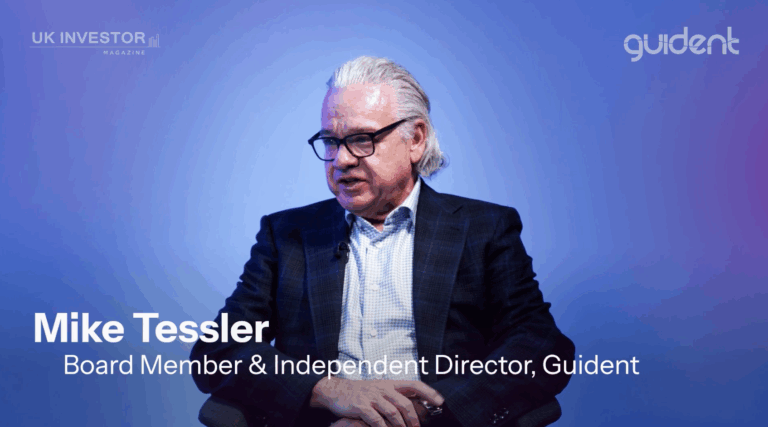
The UK Investor Magazine was delighted to welcome Guident’s Michael Tessler to discuss the future of autonomous vehicle safety and his new role as an Independent Director of Guident.
AIM movers: Trellus Health renews contract and Roadside Real Estate fundraising

Trellus Health (LON: TRLS), which has developed a digital platform to manage chronic health conditions, has secured a six-month extension to its deal with Johnson & Johnson Health Care Systems to provide Trellus Elevate for patients with moderate to severely active inflammatory bowel disease. Monthly cash burn has been reduced to $400,000. The 2025 revenues will be around $545,000. A $5m convertible facility has been secured, and the $737,500 drawdown from the facility will provide enough cash for the first quarter of 2026. The share price doubled to 0.9p.
Mongolia-focused oil and gas producer Petro Matad (LON: MATD) has received cash for past sales to PetroChina and an agreement for 2026 is being discussed. Zeus has edged up its 2025 EBITDA from a loss of $1.2m to a loss of $1.3m due to a lower than expected oil price. Net cash was $3.5m at the end of 2025. Farm out discussion continue for Block XX and Block VII. The share price increased 14.3% to 1.2p.
Operational compliance platform developer Crimson Tide (LON: TIDE) has renewed for 36-month its contract with printing press manufacturer Koenig & Bauer, where there is a long-standing relationship. The share price improved 8.82% to 92.5p.
Reabold Resources (LON: RBD) points out that Beacon Energy (LON: BCE) has published a readmission document for the purchase of its 47.4%stake in LNEnergy and is raising £3.75m. The total earn out price is €16m. Beacon Energy shares are suspended. The Reabold Resources share price rose 7.14% to 0.09p
FALLERS
Computer vison technology developer Seeing Machines (LON: SEE) says interim revenues will decline from $25.3m to up to $24m. Annualised recurring revenues have grown from $13.5m to $14m. The EBITDA loss will decline from $17.7m to below $13.7m. Cash had fallen to $3.4m, but more recently a $14.1m advanced payment has been received. Automotive production volumes continue to grow, and new legislation comes into force in the EU that mandates camera-based driver monitoring systems for new vehicles that will further boost demand. The share price slumped 21.3% to 3.305p.
Celsius Resources (LON: CLA) says that a subsidiary has exercised contractual rights to require Sodor Inc to relinquish its 60% stake in Makilala Mining Company, Inc because it has not paid any of the $5m consideration. Celsius Resources has received non-binding offers for the Opuwo project. Celsius Resources is delisting from the Namibia Securities Exchange. The share price declined 10.6% to 1.05p.
On Tuesday evening, Roadside Real Estate (LON: ROAD) raise £20.75m at 60p/share. This will be invested in building the portfolio of petrol forecourt stations. It is acquiring seven sites for £32.4m. The company’s stake in Cambridge Sleep Sciences should raise £48m in two tranches and help to finance expansion. Roadside Real Estate is expected to move into profit in the year to September 2027. The share price dipped 5.76% to 65.5p.
Education administration software provider Tribal Group (LON: TRB) announced an interim dividend of 1.3p/share and the ex-dividend date is 26 February. This replaces a final dividend that would have been paid in July. The share price fell 3.47% to 69.5p.
Exploring growth ambitions with Pathos Communications
The UK Investor Magazine was delighted to welcome Omar Hamdi, the founder and CEO of Pathos Communications, to the podcast to discuss Pathos Communications’ recent IPO and future plans.
FTSE 100 surges through 10,600 as inflation falls to 3%
The FTSE 10 surged through 10,600 on Wednesday as hopes of an interest rate cut swelled after UK inflation fell to 3%.
Any doubt that the Bank of England would cut rates in March after yesterday’s poor UK jobs data has surely been extinguished by today’s inflation data, which leaves the voting committee little choice but to reduce borrowing costs.
“A month-on-month drop in both headline and core inflation certainly delivers the goods for the UK economy, clearing the way for a fresh rate cutting campaign by the BoE,” said Chris Beauchamp, Chief Market Analyst at IG.
“It looks like Britain, and her embattled government, have managed to come through the summer’s hotter run of inflation, and provides some hope that we can see a sustained improvement in employment and growth figures by year end. Both the PM and the chancellor will hope the news arrives earlier, given the pressure on them both.”
The question on investors’ minds now is how many more rate cuts the Bank of England will make in 2026, and the market reaction suggests some are hopeful of additional support from the bank later this year.
London’s leading index was 0.8% higher at 10,648 at the time of writing.
“The FTSE 100 made new record highs above 10,600 as inflation dropped more sharply than expected to a 10-month low,” said AJ Bell investment director Russ Mould.
“This increases the chances of an interest rate cut when the Bank of England meets next month – which is typically good news for stocks and shares in general. It is also a positive for the FTSE 100 given the likely knock-on effect on the pound.
“Lower rates typically translate into weaker sterling which, in turn, flatters the overseas earnings which dominate the index.
“Mining, energy and defence firms were all in demand in early trading after results from Glencore and BAE Systems. Oil prices were higher as Trump rattled the sabres on Iran amid ongoing negotiations between Tehran and Washington over the former’s nuclear programme.”
Antofagasta was the FTSE 100’s top riser, adding 4%, as the copper miner rebounded after a wobble yesterday.
Glencore was the second top riser, gaining 3%, on the back of 2025 number. Adam Vettese, market analyst for eToro, said: “Glencore has delivered one of those classic mixed mining updates, indicating the company is better under the bonnet than the headline numbers suggest. Core earnings dipped 6% to $13.5bn as weaker coal prices offset record copper, but the second half showed a clear improvement and the trading arm once again provided a solid cushion.
BAE Systems was also among the risers after releasing its 2025 results that confirmed the benefits of increased defence spending globally. Revenue increased 10%, driving a 12% rise in EPS.
“BAE had been expected to post a very strong set of numbers, and today’s figures appear to have done the trick. After such huge gains and the corresponding surge in its valuation, the bar for outperformance has been set much higher, but for the moment the group appears capable of keeping shareholders happy,” said Chris Beachamp, Chief Market Analyst at IG.
One year on from DeepSeek: China and the tech race

Xin-Yao Ng, Manager, Aberdeen Asia Focus
The Soviet Union launched Sputnik 1, the first artificial satellite, in October 1957. Rocked by the abrupt realisation that it was trailing its arch-enemy in the nascent “space race”, America was instantly plunged into panic.
Reactions were varied in their wildness but united in their pessimism. Although Sputnik I measured only 58 centimetres in diameter, one prominent astrophysicist claimed the Soviets could land on the Moon within a week. Future President Lyndon B Johnson spoke of “a second Pearl Harbour”, while one his aides warned the US was losing the battle “for control of the universe”.
Fast-forward nigh on 70 years and, true to Mark Twain’s oft-quoted dictum, we find history might not repeat but often rhymes. The Soviet Union is no more, yet the US is now engaged in another epic technological showdown with a rival superpower – and it once again dreads the prospect of finishing as runner-up.
The “Sputnik moment” in this instance came in January 2025, with the unveiling of DeepSeek-R1. Evidence of China’s ability to produce a chatbot capable of matching and even outstripping those of the US immediately sent shockwaves around the West.
First and foremost, it became clear that the fight for AI supremacy would no longer be contested only by a handful of established American tech titans. More broadly, the prevailing notion that China should be seen as little more than a determined “fast follower” was dramatically undermined.
With $1 trillion wiped off the US stock market, even Donald Trump – not exactly an individual renowned for episodes of humility and introspection – was moved to sound a note of caution. “The release of DeepSeek – AI from a Chinese company – should be a wake-up call for our industries that we need to be laser-focused on competing to win,” he said.
What really spooked the Americans, of course, was that DeepSeek proved able to go toe-to-toe with the likes of ChatGPT despite having been developed with far fewer resources. In other words, compared to its US counterparts, China’s upstart was remarkably cheap to produce.
So where do things stand now? According to Demis Hassabis, CEO of Google DeepMind, China’s AI models may be only “a matter of months” behind the best of the West.
Considering its source, that’s quite a compliment – even if it comes with the caveat that the US remains more likely to deliver further genuine breakthroughs. Meanwhile, perhaps even more compellingly, there’s no doubt that China has carved out a clear advantage in a number of other tech arenas.
Take electric vehicles (EVs). China is now the number one exporter of EVs. Last year, with annual sales exceeding 2.25 million, BYD surpassed Tesla to become the biggest seller of battery-powered cars. Here, again, lower pricing has been key.
Relatedly, China is also the leading manufacturer of batteries for EVs, as well as for energy storage. In addition, while its enduring affection for fossil fuels continues to earn negative headlines, the world’s second-largest economy is at the forefront of sustainable energy.
Research capacity is an important driver here. According to a report by the Australian Strategic Policy Institute (ASPI), China is now at the vanguard of studies into 66 out of 74 critical technologies – including generative AI and brain-computer interfaces – leaving the US top of the heap in just eight.
In this regard, notes ASPI, a particular pattern is becoming all too familiar. In short: the US initially holds the upper hand, only for China to catch up and move ahead.
Another major factor is the renewed enthusiasm for tech in policymaking circles. Whereas entrepreneurship was in many ways strongly discouraged several years ago, Beijing now has a healthy appetite for companies keen to achieve growth by embracing the cutting edge.
Many of these are still relatively small, which can present a difficulty for investors. The basic problem is that the long-term promise of such firms is likely to go widely unrecognised – not least amid the noise that constantly surrounds the likes of Nvidia, Microsoft and other household-name mega-caps.
This is where on-the-ground knowledge and direct engagement can make a real difference to portfolio construction and management, especially from the perspective of diversification. It’s why the members of the Aberdeen Asia Focus plc team see discovering “hidden gems” as fundamental to the fund’s continued outperformance.
Unlike the incredulous Americans when their shortwave radios first picked up Sputnik 1’s distant signal, we’re not in the business of overreacting. But if we encounter something small, innovative and potentially game-changing – whether in China or elsewhere in Asia – we’re certainly likely to take a very keen interest.
Companies selected for illustrative purposes only to demonstrate the investment management style described herein and not as an investment recommendation or indication of future performance.
Important information
- The value of investments, and the income from them, can go down as well as up and investors may get back less than the amount invested.
- Past performance is not a guide to future results.
- Emerging markets tend to be more volatile than mature markets and the value of your investment could move sharply up or down.
- Investment in the Company may not be appropriate for investors who plan to withdraw their money within 5 years.
- The Company may borrow to finance further investment (gearing). The use of gearing is likely to lead to volatility in the Net Asset Value (NAV) meaning that any movement in the value of the company’s assets will result in a magnified movement in the NAV.
- The Company may accumulate investment positions which represent more than normal trading volumes which may make it difficult to realise investments and may lead to volatility in the market price of the Company’s shares.
- The Company may charge expenses to capital which may erode the capital value of the investment.
- The Company invests in smaller companies which are likely to carry a higher degree of risk than larger companies.
- Movements in exchange rates will impact on both the level of income received and the capital value of your investment.
- There is no guarantee that the market price of the Company’s shares will fully reflect their underlying Net Asset Value.
- As with all stock exchange investments the value of the Company’s shares purchased will immediately fall by the difference between the buying and selling prices, the bid-offer spread. If trading volumes fall, the bid-offer spread can widen.
- The Company invests in emerging markets which tend to be more volatile than mature markets and the value of your investment could move sharply up or down.
- Specialist funds which invest in small markets or sectors of industry are likely to be more volatile than more diversified trusts.
- Yields are estimated figures and may fluctuate, there are no guarantees that future dividends will match or exceed historic dividends and certain investors may be subject to further tax on dividends.
Other important information:
The details contained here are for information purposes only and should not be considered as an offer, investment recommendation, or solicitation to deal in any investments or funds and does not constitute investment research, investment recommendation or investment advice in any jurisdiction. Any data contained herein which is attributed to a third party (“Third Party Data”) is the property of (a) third party supplier(s) (the “Owner”) and is licensed for use with Aberdeen. Third Party Data may not be copied or distributed. Third Party Data is provided “as is” and is not warranted to be accurate, complete or timely. To the extent permitted by applicable law, none of the Owner, Aberdeen, or any other third party (including any third party involved in providing and/or compiling Third Party Data) shall have any liability for Third Party Data or for any use made of Third Party Data. Neither the Owner nor any other third party sponsors, endorses or promotes the fund or product to which Third Party Data relates.
The Aberdeen Asia Focus PLC Key Information Document can be obtained here.
Issued by abrdn Fund Managers Limited, registered in England and Wales (740118) at 280 Bishopsgate, London EC2M 4AG. The company is authorised and regulated by the Financial Conduct Authority in the UK.
Find out more at aberdeeninvestments.com/aas or by registering for updates. You can also follow us on X, Facebook and LinkedIn.
BAE Systems delivers record breaking revenue in 2025
BAE Systems has posted record-breaking financial performance in 2025, with sales climbing 10% to £30.7bn and underlying earnings per share rising 12% to 75.2p, driven by strong demand across all its business sectors.
It will come as no surprise that BAE Systems had a strong 2025, given heightened geopolitical risks and a push by governments globally to ramp up defence spending.
Underlying earnings before interest and tax rose 12% to £3,322m, with return on sales improving to 10.8%. The defence giant generated free cash flow of £2,158m, whilst its order backlog swelled to a record following £36.8bn of new order intake during the year.
“A 12% rise in operating profit tells you governments aren’t hesitating in reaching for their chequebooks,” said Mark Crouch, market analyst for eToro.
“BAE’s order book now stands at a record £83.6bn, stretching years into the horizon, and it’s why BAE shares have definitively outpaced the FTSE 100. With free cash flow set to top £6bn through 2026, that trajectory looks set to continue.”
Shareholders will receive a dividend of 36.3p per share, up 10% on the prior year.
BAE Systems shares were 3.1% higher at the time of writing, but failed to convincingly break through previous highs in the 2,150p – 2,160p region, suggesting the market may have been hoping for a little more from the group.
Nonetheless, today’s results reflect a broad increase in demand for the group’s products that more than justifies the meteoric rise in shares over the past four years.
Norway selected BAE’s Type 26 frigate for its future warship programme in a Government-to-Government agreement worth £10bn, potentially the UK’s largest ever warship export deal by value. A separate agreement saw Turkey commit to purchasing 20 Typhoon aircraft in a deal anticipated to be worth £4.6bn to BAE, sustaining Typhoon production and supporting 20,000 UK jobs.
In space, the company secured a $1.2bn contract to provide the US Space Force with space-based missile-tracking capabilities, whilst its Armored Multi-Purpose Vehicle programme reached 500 deliveries for the US Army.
The company also launched Edgewing, a joint venture with Italian and Japanese partners to design and develop the next-generation combat aircraft under the Global Combat Air Programme (GCAP).
The growing orderbook underpins BAE Systems’ orderbook, and analysts see the stock as a solid option for seeking exposure to the sector.
“Despite a good run so far in 2026, with the shares up around 15%, its valuation isn’t too demanding, especially compared to some peers. For investors looking to get exposure to the defence sector, BAE Systems remains a compelling choice,” explained Aarin Chiekrie, equity analyst, Hargreaves Lansdown.


Seeking resilient income and capital growth with Dunedin Income Growth Investment Trust
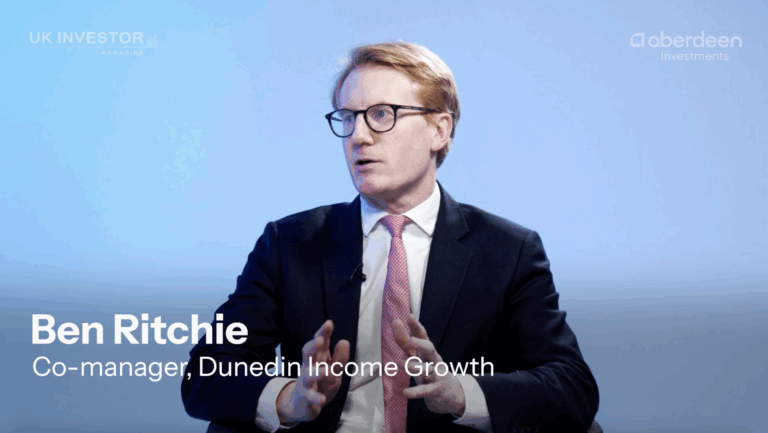
Jeremy Naylor is joined by Fund Manager Ben Ritchie to discuss Dunedin Income Growth’s differentiated approach to growing a stable income.
The Aberdeen managed Dunedin Income Growth Investment Trust has grown or maintained its dividend for over 40 years and currently yields a benchmark-beating 6.3%.
Ben provides deep insight into their thinking around core portfolio holdings, particularly Tesco for which Ben drills down into their investment thesis and why the retailer earns a place in the fund.
He and Jeremy explore the current environment for the trust’s investment style and look at where managers see opportunity.
NextEnergy Solar Fund NAV falls but dividend maintained

NextEnergy Solar Fund has published its unaudited Net Asset Value and operational update for the quarter ended 31 December 2025, revealing a drop in NAV per share driven by weaker power price forecasts.
But changing hands at 50p on Wednesday, the solar-focused investment trust still trades at a huge discount to NAV, despite falling to 84.9p from 88.8p at 30 September 2025, as third-party consultants have revised down their long-term power price assumptions.
It also trades at a significant discount to the adjusted NAV of 82.9p, which reflects the UK Government’s retrospective change to ROC and FiT inflation indexation and the switch from RPI to CPI.
That adjustment will be reflected in the 31 March 2026 year-end figures.
Total ordinary shareholders’ NAV stood at £488.4m, against a gross asset value of £997m.
Operationally, the quarter was characterised by typical winter softness. UK irradiation came in 9.3% below budget, pushing electricity generation 12.9% under target, excluding grid outages. These seasonal fluctuations are to be expected and will have little long-term impact.
Importantly for investors, there was no change on the dividend front. NESF held its quarterly payout steady at 2.11p per ordinary share, matching the prior year.
The board reconfirmed its full-year dividend target of 8.43p per share for the year ending 31 March 2026, with cover forecast at 1.1x–1.3x by earnings.
“NESF’s portfolio continues to demonstrate its underlying resilience during what has traditionally been a seasonally softer period for solar generation,” said Tony Quinlan, Chairman of NextEnergy Solar Fund.
“Despite lower winter irradiation and the impact of revised power price forecasts on our NAV, the Company remains on track to deliver its full year dividend target of 8.43p per ordinary share.
“The Government’s recent confirmation to shift ROC and FiT inflation indexation from RPI to CPI has introduced an additional headwind; however, with clarity now emerging, we are confident that NESF is well positioned to navigate this transition through the strength of its diversified portfolio and disciplined capital management approach.”
Since inception, the company has returned £431m in dividends to ordinary shareholders, equivalent to 82.6p per share.
NextEnergy Solar Fund yields around 16% at current levels.
AFC Energy receives Environment Agency approval

AFC Energy has received revised approval from the UK Environment Agency to export and sell low-carbon hydrogen produced at its pilot ammonia-cracking plant in Dunsfold, Surrey, thereby accelerating revenue generation by several months.
The revised Research and Development permit reflects the company’s ability to produce ISO 14687 grade D hydrogen at 99.97% purity, in volume, and to demonstrate safety protocols.
The Dunsfold plant can produce up to 300kg of hydrogen per day in its current configuration.
The permit revision also provides operational flexibility, allowing AFC Energy to train operatives on-site at Dunsfold ahead of the plant’s planned relocation, removing a previous scheduling constraint.
AFC Energy is progressing its Joint Venture with Industrial Chemicals Group Ltd (ICL) to establish hydrogen production at ICL’s Port Clarence facility in Middlesbrough, deploying multiple Hy-5 ammonia cracker units, each capable of producing up to 500kg of hydrogen per day.
The JV is engaging with the Environment Agency at both local and national levels to develop an accelerated permitting framework for future Hy-5 deployments across the UK.