Helix Exploration, the helium exploration and development company focused on the Montana Helium Fairway, will soon begin production at its flagship Rudyard project after resolving a minor technical issue that temporarily delayed production.
The company identified a problem with the Variable Speed Drive (VSD) during the final commissioning stages. The issue has now been fixed, with the VSD operating seamlessly.
Helix intends to provide a market update on its production milestone, alongside a broader operational review, during the week commencing 16 February 2026.
“Our team has worked tirelessly, and thanks to their dedication and expertise, we are now closer than ever to achieving a significant milestone – becoming the first helium producer in the state of the Montana,” said Bo Sears, Chief Executive Officer of Helix Exploration.
“The Board remains confident in the tremendous potential of the Rudyard project and is excited to take this important step towards production, creating value for our shareholders while contributing to the global helium market.”
Once production commences, the company plans to host several prospective offtake partners at the Rudyard site and says it will evaluate potential offtake arrangements to secure terms.
The Rudyard project is thought to be able to generate net revenue of $115 – $220 million over a 12.5 year life of field.
Anthropic, the operator of the Claude AI chatbot, has secured $30 billion in Series G funding, valuing the AI company at $380 billion post-money, in one of the largest financing rounds in technology history.
The round was led by GIC and Coatue, with co-leads including D. E. Shaw Ventures, Dragoneer, Founders Fund, ICONIQ, and MGX.
Prominent institutional investors also joined the round, with Anthropic receiving investments from BlackRock, Blackstone, Fidelity Management & Research Company, Goldman Sachs Alternatives, JPMorgan Chase, Morgan Stanley Investment Management, Qatar Investment Authority, and Sequoia Capital, among others.
The round also includes portions of previously announced investments from Microsoft and NVIDIA.
Revenue growth
The fundraising comes as Anthropic reports significant growth revenue generation. The company now has run-rate revenue of $14 billion, having grown over 10x annually in each of the past three years. This is remarkable for a business that earned its first revenue less than three years ago.
The number of customers spending over $100,000 annually on Claude has grown sevenfold in the past year. More than 500 customers now spend over $1 million annually, up from just a dozen two years ago. Eight of the Fortune 10 are now Claude customers.
Claude Code, the company’s agentic coding platform, launched to the public in May 2025 and is an example of how Anthropics’ focus on specific tasks has become a key element of customers’ workflows, helping grow the firm’s revenues. The code product has reached over $2.5 billion in run-rate revenue, more than doubling since the beginning of 2026. A recent analysis estimated that 4% of all public GitHub commits worldwide are now authored by Claude Code, double the percentage from a month prior.
“This fundraising reflects the incredible demand we are seeing from these customers, and we will use this investment to continue building the enterprise-grade products and models they have come to depend on,” said Krishna Rao, Anthropic’s Chief Financial Officer.
The Series G investment will fund continued frontier research, product development, and infrastructure expansion as Anthropic consolidates its position as a leader in enterprise AI.
Although Anthropic didn’t address an IPO in a statement released yesterday, the firm is reported to be considering a listing later this year and is in a quiet race with OpenAI to become the first foundational AI firm to list.
The FTSE 100 hit a fresh intraday record high on Thursday as markets shrugged off soft UK GDP data, and Schroders’ takeover helped lift the index.
London’s leading index was trading 0.1% higher at 10,482 at the time of writing, after touching a high of 10,535.
“The Footsie has scaled fresh heights, as demand for London-listed assets intensifies,” explained Susannah Streeter, Chief Investment Strategist, Wealth Club.
Schroders shares were 28% higher after agreeing to a £9.9 billion takeover by a US investment group.
“The mega takeover of Schroders by US institutional investor Nuveen demonstrates how overseas players are sniffing out untapped value in UK companies. The acquisition will create an asset management behemoth and, thanks to the decision to locate the merged company in London, adds shine to the City’s reputation as a leader in global asset and wealth management.”
It will, however, be a blow to London’s equity markets as another stalwart leaves the FTSE 100.
Elsewhere, several high-profile results announcements were made by FTSE 100 companies.
Unilever released full-year results on Thursday, showing fourth-quarter progress with sales and volumes increasing. However, a disappointing outlook for 2026 overshadowed any optimism around recent sales growth, and shares slipped 1%.
“Today’s results fit into a pattern of recent UK corporate updates, cautiously optimistic but by no means ambitious,” said Chris Beauchamp, Chief Market Analyst at IG.
“Sales growth targets for 2026 seem achievable, but are still short of the 5% target the company has spoken of in the past. Instead it seems investors will just have to wait and see, but with the stock trading at a more expensive level relative to its peers there’s not much room for disappointment.”
Underpressure RELX provided investors some reassurance around AI in their 2025 results with steadily growing revenues and profits.
“RELX’s latest results are a pivotal moment for the business following market concerns that Anthropic’s new legal AI tool would eat its lunch,” explained Dan Coatsworth, head of markets at AJ Bell.
“RELX’s message on AI is loud and clear – it’s an opportunity, not a threat. It has deployed AI across its own business to become more efficient and to benefit clients. However, there still feels a sense of trepidation among investors about third party AI disruption, given a muted share price reaction to the results. That is despite the company ticking all the right boxes on revenue, profit and dividend growth.”
Investors may also find some solace in the firm’s valuation and PE Ratio of around 17x earnings.
British American Tobacco weighed on the index after reporting falling revenues despite increased sales of smokeless products. BATS shares were down 2% at the time of writing.
Sancus Lending (LON: LEND) is increasing the size of its credit facility with Pollen Street Capital from £200m to £300m and extended the maturity to 11 February 2031. This will enable the company to grow property-related lending. The share price is one-third higher at 1.2p.
Digitisation services provider TPXimpact (LON: TPX) has won a second large contract this week. The latest is a four-year contract with DEFRA worth £39m. That is the second largest contract TPXimpact has ever won. The contract covers digitisation of programmes across agricultural, environmental and sustainability areas. This follows a two-year, £22m contract with NHS England. The share price increased 17.9% to 33p.
Pri0R1ty Intelligence (LON: PR1) has launched the Vox AI-powered voice agent and secured The Property Buying Company as a new client that will take two Vox licences. This should generate 10,000 outbound sales calls in the first month. The share price improved 7.69% to 2.1p.
Inspiration Healthcare (LON: IHC) says that revenues were ahead of expectations in the year to January 2026. Revenues are expected to rise from £38.3m to £47.5m, including more than £8m from one-off exports, while the loss will be slashed from £3.1m to £400,000. The medical technology supplier will find it difficult to maintain revenues this year, despite the recent US hospital order. The share price recovered 7.25% to 18.5p.
Europa Oil & Gas (LON: EOG) raised £641,000 from a retail offer at 1.2p/share. A placing had raised £3.5m. The cash will finance the company’s share of the drilling costs of the Barracuda prospect in Equatorial Guinea. Europa has a 42.9% interest in Antler Global, which has a 40% interest in Barracuda, although it only has to fund 5% of costs up to $53m. That should leave more than £2m for working capital. The share price rose 5.77% to 1.375p.
Griffin Mining (LON: GFM) says gold production has started in Zone III of the Yuan Long orebody at the Caijiaying Mine in China. Drilling is expanding the contained gold estimate for the orebody. The share price gained 5% to 336p.
There are some places that have a share price jump for Origin Enterprises (LON: OGN) shares, but that is due to a change in currency from €4.25/share on Wednesday to 370p/share. Taking an exchange rate of €1.15/£ the Wednesday share price was 369.6p, so there has been a small gain.
FALLERS
Strategic Minerals (LON: SML) reported positive results from exploration at the Redmoor tungsten tin copper prospect in Cornwall. Drillhole CRD037 has intersected the central portion of the target and confirmed continuation of high-grade mineralisation, including silver. The share price fell 4.23% to 3.4p.
Uranium investor Yellow Cake (LON: YCA) increased the amount of cash raised in a placing at 629p/share from £55m to £80.6m because of investor demand. This will fund the purchase of 1.16 million pounds of physical uranium at $86.15/lb – a 2.1% discount to the spot price – and other opportunistic purchases. The implied pro forma NAV at the uranium purchase price is 629p/share. The share price dipped 0.89% to 640.75p.
Ex-dividends
Samuel Heath (LON: HSM) is paying an interim dividend of 4.5p/share and the share price slipped 30p to 355p.
Knights Group Holdings (LON: KGH) is paying an interim dividend of 1.94p/share and the share price is 0.25p to 184.75p.
Oxford Metrics (LON: OMG) is paying a final dividend of 3.25p/share and the share price dipped 3.3p to 55.9p.
Ramsdens Holdings (LON: RFX) is paying a dividend of 11p/share and the share price fell 15p to 430p.
Renew Holdings (LON: RNWH) is paying a final dividend of 13.33p/share and the share price declined 7p to 923p.
Thomas Moore, Manager of Aberdeen Equity Income Trust, and Iain Pyle, Manager of Shires Income, discuss the rationale, structure and shareholder implications surrounding the proposed combination of Aberdeen Equity Income Trust with Shires Income.
Automation is really no longer a secondary aspect of the forex trading environment. Instead, it is changing the very nature of the marketplace, from the speed of execution to the real-time management of risk. The world is one of constant data flow and diminishing profit margins. The digital strategy is no longer a choice; it’s a necessity. The measure of a trader is no longer the amount of time they spend gazing at a screen.
The global currency marketplace is really shifting from a manual chart-watching environment to one driven by speed, precision, and a systematic approach to trading. This is true for the institutional trading environment and for individual traders as they navigate the uncertain world of 2026.
The Evolution of Execution Speed
Human reaction times are being consistently surpassed by the conditions of the modern market, making manual intervention less practical than ever. Most of the volume in the world’s markets is now handled by automated systems, largely because economic data releases can trigger decisive market moves in milliseconds.
When you finally enter the market in response to these movements, they have probably already been factored in.
Process automation enables data to be acted upon instantly, enabling entries and exits with an accuracy that human input alone cannot match. This helps maintain profit margins that would otherwise erode in the fast-paced market environment. You don’t have to be stuck in front of a screen for hours anymore just to catch a single opportunity.
Instead, market conditions are continuously monitored by technology, allowing you to focus on broader market movements in the background.
When the markets are in a state of fluid change between different price points, speed is less about making trades and more about protecting the integrity of your strategy. This means automated execution systems can help you apply your rules as soon as they are presented, not seconds later when the opportunity may have passed.
When every second counts in the markets, delays of just milliseconds can significantly impact your results over time.
Enhancing Precision with Automated Forex Strategy Tools
Modern systems extend far beyond basic order placement. They provide a structured framework for managing exposure across multiple currency pairs at once. Using automated forex strategy tools, your predefined rules are applied consistently, without hesitation or emotional bias.
These tools can monitor dozens of indicators and price behaviours simultaneously, identifying high-probability setups across both major and emerging-market pairs in real time.
They also support extensive backtesting, running thousands of strategy variations on historical data to identify stable configurations. This shifts decision-making away from instinct and toward measurable probability.
You can assess how a strategy would have performed during periods such as the 2008 financial crisis or the Brexit referendum, building confidence in the system’s resilience. That historical perspective offers a level of reassurance that manual trading struggles to replicate.
Adaptive Risk Management and Drawdown Control
Risk management has shifted from traditional static to dynamic risk management. This means the size of the positions is now controlled using data rather than assumptions. For example, if the spreads widen or the prices are not behaving properly, the size of the positions can be scaled down or the trading can be stopped altogether until the prices behave properly.
Also, real-time monitoring of drawdowns ensures that the losses do not exceed the acceptable level. This feature reduces the risk of compounding losses during periods of volatility. Automated hedging ensures risks are hedged with correlated products.
Similarly, smart order routing ensures orders are routed to secure the best prices and minimise costs. This feature ensures that, over time, performance is smoother by reacting to risks rather than losses.
The Strategic Value of Tools
The real power of automation is in its ability to transform vast amounts of data into useful knowledge. As automated forex strategy tools become a part of your daily process, your focus is no longer on making a particular trade, but instead on how to improve the overall system.
Years’ worth of data can be used to identify structures and reactions over time that would be impossible to learn through manual methods.
This is not a tool meant to replace a trader. Rather, it is meant to enhance a trader. By offloading some of the scanning and trading process to a computer, you allow your mind to focus on what is working, what is not, and how to improve your overall strategy.
Trading is no longer driven by emotion; it is driven by consistency. Trading is no longer driven by reaction but by refinement.
Future-Proofing Portfolios Against Market Fragmentation
However, as global markets fragment, it is essential that strategies adapt. Automation enables strategies to react to changing environments. It can seamlessly shift between trend-following and mean-reversion approaches. Therefore, it ensures that strategies remain relevant despite changes in central bank policies, liquidity, or geopolitical allegiances.
The best way to approach this is through partnership. The machines will process information quickly, while you will provide guidance. Through this partnership, you will be able to navigate the forex markets effectively.
Stability, predictability, and speed are essential. Therefore, by adopting this technology, you can prepare your portfolio for what is coming rather than reacting to what has been.
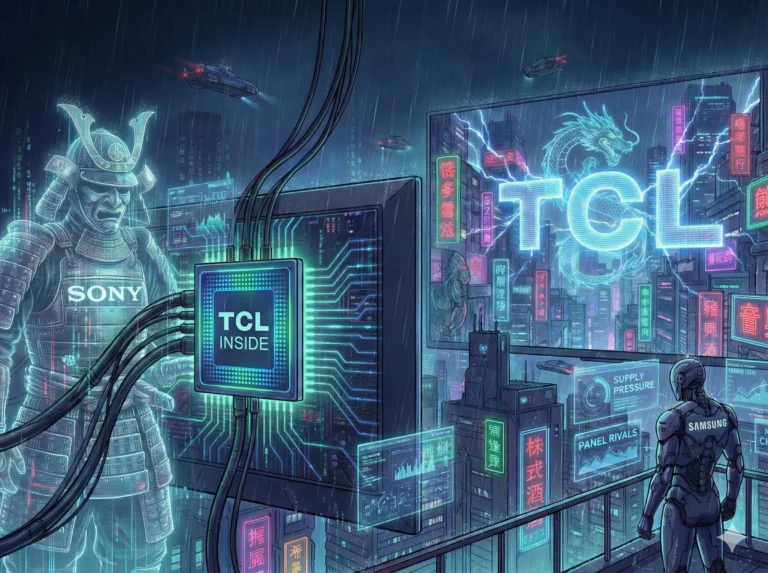
Sony TV: Japanese “Soul,” Chinese “Body”: Sony recently handed effective control of its TV business to TCL, marking the endpoint of a 15‑year structural shift from Japanese to Chinese TV manufacturing. The move signals the end of the “Japanese precision” era in the TV market.
Samsung: The Last Titan: With Sony stepping back, Samsung remains the only major non‑Chinese global TV champion. But it faces growing pressure: shrinking supply options, the need to buy panels from rivals, and price/performance challenges from Chinese Mini‑LED.
TCL: Hardware + Software + Audience: TCL combines upstream panel scale (CSOT), a Google TV‑first OS (better UX, lower R&D cost) and gamer‑centric features (144Hz, low input lag). That integrated strategy compresses costs, narrows premium differentiation, wins younger buyers, and threatens incumbents’ share and margins.
The “Currys” Test
Walking into a Currys or John Lewis and shoppers may see two 75‑inch TVs side by side:
Sony Bravia: £1,499. Sales pitch: “Japanese precision” and “cinema quality.”
TCL: £899. Sales pitch: “Budget option.”
Shoppers assume the £600 premium buys better hardware, quality, and longevity. In reality, both are likely built around the same Chinese display panels. That £600 gap is largely a brand premium: a “logo tax.”
The “Bravia” Surrender
Sony stopped making TV panels years ago and has long sourced them from Chinese and Korean suppliers, focusing instead on image‑processing and system integration.
As Sony’s global TV share slid below 2%, scale and margin pressures pushed the company to pivot towards higher‑margin businesses such as gaming, music, film, and anime.
In response, Sony recently formed a joint venture with TCL (51% TCL / 49% Sony) to transfer control of its TV business to TCL. The JV targets starting operations in April 2027.
What the JV means: Sony effectively “licenses” its brand equity and image‑processing capability, while TCL brings panel and manufacturing scale. Product lines will likely combine TCL’s hardware with Sony’s chips and tuning.
For consumers, the practical difference between premium and budget models will narrow as vertically integrated Chinese manufacturers supply the core components.
For Sony, the move is a strategic retreat to focus on content and entertainment while retaining a branded presence in TVs.
TCL’s upside: TCL gains a premium global brand and Sony’s video processing know‑how, accelerating its climb up the value chain.
The JV strengthens TCL’s position to challenge incumbents such as Samsung in mid‑to‑high segment, reshaping competitive dynamics in global TV markets.
The Timeline of Surrender
The Sony–TCL deal is the final chapter in a 15‑year shift in which Koean and Japanese TV makers have ceded manufacturing and scale to rising Chinese players.
2009: Pioneer discontinued the legendary “Kuro” plasma line, as it was unable to justify costs vs cheaper LCDs.
2012–2014: Hitachi and Philips exited manufacturing and licensed their TV brands to Chinese OEMs.
2016: Sharp, long regarded as an LCD pioneer, was acquired by Foxconn (Hon Hai).
2017: Toshiba sold its TV unit to Hisense, handing a 40‑year legacy to a Chinese challenger.
2022: Samsung Display closed its last LCD factory to focus on OLED, leaving Samsung’s low-to-mid end TV models reliant on external panel suppliers.
2026: TCL acquired LG Display’s Guangzhou LCD plant, boosting Chinese panel capacity.
2026: Sony spun off its TV business into a joint venture with TCL, where TCL holds a 51% controlling stake.
TCL: The Two-Headed Dragon
TCL ranked No. 2 globally in terms of TV shipments, behind Samsung with 16% market share.
Source: Counterpoint, AP
The historical gap has narrowed substantially. In 2015 Samsung shipped about four times as many units as TCL. By late 2025, the difference had materially compressed. In several regions, including Eastern Europe and the Middle East & Africa, TCL already leads in volume. We expect a global leadership flip to be likely in 2026–2027.
Source: Counterpoint, TrendForce, Omdia, HIS, AP
TCL’s dual structure: Kitchen vs Restaurant
The Kitchen — TCL Technology (000100.SZ)
Focus: upstream manufacturing for semiconductors, display materials, and photovoltaic modules.
Asset base: CSOT (China Star Optoelectronics Technology) panel fabs and other upstream capacity.
Role: supplies panels (and related components) to TV brands, including third parties. The recent acquisition of LG Display’s China LCD plant in early 2026 increases scale and lowers unit costs.
Investment character: a commodity‑cyclical industrial play exposed to capex cycles and panel pricing.
The Restaurant — TCL Electronics (1070.HK)
Focus: downstream consumer products and branding.
Role: Assembles TVs using panels from the kitchen, manages distribution, and markets under TCL (and Sony/BRAVIA under JV arrangements).
Advantage: Tight upstream affiliation with CSOT secures supply, compresses cost, and allows aggressive pricing and faster product rollouts.
Rise of the Chinese bloc in the global TV market
The global TV market has shifted materially over the past decade, driven by consolidation of supply, faster Chinese scale-up, and changing technology mixes.
The collapse of the old guard
LG: Dominates OLED with over 50% share, but its overall unit volume has declined. LG’s OLED strength does not translate well to the mass‑market LCD/Mini‑LED segments where Chinese competitors compete aggressively on price and scale.
Sony: Market share has fallen from roughly 5% a decade ago to under 2% currently. The joint venture with TCL appears to be Sony’s de‑risking and exit path from a manufacturing model that no longer delivers scale or margins.
The rise of the Chinese bloc
Rapid share gains: The combined shipment share of TCL and Hisense rose from about 11% in 2015 to roughly 26% currently, closing the gap on the Korean bloc (Samsung and LG).
Structural advantages: Chinese players benefit from vertically integrated supply chains (panel fabs, backlights, modules), lower cost structures, aggressive capex, and tight upstream‑downstream coordination that compresses unit costs and accelerates product rollout.
Source: Counterpoint, TrendForce, Omdia, HIS, AP
Samsung : The Last Titan
With Sony effectively exiting TV manufacturing, Samsung stands as the last major non‑Chinese global TV player. Having said that, it is facing intensifying pressure from Chinese rivals such as TCL and Hisense.
Global share dynamics: TCL has overtaken LG to become the No. 2 TV shipper and is closing the gap with Samsung, driven by aggressive expansion in Europe and MEA and strength in mini‑LED. Korean brands are losing share in many regions.
Panel supply vulnerability: After Samsung exited LCD panel manufacturing in 2022, it no longer owns a broad LCD supply base. For mid‑range models, it must source panels from suppliers such as TCL/CSOT, effectively financing its key competitor and exposing Samsung to supply‑chain and margin risk.
Flagship tech under attack: Samsung’s OLED delivers superior “perfect black” performance but at a significantly higher cost, especially above 77 inches, where OLED pricing rises sharply. TCL’s mini‑LED implementations now approximate OLED picture quality at a fraction of the price, eroding Samsung’s premium advantage, especially in the growing super‑large TV segment (>75 inches).
The “OS” War
Beyond hardware, software strategy has become a decisive battleground. Samsung and LG double down on proprietary ecosystems, while TCL embraces a different path with Google TV.
Samsung / LG — the “walled‑garden” strategy
Objective: Own the OS (Tizen, webOS) to capture user traffic, ad revenue, and service monetisation.
Tradeoff: Proprietary UIs are often cluttered, include intrusive or unskippable ads, and require heavy in‑house R&D to keep up with platform features and developer ecosystems.
TCL — the “Android” strategy
Objective: Adopt Google TV as the native OS rather than build and maintain a proprietary platform.
Advantage: Saves software R&D and maintenance costs, provides consumers a familiar, well‑supported interface, and delivers faster access to apps and features that users actually want.
Outcome: TCL delivers a cleaner, faster, and more intuitive TV experience that often outperforms many “premium” Korean models on UX metrics.
In our view, proprietary ecosystems might offer monetisation upside, but in practice many consumers prefer the simplicity and breadth of a Google TV‑based experience and favour brands that adopt open, familiar platforms.
Capturing the “Console Generation”
Traditional TV brands prioritise “cinema fidelity” — perfect skin tones, director’s intent and deep blacks. TCL targets a different, fast‑growing segment: console gamers.
Feature gap: Historically, features like 144Hz and Variable Refresh Rate (VRR) were reserved for flagship TVs, limiting high‑refresh gaming to premium buyers.
Democratization of gaming tech: TCL pushed 144Hz VRR and low input‑lag into mid‑range models, making pro‑level console performance accessible to mass markets.
Demand shift: Younger buyers prioritise responsiveness and frame rate over subtle film grading. By optimising for input lag, refresh rate, and game modes, TCL aligned product design with this demographic’s needs.
As a result, TCL captured an expanding group of buyers who value gaming performance. Offering gamer‑centric features at competitive prices differentiates TCL from legacy premium brands still focused on cinematic picture tuning, helping TCL win both market share and brand loyalty among the next generation of TV purchasers.
Source: Amazon, AP
The Geopolitical Hedge: Global Production
TCL does not ship finished televisions across the world; it ships components. Key components such as panels are shipped from China to local assembly hubs overseas, where the final product is screwed together.
For the EU & UK: The Zyrardow, Poland plant. This facility allows TCL to service the European market with inventory that qualifies as EU Origin. By shipping components and assembling locally, they bypass the import duties that plague pure-play Asian exporters.
For the US: The Juarez, Mexico plant (MASA). TVs rolling out of this factory are stamped “Assembled in Mexico,”effectively shielding them from US-China trade war tariffs.
This article is a “periodical publication” for information only and is not investment advice or a solicitation to buy or sell securities. This article does not constitute a “personal recommendation” or “investment advice” under UK FCA regulations. Investing in equities involves significant risk. The author holds NO position in the securities mentioned. There is no warranty as to completeness or correctness. Please do your own due diligence or consult a licensed financial adviser. Please read the Full Disclaimer before acting on any information. Images created with the assistance of Gemini AI.
New ONS data showed that UK GDP growth for the fourth quarter remained at the painfully slow rate of just 0.1%, matching the third quarter.
Growth of 0.1% during the period was weaker than the 0.2% economists expected.
Slow growth won’t come as a surprise after the economy almost ground to a halt as businesses and consumers fretted about the budget’s outcome and reacted to a raft of new measures.
The services industry was flat during the period, while construction output fell 2.1%. Household and government spending helped steady the ship, with fractional growth.
“The UK economy ended 2025 firmly in the slow lane, undershooting expectations and remaining in a low gear in the final quarter of the year as businesses and consumers digested the Chancellor’s November Budget,” said Scott Gardner, investment strategist at J.P. Morgan Personal Investing.
“This marks a clear reversal in fortunes for the economy after strong growth shown in the first half of the year failed to carry over into the rest of 2025.”
The ONS estimates that the UK economy grew 1.3% in 2025 after posting growth of 1.1% in 2024.
Headlines from Unilever’s full-year results were strong and show signs of improvement. Unilever delivered underlying sales growth of 3.5% in 2025, which accelerated to 4.2% in the fourth quarter, as the consumer goods giant completed its strategic transformation following the demerger of its Ice Cream business.
However, revenue slipped 3.8% to €50.5 billion on a reported basis due to adverse currency impacts and disposals, despite volume growth strengthening to 1.5% for the full year and 2.1% in Q4.
The acceleration in the fourth quarter should be a reason for optimism.
Unilever’s Power Brands, representing 78% of turnover, led performance with 4.3% underlying sales growth and 2.2% volume growth. Beauty & Wellbeing posted the strongest growth at 4.3%, followed by Personal Care at 4.7%.
“Unilever’s fourth-quarter underlying sales landed ahead of market expectations, driven by impressive volume growth. The pace of sales growth ramped up throughout the year, highlighting that the group’s innovation plans and sharpened focus on emerging markets are bearing fruit,” explained Aarin Chiekrie, equity analyst, Hargreaves Lansdown.
The fly in the ointment and the reason why shares were trading down by around 2% on Thursday was a disappointing outlook.
Unilever said: “2026 growth is expected to be at the bottom end of the underlying sales growth range reflecting the slower market conditions.” This isn’t something investors want to hear.
After years of struggling with sales growth amid inflationary pressures and global economic uncertainty, the fourth quarter could have been a turning point for the group. But the outlook has dashed those hopes.
Schroders shares soared on Thursday after agreeing to a recommended £9.9 billion takeover by Nuveen, the asset management arm of US insurance giant TIAA.
Under the terms of the transaction, Schroders shareholders will receive 590p per share in cash, plus permitted dividends of up to 22p. This represents a 29% premium to Tuesday’s closing price of 456p.
The offer values Schroders at 612p, assuming full dividend payment. That’s a 47% premium to the three-month average share price and 61% above the twelve-month average. The takeover price has been struck at a share price not seen since 2022.
The deal values Schroders at 17 times adjusted operating profit for 2025.
Schroders shares were 29% higher at 589.5p at the time of writing, reflecting strong shareholder support for the deal, which isn’t likely to face many hurdles.
Nuveen has secured irrevocable undertakings from the Schroder family interests and certain directors, covering approximately 42% of the company’s issued share capital.
The takeover was announced alongside full-year results, which showed Schroders’ AuM rose 6% to £823.7 billion over the past year as profit before tax jumped 21% of £673.8 million.
Creating a Global Giant
The combination will create one of the world’s largest active asset managers, with nearly $2.5 trillion in assets under management balanced across institutional and wealth channels.
London will serve as the combined group’s non-US headquarters and largest office, housing around 3,100 professionals. The Schroders brand will be retained.
Nuveen has indicated that any future listing of Schroders or the combined group would include London as one of the dual listing venues, subject to analysis at the time.
“In a competitive landscape where scale can help deliver benefits, in Nuveen we see a partner that shares our values, respects the culture we have built and will create exciting opportunities for our clients and people,” said Richard Oldfield, the Group Chief Executive of Schroders.
“The transaction will significantly accelerate our growth plans to create a leading public-to-private platform with enhanced geographic reach and a strengthened balance sheet. Together, we can create an exceptional opportunity to provide clients with a true breadth of high-quality solutions to meet their evolving needs.”