AIM movers: Pulsar Helium discovery and Galantas Gold profit taking

18

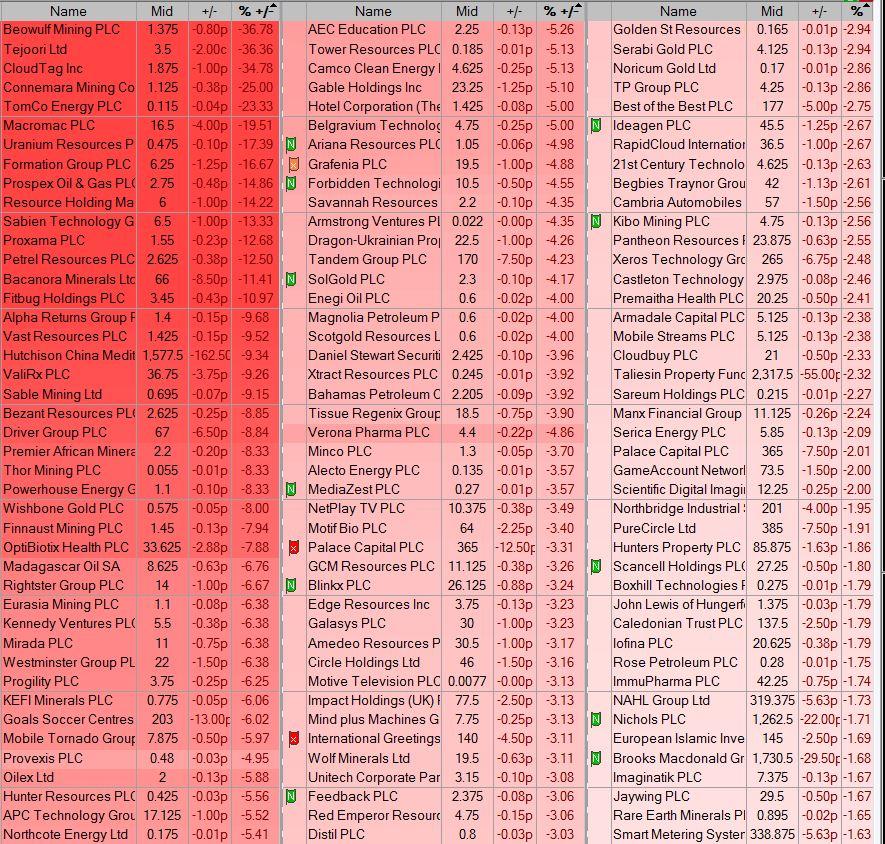
Quadrise (LON: QED) non-executive director Dilip Shah had sold 1,000 shares at 6.55p on 17 January 2025 and was transferred 35 million shares and not 34.16 million shares in December as previously announced. Because of his failure to comply with company share trading policy he has stepped down from the board. The share price increased 9.8% to 2.8p.

Pulsar Helium (LON: PLSR) says that the Jetstream #5 appraisal well at the Topaz project in Minnesota has encountered an additional pressurized gas influx at approximately 2,857 feet in depth. This new gas zone is estimated at around 1,292 psi, the highest recorded to date at Topaz. The drilling of the hole continues before moving to the next well. The share price improved 7.98% to 57.5p.

Biopesticides developer Eden Research (LON: EDN) has achieved a second regulatory authorisation this week with fungicide Novellus+ gaining approval in Chile. This is used in wine and table grapes to control grey mould (Botrytis cinerea) and powdery mildew (Uncinula necator). Earlier in the week Mevalone was granted approval in France to use on grapes to control downy and powdery mildew. The share price rose 8.2% to 3.3p.

FALLERS

Shareholders in Indus Gas (LON: INDI) voted in favour of leaving AIM and that will happen on 23 January. JP Jenkins will provide a matched bargains facility. The share price slumped 32.4% to 1.85p.

Galantas Gold (LON: GAL) has been hit by profit-taking after the jump following news that it is acquiring 100% of the Andacollo Oro gold project in Chile. The share price slipped 15.2%, but it has trebled over the week.

Sunrise Resources (LON: SRES) says that the option period for the sale of Hazen project without being exercised. Sunrise Resources will retain the project, which is non-core. The share price dipped 9.09% to 0.025p.

ValiRx (LON: VAL) has entered a nine-month, evaluation and material transfer agreement with The Royal Institute for the Advancement of Learning/McGill University and The Institute for Research in Immunology, and Cancer-Commercialization of Research in Canada. This will evaluate a RNA Helicase inhibitor. ValiRx will own the evaluation results, and they can be swapped for a 15% take in the company set up to commercialise the technology. The share price fell 4.88% to 0.39p.

The London Robotaxi: Why Uber & Lyft Are Betting on Baidu?

2

(Analysis for informational purposes only. Capital at risk.)

Summary

  • The Strategic Signal: Uber & Lyft’s 2026 Robotaxi partnership with Baidu in London underscores the competitiveness of Chinese low-cost autonomous driving solutions in the international market.
  • The Valuation Dislocation: At current levels, Baidu trades at a structural dislocation. Our Sum-of-the-Parts (SOTP) analysis implies the Apollo Robotaxi unit is effectively priced at ~7 cents on the dollar relative to Waymo’s private market benchmark.
  • The “Show me the money” Test: Ultimately, the sector is pivoting from “promise” to “profit.” Robotaxi platforms must pass the “show me the money” test by demonstrating sustainable unit economics to justify and sustain their valuations.

Uber, Lyft and Baidu signal a step‑change for UK robotaxi development

Uber and Lyft’s decision to partner with Chinese tech giant Baidu to test robotaxis in London in 2026 marks a major milestone for autonomous driving in the UK and an acceleration of Chinese autonomous driving expansion into Europe. The move follows Waymo’s recent entry into the UK market and suggests a wave of new entrants from 2026 onwards.

After earlier attempts to build in‑house autonomous driving systems, Uber and Lyft are now prioritising their core competency—network operations—while outsourcing vehicle autonomy to technology partners. Choosing Baidu rather than a U.S. supplier is notable given ongoing U.S.–China geopolitical tensions in technology and underscores the competitiveness of Chinese autonomous driving technology in the international market.

The ‘Regulatory Firewall”

While the partnership appears to be a technological and operational choice, it also serves as a risk-transfer mechanism that protects Uber’s and Lyft’s balance sheet under the UK’s Automated Vehicles Act 2024.

The Act shifts criminal and civil liability from the driver to the “Authorised Self-Driving Entity” (ASDE). Securing ASDE status requires significant capital reserves for insurance and safety validation. By partnering with Baidu, Uber and Lyft are constructing a “Regulatory Firewall”:

  • Baidu (The ASDE): Assumes the regulatory burden, insurance costs, and legal exposure as the manufacturer/operator.
  • Uber/Lyft (The Broker): Retains the customer relationship and booking fee while keeping the “crash risk” off their balance sheet.

This structure potentially allows the ride-hailing giants to remain asset-light and liability-remote, outsourcing the cost of UK regulatory compliance to Baidu. For Baidu, absorbing this liability is the strategic “cost of entry” required to deploy its RT6 fleet in Europe’s most valuable mobility market.

Baidu’s offering: Apollo RT6 and cost advantage

Baidu will deploy its Apollo RT6 — a purpose‑built EV for ride‑hailing — in the UK tests. The RT6 is equipped with 38 sensors, including eight LiDARs, and has an estimated cost of roughly £ 21k (CNY 200k), significantly lower than Western competitors like Waymo, which carries an estimated cost of over £80K.

Source: The company, AP

For Uber and Lyft, this effectively imports Chinese manufacturing deflation into the UK. Baidu has already achieved unit-economics breakeven in Wuhan. By utilizing an low-cost fleet, operators can achieve fleet profitability significantly faster than competitors burdened by high hardware cost.

Why the UK matters for L4?

The Automated Vehicles Act 2024 strengthens the UK’s position by shifting legal liability for Level‑4 (L4) autonomous operation from the user to the manufacturer once safety cases are approve1d, and by allowing scaling once regulators are satisfied. This single‑act approach also provides a more centralised, predictable framework than the more fragmented regulatory regimes in some EU countries, such as France and Germany.

UK’s Autonomous Driving Roadmap

The UK government has established a long-term autonomous driving strategy anchored by 2035 targets, while the broader industry generally views 2030 as the “tipping point” leading up to that goal.

  • 2030: Commercial self-driving services operational across the UK’s Strategic Road Network, moving beyond isolated city pilots to inter-city logistics and mass transit.
  • 2035: The UK connected and automated mobility (CAM) sector is projected to generate £42bn in economic value and create 38,000 skilled jobs, with roughly 40% of new car sales expected to feature significant self-driving capabilities.

Source: UK government policy papers, SMMT, Frost & Sullivan

The “Big Four” in L4 autonomous driving

We identify four leading L4 players: Waymo (Alphabet), Baidu (BIDU / 9888.HK), Pony AI (PONY US/2026 HK), and WeRide (WRD US/800 HK). Waymo remains the leader in fleet size and driverless mileage, with Baidu a close second. Pony AI and WeRide are smaller individually, but collectively Chinese players operate at a comparable scale to Waymo.

  • Waymo: fleet ~2,500 vehicles, ~204m km driverless mileage, ~450k paid rides per week, ~20m km of total robotaxi rides in the U.S. Waymo’s vehicles (e.g., Jaguar, Zeekr models) are materially more expensive on a per‑vehicle basis than Baidu’s RT6.
  • Baidu: About 240m km of AV testing, of which 140m km were driverless. Apollo Go reportedly operates over 1,000 robotaxis, has completed over 17m rides, and now fulfills approximately 250k fully driverless orders per week.
  • Pony AI: About 1,000 robotaxis currently; target fleet of 3,000 by 2026; international expansion into Qatar, South Korea, Singapore, and Luxembourg.
  • WeRide: About 1,000 robotaxis and >1,600 L4 vehicles, About 55m km of L4 mileage, and international licenses across US, UAE, Saudi Arabia, Singapore, and several European countries.

Source: The companies

Tesla as a looming contender

Tesla is a credible challenger despite a later commercial robotaxi push (mid‑2025). Its advantages are a massive driving dataset (over 7bn miles of FSD usage) and market-leading FSD software. Currently, Tesla has about 1,000 robotaxis but still requires human safety drivers.

Commercialisation remains in an early stage

L4 robotaxi services are still at an early commercial stage; revenue contribution and profitability for most operators remain limited:

Waymo: Waymo’s standalone financials are not disclosed by Alphabet, but it is widely believed to be operating at substantial losses due to heavy ongoing investment in technology, fleet expansion, and operations. Reportedly, Waymo is in talks to raise over USD 15bn in a new funding round at a potential valuation of up to USD 100bn—more than double its reported USD 45bn valuation from October 2024. If completed, the deal would provide a new valuation reference for other L4 robotaxi platforms.

Baidu (BIDU US/9888 HK): By Oct 2025, Apollo Go recorded ~240m autonomous km (140m fully driverless). In 3Q25 Apollo Go delivered 3.1m fully driverless rides, up 212% YoY. Baidu has not disclosed material revenue from autonomous driving; its near‑term earnings remain dominated by online marketing (c.62% of revenue) and AI cloud/applications (c.38%).

Pony AI (PONY US/2026 HK): Operating ~1,000 robotaxis and expanding internationally. 3Q25 revenue was ~USD 25m (+74% YoY), but the company posted a USD 61m net loss in the quarter (net margin ≈ -241%), with R&D (~USD 60m) heavily outweighing current revenue.

Source: The company

WeRide (WRD US/800 HK):As of Oct 2025, the company reported ~750 robotaxis, >1,600 L4 vehicles, and ~55m km of L4 mileage. 3Q25 revenue rose 144% YoY to ~USD 24m, but WeRide reported a USD 43m quarterly net loss (net margin ≈ -179%), again reflecting high R&D spend (~USD 44m). By end-2025, its Robotaxi reached 1,000 and company plans to reach hundreds of thousands of Robotaxis by 2030. 

Source: The company

On a positive note, Chinese robotaxi operators are reaching or approaching unit‑economics breakeven in selected markets. Baidu has achieved unit‑economics breakeven in Wuhan, while Pony AI recently reached breakeven in Guangzhou following the rollout of its Gen‑7 robotaxis. WeRide expects to reach breakeven in Abu Dhabi after securing permission to remove the in‑vehicle safety officer. These milestones suggest robotaxi platforms are moving toward a “profitability inflection point” where proven unit economics in a few core cities can be replicated elsewhere.

Baidu’s Valuation Paradox: ‘Free Option’ on Autonomy?

The London pilot exposes a disconnect in global valuation multiples.

Waymo, the leading US player, has reportedly seeking valuations exceeding USD100bn in recent capital raises. On the other hand, Baidu—China’s leading player —trades at a market cap of about USD50bn. But Baidu is not a pure-play AV startup; it is a internet conglomerate with various segments.

To access the implied value of the autonomous driving unit (Apollo), we perform a SOTP analysis as below.

  • Net Cash & Investments: Baidu holds ~USD 21bn in net cash and long-term investments (after holding discounts).
  • Cloud Business: Valuing the AI Cloud division at a conservative 3x P/S yields ~USD 15bn.
  • Search business: Even applying a distressed 5x P/E multiple to the mature advertising business contributes ~USD 7bn.

The Implied Alpha: When these components are deducted from the market cap, the implied value assigned to Apollo is approximately USD 7bn.

At current levels, investors are paying a ‘distress price’ for the search business and acquiring the Apollo option for ~7 cents on the dollar relative to Waymo.

Asset ComponentNet Value
(USD bn)
Per Share (USD)Methodology (with 25% holding discount)
Cash & Investments2163Book Value
AI Cloud12362.5x Price/Sales
Core Search (Ads)7195.0x P/E (Distress multiple)
iQiyi12
Sum of Non-Robotaxi Assets41120
Current Market Cap48142
Implied Value of Apollo721(Market Cap – Sum of Assets)
Benchmark: Waymo100Private Market Valuation
Discount to Waymo93%

The risk-reward profile

As discussed above, the market has priced Baidu’s autonomous ambitions at low value. This creates an asymmetric risk-reward profile:

  • Downside protection: Supported by the profitable search utility and a net cash position covering ~40% of the market cap.
  • Upside optionality: Exposure to the only non-US autonomous fleet with global scale, entering a Tier-1 Western market with a structurally lower cost base.

Should Baidu can demonstrate positive unit economics in a high-labour-cost market in the long run, a re-rating of the Apollo asset might happen.

The Valuation regime: From ‘proxies’ to ‘profits’

While Baidu’s individual valuation appears dislocated, it suffers from a broader industry skepticism.

Valuing robotaxi platforms such as Waymo is challenging because commercialisation is still nascent and companies are investing heavily in R&D and fleet expansion. With “small revenue, big losses” profiles, conventional multiples such as P/E or P/S based on current or near‑term financials are often meaningless.

One approach is to build a long‑term financial forecast (for example, a 10‑year model), apply DCF techniques, or use EV/EBITDA or P/E on long‑dated estimates (e.g., 2030E) and discount back to today. However, these long‑horizon methods are sensitive to assumptions and less reliable when industry visibility is low and outcomes hinge on regulatory shifts, unit economics, and competitive dynamics.

Alternatively, investors can supplement traditional metrics with scale‑oriented proxies—for example, price‑per‑vehicle or price‑per‑ride—that capture fleet size and commercial activity.

Price per vehicle: This metric values the implied value for each autonomous vehicle as a revenue generating asset like a hotel room.

Price per weekly ride: This effectively values the volume of commercial activity, instead of just the asset (fleet) size. This is the “Facebook DAU (Daily Active User)” metric for Robotaxis.

For instance, PE investors recently reportedly valued Waymo at about USD100bn, based on its 450,000 paid weekly rides and 2,500 vehicles, which implies a valuation of roughly USD222,000 per weekly active ride or USD40mn per vehicle. On the other hand, the public equity market is valuing USD6.8mn per vehicle and USD2.9mn per vehicle for Pony AI and WeRide respectively, much lower than Waymo.

Source: AP

On the flip side, these alternative metrics are essentially “proxy” valuations, focusing on top-line activities (rides and vehicles) and ignoring crucial fundamentals such as unit economy, cost-per-miles, utilization, cash flows, etc.

In addition, the market is applying a significant premium to Waymo, reflecting a perceived moat and first‑mover advantage. Should an emerging player like Tesla successfully enter the market and achieve scale, such premium (and implied per‑vehicle valuations) could compress sharply.

The Ultimate “Show Me the Money” Test

Ultimately, robotaxi platforms must pass the “show me the money” test. Currently, many valuations are premised on promise — fleet size, miles and ride volume — but over time investors will demand proof of sustainable profitability. In that phase, robotaxi platforms must generate enough cash to cover operating costs and capex. If unit economics do not improve, the sector would faces a de-rating. The market will stop valuing these companies as high-margin software platforms (based on P/S) and start valuing them as capital-intensive fleet operators (based on P/B).

This article is a “periodical publication” for information only and is not investment advice or a solicitation to buy or sell securities. This article does not constitute a “Personal Recommendation” or investment advice under UK FCA regulations. Investing in Asian markets involves significant risk. The author holds NO position in the securities mentioned. There is no warranty as to completeness or correctness. Please do your own due diligence or consult a licensed financial adviser. Please read the Full Disclaimer before acting on any information. Images created with the assistance of Gemini AI.

Article provided by Asia Pulse.

FTSE 100 boosted by Glencore and Rio Tinto merger talks

The FTSE 100 rose on Friday as investors reacted to confirmation that Glencore and Rio Tinto were in talks to create the world’s largest mining company.

London’s leading index was trading 0.4% higher at 10,084 at the time of writing.

“The FTSE 100 solidified its position above 10,000 on Friday after a mixed week which has seen the index attain fresh record levels,” says AJ Bell investment director Russ Mould.

“The mining sector continues to be a plus point for the FTSE 100 with Glencore and Rio Tinto confirming talks about a merger which would create the world’s largest miner.”

Glencore and Rio Tinto confirmed on Friday that they had resumed merger talks to bring together the FTSE 100’s two largest mining groups, with a combined market value of £149bn.

“Details are thin on the ground, but a deal could see Rio scoop up some or all of Glencore’s assets. A full combination would create a global leader in multiple industrial metals including iron ore and transition metals such as copper, cobalt and lithium,” Derren Nathan, head of equity research, Hargreaves Lansdown explained.

Glencore shares rose 9% on the news while Rio Tinto fell 2%.

“The divergent share price reaction would suggest the market thinks Glencore would be the bigger beneficiary of a deal. A key driver for the merger is the scramble for copper given its role in electrification and constrained supply,” Mould said.

Merger talks helped boost the rest of the FTSE 100’s diversified mining sector, with Antofagasta adding 3% and Anglo American rising 2.4%.

Elsewhere, Sainsbury’s shares were down over 4% after the retailer released its festive trading numbers that revealed another poor period of trading for its general merchandise business.

Grocery sales rose 5.4% in 16 weeks to 3 January 2026 but General Merchandise and Clothing fell 1.1% over the same period.

Analysts see Argos poor performance over the Christmas period as the final nail in the coffin for the unit, with Sainsbury’s likely to seek a disposal to focus on its more successful food business.

“Sainsbury’s has essentially hung up the ‘for sale’ sign over Argos today, after the chain spoiled a decent set of numbers for the supermarket’s core business,” said Chris Beauchamp, Chief Market Analyst at IG. 

“The move to buy Argos looks increasingly like a wrong turn and an unnecessary distraction, especially when competition with Tesco over food sales is poised to heat up once more. Sainsbury’s has more important things to worry about, so the future for Argos is almost certain to see it become the target for yet another bidder.” 

Marks & Spencer continued its rally, sparked by yesterday’s trading update, with another 2% rise. AB Foods gained 1% as it recouped a small proportion of losses sustained yesterday after issuing a profit warning amid slow Primark sales.

Sainsbury’s shares hit by slow Argos sales over the festive period

Sainsbury’s shares fell on Friday after releasing its festive trading update, with total retail sales (excluding fuel) rising 3.9% in the third quarter and 3.3% over the crucial six-week Christmas period.

But poor performance at Argos overshadowed robust food sales, sending shares down by over 4% at the time of writing on Friday.

Like-for-like sales grew 3.4%, driven by strong grocery performance, which increased 5.4% in the quarter and 5.1% over Christmas. The supermarket giant sold 20% more turkeys than last year as customers chose Sainsbury’s for their main Christmas shop, with Nectar loyalty scheme participants saving an average of £27 on their festive purchases.

Food sales proved the standout performer. Fresh food sales surged 8%, whilst premium own-label range Taste the Difference grew 15%, making it the fastest-growing premium own brand in the market.

The grocer launched over 260 new Taste the Difference products during the quarter, with party food items and festive desserts proving particularly popular. Groceries online sales jumped 14%, boosted by strong growth in on-demand delivery and improved availability.

However, while food sales were strong, Sainsbury’s was dragged down by its Argos business unit. Argos sales fell 1% in the quarter and 2.2% over Christmas, reflecting weak consumer confidence and subdued spending on higher-ticket items such as furniture.

“Keep in mind that Sainsbury’s is more exposed to general merchandise than its peers, owing to its ownership of Argos,” said Aarin Chiekrie, equity analyst, Hargreaves Lansdown

“General merchandise is the most cyclical area of the supermarket economy to be in, so being overweight in this arena can really slow sales down when things get tough. Recent initiatives are helping to drive higher sales volumes at Argos, but consumers remain cautious and are steering clear of big-ticket items.”

Kier Group: Trading Update on 20th should reflect strong Interim Period, with growing Order Book

On Tuesday 20th January, the Kier Group (LON:KIE), whose vision is to be the UK’s leading infrastructure services and construction company, will be reporting a Trading Update for the first-half of its current year. 
It should be more than positive and boasting of further growth in its Order Book – such news of which could help to boost still further the upward progress of its shares, now trading at 226p, up some 64% in the last year. 
The Business 
The £1bn-capitalised group, which is a leading provider o...

Rio Tinto and Glencore in $260 billion mega merger talks

Rio Tinto and Glencore are in merger talks that could result in the creation of the world’s largest mining company, as deal-making in the sector picked up where it left off in the new year.

Following reports by the Financial Times overnight, Rio Tinto said in a statement on Friday that they: ‘note the announcement by Glencore and confirm that Rio Tinto and Glencore have been engaging in preliminary discussions about a possible combination of some or all of their businesses, which could include an all-share merger between Rio Tinto and Glencore’. 

Glencore shares jumped over 8% in early trade on Friday, while Rio Tinto slipped 2%.

“Last year’s theme of consolidation in the natural resources sector has shown no sign of let up in the early part of 2026,” said Derren Nathan, head of equity research, Hargreaves Lansdown.

“In the same week we’ve seen Chevron make a swoop for Lukoil’s non-Russian fossil fuel assets, Rio Tinto and Glencore have confirmed that the mother of all mining deals could be back on the table.”

Rio Tinto and Glencore explored a potential tie around a year ago, but a deal couldn’t be struck at the time. Talks resume with many metals trading near all-time highs.

A successful merger would create a mining behemoth with exposure to pretty much every major metal group, as well as Glencore’s significant coal assets.

“Details are thin on the ground, but a deal could see Rio scoop up some or all of Glencore’s assets. A full combination would create a global leader in multiple industrial metals including iron ore and transition metals such as copper, cobalt and lithium,” Nathan explained.

The news of a potential tie-up between Glencore and Rio Tinto follows the merger of Anglo American and Teck Resources to form Anglo Tek, which is awaiting antitrust clearance. 

FTSE 100 silver miner Fresnillo was also busy on the M&A front towards the end of last year, snapping up Probe Gold. 

AIM movers: Largest ever contact or Cerillion and RentGuarantor loss higher than expected

4

Cerillion (LON: CER) has won its largest ever contract for its BSS/OSS software suite and provide ongoing support and maintenance. The Oman Telecommunications contract is worth c.£42.5m over five years will underpin the current forecasts for this year and in the future. The share price jumped 11% to 1365p.  

First Development Resources (LON: FDR) announced progress with the Selta project in Northern Territory, Australia. Lander West is prioritised as a key gold target following a Gradient Array Induced Polarisation geophysical survey. This will also help to refine and prioritise other potential drill targets. The share price improved 7.41% to 2.9p.

Digital health company MedPal AI (LON: MPAL) has integrated the MedPal app and the online MedPal Clinic. This will help to identify key indicators, such as weight loss and blocked metabolism. The targeting will be extended to all medications. The share price increased 5.88% to 6.75p.  

Telematics services provider Quartix (LON: QTX) says 2025 revenues and profit will be ahead of expectations. Cash was £5.6m at the end of the year. Annualised recurring revenues are 14% ahead at £37m and net revenue retention is 98.1%. A final dividend of 7.5p/share is anticipated, taking the total to 10p/share. The share price rose 4.55% to 298p.

Kistos (LON: KIST) says pro forma exit production for 2025 was 22,700 boepd following acquisitions, Average production for the year was 9,000 boepd, Guidance for 2026 is 19,000-21,000 boepd. Net debt was $81m at the end of 2025. The share price is 3.18% higher at 178.5p, having been183.5p earlier in the day.

FALLERS

ECR Minerals (LON: ECR) has raised £1.5m at 0.26p/share. Initial gold production is expected at the Raglan project next month. Cash will be spent on finalising preparations for the Blue Mountain gold project in Queensland, exploration at the Lolworth Project, North Queensland and on other projects. The share price slipped 17.9% to 0.275p.

Rent guarantee services provider RentGuarantor Holdings (LON: RGG) increased full year revenues from £1.27m to £2.39m, which is 9% higher than expected. However, the loss is expected to be much more than the forecast of £446,000. Marketing spending was brought forward to 2025. The share price fell 5.65% to 29.25p.  

Ex-dividends

Facilities by ADF (LON: ADF) is paying an interim dividend of 0.3p/share and the share price is unchanged at 17.5p.

Cohort (LON: CHRT) is paying an interim dividend of 5.8p/share and the share price fell 47p to 1077p.

Dotdigital (LON: DOTD) is paying a final dividend of 1.21p/share and the share price declined 0.1p to 66.5p.

FIH Group (LON: FIH) is paying an interim dividend of 1.25p/share and the share price is unchanged at 249p.

Jet 2 (LON: JET2) is paying an interim dividend of 4.5p/share and the share price slid 5.5p to 1415.5p.

Northamber (LON: NAR) is paying a final dividend of 0.3p/share and the share price dipped 1p to 31.5p.

FTSE 100 dips after mixed updates from retailers

The FTSE 100 was lower on Thursday as investors digested mixed festive trading updates from Tesco, AB Foods, and Marks & Spencer.

London’s leading index was down 0.2% at 10,028 at the time of writing.

Although there will be underlying concerns about geopolitics and what Donald Trump will do next after threatening military action to take Greenland and seizing more oil tankers, there was enough on the corporate front to keep UK-focused traders busy with a raft a festive trading updates.

Tesco shares fell, AB Foods tanked, and Marks & Spencer received a favourable market reaction, after releasing their respective updates.

On the face of it, Tesco’s Christmas trading update wasn’t that bad. Market share was the highest in a decade and group Christmas sales rose 2.4%. But this wasn’t enough for investors with lofty expectations after a strong run in the stock last year, and shares sank 4%.

“Tesco’s share price had a great 2025, but it was accompanied by a sharp increase in its valuation. The consequence of this has been clear this morning,” explained Chris Beauchamp, Chief Market Analyst at IG.

“Simply reporting good numbers isn’t enough to avoid a share price fall, and having fallen short on Q3 sales investors have been given a reason to sell and await a better set of figures.” 

Marks & Spencer, on the other hand, had a much better response to their festive trading period. Shares rose on Thursday

“The festive period delivered a respectable showing in food, with like-for-like sales up 5.6 per cent, but that’s where the Christmas cheer ended. Clothing, home and beauty slipped 2.9 per cent, a reminder that the aftertaste of last year’s cyber-attack still lingers,” Mark Crouch, market analyst for eToro said.

“It’s perhaps unsurprising that food once again did the heavy lifting, underlining the strength of M&S’s core proposition. Yet investors are unlikely to be sweet-talked by groceries alone. The proof, as ever, is in the pudding, and M&S shares are down around 20 per cent since October, signalling doubts that last year’s fallout has been contained.”

The differing reactions to Marks & Spencer’s and Tesco’s results are largely due to share price performance leading up to the results. Marks & Spencer had a torrid end to the year as investors counted the cost of a cyberattack, while Tesco added 50% from its April low to its November high.

Primark-owner was the FTSE 100’s top faller, tanking 11%, after issuing a profit warning amid poor sales at the retailer.

“Primark has had a challenging start to the financial year, with a mixed performance,” said George Weston, Chief Executive of Associated British Foods.

BAE Systems was the FTSE 100’s top riser after Donald Trump announced he would like the US to increase its defence budget to $1.5 trillion from $1 trillion and called on manufacturers to invest in new plants rather than distributing cash to shareholders.

“The proposed sharp increase in the defence budget would be good news for defence contractors, explaining why shares have rallied across the sector,” said Russ Mould, investment director at AJ Bell.

“BAE Systems jumped more than 6% while US names such as Lockheed Martin moved in a similar fashion in pre-market trading.”

Tesco shares tumble as festive expectations missed

Tesco shares sank on Thursday after the grocer delivered a festive trading statement that missed expectations and exposed the vulnerability of the stock’s valuation after a strong run through 2025.

On the face of it, Tesco had a reasonable festive trading period, prompting the supermarket giant to upgrade its profit outlook to the upper end of its £2.9bn to £3.1bn operating profits guidance as it achieves its highest UK market share in over a decade.

The retailer’s market share rose 23 basis points to 28.7%, whilst the 4-week share climbed 31 basis points to 29.4%. This outperformance was driven by volume and value growth ahead of the market.

Fresh food proved a standout category during the festive period, with like-for-like sales up 6.6%, while the premium Finest range achieved 13.0% sales growth, with party food up 22%.

Online sales grew 11.2%, boosted by extended Christmas Eve deliveries, whilst rapid delivery service Whoosh surged 47%. The non-food division also performed well, with Home & Clothing like-for-like sales up 2.1%.

However, retail sales growth missed expectations, and investors dumped the stock on Thursday.

“Tesco posted a softer-than-expected Christmas trading update, signalling that growth is becoming harder to sustain in a more price-sensitive consumer environment,” said Lale Akoner, global market analyst for eToro.

“UK like-for-like sales missed market expectations, reflecting cautious household spending and intensifying competition from discounters, which triggered a sharp negative share price reaction.”

Booker played a part in the disappointment on Thursday, delivering mixed results, with core catering sales up 2.4% supported by specialist merchant Venus. However, core retail sales declined 0.4%, impacted by approximately 200 basis points from a lower-margin national account contract ending in August, alongside continued tobacco market weakness.

“Tesco’s share price had a great 2025, but it was accompanied by a sharp increase in its valuation,” explained Chris Beauchamp, Chief Market Analyst at IG.

“The consequence of this has been clear this morning. Simply reporting good numbers isn’t enough to avoid a share price fall, and having fallen short on Q3 sales investors have been given a reason to sell and await a better set of figures.” 

Marks & Spencer delivers solid Christmas trading update

Marks & Spencer has pleased investors with solid results for its third quarter ending 27 December 2025, with food sales driving growth whilst fashion sales declined amid fragile consumer confidence and unseasonably mild weather.

The retailer’s food business delivered strong performance, with underlying sales rising 6.6% and like-for-like sales up 5.6%. UK volume growth reached 2.3%, with M&S achieving a historic high market share of 4.0% in November – marking over three years of consecutive market outperformance.

Marks & Spencer shares rose on the immediate reaction to the release, gaining 3% in early trade on Thursday.

Food was the real winner over Christmas for M&S. Total food sales hit £2.7 billion, supported by robust demand across core grocery categories. Innovation in Italian ready meals, in-store bakery and deli offerings contributed to growth, whilst value ranges including ‘Remarksable Value’ and ‘Bigger Pack, Better Value’ expanded by 20%.

The division benefited from increased customer numbers and shopping frequency, alongside strong operational execution that reduced markdown and waste versus the prior year.

“Marks & Spencer will be hoping the Christmas quarter provides a springboard into the new year, one the retailer desperately needs,” said Mark Crouch, market analyst for eToro.

“The festive period delivered a respectable showing in food, with like-for-like sales up 5.6 per cent, but that’s where the Christmas cheer ended. Clothing, home and beauty slipped 2.9 per cent, a reminder that the aftertaste of last year’s cyber-attack still lingers.”

Fashion, Home & Beauty sales fell 2.5%, with like-for-like sales down 2.9%, generating £1.3 billion in revenue. Whilst online sales returned to growth, this was offset by declining store sales attributed to reduced high street footfall and lingering effects from an earlier operational incident impacting stock data and management.

Despite entering the sale period with higher stock levels than last year, sell-through rates proved strong. M&S regained market share leadership in the category and now ranks first for customer perceptions of style, quality and value. New season products are resonating with customers, and the Bristol Cabot Circus store is outperforming expectations.

International and Ocado Performance

International sales rose 0.9% to £158 million, with new wholesale agreements and online growth offsetting shipment phasing issues and weaker Indian performance.

Ocado Retail sales increased 13.7% to £843 million, driven by 10.7% volume growth and 11.0% order growth. M&S products on Ocado.com grew 16.3%, representing approximately 30% of total Ocado Retail sales.

“Having been on cloud nine earlier in the year, the cyber incident delivered a stiff dose of reality for M&S management and investors alike,” Crouch said.

“In a fragile consumer environment, M&S cannot afford to let anymore momentum slip through its fingers. Christmas may have steadied the ship, but turning seasonal cheer into durable growth will now require flawless execution.”