AIM movers: Burford Capital case judgement overturned

0

Share buying late in the week pushed up the share price of Jade Road Investments (LON: JADE) by 64.7% to 70 cents. There were just over 20,000 shares traded on Thursday and Friday, compared with fifteen the previous week.

Emissions reduction fuel technology developer Quadrise (LON: QED) had cash of £4m at the end of 2025 having lost £2m in the first half. The MSC vessel and OCP (Morocco) trials are being prepared and there are talks with other ship owners. The share price increased 56.7% to 2.35p.

SkinBioTherapeutics (LON: SBTX) shares initially fell following the announcement at the end of last week that interim results will be delayed but this week the share price ended up recovering 52% to 9.5p. That is back to the pre-announcement level. The board investigation is continuing. This means that trading in the shares will be suspended on 1 April. Cash was £2.44m on 19 March.

Malaysia-based mobile payments company MobilityOne (LON: MBO) says that Technology & Telecommunication Acquisition Corporation has had its prospectus approved by the SEC in the US. This brings nearer the completion of the proposed joint venture with the company. The share price rebounded 46.2% to 9.5p.  

FALLERS

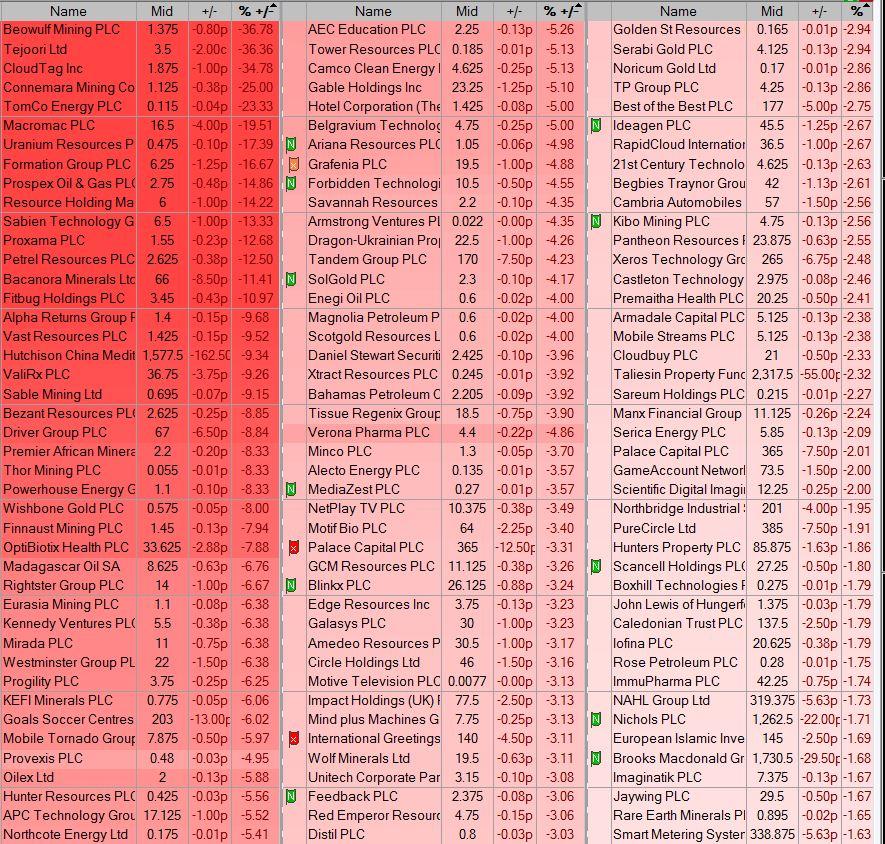
Shares in spirits brands owner Distil (LON: DIS) halved to 0.045p following a trading statement outlining poor fourth quarter trading. Full year revenues will be well below expectations. Stock levels in the trade were higher than expected. Sales by the UK distributor are 51% ahead in the first two months of this year, but consumer spending remains depressed. The US launch of Blavod black vodka has been delayed due it still awaiting tax approval from the authorities. Marketing spending has been agreed with UK retailers to help sales to recover.

Litigation finance provider Burford Capital (LON: BUR) announced on Friday afternoon that the US Court of Appeals had overturned the decision won by Burford’s Petersen and Eton Park concerning claims against The Republic of Argentina and YPF. There was a two to one ruling. Argentina had not made a tender offer when it took over a 51% stake in YPF from Repsol. The $16.1bn judgement was overturned. The share price slumped 42.5% to 339p. This is the lowest the share price has been for six years.

Premier African Minerals (LON: PREM) is raising £750,000 at 0.126p/share. The previous fundraising was at 0.0185p/share. The cash will finance the installation of the new plant at the Zulu lithium and tantalum project, plus ongoing operations. The share price declined 36.9% to 0.01325p.

The Mission Group (LON: TMG) revenues fell by one-fifth to £68.8m, although continuing operations revenues were only 8% lower. Pre-tax profit on continuing operations slid 39% to £3m. The marketing services provider has net debt of £9m. Annualised cost savings will benefit this year. Onward Opportunities (LON: ONWD) has raised its stake from 10.8% to 11.1%. The share price slipped 32.4% to 12.5p.

US and UK equities, AI investing tools, and ISAs with Robinhood UK’s Dan Lane

Dan Lane, lead analyst at Robinhood UK, joins us for a wide-ranging conversation on markets, money, and the future of investing in Britain.

We open with the big macro picture, examining what the latest volatility in the Middle East means for equities and how investors should think about interest rates and inflation in an uncertain geopolitical environment.

From there, we turn to the UK investing environment. Dan gives his honest take on whether Britain has a cultural problem with investing, how younger generations are approaching the stock market differently, and what still needs to change.

We dig into ISAs and why so many people leave their annual allowance untouched, the most damaging myths Dan hears regularly, and his verdict on whether government policy will actually shift behaviour.

We finish with a look at how AI is transforming what retail investors can do today versus five years ago, and the most exciting applications Dan has seen emerging in the space.

We close on UK-listed companies. We ask whether Dan is optimistic or pessimistic right now, and if he had fresh money to put to work in one corner of the UK market today, where would it go?

FTSE 100 falls again with Brent above $110

The FTSE 100 sank on Friday after Trump’s decision to extend a deadline for strikes on Iranian power plants failed to steady markets.

London’s leading index had started the session in positive territory, but gains quickly turned to losses, leaving the FTSE 100 0.7% in the red at the time of writing.

Susannah Streeter, chief investment strategist, Wealth Club, said: “Investors are set to stay in a wary mood at the end of a week infused with nervousness about the trajectory of the war in Iran. President Trump has extended the deadline of his ultimatum to Iran, which initially offered respite from the sell-off, but a pessimistic mood has settled back in.”

The FTSE 100 is struggling to stay above 10,000 with sentiment souring and the TACO (Trump always chickens out) trade not having the same impact it had amid last year’s trade war.

Indeed, the Iranian conflict is a very different war that threatens deep repercussions for the global economy and isn’t as easy to remedy as it was to roll back on tariff threats last year. Investors will also be wary of a potential ground invasion with the US moving more troops to the region.

The oil market is having none of Trump’s claims that negotiations with Iran are progressing, and Brent Crude rose to $111 on Friday.

No one knows when the conflict will end. We do, however, know that the longer it rumbles on, the greater the risk to inflation and potential interest rate hikes that curtail economic growth. Consumer spending power is also being eroded, which will filter through to company earnings.

These risks were front and centre on Friday as 90% of the FTSE 100’s constituents traded in the red.

It was a familiar story on Friday, with cyclical and interest-rate-sensitive sectors leading the way lower.

Miners fell as Antofagasta erased all of this year’s gains with another 3% decline. The copper miner has lost around a third of its value since the Middle East war began.

There was more pain for housebuilders. Barratt Redrow fell 2.6% and is now down 31% since the start of 2026. Barratt is the worst-performing FTSE 100 stock of the year. Almost all of this year’s losses were suffered since the US and Israel launched attacks on Iran.

Metlen Energy & Metals was the FTSE 100’s top faller, down 6%, after the group delayed the release of its FY2025 results by nine days.

“In London, the big faller was Metlen Energy & Metals. The Greek company is enduring a bumpy start to life on the London market, having shifted its listing last summer,” said AJ Bell investment director Russ Mould.

“Guidance was cut in February and delaying results is never a good look.”

AstraZeneca was the FTSE 100’s top riser on the back of positive trial results for a chronic obstructive pulmonary disease (COPD) treatment.

AIM movers: Stakebuilding in Everyman Media and Switch Metals MRE delayed

1

Ireland-based cinema operator Omniplex has taken a 5.35% stake in Everyman Media Group (LON: EMAN). The share price rebounded 13.7% to 29p.

ImmuPharma (LON: IMM) has received a first Combined Search and Examination Report for the UK patent for autoimmune disease programme P140. A supporting study has been completed. The company recently raised £6.5m at 6p/share. ImmuPharma says that there is significant interest from potential licence partners for P140. The share price improved 10.3% to 5.015p.

Rockrose Energy has bought more shares in bid target Deltic Energy (LON: DELT). It acquired 529,000 shares at 3.4822p each, taking the shareholding in the oil and gas company to 3.19%. The recommended offer is 7.46p/share. The share price rose 7.14% to 3.75p.

Hargreaves Services (LON: HSP) has launched a tender offer at 850p/share. Originally, the indicative price was 750p and the amount being spent has been raised from £15m to £20m. Further renewable assets have been sold since the original announcement. The share price increased 7.14% to 785p.

FALLERS

Switch Metals (LON: SWT) has announced the washing programme has been completed for the Issia tantalum and lithium in the Côte d’Ivoire. Laboratory assays and modelling is ongoing so that the maiden mineral resource estimate can be published. This had been expected in the first quarter of 2026. The share price dived 24.1% to 11p.

Interim figures for Parkmead Group (LON: PMG) had £12.9m in cash at the end of 2025 and since then the cash position has grown to £16.1m. This will provide funding for oil and gas and renewable asset investment. Up to £120m more can become payable for the past sale of UK North Sea assets depending on the approval of field developments. The share price slipped 8.33% to 22p.

Computer vision technology Seeing Machines (LON: SEE) says that it expects to be EBITDA positive in the third and fourth quarters of the financial year to June 2026. Interim revenues dipped from $25.3m to $23.4m, due to planned reductions in non-core operations. Automotive royalties and aftermarket revenues both increased and gross margin improved to 58%. There will be a refinancing by June. The share price declined 4.84% to 2.95p.

Coiled Therapeutics (LON: COIL), which was formerly Roquefort Therapeutics, has moved from the Main Market to AIM acquiring the global rights to a potential cancer treatment known as AO-252. This cost £31.9m in shares. AO-252 is “a brain-penetrant small molecule targeting Transforming Acidic Coiled-Coil Containing protein 3 (TACC3) protein-protein interactions”. Preclinical trials have indicated the effectiveness in tumour regression in some cancers. A placing is raised £8.5m at 10p/share. valuing the company at £42.6m. The share price initially fell 5% but recovered to 10p.  

Inside Polar Capital Technology Trust’s AI maximalist investment strategy  

Polar Capital Technology Trust (PCT) has been one of the standout performers in the technology investment trust space over the past year.  

For the trust’s financial year to date, its Net Asset Value (NAV) total return of 72% and share price return of 77% has outperformed its benchmark, the Dow Jones Global Technology Index, which has returned 40% over the same period (as at 27 February 2026, all figures in Sterling terms. The Company’s financial year ends on the final day of April each year).  

If there were ever an investment trust to demonstrate the benefits of active management over passive investment, Polar Capital Technology Trust could well be it.  

The managers pursue a high-conviction, high-turnover approach to investing in the AI revolution, and its lead manager, Ben Rogoff, describes it as “an active, active manager.” 

The thesis: discontinuous progress 

At the heart of PCT’s strategy is the view that AI is not following the normal arc of technological adoption. Rather than advancing incrementally, AI is exhibiting what Rogoff calls “discontinuous progress,” where decades of development compress into years.  

The trust draws parallels with the printing press, railway construction, and mass production.  These are moments where technology didn’t just improve people’s lives, but fundamentally rewired how economies function. 

This framing matters because it shapes how PCT allocates capital. Where a conventional technology fund manager might wait for clear evidence of mainstream adoption before committing, PCT’s team is incredibly forward-thinking and prepared to spend time exploring areas that others may overlook. We look at what this means in practise later in this article.  

Exploding enterprise revenues, enormous capital expenditure commitments, and rapid AI model improvement are all cited by the PCT team as confirmation that the inflection point has arrived.  

In their view, 2026 is the year AI transitions from a topic of debate to a key driver of economic performance. 

Gauging growth: revenue, capex, and adoption 

PCT tracks several key indicators to validate its thesis. The most striking is the revenue trajectory of the leading AI model providers. OpenAI’s annualised recurring revenue grew from roughly $10 billion to over $20 billion in less than twelve months through to the end of 2025, and had reportedly reached $25 billion by early March 2026. Anthropic’s growth has been even more dramatic on a relative basis, growing from $1 billion in annualised revenue in late 2024 to $9 billion by the end of 2025, before accelerating to $14 billion by mid-February 2026 and $19 billion by early March. 

Capital expenditure from the hyperscalers Alphabet, Amazon, Meta, and Microsoft, provides a second critical signal. Consensus estimates now project combined hyperscaler capex of $667 billion in 2026, around 62% higher than the prior year and $127 billion above where expectations stood at the start of Q4 earnings season. Google alone guided to $180 billion at the mid-point, considerably above the $130 billion the market had expected. Amazon raised its outlook to $200 billion, spanning AI, chips, robotics, and low earth orbit satellites. 

The adoption of AI tools worldwide reinforces the thesis. OpenAI confirmed 900 million weekly active users and 50 million paying consumer subscribers. Alphabet processes well over a quadrillion tokens monthly across its AI services, a figure that has grown several times over in under a year. PCT’s manager argues these metrics point to a structural shift in how businesses and consumers interact with technology. Importantly, the demand curve is steepening, not flattening. 

Portfolio Construction: Hardware Over Software 

PCT’s portfolio construction reflects a core belief that the AI cycle is fundamentally a hardware story, not a software one. Their view was validated in early 2026, when software stocks were ravaged by fears of AI disruption, sector by sector. Some of the world’s leading SaaS names have lost well over 50% of their value in recent years. 

But PCT appears to have been ahead of the game, and the trust has dramatically reduced its software exposure, increasing its allocation to semiconductors, power infrastructure, optical networking, and memory. These are the physical building blocks of AI, sometimes known as the ‘AI enablers’. 

Semiconductors and semiconductor equipment represent the largest sector allocation at roughly 37% of the portfolio, followed by interactive media and services, and technology hardware. Software, by contrast, has been cut to less than 5%, a negligible weighting, driven by the team’s conviction that agentic AI, combined with outcome-oriented pricing, will disrupt traditional headcount-based software-as-a-service models. 

Geographically, the trust has been shifting away from the US at the margin, with Asia Pacific exposure growing. The US and Canada still account for around 64% of the portfolio, but the trust holds meaningful positions in Asian names like TSMC and Samsung Electronics, reflecting the concentration of advanced semiconductor manufacturing in the region. 

Perhaps the most telling feature of the portfolio is its active share, which sits near recent highs at around 49%. The trust holds approximately 94–98 positions but makes large individual-stock bets and is willing to have zero weightings in major index constituents when the growth case doesn’t stack up. The manager is significantly underweight the “Magnificent Seven” group of mega-cap US technology companies and is content to use call options to manage the upside risk of being underweight names like Apple, Microsoft, and Alphabet. 

Current holdings: Following the bottlenecks 

PCT’s top ten holdings read as a map of the AI supply chain. NVIDIA remains the largest position at around 9–10% of NAV, though the trust is notably underweight relative to the benchmark. Alphabet has risen sharply in the portfolio following the success of its Gemini 3 model and the commercialisation of its custom TPU chips. TSMC, Broadcom, and Samsung Electronics round out the semiconductor-heavy upper echelons of the portfolio. 

The more interesting story, however, lies in the relatively under-the-radar overweight positions. These may be the positions that distinguish PCT from a passive technology vehicles. LAM Research, a memory chip equipment manufacturer benefiting from acute DRAM and NAND supply bottlenecks, was the trust’s largest overweight at the end of 2025.  

Ciena and Lumentum Holdings, both optical networking specialists, represent high-conviction positions driven by the manager’s belief that power-intensive electrical networking is increasingly threatened by fibre-optic alternatives. Ciena’s shares have risen over 300% in the past year. Lumentum’s have risen over 850%. These companies’ returns would have had a negligible impact on the majority of passive alternatives.  

Even more unconventionally, PCT took a position in Caterpillar on the basis that its industrial generators provide a near-term solution to the power squeeze constraining data centre expansion, and that its mining equipment exposure gives it leverage to rising copper demand. 

Ben Rogoff has explained in a recent video interview that PCT is always looking for the most important companies in the AI story. This may not always be the ‘Mag 7’ companies responsible for the capex driving the industry forward.  

The risks and the conviction 

PCT’s manager is clear-eyed about the risks. If AI model progress stalls, investment momentum could reverse quickly. But this risk is considered small enough not to materially detract from the investment case.  

Geopolitical uncertainty, including tensions in the Middle East and shifts in US trade policy, adds further complexity. The trust’s concentrated sector focus means that a broad downturn in technology sentiment would hit hard. 

Yet the trust continues to invest with a high level of conviction and doesn’t buy into the idea of an ‘AI bubble’. Most of the performance in the technology sector in recent years has been driven by earnings growth rather than valuation expansion, a crucial distinction from the late 1990s bubble.  

AI spending currently represents around 1% of global GDP. Historical precedent suggests this could rise to 2–5% at peak intensity over a cycle lasting five to ten years. Should this come to pass, the companies in the PCT portfolio will be direct beneficiaries.  

For those that share PCT’s view on the continued expansion of AI, the recent bout of volatility in equity markets has presented an interesting opportunity in a widening of the discount to NAV around 9.2%. 

Past performance is not indicative or a guarantee of future returns. 

JPMorgan India Growth & Income Investor Presentation March 2026

JPMorgan India Growth & Income (JIGI) is a “high conviction ideas” portfolio of Indian equities that aims to provide capital growth from Indian investments, while also paying an enhanced dividend totalling at least 4% of the NAV as at the end of the preceding financial year.

Download the presentation slides.

Seeing Machines posts improved half-year results as automotive royalties surge

Seeing Machines has reported its results for the six months to 31 December 2025, with improving margins and strong automotive growth offsetting a planned decline in one-off engineering revenues.

Adjusted revenue came in at $23.4m, down from $25.3m a year earlier, though the drop was largely expected as OEM revenue fell as non-recurring engineering fees and certain legacy licence arrangements wound down.

Investors will be interested to note that recurring numbers improved, with annualised recurring revenue rising to $14.0m.

Aftermarket revenue jumped 18% to $12.7m, and automotive royalties surged 33% to $8.4m, as production volumes from maturing programmes continued to build.

Gross margin improved from 55% to 58%, and the adjusted EBITDA loss narrowed by $4.0m to $13.7m.

All in all, a solid set of results.

The company now has more than 4.8 million cars on the road fitted with its driver and occupant monitoring systems, up 67% year-on-year.

On the business development front, Seeing Machines expanded a European Tier 1 programme by around $10m in lifetime value, secured a new production award with Mitsubishi Electric Mobility Corporation in Japan, and added several aftermarket fleet wins including a $1.8m order from a North American autonomous vehicle operator.

Looking ahead, the company expects royalty volumes to rise significantly as the General Safety Regulation implementation approaches in Europe, prompting OEMs to scale their compliance strategies. Adjusted EBITDA is expected to turn positive in both Q3 and the second half of the financial year.

“We delivered strong underlying performance in the half, with Automotive royalties growing 33% alongside a 62% increase in production volumes, and continued expansion in Guardian driving recurring revenue growth and improved margins,” said Paul McGlone, CEO of Seeing Machines.

“We are scaling rapidly, with over 4.8 million cars on road, new program wins across Europe and Japan and increasing Aftermarket momentum. At the same time, continued innovation, including our 3D Cabin Perception Mapping platform and impairment detection capabilities, reinforces our technology leadership.”

Aberdeen New India Investment Trust Investor Presentation March 2026

Aberdeen New India Investment Trust PLC aims to achieving long-term capital appreciation by investing in high-quality companies based in India or those deriving significant revenue from India. The trust seeks out well-governed, world-class organisations that can deliver sustainable growth and withstand market volatility. 

Download the presentation slides.

ImmuPharma reports patent progress and new data for P140 autoimmune platform

ImmuPharma shares rose on Friday after providing an update on P140, its autoimmune technology platform, pointing to progress on three fronts: patents, supporting data, and a forthcoming scientific publication.

The company has received its first Combined Search and Examination Report on a UK patent application for P140, filed in September 2025. Management describes the response as supportive and in line with expectations at this stage. ImmuPharma plans to follow up with a Patent Cooperation Treaty application to seek protection across key commercial territories.

ImmuPharma shares were 13% higher at the time of writing.

Alongside the patent process, the company has completed a new study designed to stress-test P140’s associated diagnostic test and bolster the statistical strength of its dataset. The results came back positive and supportive of the application.

The scientific team, led by CSO Dr. Sébastien Goudreau and Head of R&D Dr. Laura Mauran, is now preparing a manuscript on P140’s technology platform and mechanism of action for submission to a peer-reviewed journal. The company intends to share the findings more widely with the scientific community once published.

On the commercial front, ImmuPharma says partnering discussions are ongoing with several potential partners, some of whom are under signed confidentiality agreements.

The team was in Lisbon this week at Bio-Europe Spring, where it held a number of P140-related meetings. The company says it remains focused on securing a licensing deal in 2026. Investors will watch with interest.

Herald Investment Trust warns of backstop tender offer

Herald Investment Trust said it is still trying to reach a deal with activist investor Saba Capital but warned it will press ahead with a full tender offer near NAV if talks fail.

The board confirmed it continues to seek a “mutually agreeable solution” that would give shareholders a choice of outcome. Failing that, it will proceed with a backstop tender offer allowing eligible shareholders to exit up to 100% of their holding at a price close to net asset value.

The Herald Investment Trust proposed a tender offer earlier this year, but Saba blocked it.

But the trust is being forced to explore ways to fight off the constant pressure from Saba Capital, which is attempting to seize control of the £1.1bn investment trust.

Herald, which has delivered a 2,904% total return on NAV since inception, acknowledged that a forced exit would trigger an unwelcome tax event for many long-standing shareholders holding significant capital gains.

It said it is exploring ways to let investors roll into a non-Saba-controlled vehicle in a tax-efficient manner while still offering a meaningful cash exit, though it cautioned there is no certainty this can be achieved as it depends on third-party agreements and regulatory approvals.

In the meantime, Herald has been aggressively raising liquidity. Cash and government bonds have climbed to around 26% of net assets as at 26 March, up from 18.4% at the end of February. The investment manager has been selling down holdings, including less liquid positions, to avoid the value destruction that could come from a fire sale under time pressure.

The board noted that the large majority of non-Saba shareholders have made clear through previous votes that they have no desire to end up in a Saba-controlled vehicle.