2022: what doesn’t kill you makes you stronger

Ben Ritchie and Rebecca Maclean, Investment Managers, Dunedin Income Growth Investment Trust PLC

The painful adjustment to an environment of higher inflation and interest rates was the financial market story of 2022. A tough combination of the war in Ukraine, the legacy of the exceptional policy response to the pandemic and disrupted supply chains pushed prices higher for energy, agricultural commodities and, increasingly, labour. Central banks were forced to raise interest rates to curb these pressures.

These stresses were mostly felt in short-term inflation expectations, while longer-term expectations moved only slightly. Nevertheless, the short-term moves were severe. In the UK, inflation hit levels of 13-14%, the highest levels seen since the early 1980s. The Bank of England raised rates nine times from December 2021, pushing up gilt yields, peaking at the time of the shambolic Truss/Kwarteng mini-budget.

Whilst this created an extremely difficult backdrop for stock markets, 2022 was not without its success stories: the UK’s larger companies were flattered by a weaker sterling (a significant share of their revenues comes from overseas) and by the strong performance of commodity-related sectors. However, the domestically-focused FTSE 250 saw double-digit falls for the year. 

Sector performance was significantly influenced by the interest rate cycle. Companies with high debt, or little pricing power struggled as the economic environment weakened and borrowing costs soared. Energy was the year’s stand-out performer, but there were other pockets of resilience, including healthcare, utilities and consumer staples. The worst-performing sectors were domestic cyclicals such as real estate, consumer discretionary and technology. There was a significant rotation away from growth and towards ‘value’ sectors. 

Sentiment towards UK assets was volatile. There can be little doubt that the mini-budget left the UK on the naughty step for many investors. The subsequent Autumn statement stabilised the situation, but the UK is still viewed carefully for any signs fiscal discipline may be lapsing. 

The trust in review

It was a year of two halves for Dunedin Income Growth Investment Trust (DIGIT). Amid the uncertainty during the first six months of 2022, our main focus was to test the thesis for all the companies in the portfolio against the new economic environment, and make any adjustments. Selectively, we added to existing holdings when share prices fell back and made a few selective sales. We exited GSK (formerly GlaxoSmithKline) and Haleon, for example and added to Unilever, Aveva and the London Stock Exchange. These are all good quality businesses with long-term growth prospects that had been sold down. 

In the second half of the year, as more clarity emerged and markets adjusted to higher inflation and interest rates, we started to look more closely for new opportunities. This included switching out of Persimmon and adding Taylor Wimpey, adding insurance group Hiscox, while also introducing Oxford Instruments, a specialist industrial manufacturer of high tech industrial equipment. At the moment, we are finding the most significant opportunities among domestic cyclical companies, where share prices have been hit hard. That includes companies such as Morgan Sindall and Marshalls. 

The trust is well-balanced for defensiveness and recovery. It should be resilient if the economic environment worsens – the earnings and balance sheets for companies in the portfolio are likely to be more robust. However, if investors become more confident and enthused, we have been increasing our exposure to UK mid cap, domestically-focused businesses, so would hope to participate in that recovery. We are minutely focused on getting company selection right – if we do, share prices will follow. 

The year ahead?

At the start of 2023, the market remains focused on inflation and interest rates: where will inflation level out? How quickly will it subside? Will it become embedded in wages? In all scenarios, markets will be watching central banks’ next move. It is likely that, barring a significant shock, we are closer to the end than the beginning of the tightening cycle. 

Perhaps this may even mean that investors will have a less intensive focus on interest rates and inflation this year. The market had a significant adjustment to make in 2022, but expectations now appear more settled. This may finally allow a greater focus on the specific characteristics of individual companies, after a year when inflation data and the latest guidance from the US Federal Reserve occupied investor attention. 

We would certainly welcome more focus on individual businesses. This is where we spend our time, looking at how a business is performing from a revenue, profit, cash flow and dividend point of view. Broader market sentiment and macroeconomic data are important, but these factors tend to be unpredictable. In the year ahead, we hope to spend less time talking about inflation and more time talking about profitability. 

Optimism versus pessimism

There are a wide range of outcomes for 2023 and we believe share price performance may vary considerably depending on the company and individual subsector. There are plenty of reasons for caution with UK consumers facing the rising cost of living, higher mortgage rates and interest costs. Similarly, forward-looking global economic indicators are negative, and some of the more economically sensitive sectors may have to lower their forecasts. The key questions though are how much of this is priced in and do companies have the strength of balance sheet and cash generation to trade through what may be difficult times ahead. In that regard we are optimistic that for those able to take a medium-term view that there are attractive opportunities emerging.

There also remain pockets of strength. For example, The US Inflation Reduction Act and the need to drive energy security will support sectors such as renewables across the world. Likewise there remains strong structural growth drivers in areas such as healthcare, speciality chemicals and financial services. We are also more optimistic on the prospects for consumers in emerging markets, particularly in Asia. Companies providing essential products and services to these end markets, with strong competitive positions and resilient financials should be well-placed to navigate an uncertain period ahead. Looking to balance the portfolio between exposure to both structural growth and selective cyclical opportunities is where we see the best combination of risk adjusted returns in 2023.

Companies selected for illustrative purposes only to demonstrate the investment management style described herein, and not as an investment recommendation or indication of performance.

Important information

Risk factors you should consider prior to investing:

  • The value of investments, and the income from them, can go down as well as up and investors may get back less than the amount invested. 
  • Past performance is not a guide to future results. 
  • Investment in the Company may not be appropriate for investors who plan to withdraw their money within 5 years. 
  • The Company may borrow to finance further investment (gearing). The use of gearing is likely to lead to volatility in the Net Asset Value (NAV) meaning that any movement in the value of the company’s assets will result in a magnified movement in the NAV. 
  • The Company may accumulate investment positions which represent more than normal trading volumes which may make it difficult to realise investments and may lead to volatility in the market price of the Company’s shares. 
  • The Company may charge expenses to capital which may erode the capital value of the investment. 
  • Derivatives may be used, subject to restrictions set out for the Company, in order to manage risk and generate income. The market in derivatives can be volatile and there is a higher than average risk of loss. 
  • There is no guarantee that the market price of the Company’s shares will fully reflect their underlying Net Asset Value. 
  • As with all stock exchange investments the value of the Company’s shares purchased will immediately fall by the difference between the buying and selling prices, the bid-offer spread. If trading volumes fall, the bid-offer spread can widen. 
  • Certain trusts may seek to invest in higher yielding securities such as bonds, which are subject to credit risk, market price risk and interest rate risk. Unlike income from a single bond, the level of income from an investment trust is not fixed and may fluctuate. 
  • Yields are estimated figures and may fluctuate, there are no guarantees that future dividends will match or exceed historic dividends and certain investors may be subject to further tax on dividends.

Other important information:

Issued by abrdn Fund Managers Limited, registered in England and Wales (740118) at 280 Bishopsgate, London EC2M 4AG. abrdn Investments Limited, registered in Scotland (No. 108419), 10 Queen’s Terrace, Aberdeen AB10 1XL. Both companies are authorised and regulated by the Financial Conduct Authority in the UK.

Find out more by registering for updates. You can also follow us on social media: Twitter and LinkedIn.
FTSE 100 stumbles on weak manufacturing data

The FTSE 100 dipped on Tuesday after manufacturing data from the UK and Eurozone sapped confidence from markets, despite a roaring session in the US overnight.

The FTSE 100 was trading down 0.25% at 7,764 in early afternoon trade following news the UK and Eurozone manufacturing sector contracted, but at a slower rate than expected.

“It seems there’s no such thing as good news, as a brighter outlook painted by the PMI numbers for the eurozone also led to a slip in stocks. Manufacturing activity shrank the least in five months for the region, but the realisation is washing over investors that although this is certainly progress, there is still a long way to go at a time when a hawkish ECB is preparing to hike rates further,” said Susannah Streeter, senior investment and markets analyst, Hargreaves Lansdown.

“The UK snapshot shows how low consumer confidence, widespread strikes and the ratcheting up in interest rates are clearly taking their toll, with business activity falling to a two-year low. The flash reading for January dropped more sharply than expected to 47.8 from 49, in December with below 50 indicating a contraction.’

UK-focused stocks such as the housebuilders and retailers were actually stronger on Tuesday, but those exposed to global growth felt the pain of mixed manufacturing data.

Miners were down heavily, as were the oil majors BP and Shell.

AB Foods

AB Foods were weaker on Tuesday after releasing a relatively upbeat set of festive trading figures. Revenue was 20% on an actual currency basis in the 16 weeks to 7th January, but a warning of future cost pressures evidently caused concerns among investors.

Strong US session

The softer session in Europe followed a strong session in the US driven higher by technology names including Meta, Tesla and Alphabet. US futures were falling going into the US open on Wednesday.

The disparity between the FTSE 100 and US stocks yesterday was reminiscent of the variability in performance last year when the FTSE 100 outperformed the major US indices significantly. 

UK stocks secured a rare outperformance compared US stocks in 2022 in the face of rising energy prices and economic uncertainty that favoured London’s defensive nature.

This is now showing signs of reversing with US tech storming ahead and the defensive attributes of the FTSE 100 becoming a drag on the index, compared to US counterparts.

AIM movers: Norman Broadbent

9

Shares in executive search firm Norman Broadbent (LON: NBB) jumped 42.9% to 5p on the back of a 27% increase in net fee income to £7.34m in 2022. The fourth quarter was stronger than the previous quarters and the new year has started well. This has enabled 2022 EBITDA of £100,00 compared with a loss in 2021. Sub-letting excess London office space is paying for a new Edinburgh office.

Some better news from Fire Angel Technology (LON: FA.) where the loss was reduced last year, even after higher procurement costs, and it expects significantly enhanced margins this year. The share price jumped 20.5% to 9.7p. That is the highest the share price has been since September when the interims were published.  The home safety products supplier increased 2022 revenues by nearly one-third to £57.5m. A further reduction in loss is expected this year with helpful currency movements providing potential for further upside.

Trading at energy supplier Yu Group (LON: YU.) continues to beat guidance. Liberum has increased its 2022 earnings forecast by 13% to 30.3p a share. Renewal rates have increased as customers seek to lock-in prices and margins have improved. The share price rose 9.72% to 700p, which is the highest it has been since 2018.

Broadcast software provider Pebble Beach Systems (LON: PEB) figures for 2022 were in line with expectations with pre-tax profit expected to be £1.7m. Recurring revenues have increased. The share price improved by 9.38% to 8.75p.

Positive interims from toilet tissue supplier Accrol (LON: ACRL) have sparked upgrades. Interim revenues were 64% ahead at £121.1m and pre-tax profit jumped from £500,000 to £3.2m. Zeus has increased its full year pre-tax profit forecast from £6.7m to £7m. There is still room for margin improvement. Net debt is expected to be £22.9m at the end of the financial year and it will fall rapidly from then on. The share price moved up by 7.18% to 31.35p.

Results from aerospace composites kits supplier Velocity Composites (LON: VEL) were as expected following the trading statement at the end of 2022. In the year to October 2022, revenues were 22% higher at £12m, while he loss was flat at £1.5m. A further loss is forecast for this year. The share soared on the back of the US deal with GKN Aerospace and there has been profit taking. The share price declined by 6.25% to 60p.

Yesterday Kropz (LON: KRPZ) reported the first bulk sale of phosphate concentrate from the Elandsfontein project. The share price rose from 3.55p, which is the all time low, to 4p, but today it has fallen back 6.25% to 3.75p.  

Revenues remain modest at diagnostics company Oxford Biodynamics (LON: OBD) even thought EpiSwitch CiRT prognostic test was launched in the US last February. Sales have started to build up so there should be a significant improvement this year on the 2021-22 revenues of £200,00. Pro forma cash is £10.3m following the October fundraising. The share price fell 5.24% to 14.475p.

FireAngel Safety Technology Group – sales up 32% in 2022 precedes break into big profits in 2024

This leading developer and supplier of home safety products delivered a resilient performance in 2022.

Reporting its strongest revenue performance since 2017, the group’s business unit made a strong showing across most of its territories, with demand outweighing supply, driven by increasing legislation.

Sales for the year at FireAngel Safety Technology Group (LON:FA.) are expected to have risen 32% to £57.5m (£43.5m), while the group’s adjusted pre-tax loss was down 30% at £2.1m (£3.0m).

FireAngel’s principal products are connected smoke alarms, CO alarms, heat alarms and accessories. The group has an extensive portfolio of patented intellectual property in Europe, the US and other selected territories.  

Executive Chairman John Conoley stated that: 

“The expected FY22 result represents an outstanding performance set against the unprecedented macro circumstances. Whilst the reported result will not be what we had set out to achieve, the underlying numbers demonstrate the strong progress made in line with our ambitions outlined at the time of the Company’s fundraising in H1 2021.

“Societal and regulatory development continues to drive demand for our products. Our continuing focus on self-help pleasingly shows a resilience in overcoming a wide range of macro headwinds to leverage this demand. 

The Board expects additional significant improvement in our financial journey in 2023, positioning the Group for further progress against our strategic plans.”

Analyst Opinion – there will be a strong demand for the group’s products

Ahead of the group’s finals being reported in April, analyst Rob Sanders at Shore Capital Markets is estimating that the current 2023 year will see sales of £64.0m, with adjusted pre-tax losses falling impressively to just £0.9m.

Sanders sees the big turnaround showing through next year, with sales estimated at £74.0m and adjusted pre-tax profits coming out at £2.8m, worth 1.4p in earnings per share.

Conclusion – a penny-stock doubler 

On these estimates FireAngel shares could easily double from the current 8p within the next year or so.

Inheritance tax receipts rise £700m to £5.3bn

The UK government’s income from inheritance tax continued to grow in the period from April to December last year as higher property prices and increasing value of investments meant more people became liable for the tax.

IHT tax bills from £700m to £5.3bn from April to December last year.

The government has frozen the inheritance tax rate at £325,000 for two years which likely lead to more people becoming liable for the tax in the coming years.

Mitigating IHT

Fortunately, IHT is a tax that can be managed through the effect use of schemes designed by the government to spur private investor investment in growing businesses.

These include the EIS and SEIS scheme that are exempt from IHT, should investments be held for two years.

“Inheritance tax (IHT) receipts will continue to remain high given the freezing of IHT thresholds for two more years. One area that advisers and investors could consider helping mitigate against IHT is by investing in an Enterprise Investment Scheme (EIS), as full inheritance tax relief is provided, for the life of the investment once the shares have been held for two years,” said John Glencross, CEO and Co-Founder of Calculus.

Lloyds share price: is 50p a bridge too far?

The Lloyds share price has been flirting with the 50p level since the beginning of 2023 – but it is yet to break the key psychological level convincingly.

Despite higher interest rates boosting Lloyds key profitability metrics, the threat of a downturn in the UK economy capped Lloyds shares gains for most of 2022.

Having recovered from below 24p in the immediate aftermath of the pandemic, the Lloyds share price has more than doubled and handsomely rewards investors that bought Lloyds shares when everyone else was selling.

Whether Lloyds can continue past 50p will depend heavily on economic dynamics that held it below 50p for so long. Higher interest rates are now largely priced into shares with net interest margin touching 2.98% in Q3 2022. Focus will now be on the consequences of a slowing UK economy.

UK Mortgages

Upcoming banking results will be poured over for details of the strength of their mortgage business. The Lloyds business model is heavily overweight UK mortgages compared to peers and any weakness in UK housing will cause concerns for investors. For example, Barclays has a substantial investment banking arm that has propped up earning in recent years.

Lloyds is the UK’s largest provider of mortgages and the ongoing success of the UK housing market is inextricably linked to Lloyds future profits. Lloyds open mortgage book stood at £298.4bn 31st September 2022, up from £292.6bn a year prior.

Should Lloyds start to see disruption in the housing market, provisions will have to be made for possible bad debts and will weigh on profits.

Lloyds made a net provision charge of £1bn in the nine months to end of September 2022, after recording a net credit in the same period a year higher.

The extent to which impairments will accelerate or decelerate will be crucial to the short term performance of the Lloyds share price.

Higher interest rates will now largely be priced into UK banks and their net interest margins are typically in line with analyst estimates. This will exacerbate the importance of new mortgage business and provisions for bad loans.

If the Lloyds share price fails to break 50p in the current market rally, it will become a strong level of resistance in the future after failing their on numerous occasions.

Lloyds full year results for 2022 are due to be released 22nd February.

CyanConnode raising £5m to accelerate expansion

6

Narrowband radio frequency communications networks developer CyanConnode (LON: CYAN) is raising £5m at 17p a share in order to strengthen the balance sheet and stock up with long lead time components. Three directors are investing £110,000 in the placing, which is at the current market price.

The share price has risen by more than 50% over less than four months, providing an opportunity to raise cash to finance expansion. In October 2022, there was a £500,000 share subscription at 12.25p a share. Earlier in the year, £2m was raised at 14p a share. In June 2021, £3.15m was generated from a placing and subscription at 9.5p a share.

CyanConnode has a strong order book and is participating in tenders for 75 million smart meters in India, which is equivalent to £1bn of revenues. Management hopes to win between 20 million to 30 million orders over five years. There are also opportunities in other countries.

In the six months to September 2022, revenues fell from £4.08m to £1.35m. The operating loss doubled to £2.4m. There was a £114,000 cash outflow from operations and there was more than £1m in the bank at the end of September 2022.

Revenues have already reached £5m in this financial year thanks to strong trading since the interims. The cash generated has already been invested in inventories.

Full year revenues of £12.5m are currently forecast and this is expected to rise to £16m in the year to March 2024, when a small profit is forecast.

The FTSE 100 gains ahead of major economic data releases this week

The FTSE 100 gained on Monday as investors prepared to receive major economic updates later this week, including US GDP and inflation.

After a busy period of company results and updates, equity investors will be bracing for the macro consequences of insights into global economic growth from the US.

“The FTSE 100 ticked higher on Monday without suggesting it would threaten the all-time high which it briefly flirted with before a sell-off at the end of last week,” said AJ Bell investment director Russ Mould.

“The big economic announcements come on Thursday and Friday as the US releases GDP figures for the fourth quarter and core inflation numbers from the world’s largest economy are also released.”

“These will offer insight into two key and related factors which are grabbing the market’s attention right now. First, will the US avoid a deep recession and second, will inflation ease sufficiently to allow the Federal Reserve to ease up on interest rates before it has inflicted too much pain on businesses and consumers?”

FTSE 100 gains

The FTSE 100 was gaining with the usual high-beta suspects leading the index higher. Ocado, which has a beta of 1.75, was the top gainer, up 2.3%, at the time of writing. Ocado has become one of the fastest moving FTSE 100 constituents and is now regularly the top riser or faller.

Miners were stronger on continued optimism around China. Antofagasta rose 1.5%, Rio Tinto 1.3% and Anglo American 1.1%.

St James’s Place was the FTSE 100’s top faller after the wealth manager’s rating was cut by analysts at both Barclays and HSBC. Barclays now has a price target of 1,507p with a hold rating. St James’s Place was down 2.5% to 1,203p at the time of writing.

AIM movers: Sosandar third party deal with Sainsbury and Audioboom misses expectations

5

Online fashion retailer Sosandar (LON: SOS) has secured its latest wholesale partnership with Sainsbury, which will sell part of its range of clothing and accessories online and in stores later in the year. Sainsbury is growing market share in non-food markets. Existing partners include NEXT and John Lewis. This will not have a significant effect on the year to March 2023 when revenues of £42.5m and a move into profit is forecast. The 2023-24 forecast does not include any contribution from Sainsbury and pre-tax profit of £3.1m is already forecast on revenues of £58m. The share price rose by 9.52% to 23p.

Intercede Group (LON: IGP) has sparked further upgrades with its latest trading statement. The identity management software company says it could get better if further sales close before the end of March 2023. Forecast 2022-23 pre-tax profit has been trebled to £600,000 on a 6% upgrade of revenues. The share price is still much lower than 18 months ago, but it recovered 20.4% to 68p.

Energy transition services company Getech Group (LON: GTC) says 2022 revenues were ahead of expectations at £5m and there is a record order book of £4.6m. Transitional petroleum contributes two-thirds of revenues with the rest coming from critical metals. There was cash of £4.3m at the end of 2022 and that is enough for current requirements. There are plans to raise more cash from selling Kitson House, but the disposal has been delayed. There are discussions with strategic investment partners. The share price increased 10.9% to 15.25p.

Invinity Energy Systems (LON: IES) says existing contracts underpin growth in in 2023. There are £22m of vanadium flow battery systems due for delivery in 2023 and a further £7.4m order book for 2024. There was £5.1m in the bank at the end of 2022. Pilot projects with Siemens Gamesa should begin in the summer and a next generation product should be available in the first half of 2024. The share price is 11.5% ahead at 43.5p.

Surgical Innovations (LON: SUN) says 2022 revenues will be 5% ahead of expectations at £11.3m and this should enable the surgical instruments supplier to breakeven as gross margins recover. The UK grew significantly and momentum in the fourth quarter is carrying on into this year, although trike action could hit demand. International sales should continue to recover. The share price is 9.38% higher at 1.75p.

Vast Resources (LON: VAST) expects litigation in Zimbabwe relating to diamond joint ventures to be concluded this month. This could lead to the release of a parcel of 129,400 carats of rough diamonds. This litigation started in 2009. The share price is 5.26% ahead at 0.2p, having been 0.24p earlier in the day.

Podcast content platform operator Audioboom (LON: BOOM) increased revenues by one-quarter to $75.5m in 2022. However, this is lower than forecast and pre-tax profit has been downgraded to £3.2m, compared with £2.7m in 2021. Advertising spending has been weak because of economic conditions. Net cash was better than expected at $8.1m. The share price declined 6.03% to 397.5p.

Textile wholesaler Leeds Group (LON: LDSG) reported flat interim revenues of £15.6m, but the loss was more than halved at £224,000, although that includes a £138,000 gain on a property sale. Net debt is £6.13m, but that includes cash that will be used to pay the creditors of subsidiary KMR, which is in the hands of an insolvency administrator. The share price fell 7.14% to 13p.

Consider the M&G Global Emerging Markets Fund in the Chinese New Year

The M&G Global Emerging Markets Fund is increasing exposure to China and sees the world’s second largest economy as a potential source of outperformance in the coming year.

As we start the Chinese New Year – the Year of the Rabbit – China is dominating headlines and gaining the attention of investors.

The end of Zero COVID policies promises to boost the Chinese economy and provide support for mainland and Hong Kong equities. Indeed, the leading Hong Kong indices have rebounded some 40% from last year’s lows.

Having been called ‘uninvestable’ by investment bankers and fund managers through 2021 and 2022, China is beginning to shake off stigma attached to the policies of China Communist Party and the woes of their domestic property market.

The dramatic shift in the approach to COVID highlights the Chinese leadership’s desire to pursue growth. Their willingness to roll back COVID policies they had previously been steadfast in delivering has demonstrated economic health is still the CCP’s main priority.

Having scrapped lockdowns and restrictions at the end of last year, the Chinese New Year may mark a new chapter in the Chinese economy and returns for investors in Chinese equites.

Increasing China Exposure

Speaking at an M&G event held in London last week, Fund Manager Michael Bourke alluded to a rotation towards China in their portfolio as a result of the Chinese reopening and valuation of Chinese equities.

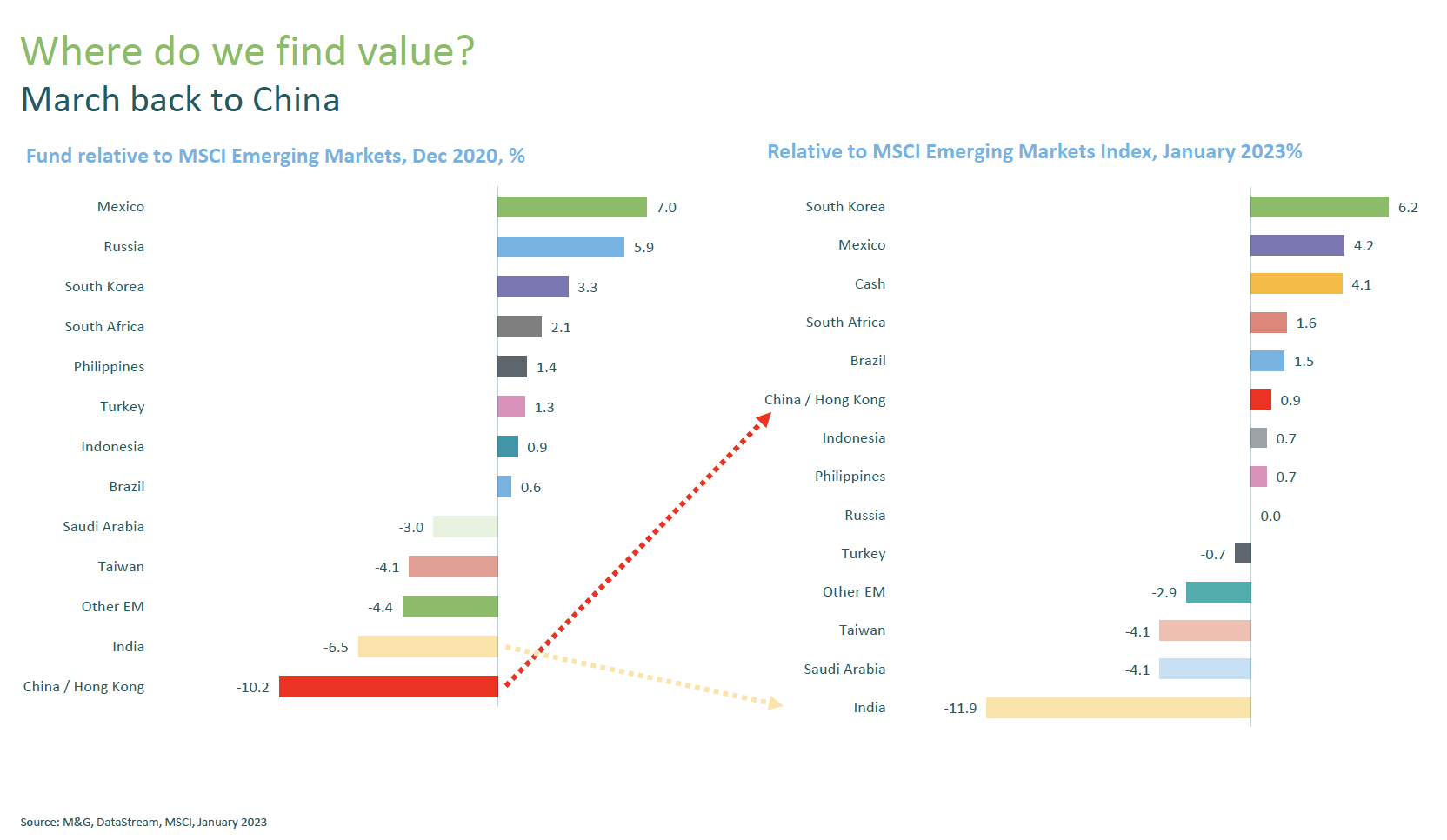
The extent to which managers of the M&G Global Emerging Markets Fund have increased their exposure to China is illustrated below. From being underweight China compared to the MSCI EM benchmark by 10.9% in December 2020, the fund is now overweight China by 0.9%.

Being significantly underweight China through 2021 and early 2022 meant the M&G Emerging Markets Fund significantly outperformed the benchmark. Sharp losses in Chinese tech names were a major drag on Emerging Markets over the past 18 months and avoiding the sector helped produce M&G’s outperformance compared to the benchmark.

However, the losses in Chinese stocks are now being seen as major opportunity – and a sustained recover in Chinese equity may provide the M&G team with third consecutive year of outperformance.

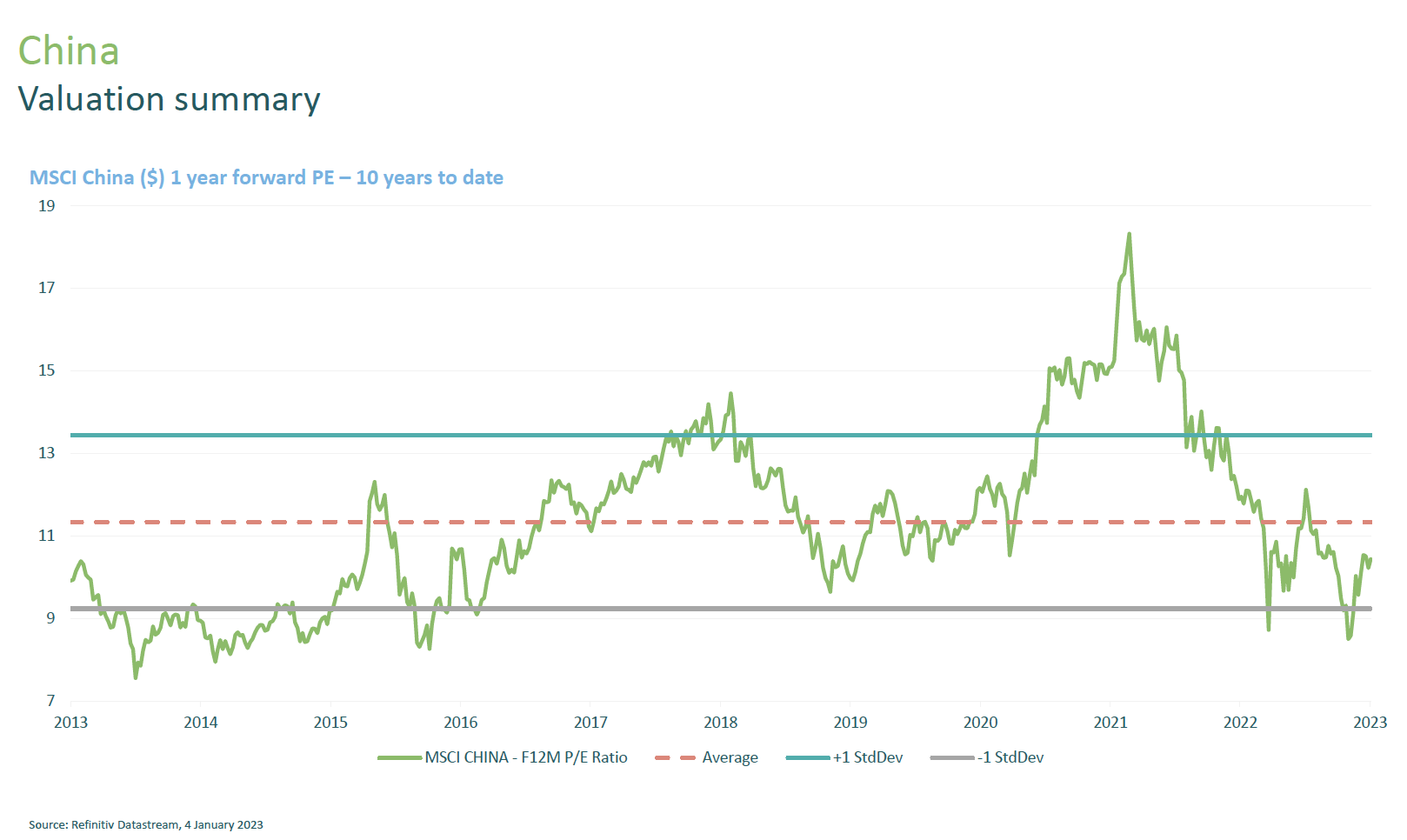
The valuation argument is compelling. Bourke explained that Chinese equity valuations have spent a considerable period trading one standard deviation away from the average price-to-earning ratios, and are ripe for a rebound.

Alibaba accounts for 3.9% of the M&G portfolio while Chinese finance conglomerate Ping AN Insurance Group earns a 3% weighting.

In addition to China, Bourke detailed their interest in Mexico and South Korea, while saying they saw little value in India currently.

Mexico’s proximity to the US and manufacturing capabilities has driven a 4.2% higher weighting in the M&G EM portfolio compared to the benchmark.

South Korea’s traditional tech names and semi conductor companies have been swept up in the global tech sell off are also providing fairly attractive valuations.

Samsung and Taiwan Semiconductor were the top two holdings as of 31st December.