Over 50s leaving work early could hit retirement plans costing the UK billions

0

‘Supporting people in their 50s to stay in work for longer should be a priority’ says analyst

People retiring between the ages of 50 and 64, the state pension age, could cost the pension economy £88bn, the ONS has said.

While if the employment rate among 50 to 64-year-olds was similar to those aged 35 to 49 years, it could add 5% to GDP or £88bn.

Tom Selby, head of retirement policy at AJ Bell said the early exit of people aged between 50 and state pension age from the workforce has a significant impact on both individual retirement plans and the wider economy.

Not everyone who stops working early does so voluntarily. In many cases it can be down to issues such as ill-health.

“Worryingly, although perhaps not surprisingly, people who work in low-paying or physically intensive sectors are six times more likely to stop working before state pension age because of ill-health than those working in other professions,” said Selby.

Also, women are much more likely to be economically inactive before state pension age than men.

  • At age 50, 17.9% of women were economically inactive compared with 9.6% of men, while at age 64, 58.6% of women were economically inactive compared to 44.9% of men.

This has the potential to potential of “perpetuating the gap in pensions between the sexes”, according to Selby.

“Stopping working in your 50s – when in theory your earning power and ability to save should be at its highest – could also have a significant impact people’s retirement outcomes.”

In a number of cases it could mean making your retirement funds stretch for longer, meaning there is to spend for one’s later years.

“It also potentially impacts on people’s health and wellbeing. For all those reasons, supporting people in their 50s to stay in work for longer should be an absolute priority for policymakers,” says Selby.


1,500 Just Eat jobs to be created at Sunderland customer service site

0

Just Eat has 58,000 restaurant partners and millions of takeaway customers

Just Eat, the food delivery platform, confirmed plans to create more than 1,000 customer service roles at its new office close to Sunderland.

The jobs were previously outsourced to third party operators based in Bulgaria and the Philippines.

Just Eat has said its employees will begin by working from home, as it gets round to organising a hybrid model involving a mixture of both.

Business minister Paul Scully praised the announcement as a step towards levelling up the whole of the UK.

With 58,000 restaurant partners and millions of takeaway customers, the new roles will help the company to manage its growth levels.

Just Eat‘s UK managing director, Andrew Kenny, said the new customer care staff would result in quality service for their customers and restaurant partners.

“As a platform that covers 95% of UK postcodes, we also know the importance of increasing career opportunities outside of London and the South East.”

“We’re pleased to be announcing our commitment to the North East, to help boost the region’s economy,” Kenny added.

The Just Eat share price is up by 1.14% during the morning session on Wednesday.

UK supply chain issues affecting food supplies and retail stocks

0

Economists feel shortages could jeopardise recovery from pandemic

The UK’s supply chain crisis is getting worse as each day goes by, with goods from retail stores running low and supermarkets having difficulties stocking their shelves.

Due to worldwide supply chain disruptions as a result of the pandemic and worker shortages, in addition to Brexit related issues, major retailers’ stock levels are at their lowest levels since the 80s.

This is a warning that came from the CBI yesterday.

These shortages could jeopardise the UK’s recovery from the pandemic, according to economists.

Andrew Sentance, a former member of the Bank of England’s monetary policy committee, said:

“It’s quite striking, I don’t think we can dismiss this as a flash in the pan. Now that lockdown has been eased, we’re seeing a truer reflection of the impact of Brexit and issues building up before the pandemic.”

“We could see this persisting for longer than people expect. Skills shortages could go on for a few years, the impact of Brexit on our ability to attract workers from the EU is not going to go away quickly and the process of training was quite significantly disrupted by the pandemic, when people were not working and furloughed.”

UK Investor Magazine reported on Tuesday that McDonald’s is running out of milkshakes in all of its 1,250 restaurants across the UK as the fast-food company feels the impact of supply chain issues.

In addition to milkshakes, McDonalds has also run out of bottled drinks at a number of its locations. 

“Like most retailers, we are currently experiencing some supply chain issues, impacting the availability of a small number of products,” the company said. 

“Bottled drinks and milkshakes are temporarily unavailable in restaurants across England, Scotland and Wales.”

Greatland Gold confirms directorate changes and establishes ‘Technical Advisory Committee’

0

CEO Shaun Day says news is a measure of firm’s ‘growing reputation’

Greatland Gold (LON:GGP) has confirmed the appointment of Paul Hallam as a new non-executive director, as well as establishing a ‘Technical Advisory Committee’.

Paul Hallam is a senior mining industry professional with more than 40 years of Australian and international resource experience across a range of commodities, including both surface and underground mining.

Hallam’s previous roles include director of operations with Fortescue Metals Group, executive general manager of developments & projects with Newcrest Mining Limited, director of Victorian operations with Alcoa as well as executive general manager of base and precious metals at North Ltd.

His appointment to the board of the AIM-listed firm will take effect from Wednesday, 1 September 2021.

Greatland Gold also announced that Callum Baxter has been appointed to the Technical Advisory Committee. Baxter will step down from his full time role as chief technical officer and director of the company on Tuesday 31 August 2021 and focus on this new initiative.

The Technical Advisory Committee will report to the CEO and provide technical input and enhance the company’s existing capabilities in exploration, resource definition, mine development and ore processing. In addition to Callum Baxter, Greatland Gold appointed recognised industry experts Stuart Masters, Simon Hanrahan and Dr Ian Ritchie to the Technical Advisory Committee.

Shaun Day, Chief Executive Officer of Greatland Gold , commented: “It is a measure of our growing reputation as a Company that we are able to attract high-quality people to Greatland, and I am delighted to welcome Paul Hallam to our Board as Independent Non-Executive Director.”

“Equally, I would like to recognise the significant contribution of Callum Baxter and thank him for his outstanding contribution to Greatland over the past 16 years. Callum had the vision and conviction to lead the discovery of Havieron and he has built an exploration team with the capability to continue pursuing the next generation of tier-one mineral deposits by applying advanced exploration techniques in under-explored regions. I am delighted that Callum has agreed to join the Technical Advisory Committee, and we will continue to benefit from his expertise.”

Amigo sneaks out results

0

Amigo Holdings (LON: AMGO) sneaked out its full year figures at 6.29pm on Tuesday evening. It is not a great surprise that Amigo, which offers short-term and guarantor loans to people with poor credit, did not want to publicise the figures or its continuing financial problems.  

The accounts were required to be published by 2 September or it would have breached the covenants for its 7.625% secured loan notes. It was required to publish accounts within 120 days of the year end, and they were published soon after the results were announced.

In the year to March 2021, revenues slumped from £294.2m to £170.8m, while the loss increased from £37.9m to £283.6m. The impairment charge was £60.7m and 11.8% of the gross loan book is more than two months past its due payment date. Covid-19 has exacerbated the problem.

Complaints cost £318.8m during the year and the complaints provision nearly trebled to £344.6m. That assumes that known and expected complaints are settled in full.

Borrowings have fallen from £460.6m to £296.5m, as the net loan book declines from £643.1m to £340.9m. There is cash in the bank of £177.9m, plus restricted cash of £6.3m. Net liabilities are £121.4m.

Scheme

A scheme of arrangement was agreed with more than 95% of the creditors that voted but it was rejected by the High Court in May. An agreement could reduce the outflow.

Management is trying to come up with a new scheme of arrangement, which is an alternative to the company being insolvent. No scheme and the company may not be able to continue trading, particularly as there is uncertainty about the ability of loanees to pay back the money when furlough ends.

The FCA is still investigating the company and that means that the business cannot be relaunched.

The share price was 8.38p when the market closed on Tuesday – nearly two hours before the announcement. That values the company at £39.8m.

Whether the business is worth anything is dependent on the FCA investigation and any scheme of arrangement that can be agreed by the High Court.

Director dealings: Six decades at Castings and still a buyer

Foundries operator Castings (LON: CGS) chairman Brian Cooke acquired 5,000 shares at 371.8p each following last week’s cautious AGM statement.
That is an investment of £18,590. He had bought 5,000 shares at 368p each during February. He was also buying shares last autumn.
Brian Cooke is a former boss of Castings, having joined the company in 1960, and he became non-executive chairman on 31 March 2015. He owns more than 4.5% of Castings.
Business
Castings operates two iron foundries in the West Midlands and Derbyshire, plus a machining operation at the west Midlands site. The main customer sect...

Clearpay upside for ThinkSmart

Broker Canaccord Genuity believes that the acquisition of buy now, pay later finance Australia-based provider Afterpay by Square Inc could be good news for ThinkSmart (LON: TSL) which retains a residual stake in the UK-based Clearpay, which it sold to Afterpay.
There was a 10% stake retained in Clearpay by ThinkSmart, but employees will receive some of the shares, so the net stake is 6.5%.
There is an option for the remaining stake in Clearpay to be acquired by Afterpay - or ThinkSmart can require it to buy it - in 2023-24. There is a part of the agreement that enables Afterpay to accelerate t...

Scottish Mortgage share price reacts well to vaccine news as fund navigates tech stocks

0

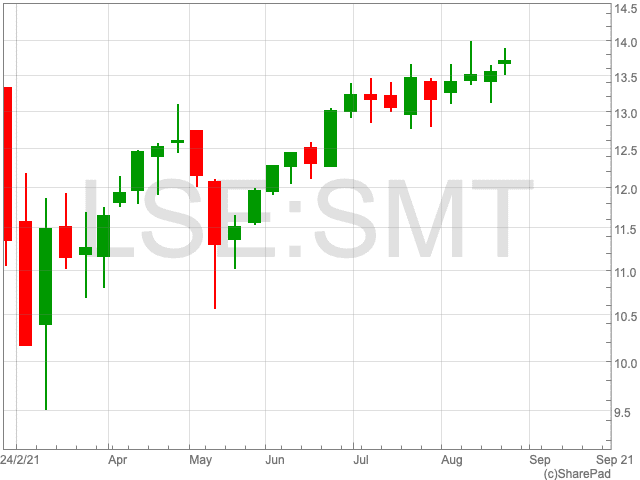
The Scottish Mortgage share price has been on a good run of form over the past six months, supported by recent gains from the tech-focused Nasdaq composite. The Nasdaq composite closed up 1.55% yesterday, outperforming the Dow Jones and the S&P 500, while the Scottish Mortgage share price followed suit on Tuesday, adding 1%.

Over the past six months the fund has been on an upward trajectory, increasing its value by 12.61%, despite a bump in the road caused by a crackdown by China on its technology sector. While its holdings in Tencent, NIO and Alibaba remain high, the fund was able to benefit from the news that US Food and Drug Administration approved the Pfizer jab as its first Covid-19 vaccine. Investors in the Scottish Mortgage share price will be hoping the Chinese Communist Party take a more relaxed approach and that the vaccine roll-out proves to be a success.

Scottish Mortgage’s top holding, making up 8.5% of the fund, is Moderna. The American pharmaceutical and biotechnology company saw its share price jump by 7.55% yesterday.

It is though Scottish Mortgage anticipated a move back towards biotech companies, as it shows its impressive ability to navigate tech stocks.

Having readjusted its portfolio following the China crackdown, the Scottish Mortgage share price looks well positioned. However, judging by its top ten holdings, the fund retains faith in the future of the Chinese economy.

Crypto outshines gold as asset of choice for investors but remains behind stocks and P2P investments

65.8% of European investors hold crypto assets within their portfolio

A survey carried out by analysts at Robo.cash, the investment platform, found that 65.8% of European investors hold crypto assets within their portfolio.

Crypto assets rank third in popularity when compared to others behind P2P investments and stocks.

The number of investors who increased their holding in crypto during 2021 is at 42%, up from 31% from the year before.

The majority of those investing in the space (82.9%) limited their crypto investments to a quarter of their total portfolio, while 34.2% of respondents said that had no crypto in their portfolios at all.

The determining factor in acquiring an asset is the combination of reliability and profitability.

For this reason, according to respondents, the best options for investing are stocks and P2P payments.

Gold, on the other hand, appears to be falling out of favour with investors, despite its track record spanning millennia.

“Apparently, the traditional asset, despite its fairly high reliability, finds little response from the “new generation” of modern investors”, researchers said.

15.1% view crypto as the most attractive asset to investors while 3.2% have that view of the precious metal.

Most people (38.4%) view stocks as the best form of investment will 20.6% would give the title to P2P investments.

“The interest in crypto is explained, rather, by the broad outlook of P2P investors in search of optimal investment opportunities”, add the analysts. “Another supporting factor is the steadily increasing strategic trend. However, the extremely high volatility of cryptocurrency prices is undoubtedly a serious deterrent. In this sense, the guaranteed high profitability inherent in P2P investments is much more interesting for European investors, and this interest is growing. It is confirmed by the fact that 46.7% of surveyed intend to increase their share of P2P investments in portfolios this year”.

Investors should prepare for ‘jittery markets’ in September says deVere CEO

0

Nigel Green says there are three main triggers for market rout

There could be a nervy spell in financial markets in September over concerns of the Delta variant, regulatory attacks by the Chinese government and changing monetary policies, according to the CEO of deVere Group, one of the largest asset management firms in the world.

Nigel Green, who heads up deVere, added that investors should consider reviewing their portfolios with the view to possibly rebalancing them.

“History teaches us that October is tricky for stock markets having been the month in which some of the biggest market routs have begun,” Green said.

“But this year, I believe the autumnal volatility is going to be seen earlier, with markets getting jittery in September.”

There are, according to the deVere CEO, three main triggers for the expected market rout.

“First, markets are likely to pull-back due to expected slower economic growth, which is being driven by serious worries over the Delta variant of Covid and how it could force further restrictions, impacting many sectors,” he notes.

Investors could be willing to wait some more time for the economy to make a full recovery from the pandemic. While Green suggests that most of the pent-up demand accrued during the lockdowns has now been burned out.

“Second, markets will be carefully monitoring for signs of a broader regulatory crackdown on Chinese tech companies after Beijing effectively issued a shock ban on the country’s $100bn private tutoring sector last month,” said Green.

“That regulatory attack appears to highlight the Chinese government’s new thinking and its increasing push for control of private enterprise.  This stance could be expected to ripple through global markets as we move into the critical month of September.”

He continues: “Third, markets could throw a ‘taper tantrum’ as central banks signal that their massive stimulus packages – which have supported asset prices – are fading.”

Despite these potential obstacles, Green says it is very possible that the 2021 bull-run continues through to the end of the year. However, he adds that markets could become more turbulent.

“Yet, as ever, with the turbulence some key opportunities will be presented for investors to grow their wealth by topping up their portfolios. Those best-positioned to seize these will be those who are properly diversified across asset class, sector, currency and region.”