Ryanair set to “hoover up” demand despite record losses

0

Ryanair passengers fell by 81% to 27.5m

Ryanair (LON:RYA) confirmed on Monday that it made a loss of (€815m) £702m for the previous financial year, which it put down to the disruption caused by the coronavirus pandemic.

The airline, which made a profit after tax for the previous 12 months to 31 March, saw its passenger numbers plummett to 27.5m, a fall of 81%.

Ryanair also laid blame at the feet of governments across Europe, by saying that: “European govts (with little notice or co-ordination) imposed flight bans, travel restrictions and national lockdowns”.

The airline said it was able to find its way through the ordeal of the pandemic thanks government support schemes, as well as negotiating pay-cuts with staff.

Ryanair disclosed a cash holding of €3bn, which the company suggested will see it through the remainder of the crisis in a healthy position.

Jack Winchester, analyst at Third Bridge, commented on the airline’s ability to weather the storm and come out the other end of the pandemic.

“This morning’s results from Ryanair come with little surprise. For an airline which was consistently making considerably over a billion Euros of operating profit pre-Covid, this 840mEUR loss shows how devastating Coronavirus has been for the air travel market,” said Wnchester.

“Ryanair, like its ultra-low-cost peer Wizz Air, weathered the crisis far better than its legacy counterparts. It also stands ready to hoover up the pent-up demand for foreign holidays we’re about to see as rules on international travel finally ease.”

“While Lufthansa, IAG and Air France KLM all struggled under the weight of huge hub-and-spoke airline operations, Ryanair’s point-to-point model meant it was able to adapt faster and more fully to a historic year of low demand.”

“Ryanair, never one to waste a crisis, is now going on the offensive, seeking to gain further market share and utilise the 210 new Boeing 737 Max aircraft it has recently ordered.”


Standard listing: Alphawave IP

More and more data is being transmitted and it needs to be done rapidly and accurately. Data that is created and consumed totalled 40 zettabytes in 2019 and could reach 175 zettabytes by 2025. Alphawave IP technology addresses the wired connectivity IP part of the market. It is still a relatively small business, but it could get much bigger.
A joint venture with Wise Road Capital would help increase business in Asia Pacific – China, Hong Kong and Macau in particular. As part of a framework agreement, Alphawave would have to invest up to $170m. This deal also involves licensing specific IP to W...

Standard list reversal: Cizzle Biotechnology

Cizzle Biotechnology is developing a test that could make diagnosing lung cancer more accurate by preventing false positives. Eliminating these false positives will reduce the worry for patients and save money.
A prototype has been developed. Cizzle needs to produce a monoclonal antibody, optimise reagents and validate the test. That could take two years.
The share price started at a premium on the first day of trading but ended it at 9.375p.
Cizzle is a bet on its ability to develop a commercial diagnostic test for lung cancer. The potential is enormous, and the valuation is modest. If the te...

Revolting shareholders: Ocado diversity concerns

There were 23% of votes cast at the Ocado (LSE: OCDO) AGM against the re-election of senior independent director Andrew Harrison. The lack of gender diversity on the board of the grocery retail technology company has been blamed on his inaction by some shareholders, while others were not happy with the remuneration committee approach to executive pay.
The nominations committee has reviewed the board structure and there is an all-female short list for another director.
There were 12.7% of votes cast against the remuneration report, compared with 29.8% last year. At the previous AGM, there had b...

Portugal welcomes back Brits from midnight on Monday

0

Portuguese government make assurances that testing capacity will meet demand

Portugal is set to reopen to UK investors who test negative for coronavirus on Monday, despite the country extending a national emergency until the end of May as it continues its recovery from the third wave of the pandemic.

The confirmation comes just a week after the British government added Portugal to its “green list” of countries to which UK citizens are able to travel to from 17 May without needing to isolate upon their return.

The Portuguese government confirmed in a statement on Friday that Brits will be allowed to enter the country from midnight on Monday.

The statement read: “This decision will revoke the essential travel restrictions, that [are] in place until 16 May. Any person entering Portugal will have, in any case, to have an RT-PCR test done 72 hours before departure.”

The statement also made reassurances that there will be adequate capacity for testing to match the demands of tourists, while thousands of people have been trained as part of an initiative to keep the country safe.

João Fernandes, the president of the Algarve Tourism Board, told The Guardian that he welcomed the decision. “It’s really important because the UK is our main market and there isn’t the concern about the [health] risk because they have the best pandemic indicators,” he said.

“We have hotel groups that have seen more bookings in this past week than in a whole month in a normal year,” said the association’s president, Elidérico Viegas.

“The UK is not just any market for us; it’s our most important supplier of tourists and so having a aerial corridor between the UK and Portugal – and the Algarve specifically, which is the preferred destination for British visitors – brightens the outlook for hotel and tourist business owners.”

Airlines, and companies such as Rolls-Royce, that depend on the industry will be keeping a close eye on how things unfold in Portugal in the hopes that more major holiday destinations will open.

Scottish Mortgage Investment Trust share price: could crypto play a major role as tech stocks lose favour?

0

Scottish Mortgage Investment Trust Share Price

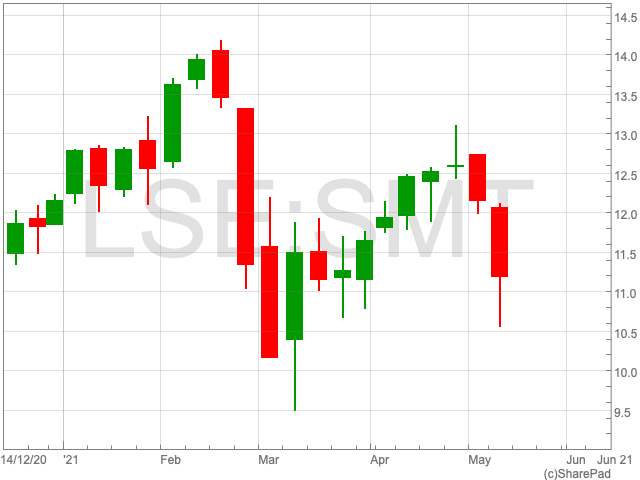
As the graph below demonstrates, it has been an interesting year so far for the Scottish Mortgage Investment Trust share price. After being relatively untroubled during the pandemic, and even seeing its growth soar through 2020, it finally faced some bumps in the road in 2021. With the tech sell-off, James Anderson stepping down and the company dipping its toes into the world of cryptocurrencies, now could well be a pivotal moment in the outlook of the fund.

US Tech Stocks

A cause of Scottish Mortgage’s dips through 2021 has been the downturn of a number of its US tech stocks. Ironically, it was by selecting such stocks that has seen the company make outstanding gains in the past.

The Nasdaq, which features a number of major US tech stocks, has seen a sharp fall over the past month, now down to 13,254. In repose, Scottish mortgage confirmed yesterday that it that it sold 80% of its Tesla holding over the past 12 months. The trust also sold its shares in Facebook and Google’s parent company Alphabet, as well as cutting its stake in Amazon.

The question now is where its growth will come from, as markets appear to be concluding that valuations are out of touch with earnings. One are of focus for the trust could be cryptocurrencies.

Crypto

Investors seeking to gain exposure will be intrigued by Scottish Mortgage’s foray into the world of crypto. In its first investment into the industry, the FTSE 100 company invested £72m into Blockchain.com, the largest cryptocurrency company in the UK.

It is worth noting that Scottish Mortgage Investment Trust’s assets under management are valued at £18bn, and so its exposure is limited at this point.

However, it still highlights the emergence of the crypto space, as well as Sottish Mortgage’s willingness to invest.

Guru Capital to acquire UK Fintech Oval Money

Oval Money will be acquired by and integrated into the UK based online CFD Broker ETX Capital

Guru Capital, the private equity firm based in Switzerland, confirmed on Friday that it has acquired substantially all the assets of UK based Fintech company Oval Money.

Oval Money will be acquired by and integrated into the UK based online CFD Broker ETX Capital, a Guru Capital portfolio company.

Guru Capital is also in the process of negotiating the purchase by an associated fund of 100% of the shares of Oval Money’s Spanish regulated investment firm subsidiary, Oval Marketplace A.V., S.L.

The company said via a statement that its acquisitions support ETX’s and Oval’s shared mission of bringing a wide range of financial services and products to the market in an affordable way.

“The combination will help accelerate business growth and client engagement by supporting clients in setting smart rules for defining their savings habits and investment goals, making payments, and tracking spending as well as trading in the financial markets through a single mobile app,” Guru Capital said.

Oval operates a mobile app that has over 100,000 active users, helping them to save and invest through their marketplace of financial products, while ETX is an online CFD and Financial Spread Betting brokers providing online trading services primarily to UK and European clients.

Rolls-Royce share price: positive news emerges from AGM amid air travel uncertainty

0

Rolls-Royce Share Price

The Rolls-Royce share price has struggled so far in 2021 as the outlook for the aviation industry has remained cloudy. Since the beginning of the year it has lost 6.94% in value. While over the past 12 months it is up by 22%, but is still more than 50% below its pre-pandemic high. With the company’s annual general meeting taking place yesterday, and vaccine roll-outs across the world moving further along, now is a pivotal moment for investors curious about the FTSE 100 engineering giant’s stock.

Return to Positive Cash Flow

Following its AGM yesterday, Rolls-Royce said it is expecting its cash flow to turn positive during H2 of 2021 “as engine activity recovers and cost savings are delivered”.

This announcement is especially important as Rolls-Royce ended last year with debt at £3.6bn as the group took measures to refinance. This came about partly because Rolls-Royce made 1,400 people redundant, saving the company up to £1.3bn a year.

Air Travel

However, for the Rolls-Royce share price to sustain its recovery and go further, it will need to show its ability to perform over a longer period of time. The question comes back to air travel. It is clear that there is pent-up demand.

However, whether or not that can turn into flights, and soon, is a different question. Leaders at the major UK and US airlines are frustrated and have called on their governments to do more to restart transatlantic travel.

“The airline industry needs adequate lead time to establish a plan for restarting air services, including scheduling aircraft and crews for these routes as well as for marketing and selling tickets,” said a letter to the transport chiefs of both countries.

There is also frustration over the UK’s “green list” which many consider to be underwhelming, containing only one mass-market destination in Portugal. “It is very disappointing and frankly not worth commenting on,” said IATA director general Willie Walsh in response to the list’s publication.

If the company does not see a return to flying in time to rescue is earnings for the 2021 holiday period, then it could be another year of losses, and the Rolls-Royce share price could be in trouble.

Electric Aeroplane

Rolls-Royce also confirmed that its all-electric aeroplane will fly within the next few weeks.

The ‘Spirit of Innovation’ will be the fastest electric plane on earth, aiming for a top speed in excess of 300mph. The aircraft will also be able to fly the distance between London to Paris, or 200 miles, on only one charge.

The company’s plan is to eventually apply the technology to products that can be brought to the market. “We are bringing a portfolio of motors, power electronics and batteries into the general aerospace, urban air mobility and small commuter aircraft sectors as part of our electrification strategy,” Rolls-Royce said in a statement following its AGM.

Sage to reach top end of guidance despite profits falling by 31%

0

Sage CEO believes SME companies will lead the recovery

Sage Group (LON:SGE), the British software company, saw its profits before tax drop by 31% to £190m during the first half of its financial year.

The FTSE 100 firm also confirmed to investors that its revenue fell by 4% to £937m, during the period of six months ending in March.

Sage’s organic growth in H1 was 4.4%, while the company said it will reach the top end of its previous 3-5% guidance over the course of the whole year.

The company outlined its strategy of moving customers over to Sage Business Cloud, which it believes will hasten its growth as companies become more digitally savvy.

The Sage share price is up by 3.56% at the time of writing to 645.80p.

AJ Bell investment director Russ Mould, commented on Sage’s results:

“The latest results from accounting software firm Sage may be a little hard to pick through but the conclusion seems to be that the company is heading in roughly the right direction.”

“Critically there was evidence of at least some of the organic growth in recurring revenue which is front and centre in the company’s strategy.”

“Historically Sage was a ‘steady-eddy’ business built on a license sales model, where most of the contracted cash came up front with high margin servicing and maintenance income rolling in over the term of the contract.”

Commenting on the results, Sage CEO Steve Hare said:

“Sage performed strongly in the first half against tough comparators, with continued recurring revenue growth and increasing levels of new customer acquisition, principally in cloud native solutions. Our deep sense of purpose and experience of supporting small and medium-sized businesses through change has equipped us well to play a vital role throughout the pandemic, and I am proud of the way our colleagues around the world have shown dedication to our customers and partners.”

“We believe that small and medium-sized businesses will lead the recovery, and I am confident that our strategic investment in Sage Business Cloud will continue to accelerate growth, as customers become stronger and more digitally-enabled.”

Last night’s Wall Street rally provides ‘port in the storm’ for FTSE 100

0

“It has been a turbulent week as the sceptre of inflation once again spooked investors however it looks like last night’s Wall Street rally is providing a port in a storm for the FTSE 100 as it enjoyed a solid bounce on Friday morning,” says AJ Bell investment director Russ Mould.

The FTSE 100, two hours into Friday’s session, finds itself up 0.72% to 7,013.20.

The big economic update coming later today is the US retail sales release.

“We’re operating in a through the looking glass world where seemingly bad news is taken positively by the markets on the basis it means central banks won’t pull back on the stimulus front or put up rates,” Mould said.

“If retail sales have surged across the Atlantic then that would likely be a headwind for equities as it would stoke the concern about rising prices and what the US Federal Reserve might need to do to keep them under control.”

Keeping cases of the Indian variant of Covid-19 under control is the something the UK is facing up to and it is prompting some concern that the next phase of reopening might be delayed. “This uncertainty could hit the hospitality and travel sectors,” Mould reckons.

FTSE 100 Top Movers

Sage (3.11%), SSE (2.44%) and BT Group (2.44%) are the biggest risers on the FTSE 100 midway through the morning session on Friday.

At the other end, thanks to a drop-off in the price of copper, miners Antofagasta (-2.13%) and Rio Tinto (-1.84%), as well as Rolls-Royce (-1.45%) are the biggest fallers.