88 Energy share price soars on repayment of debt and ESG commitment

0

88 Energy Share Price

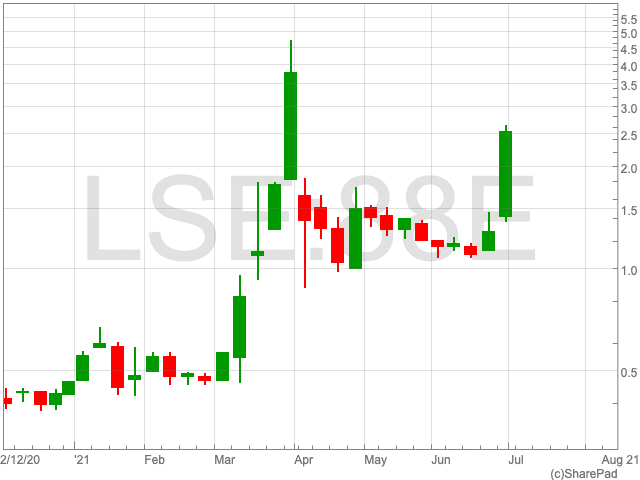
The 88 Energy share price (LON:88E) is up by 22.29% on Friday after the company revealed it has completed the sale of the Alaskan Oil and Gas Tax Credits. It means that the company has now paid of all of its existing debt. The Australia-based energy firm has now added 119.22% to its share price over the past month and 404.2% since the beginning of the year.

Today’s rise caps off a strong week for 88 Energy as the FTSE 250 company made announcements which bode well for its future.
88 Energy Repays Existing Debt

At the beginning of June, 88 Energy confirmed it had agreed the sale of Alaskan Oil and Gas Tax Credits which by a subsidiary owned by the company.

The news followed on from a previous announcement made by the compass on 21 June. 88 Energy then stated that the sale price of the Tax Credits was $18.7m.

The FTSE 250 firm said most of the money generated from the sale would be allocated to paying of 88 Energy’s outstanding debt of $16.1m. The debt was set to mature at the end of 2022.

The debtor waived early repayment penalties as 88 Energy confirmed on Thursday that the debt repayment was finalised.

88 Energy Adopts Global Standard for ESG Reporting

On 30 June 88 Energy confirmed it adopted the Environmental, Social and Governance (ESG) framework designed by the World Economic Forum (WEF).

Impact monitoring technology company, Socialsuite, a leading provider of Impact Management Systems, will measure 88 Energy’s performance across 21 core ESG metrics and disclosures.

The company will then report its ESG progress across each sustainability area.

The company has paid off outstanding debts, as well as well as committing to transparency over its sustainability measures, which has been reflected in the 88 Energy share price.


UK crypto exchange coinpass launches new trading platform

‘coinpass Trade’ is available to both individual and institutional investors

Coinpass, the British cryptocurrency exchange, confirmed on Friday that it has now launched its own trading platform.

The new platform, named ‘coinpass Trade’, will allow users to buy and sell crypto on an exchange which is listed on the Financial Conduct Authority’s temporary crypto asset register.

The exchange is available to both individual and institutional investors.

Jeff Hancock, co-founder and CEO, said: “Our goal was to design a crypto trading experience for our users that was easy to use, beautiful to interact with and provided access to the most important data when investing in crypto. 

“Typically, exchanges leave you looking at charts and order books instead of the important data to monitor and grow your crypto portfolio. Our new innovative trading platform will enable our users to actively monitor their trading positions, crypto market trends and overall portfolio performance, which are essential to investors to continue to grow their portfolio.”

At launch, coinpass Trade will support the following trading pairs and markets: 

British Pound (GBP), European Euro (EUR), Bitcoin (BTC), Ethereum (ETH), Ripple (XRP), Litecoin (LTC), Bitcoin Cash (BCH), Polkadot (DOT), Chainlink (LINK) and Stellar (XLM).

Voted Best Cryptocurrency Exchange Platform 2020 at CityAM’s CryptoAM Awards, coinpass is preparing for exponential growth to service its growing UK and European user base.

Bitcoin was highly volatile during the first half of 2021

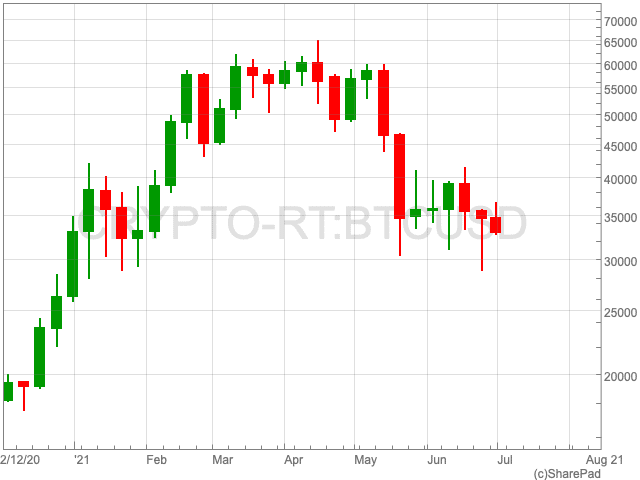
Bitcoin’s current price is $33,000

Bitcoin reached its all-time high in April, just below the $65,000 mark. However, by July, the cryptocurrency had shed nearly 50% of its value.

At the beginning of the year, bitcoin was just shy of $30,000, below its current price of $33,000.

In the early part of June, bitcoin’s 30-day volatility rose to 117%, according to Blockforce Capital and reported by Forbes.

The extreme swings in the price of bitcoin remain, and while many say it is the price to pay for long-term gains, it presents a risk for investors, especially those who are leveraged or need to access their holdings sooner than expected.

“Limited, highly inelastic supply on single cryptos can exacerbate volatility,” according to UBS. “Limited real world use and extraordinary price volatility also indicate many buyers are seeking speculative gains.”

One of the causes of the massive swings are traders taking excessive risks and being forced to sell when crypto prices fall.

Volatility could also attract institutions which may be able to capitalise on large price swings, especially over the short-term. This could be an important factor for the long-term price of bitcoin.

However, for now, many institutions appear to be reluctant.

FTSE 100 claws back week’s losses on Friday

0

On the back of a testing week for investors, with markets experiencing a couple of nasty days, UK stocks are on track to have recovered all this week’s losses. This shows, according to Russ Mould, investment director at AJ Bell, “that it can pay to hold your nerve when it comes to investing”.

“Patience is paramount,” Mould added.

The FTSE 100 traded 0.17% higher on Friday at 7,137, thanks to strength in pharma and consumer goods companies.

“Airline stocks did their best to fly higher following encouraging numbers from the sector. Wizz Air managed to fill nearly two thirds of its seats on aircraft in service during June, while Ryanair flew nearly three times as many people that month versus May,” said Mould.

“Under the circumstances, these are positive numbers. However, the airline business model is built on filling planes near or at capacity and then scooping up extra fees on top for everything from early boarding to storing bags.”

“The sector needs a continuous flow of people through airports and ongoing Covid restrictions imposed by various governments around the world mean the industry is still some way off from operating smoothly.”

The FTSE 250 advanced 0.4% to 22,708, with notable gains from property related stocks including housebuilders Bellway and Crest Nicholson, and builders’ merchant Travis Perkins.

“The housebuilding sector remains a firm favourite with investors despite the stamp duty holiday in England and Northern Ireland starting to be tapered. Fundamentally there is still a major shortage of homes in the UK, so perhaps investors are taking the view that housebuilders will be able to easily sell every property they construct and that we aren’t going to see a major property crash once the stamp duty holiday ends completely.”

FTSE 100 Top Movers

Informa (2.77%), Anglo American (2.27%) and Barratt Developments (1.79%) are leading the way on the FTSE 100 on the final day of the week.

Holding the UK index back and trailing the pack is Standard Chartered (-0.98%), Kingfisher (-0.87%) and HSBC (-0.84%).

Ryanair passenger numbers rise as CEO blasts travel restrictions

0

5.3m people boarded Ryanair flights in June

Ryanair’s passenger numbers rose sharply in June, reaching 5.3m, well up from the 0.4m recorded during the same month a year ago.

The change came as the green-list was announced and then more countries were added.

Even compared to the month before there was a dramatic shift, as 1.8m people got on Ryanair flights in May.

CEO of Ryanair Michael O’Leary has weighed in on the matter, suggesting European countries’ travel restrictions were ineffective, and called for the to be repealed on the introduction of the EU Digital Covid Certificate.

“We have to stop in Europe, individual countries imposing stupid or ineffective [restrictions]. We now have the Digital COVID Certificate that allows everybody to arrive, either vaccinated or with a negative PCR, and that should give the Germans the assurance they need,” O’Leary told Euronews.

“[German Chancellor Angela] Merkel’s plan, which was to require visitors to Germany from the UK to quarantine for two weeks, made no sense when the UK is the country with the most vaccinated population in Europe. So there’s lots of these silly ideas being floated,” the Ryanair chief said.

“We do need across Europe to welcome UK visitors to the tourism destinations of Portugal, Greece, Italy and Spain, because without them, you know, the European Union would be an awful lot poorer.”

The Ryanair share price is up by 1.05% on Friday morning to €16.37.

130 nations commit to G7 global tax reform

0

Tax havens are also part of the deal

The push for a uniform corporate tax policy across the world has received a boost as 130 countries and jurisdictions agreed to the proposals.

The Organisation for Economic Co-operation and Development said that once the deal is ratified, major companies, including Google and Amazon, would pay taxes of at least 15%.

The new tax policy will bring $150bn in tax revenues to governments around the world.

Recent progrès in talks saw all countries within the G20 group, including Brazil, China, India and Russia, come to an agreement at the G7 in London in June.

A handful of nations, including Ireland and Estonia, are yet to sign up to the tax reforms.

“The framework updates key elements of the century-old international tax system, which is no longer fit for purpose in a globalised and digitalised 21st-century economy,” the OECD said.

President Joe Biden said the deal brings the world towards an agreed upon policy that will “halt the race to the bottom for corporate taxes”.

A number of countries and jurisdictions known as tax havens are also part of the deal.

The jist of the agreement is that major companies would be required to pay a minimum of 15% tax in every country they operate in.

Mathias Cormann, Secretary General of the OECD, added that “after years of intense work and negotiations, this historic package will ensure that large multinational companies pay their fair share of tax everywhere.”

Chancellor Rishi Sunak is pushing for exemption for the City of London in the G7’s move for a new global tax system targeted at the world’s largest multinational enterprises.

Sunak previously stated that the recent agreement was “historic” however it would force the biggest tech companies to “pay their fair share of tax in the UK”. 

However, the Financial Times reported that Britain is one of a number of countries seeking “an exemption on financial services”, as the chancellor is fearful that multinational banks headquartered in London could be impacted.

US weekly jobless claims fall to a new pandemic low of 364,000

1

The S&P 500 is at a record high

The S&P 500 made a flying start to the second half of the year, reaching record levels on Thursday, as the weekly jobless claims figures surpassed expectations.

The S&P 500 is up by 0.3% on Thursday to a record high of 310.85. Year-to-date it has now added 16.49%.

At the time of writing, the Dow Jones is up by 0.24%, and 14.43% since the turn of the year.

Data revealed by the Department of Labor showed that initial unemployment claims dropped to 364,000, down by 51,000 during the week ended 26 June.

Estimates by economists were at a significantly higher level of 410,000.

While there is a shortage in the supply of labour, companies have been reluctant to let employees go.

The continued success of the vaccine roll-out has helped to slow the rate of infections as local governments have been emboldened to ease restrictions.

Many have taken up the opportunity to get the vaccine, which has raised confidence levels among consumers, and raised spending, especially on things people were unable to buy or do over the past year.

In order to match the increased levels of demand, firms are hiring more and more people.

UK manufacturing growth slows down in June but remains high

0

Export demand was buoyed as economic conditions across the world improved markedly

The UK manufacturing industry saw a slow down in growth in June, according to a survey released on Thursday.

The closely monitored IHS Markit CIPS manufacturing purchasing managers’ index dropped to 63.9, down from 65.6 in May, a record high. However, it remains well above 50, the level that indicates stagnation.

Expansion in output, new orders and employment are around the best levels in the survey’s near three-decades long history.

Businesses upped their spending as restrictions eased while demand for manufacturers’ goods became stronger.

Export demand was buoyed as economic conditions across the world improved markedly, with demand coming mostly from Asia, Europe and America.

The strong upswing in global market conditions combined with constraints introduced to combat the Covid-19 pandemic continued to result in considerable supply-chain and price inflationary pressures in June.

Average input costs rose at the fastest pace in the survey history, with over three-quarters (77%) of manufacturers reporting an increase.

Commenting on the latest survey results, Rob Dobson, Director at IHS Markit, said:

“UK manufacturing maintained a near survey-record pace of expansion at the end of the second quarter, as the re- opening of economies at home and overseas supported increased production, new orders and employment. Solid business confidence and rising backlogs of work also suggest that the current upturn has further to run.”

“The sector is still beset by rising cost inflationary pressures, however, as Brexit-related trade issues exacerbated global supply chain delays. The resulting widespread raw material shortages drove purchase prices up to the greatest extent on record, leading to an unprecedented steep rise in selling prices. There are also widespread reports of supply issues causing disruptions to production schedules and impeding the re-building of buffer stocks,” Dobson added.

“The continued inflationary impact of capacity issues at both manufacturers and their suppliers will be a further factor keeping headline inflation above the Bank of England’s 2% target in coming months.”

UK small caps on a hot streak during first half of the year

0

UK small cap companies brought in £240m of new cash in April

UK small cap companies are on a strong run of form this year as the vaccine roll-out has proved a success, while the fallout of Brexit appears to be a distant memory.

As a result, investors have put faith in the UK market, with inflows going to small cap companies in particular.

“The real stand out winner of the year to date has been the UK Smaller Companies market”, according to Laith Khalaf, financial analyst at AJ Bell, “which has enjoyed an incredibly hot streak of performance”.

“Indeed so far this year the FTSE Small Cap index has repeatedly set new record highs and now sits around 20% higher than pre-pandemic levels,” Khalaf added.

Major market performance (and FTSE Small Cap)H1 Total return %
FTSE 10010.9
MSCI AC Asia Pacific ex Japan5.7
MSCI Europe ex UK12.3
S&P 50014.0
TSE TOPIX0.5
FTSE Small Cap19.4

UK small cap companies brought in £240m of new cash in April, an increase of £23m from March, according to according to Investment Association (IA) data.

“The smaller companies market does have a greater exposure to domestic revenues than the big blue chip index, so this is partly a vote of confidence in the UK economy but also a sign of investors positioning themselves for a risk-on market,” Khalaf said.

“The strong performance of the FTSE Small Cap explains why UK Smaller Companies funds dominate the top of the performancetable so far this year. At the bottom end of the performance table, gold funds find themselves out of favour, with a global economic recovery and rising bond yields both serving to undermine demand for the precious metal.”

The S&P 500 reach a record high on the final day of June to finish H1 on a strong note. Year-to-date the S&P 500 is up by 14%, outperforming the FTSE 100 by 3.1%