German industrial output down 1% in April as supply bottlenecks hold back recovery

0

German factories remain 5.6% below pre-pandemic levels

Germany saw its industrial output fall in April due to a lack of semiconductors, timber and other intermediate goods.

It is additional evidence that supply bottlenecks are holding back a recovery in the largest economy in Europe.

The Federal Statistics Office confirmed industrial output fell by 1% on the month following a downwardly revised increase of 2.2% in March.

The dip in the industrial output figure was driven by a 3% fall in consumer goods production and a sharper fall of 4% in construction activity.

The figures mean that the German economy will be more reliant on household spending to support its economy which is still reeling in the aftermath of the coronavirus crisis.

German factories remain 5.6% below pre-pandemic levels, despite the global economy beginning to pick up this year.

Factory bosses have been drawing attention to shortages in plastics, rubber and metals and semiconductors, as suppliers have raised prices in response.

“Such a combination is unparalleled: Order books in industry are well filled and production is falling,” VP Bank economist Thomas Gitzel said, adding that the supply problems with semiconductors were causing a fall in output in the car industry.

Gritzel said that manufacturing would only be able to make a minimal contribution to the overall picture in the coming quarter, despite order books being full.

Bosch board member Harald Krüger told the Financial Times: “The only way to get out of [the recent crisis] is to have a different level of commitment”.

In an effort to ensure production of chips for its power tools in July, Bosch opened a €1bn semiconductor plant in Dresden yesterday.

“Money needs to be put on the table and actually parts have to be bought. The commitment needs to be rock solid that those parts will be bought. It can’t be: ‘Maybe I [will] buy them, prepare for it, and maybe not.’ This doesn’t work.”

Aviva must return capital says activist investor Cevian

0

Cevian Capital has acquired a 4.95% stake in Aviva

Cevian Capital, an activist investor, confirmed on Tuesday it had acquired a 4.95% stake in Aviva (LON:AV), and that the UK insurer should now be able to return £5bn of excess capital next year.

As an alternative to ousting chief executive Amanda Blanc, Cevian is encouraging the FTSE 100 company’s boss to work on a number of disposals she announced when she took over the company nearly 12 months ago.

Over the past year, Aviva has agreed to sell eight non-core businesses, raising nearly £8bn, in an effort to prioritise the UK, Ireland and Canada. The pursuits of previous leadership teams were seen by some analysts as overly ambitious, leaving Aviva with an overly big cost base.

“Aviva has been poorly managed for many years, and its high-quality core businesses have been held back by high costs and a series of bad strategic decisions,” Christer Gardell, managing partner and co-founder of Cevian said in a statement.

The insurer “has the potential to become a focused and well-capitalised market leader that produces profitable growth, generates significant cash, and is highly appreciated in the equity markets,” he added.

At the end of last month, Aviva said it had raised £7.5bn from disposals, while its intention was to return the money to shareholders. However, Aviva did not put a number on the amount.

Analysts, according to Reuters, expect the insurer to have between £3.7bn and £6.6bn in excess capital after the asset sales were completed.

“Aviva has made significant strategic progress over the past eleven months and we remain sharply focused on further improving our performance,” an Aviva spokesperson said in an emailed statement.

“We regularly engage with investors and welcome any thoughts which move us towards our goal of delivering long term shareholder value”.

Cevian manages in excess of $16bn on behalf of 350 pension funds, endowments and other investors. According to the Financial Times, it began building it stake in Aviva early this year. With its holding at 4.95%, Cevian is now Aviva’s second-largest holding behind BlackRock.

The Aviva share price is up by 2.53% during the morning session to 421.10p per share.

New standard listing: Thungela Resources

Anglo American (LON: AAL) has successfully spun off South African coal mining business Thungela Resources Ltd (LON:TGA) and the shares have started trading on the standard list in London and the Johannesburg Stock Exchange. Anglo American shareholders received one Thungela share for every ten Anglo American shares they own.
Thungela generates four-fifths of sales from exports. The major destination is India. The realised export price can sometimes be more than treble the domestic price.
There are reserves of 137Mt and resources of 756Mt. Thungela operates four open cast mines and three undergr...

Aquis to Main Market: ImperialX / CloudBreak Discovery

Aquis shell company ImperialX has finally secured some mining assets to provide a base for its business and it says that it has a pipeline of other potential deals. This includes grassroots mineral assets.
The share price has settled down at 4.5p. Management is setting its store by a rising share price and the increasing attraction of the shares to the vendors of assets that it wants to purchase.
This company seems to be a ragbag of assets. It really requires someone with some knowledge to trawl through the different investments and net smelter returns to assess just what valuation the company...

Covid-19 vaccine now available for those aged over 25

0

Under-30s make up the final group on the priority list

People in England who are older than 25 years of age are now being called to receive the Covid-19 vaccine from tomorrow, confirmed UK health secretary Matt Hancock.

Hancock’s announcement signals the final stage of the vaccination programme which began in December 2020.

Under-30s make up the final group on the priority list.

The NHS has said it is now in the “home straight” of what is the biggest vaccination programme in its history.

The news arrives as cases continue to rise with the Indian variant now the most dominant strain in the UK.

Case rates are increasing in more local areas than at any other point since the beginning of the year, with numbers rising in large parts of north-west England, as well as London and Scotland.

Hancock also said that it was “too early to make decisions” regarding the finals steps of the roadmap out of lockdown.

“The roadmap has always been guided by the data and as before, we need four weeks between steps to see the latest data and a further week to give notice of our decision,” he said.

An announcement on the data review is expected on June 14.

US markets retreat while FTSE 100 maintains morning gains

0

At lunchtime across the Atlantic Ocean, the Dow Jones is down 122.01 points, or 0.35%, having opened in the green foot seven out of the last eight days, while the S&P 500 has so far retraced by 0.23%, or 9.79 points.

Major US stocks have been quiet during recent days as investors weigh up a number of factors, including high valuations, supply-chain concerns and the overall economic outlook.

Losses in major tech companies, including Apple and Amazon, held the US markets back on Monday. While ten-year US Treasury yields increased from the lowest since April following Janet Yellen’s comments that a marginally higher interest rate could be beneficial.

“If we ended up with a slightly higher interest rate environment it would actually be a plus for society’s point of view and the Fed’s point of view,” Yellen said.

The FTSE 100 has managed to maintain the gains of the morning session off the back of strong performances from housebuilder stocks.

“With Persimmon, Barratt Development and Taylor Wimpey all up 2.8%, 2.3% and 2% respectively, the FTSE 100 has managed to hold onto its 20 point gain on the day,” said Hugh Shields, financial trader at Spreadex.

“This comes alongside news that UK house price inflation has reached a 7-year high, giving further hints that the MPC will have to take a deep look into increasing interest rates come its 24th of June announcement.”

It has also been a positive Monday for cryptocurrencies. Both Bitcoin (+1.55%) and Ethereum (+4.45%) find themselves in the green this afternoon, this in light of the Bank of England’s announcement that it will discuss the regulation of ‘stablecoins’.

“We are a long way from cryptocurrencies being used in day-to-day life, but this news is crucial step for the integration of digital currencies into mainstream society, a positive for all long-term crypto investors,” says Shields.

Finally, the president of El Salvador confirmed on Sunday that he will make bitcoin legal tender in the Central American country.

Pending backing by the country’s congress, El Salvador would become the first country in the world to officially adopt the cryptocurrency.

Avacta Group share price jumps as lateral flow test approved by UK regulator

1

Avacta Group Share Price

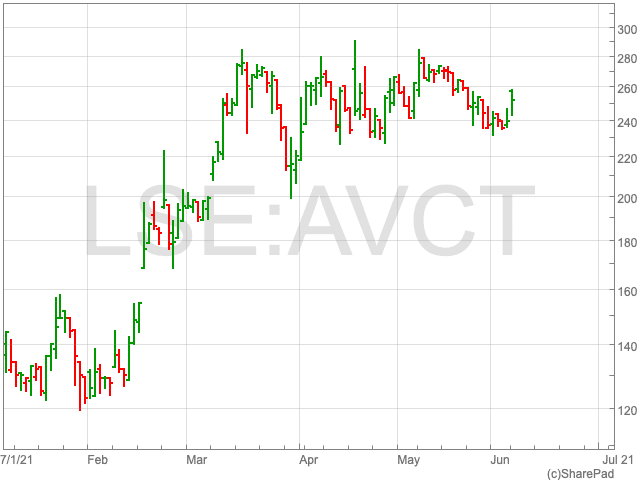
The Avacta Group share price (LON:AVCT) is up by 6.21% on Monday to 253.84p per share. Going further back, over the last 12 months and more, the biotechnology company has performed well, as have many firms involved in the production of coronavirus tests. Before Covid-19 caught the world by storm, Avacta was focused on cancer therapies and diagnostics. Since then, Avacta found an additional purpose, which boosted its share price.

Over the last six months shares in Avacta Group are up by 105%. While over the last year and three years, shares in Avacta have risen by 60.5% and 641% respectively. The question that remains is how long will demand for Covid testing products support the Avacta Group share price and by how much.

Lateral Flow Test

Today’s move came as the diagnostics and cancer therapy developer revealed that the Medicines and Healthcare products Regulatory Agency (MHRA) has confirmed registration of its ‘AffiDX’ SARS-CoV-2 antigen lateral flow test for Covid-19. This allows the AIM-listed company to put the product on the market in the UK for it to be used professionally. Product registration from a recognised body in the European Union could soon follow.

Avacta said the purpose of its lateral flow test is to provide a cost-efficient and speedy way of identifying people who are most likely to infect others. This is also referred to as having a high viral load.

The company reported that its lateral flow test, when tested in April, found a 100% sensitivity for identifying infectious people with viral loads measured by PCR of Ct<27.

Avacta confirmed ongoing commercial discussions with distributors and end-user customers in nations that accept the CE-mark for in vitro diagnostic products.

“I am delighted to receive confirmation of the registration of the AffiDX SARS-CoV-2 antigen test from the MHRA,” said Avacta Group chief executive Dr Alastair Smith.

“It is a transformative milestone for Avacta’s Diagnostics Division being the first CE marked product powered by the Affimer platform that has been brought to market.”

The AIM-company will now turn its attention to focusing on the commercial roll-out, which could boost the Avacta share price, as well as playing a significant role in allowing economies around the world return to normal.

Bitcoin set to become legal tender in El Salvador

Bitcoin holds steady as announcements come from El Salvador and Paraguay via Twitter

The president of El Salvador confirmed on Sunday that he will make bitcoin legal tender in the Central American country.

Pending backing by the country’s congress, El Salvador would become the first country in the world to officially adopt the cryptocurrency.

Bitcoin would operate alongside El Salvador’s current currency, the US dollar.

Nayib Bukele, the president of El Salvador, said it would become easier for Salvadorians living in other nations to send money back home.

“In the short term, this will generate jobs and help provide financial inclusion to thousands outside the formal economy,” Bukele said at the Bitcoin Conference 2021 in Miami.

If it passes through congress, financial services would be opened up to 70% of El Salvador’s people who do not currently own bank accounts, according to the president.

The country’s economy relies largely on money being sent from abroad, totalling 20% of El Salvador’s GDP.

A mobile payments app by the name of Strike is working to introduce bitcoin to El Salvador.

“Adopting a natively digital currency as legal tender provides El Salvador the most secure, efficient and globally integrated open payments network in the world,” Strike founder Jack Mallers said.

“This is the shot heard ’round the world for bitcoin. Adopting a natively digital currency as legal tender provides El Salvador the most secure, efficient and globally integrated open payments network in the world,” Mallers added.

Paraguay

Heading further south, further crypto news is emerging, this time in Paraguay.

Again taking to Twitter, Paraguayan MP Carlos “Carlitos” Rejala hinted at a PayPal/bitcoin related announcement.

https://twitter.com/carlitosrejala/status/1401712725886132224?s=20

Translated into English, Rejala said: “I’ve been saying this for a long time: Our country needs to move hand in hand with the new generation. The moment has come, our moment. This week we will start on an important project that will help innovate Paraguay for the whole world to see.”

Despite the news coming out over the weekend the market is largely flat on Monday. Over the past 24 hours, bitcoin is up by 0.82% to $36,363.

China’s export growth below expectations in May as copper falls

0

Chinese exports 3.2% below expectations in May

Export growth in China slowed by a more than expected amount during May, as revealed by data from the National Bureau of Statistics.

Exports rose by 27.9% in May compared to the month before, albeit down from 32.3% in April. It also fell below consensus forecasts for 32.1% growth.

Imports jumped by 51.1%, 7% higher than in April. Despite falling below consensus expectations of a 53.5% jump, it was still the fastest growth in over ten years.

Copper prices fell on Monday too, leading to concerns over a slowing of demand for the red metal. Due its wide usage, copper is looked to as a bellwether of the world economy.

The copper composite was down 2.8% at 446.3¢ around lunchtime.

“The only news that came out since (the dip) is the China export data,” a Singapore-based metals trader told Reuters.

“Friday’s rebound had already run its course, so there’s a need to retrace lower first before it (price) can go up. The medium-long term view is still bullish due to a weaker U.S. dollar,” the trader added, referring to a 1.7% gain in London on Friday.”

Capital Economics said told Sharecast: “We think that trade volumes, which are well above their pre-virus trend, will drop back over the coming quarters. Admittedly, supply constraints should start to ease later this year. But the pandemic-induced surge in demand for Chinese exports appears to be losing momentum and should reverse as global consumption patterns normalise on the back of vaccine rollouts and easing social distancing restrictions.”

“The relatively modest level of the PMI export orders indices – which measure the share of firms seeing rising orders – underlie how concentrated the current strength of foreign demand is, making it vulnerable to a pullback.”

House prices see fastest growth in seven years and ‘likely to keep rising’

0

Since May 2020 nearly £22,000 has been added to the average house price

House prices in the UK are expected to continue rising despite reaching record levels in May, according to Halifax.

Halifax, one of the UK’s biggest mortgage lenders, revealed that the price of a home jumped by 1.3% in May, brining the average selling price to a record £261,743. Many are making efforts to secure deals as the UK’s stamp duty holiday begins to draw to a close.

Since May 2020, nearly £22,000 had been added to the average house price, as the UK saw a gradual easing of its lockdown restrictions.

At a yearly rise of 9.5%, it is the fastest rate of growth in seven years.

Halifax’s findings echo Nationwide’s report from last week which suggested that UK house prices rose by an annual 10.9% over the same time period.

The Halifax managing director, Russell Galley, said: “Heading into the traditionally busy summer period, market activity continues to be boosted by the government’s stamp duty holiday, with prospective buyers racing to complete purchases in time to benefit from the maximum tax break ahead of June’s deadline, after which there will be a phased return to full rates.”

In addition to a move int the average price of a home, there has been a shift in the type of homes people are looking to move into during the pandemic. The working from home surge has created interest in bigger homes outside of city centres and with gardens.

“These trends, coupled with growing confidence in a more rapid recovery in economic activity if restrictions continue to be eased, are likely to support house prices for some time to come, particularly given the continued shortage of properties for sale,” Galley said.

Sam Mitchell, CEO of online estate agent Strike, said: “Contrary to the British weather, the UK property market was red-hot in May and house prices showed no signs of cooling.

“The fast approaching stamp duty holiday deadline has helped turn the market into a frenzy, but there are other factors at play here. A sense of normality is returning as restrictions lift and the vaccination roll out progresses, while we’ve also seen a major uplift in the 95% mortgage offering which has helped more first-time buyers come to the market.

“Many will be questioning if this level of demand will last once the stamp duty holiday begins to taper off, but let’s not forget that the UK is still faced with a major supply and demand imbalance issue. A lack of new stock, particularly houses with outside space and in rural locations, will continue to push prices up by being outweighed by demand. Plus, the Government may well have something else up its sleeve to support the market once the stamp duty holiday ends.”