Is the tide turning for UK income investing?

Charles Luke, Investment Manager, Murray Income Trust PLC

It’s a challenging time for investors, not least those in need of income generation. The coronavirus crisis continues to play out globally, with the UK hit worse than almost any other large economy at the start of 2021. Covid-19’s scars are likely to be with us for a long time and the path to economic recovery remains uncertain.

However, at Murray Income Trust, we believe there are reasons for optimism on UK equities. Indeed, income investors, who may have previously overlooked the market, may want to reconsider their positions in light of some positive drivers. Let us tell you more.

Vaccines help vanquish dividend doubts

We are all familiar with the difficult dividend backdrop of the past year or so. We’ve witnessed dividend cuts, cancellations and regulatory intervention, as companies grappled with the financial impact of the pandemic. Combined with the long shadow cast by Brexit, these headwinds were enough to turn many investors away from the UK equities market.

But the tide could be turning. The UK’s rollout of the vaccine programme has progressed extremely well, offering hope of an enduring route out of the pandemic. At the same time, the UK equities market is significantly under-owned. For example, global and European funds’ holdings of UK equities are at their lowest for many years. This offers potential for upside performance when these portfolios are reweighted. Valuation is another significant draw. Even if you adjust for sector differences, UK equities are more attractively valued than their US and European peers.

The hallmarks of quality

The UK equities market also benefits from an abundance of good-quality companies that are still paying attractive dividends. In nearly all cases where dividends were vulnerable to cuts, they have now been rebased. We can, therefore, have more confidence in the UK market’s income level, with previously over-distributing companies returning to sensible pay-out ratios.

A company’s dividend is a useful touchstone for its health. From our perspective, we place great store in the simple premise; to consistently grow your dividends over the long term, you need to grow your earnings. Good-quality companies are best placed to do just that. As income investors, it’s important to remember that dividends provide a significant part of an investment’s total return. In addition, the yield acts as a backstop for a company’s valuation.

A more optimistic outlook

In the aftermath of the pandemic, and in a world of low interest rates, high debt and pressure on corporate profits, the quality of a company will remain as important as ever. At Murray Income Trust, we believe that quality companies are more likely to be able to pay dividends even when conditions are challenging.

From here, we expect to see the following waymarks.

  • Investors will pay a premium for companies capable of delivering attractive and growing dividends.
  • Those companies with strong balance sheets that can undertake merger and acquisition activity, or continue to invest in their businesses through the cycle should emerge in a stronger competitive position.
  • Structural long-term earnings potential in a world of modest medium-term growth will continue to be prized.
  • Therefore, companies with sustainable competitive advantages and pricing power should benefit disproportionately.

Final thoughts …

As we’ve highlighted, there are several positive drivers at play in the UK equities market. For income investors who may have disregarded it, we believe now could be a good time to reconsider investing in the UK.

At a time when quality counts, we maintain our disciplined and measured focus on financially strong, resilient companies that can thrive whatever the conditions. These businesses offer the potential to grow their earnings, and hence their dividends, over the long term.

Important information

Risk factors you should consider prior to investing:

  • The value of investments and the income from them can fall and investors may get back less than the amount invested.
  • Past performance is not a guide to future results.
  • Investment in the Company may not be appropriate for investors who plan to withdraw their money within 5 years.
  • The Company may borrow to finance further investment (gearing). The use of gearing is likely to lead to volatility in the Net Asset Value (NAV) meaning that any movement in the value of the company’s assets will result in a magnified movement in the NAV.
  • The Company may accumulate investment positions which represent more than normal trading volumes which may make it difficult to realise investments and may lead to volatility in the market price of the Company’s shares.
  • The Company may charge expenses to capital which may erode the capital value of the investment.
  • Derivatives may be used, subject to restrictions set out for the Company, in order to manage risk and generate income. The market in derivatives can be volatile and there is a higher than average risk of loss.
  • There is no guarantee that the market price of the Company’s shares will fully reflect their underlying Net Asset Value.
  • As with all stock exchange investments the value of the Company’s shares purchased will immediately fall by the difference between the buying and selling prices, the bid-offer spread. If trading volumes fall, the bid-offer spread can widen.
  • Certain trusts may seek to invest in higher yielding securities such as bonds, which are subject to credit risk, market price risk and interest rate risk. Unlike income from a single bond, the level of income from an investment trust is not fixed and may fluctuate.
  • Yields are estimated figures and may fluctuate, there are no guarantees that future dividends will match or exceed historic dividends and certain investors may be subject to further tax on dividends.

Other important information:

Issued by Aberdeen Asset Managers Limited which is authorised and regulated by the Financial Conduct Authority in the United Kingdom. Registered Office: 10 Queen’s Terrace, Aberdeen AB10 1XL. Registered in Scotland No. 108419. An investment trust should be considered only as part of a balanced portfolio. Under no circumstances should this information be considered as an offer or solicitation to deal in investments.

Investors should review the relevant Key Information Document (KID) and brochure prior to making an investment decision. These can be obtained free of charge from www.invtrusts.co.uk or by writing to Aberdeen Fund Managers Limited, PO Box 9029, Chelmsford, CM99 2WJ.

FTSE International Limited (‘FTSE’) © FTSE 2019. ‘FTSE®’ is a trade mark of the London Stock Exchange Group companies and is used by FTSE International Limited under licence. RAFI® is a registered trademark of Research Affiliates, LLC. All rights in the FTSE indices and/or FTSE ratings vest in FTSE and/or its licensors. Neither FTSE nor its licensors accept any liability for any errors or omissions in the FTSE indices and/or FTSE ratings or underlying data. No further distribution of FTSE Data is permitted without FTSE’s express written consent.

Find out more at www.murray-income.co.uk or by registering for updates.

You can also follow us on Twitter and LinkedIn.

Argo Blockchain Share Price: what next after record mining revenues?

4

Argo Blockchain Share Price

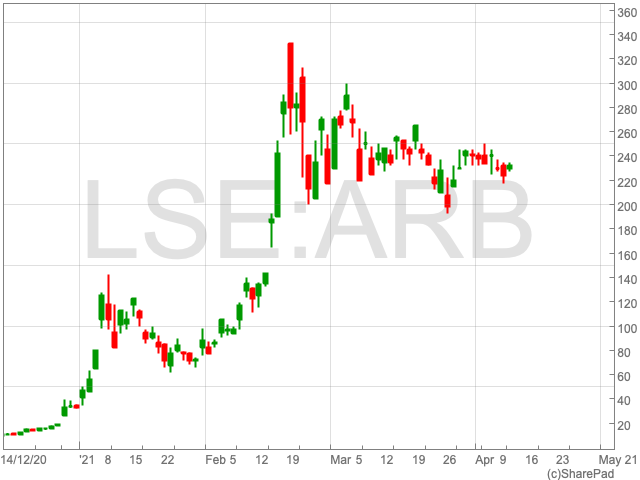
Since the beginning of 2021 the Argo Blockchain share price (LON:ARB) is up by 597% to 230p per share. It follows the prior 12 months when the company’s share price rose by just under 500% in 2020. However, more recently, over the past two months or so, shares in Argo Blockchain have retreated below its February high of 284p. Following remarkable growth of the company, and the ever-increasing influence of blockchain technology, investors will be closely monitoring Argo’s prospects.

Mining

Last month Argo mined 165 Bitcoin (BTC) or BTC equivalent, up from 129 BTC in February, takin the total amount mined in the first quarter the financial year to 387 BTC. The revenue generated from mining increased by 51% in March rose by over 50% to £6.57m, up from £4.34m in February the month before.

Argo also recently confirmed it had reached an agreement with crypto technology company DMG Blockchain Solutions to start a BTC mining pool totally powered by clean energy. Controversy surrounds the emissions generated by mining processes caused criticism of the industry. Some critics have alluded to the fact that one BTC transaction has a carbon footprint equivalent to 900 Visa transactions, while Bill Gates said BTC was “not a great climate thing”. Argo’s move in demonstrating its climate consciousness could go some way to reassuring sceptical investors and setting it apart from other miners.

Bitcoin

It goes without saying that the Argo Blockchain share price is intimately linked to the performance and adoption of BTC. If the price of bitcoin, which at the time of writing stands at £43,832.49, jumps up again, then the Argo share price is likely to follow suit, and vice versa.

According to Tom Jessop, head of Fidelity Digital Assets, BTC adoption has reached a “tipping point” thanks to an environment of “unprecedented monetary and fiscal stimulus.”

Speaking at the Investing in Crypto virtual event series hosted by MarketWatch and Barron’s, Jessop pointed to “a host of reasons” for the adoption of digital assets to proceed “at an accelerated pace.” “We’re not going to get out of this stimulated environment anytime soon,” Jessop said. “I think we’ve reached a tipping point,” Jessop added.

FTSE 100 retreats from recent highs as commodity prices fall

0

Falling commodity stocks put an end to the FTSE 100’s 13-month peak. A 0.9% decline from Brent Crude, and a sharper 1.4% slide from copper, sent the index’s weighty oil and mining stocks lower, and left the FTSE itself down by over 20 points at lunchtime.

By contrast – and almost certainly contributing to the FTSE’s losses according to Connor Campbell, financial analyst at Spreadex – the pound rose 0.1% against the dollar and 0.3% against the euro. “This as sterling tries to reset after a rough set of sessions last week,” Campbell added.

The Eurozone fared better. The DAX essentially didn’t move after the bell, holding at the 15,220 mark it spent most of last week buzzing around, with the CAC dipping 0.1%.

“Looking ahead to this afternoon and, after last Friday’s big push, the Dow Jones is set retreat from its record highs,” said Campbell.

“The futures have the index down 110 points and back below 33,700. If things go the Dow’s way this week, especially in regard to Monday’s 3-year and 10-year Treasury auctions and Tuesday’s inflation readings, then it could cross 34,000. If not, and fears of rising bond yields and inflationary pressures reignite, then the Dow’s recent gains could quickly unravel.”

FTSE 100 Top Movers

Admiral Group (1.52%), Severn Trent (1%) and Bunzl (0.98%) made the most, albeit modest, gains on the FTSE 100 at lunchtime on Monday.

Rightmove (-3.10%), Ocado (-2.77%) and Kingfisher (-2.5%) are the day’s top fallers on Monday.

Shell

Royal Dutch Shell has confirmed its plan to install 5,000 electric vehicle chargers across the UK by 2025. The oil company is also looking to invest in slower-on-street public charging points in an effort to firm up its place as a market leader established through the acquisition of Ubitricity earlier this year.

It is a part of Shell’s plan to move towards a strategy of carbon neutrality. The Anglo-Dutch FTSE 100 company is aiming to operate 500,000 charging points across the world by 2025 and up to 2.5m by 2030.

Cyber security firm Darktrace unveils plans for London float

0

Darktrace announcement comes days after disappointing Deliveroo debut

Darktrace, the cyber security company, is planning to float in London only weeks after Deliveroo ran into problems on its first day of trading.

Chief executive of Darktrace Poppy Gustafsson said on Monday that it would be “a historic day for the UK’s thriving technology sector” when the company, founded in 2013, listed on the London Stock Exchange.

Darkface’s products use artificial intelligence to detect and react to cyber threats. The company brought in revenue of nearly $200m in the past financial year but estimates that is targeting a market worth $40bn a year. The company made a profit on its earnings before interest, tax, depreciation and amortisation, with EBITDA of $9m in the past financial year.

“Developed by our talented software engineering teams in Cambridge, our artificial intelligence was the first on the market to be deployed at scale in the enterprise,” said Gustafsson. “Today [it] is responsible for protecting over 4,700 organisations worldwide from the most sophisticated cyber threats.”

Doubts have been creeping in over the future prospect of technology IPOs after shares in Deliveroo tanked by nearly a third on their trading debut in March. The company’s share price is down again by just under 1% at mid-morning on Monday.

According to a filing released by the company on Monday, Darktrace’s most sizeable market is in North American and its greatest source of growth, despite its decision to list in London.

Over a six month period ending in December, Darktrace’s revenue grew by 39% to $126.5m, compared to 45% growth in the last full year. Losses before tax rose by more than double to $47.9m during H1 of the current financial year, mainly down to a sharp rise in financing costs. Over the same period, operating losses fell to $4.9m to $21.5m in the same period.

Novacyt shares continue decline after DHSC dispute announcement

0

Novacyt says revenues and profit levels for 2021 could be lower than market expectations without supply contract for cov-19 tests

Novacyt shares (LON:NCYT), having fallen by well over 30% on Friday, are down again by 5% on Monday morning to 400p following warnings on revenues due to a dispute with the UK Department of Health and Social Care (DHSC).

The AIM-listed company has recently said “it has strong grounds to assert its contractual rights” by taking legal action as the DHSC said it would not extend a supply contract for Covid-19 tests.

The firm has said that its revenues and profit levels for 2021 could be lower than market expectations without the contract. The situation is compounded by Novacyt’s lack of clarity regarding sales as a result of the “ever-changing nature of the COVID-19 pandemic and diagnostic testing demands”.

A statement released by the company said: “Whilst the directors are confident new contract wins will continue as Novacyt expands international sales and into private sector testing, they believe revenue and profit for 2021 may be lower than current market expectations due to the absence of the DHSC contract extension.”

Novacyt delivered revenue for the first quarter of 2021 of GBP72.6 million, with 50% of this attributable to sales to the DHSC.

The Novacyt Group is an international diagnostics business generating an increasing portfolio of in vitro and molecular diagnostic tests.

CyanConnode selected as Technology Partner for EESL Energy Solutions in Middle East and Africa

0

CyanConnode (LON:CYAN) has announced that it will partner EESL Energy Solutions LLC, Dubai, (EESL), as technology partner for projects in the Middle East and Africa for smart metering and smart lighting projects.

EESL India is a joint venture of four Indian public-sector undertakings; NTPC Limited, Power Finance Corporation Limited, Rural Electrification Corporation Limited and POWERGRID Corporation of India Limited.

EESL has also established a Joint Venture in Dubai, partnering with Hansa Energy Solutions to form EESL Energy Solutions LLC.

John Cronin, executive chairman of CyanConnode, commented on the newly established partnership:

“I am delighted to announce this partnership with EESL Energy Solutions, which I believe will deliver new opportunities for CyanConnode.”

“Offering a range of business models gives a flexible approach to our partnership with EESL and we look forward to collaborating with them to develop and deliver large-scale projects in the Middle East and African markets.”

Saurabh Kumar, EESL Executive Vice Chairperson, expressed similar views over the collaboration:

“EESL Energy Solutions is promoting energy efficiency projects in the Middle East and Africa and is pleased to be partnering with CyanConnode. We have selected CyanConnode as Technology Partner to leverage its market-leading RF Mesh Technology.”

“I look forward to a successful collaborative partnership.”

CyanConnode is a leader in Narrowband Radio Frequency (RF) Smart Mesh Networks, which are used for machine to machine (M2M) communication. As well as being self-forming and self-healing, CyanConnode’s RF Smart Mesh Networks are designed for rapid deployment.

In June 2018, CyanConnode launched its award-winning Omnimesh Advanced Metering Infrastructure (AMI) platform, which has already gained considerable commercial traction, especially in India which is a key market for the Company.

On early morning trading CyanConnode’s share price is up by nearly 10%.

Cake Box expecting record revenue despite pandemic

0

Cake Box opened 17 stores in Q2 of the last financial year

Cake Box (LON:CBOX) is expecting to confirm a robust performance for the year ending 31 March 2021 in the face of lockdown restrictions over the past 12 months.

The cake seller said in an update released on Monday that it was currently holding franchisee deposits for 52 sites across the country.

Cake Box opened 17 stores in Q2 of the last financial year, including sites in Epsom, Gloucester, Newport, Ipswich and Hove. The group now has a total of 24 stores with 157 sites in total.

Cake Box is set to make a record revenue for the year, and is forecasting a rise of around 16% form the period before.

Co-founder and CEO Sukh Chamdal said: “Customer appetite for our products has continued to grow, with good traction across our expanded online and delivery services.”

“Our tested recipe of backing our franchisees has helped us deliver another year of growth, and it is thanks to the dedication of them and everyone in the Cake Box family that we have been able to emerge stronger from a year marked by the global pandemic.”

Cake Box will release its full-year results in June.

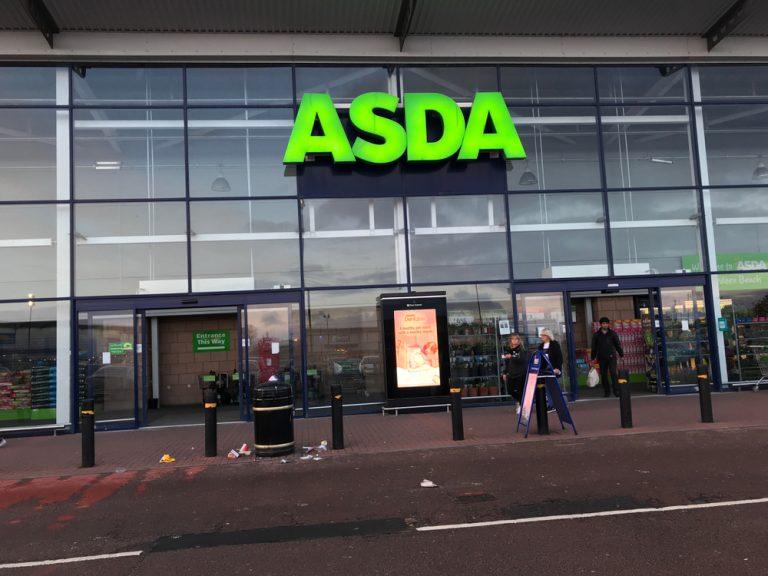
Senior Asda staff set to quit following Walmart shareholder payout

0

Asda chief executive Roger Burnley makes “personal” decision to leave

Senior staff are getting ready to quit Asda after they received payouts from a share scheme run by the supermarket’s US owner Walmart.

According to both industry sources and head-hunters, that say they have been approached by a number of Asda executives, inquiries have been above average for the sector.

Walmart recently completed the £6.8m sale of Asda to the Issa brothers and TDR Capital, the private equity firm.

A source in the industry told the Times that some of thee executives at Asda made the decision to leave because they would no longer be able to be part of the Walmart scheme. The Asda execs also referenced other issues including the failed tie-up with Sainsbury’s, the pandemic and the sale of the company.

The Times also reported that Asda has restructured its staff bonus to minimise the effect of the loss of the Walmart share scheme.

Staff can receive between 100% and 200% of their salary in cash bonuses, depending on their level of seniority.

Just this month Roger Burnley, chief executive of Asda, said that he had made the “personal” decision to leave amid rumours that the new owners had been looking for his replacement since Christmas. Burnley added that he could not see himself committing to the company for the next five years.

However, Burnley reaffirmed that his relationship with the supermarket’s owners was “magnanimous”, and he would bee continuing for thee next year to assist with succession planning.

Trevor Strain, Morrisons’ chief operating officer, Steve Murrells, the boss of Co-op, Jason Tarry, of Tesco, Stuart Machin, at M&S, Ronny Gottschlich, a former boss of Lidl, and Anthony Hemmerdinger, Asda’s chief operating officer, have been named by industry sources as potential candidates.

At the end of last year Asda was sold by Walmart to two billionaire Blackburn-based brothers in a £6.8bn deal. Mohsin and Zuber Issa are petrol station tycoons and backed by TDR Capital to buy the majority stake in the supermarket.

Shell plans thousands of ultra-rapid charging points across the UK

6

500 Shell-owned forecourts to have an average of one or two rapid chargers by 2025

Royal Dutch Shell (LON:RDSA) has confirmed its plan to install 5,000 electric vehicle chargers across the UK by 2025.

The oil company is also looking to invest in slower-on-street public charging points in an effort to firm up its place as a market leader established through the acquisition of Ubitricity earlier this year.

It is a part of Shell’s plan to move towards a strategy of carbon neutrality. The Anglo-Dutch FTSE 100 company is aiming to operate 500,000 charging points across the world by 2025 and up to 2.5m by 2030.

At present, Shell has just above 100 “rapid” 50KW and “ultra-rapid” 150KW chargers on its sites in the UK, while it is looking to double this figure by the end of 2021.

Sinead Lynch, who heads up Shell in the UK, commented further on the company’s ambitions to install charging devices:

“The ambition is to go to 5,000 by 2025. That’s not just going to be on the forecourts: we’re also wanting to step into that ‘destination charging’ space with the rapid and ultra-rapid . . . so you could see them in the car parks of supermarkets.”

Shell owns around 50% the Shell petrol stations in the UK, with the rest being franchises. Lynch added that she expects the 500 Shell-owned forecourts to have an average of one or two rapid chargers by 2025, while sites on A-roads in particular could have more.

“This is quite a lot of money we’re going to spend, so you have to spend it wisely where the commercial case is strongest,” she said.

Many sites would have “a hybrid model for decades”, but Shell would stop selling petrol entirely at some sites. Lynch added that Shell wants to create “the forecourt of the future”, which would include coffee shops and parcel pick-up services.

The company reinstated its plan to cut its carbon emissions footprint to net zero by 2050.

Shell, at the moment, has nearly 80,000 charging points across the world, including 2,700 on-street charging points in the UK, many of which were acquired through the acquisition of Ubitricity.

“The fuels market is slowly declining and the charging market is growing rapidly, so if we want to keep that market-leading position — and we do — we are going to have to grow that business quite considerably,” Lynch said.


Harwood ponders offer for superyacht services provider GYG

Harwood Capital is considering a bid for GYG (LON: GYG) that is lower than the original placing price fewer than three years ago. The possible offer for the superyacht painting and maintenance services provider is 92.5p a share in cash.
Harwood has been building up a stake in GYG and has reached 20.6%. Lonsdale Capital Partners sold a 16.8% stake on 18 January and Oryx International Growth Fund, which is related to Harwood, bought 16.65%. That was the first purchase by Harwood.
The share price had been around 70p at that time. The GYG share price rose to 87p prior to the possible bid announcem...