Good Energy (LON: GOOD) has reiterated its rejection of the bid from rival renewable energy supplier Ecotricity. Management has also outlined its reasoning behind the decision.
They believe that the indicative offer of 340p a share in cash is too low even though it is a premium to the previous market price. The argument is that the company is worth an even greater premium than being offered.
Management also believes that it has a strategic plan that provides a clear direction for the company. The focus is energy as a service and mobility as a service, particularly through Zap Map.
The potentia...
There have been four major healthcare-related bids so far this year and there are likely to be more.
The largest bid this year is for healthcare distributor UDG Healthcare (LON: UDG) which is valued at £2.7bn. Both inhaled drug delivery technology and drugs developer Vectura (LON: VEC) and hospital operator Spire Healthcare (LON: SPI) are valued at around £1bn. The value of the bid for Immunodiagnostic Systems Holdings was much lower and it has just been completed. The total value of the bids is £4.6bn, which is nearly one-fifth of the value of the major bids in the first half of 2021.
The fou...
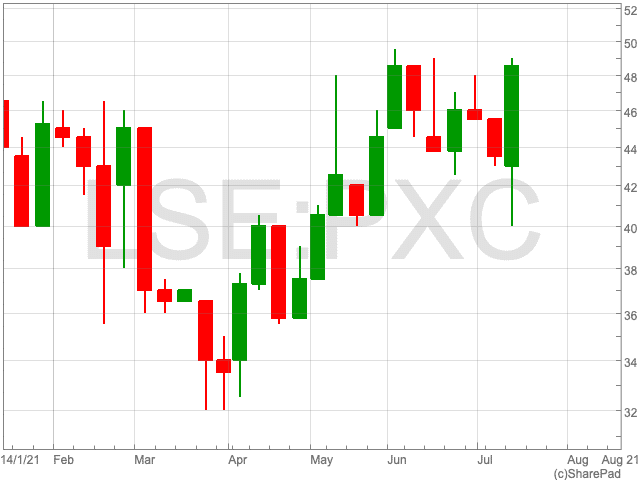
The Phoenix Copper share price (LON:PXC) increased by 16% on Wednesday as the miner made an announcement regarding its Deep Sulphide core drilling programme. The move follows what has been a volatile past six months for the copper miner, which has added 6.55% over the time period. Unlike most companies in the UK, Phoenix Copper saw its share price surge when the pandemic came into effect, in line with the value of the red metal that it mines, as its name suggests.
Sulphide-Rich Mineralisation
Phoenix Copper confirmed via an update on Thursday that sulphide-rich mineralisation had been intercepted below the copper oxide open pit at the Empire mine in Idaho.
The ‘Empire Mine’ was historically mined until the early 1940s at head grades of up to 8% copper. The first drill hole of around 20 has been completed of the 4,500-metre 2021 Deep Sulphide drilling programme.
“These are exceptional results from the first drill hole, suggesting potentially elevated grades of copper, as well as the presence of gold, silver, zinc, lead and perhaps molybdenum by-products. It reinforces our geological model that the deeper Empire underground deposit represents a major ore system, which we are only just beginning to evaluate and understand,” said Ryan McDermott, chief executive of Phoenix Copper.
Phoenix Copper said said further drilling was required to define true thickness, while samples were being logged and prepared for shipping to assay laboratories.
Copper
While the price of copper soared when the pandemic took a stranglehold of the world economy, it has been underperforming over recent weeks. The price of copper reached an all-time-high in May, getting above $10,802 per tonne, before its recent retreat. Investors in the red metal and companies that produce complementary goods will be wondering if and when it is going to see a reversal in its fortunes.
A number of analysts are estimating that the price of copper will rise significantly this year and during Q1 of 2022. Specifically, Michael Widmer, Bank of America commodity strategist, believes that copper could rise to $13,000 per tonne. Widmer added that copper could hit $20,000 per tonne by 2025.
“The world risks running out of copper” amid widening supply and demand deficits, according to Bank of America.
“If our expectation of increased supply in secondary material, a non-transparent market, did not materialize, inventories could deplete within the next three years, giving rise to even more violent price swings that could take the red metal above $20,000/t ($9.07/lb).”
Following a dip in April, house prices jumped in May, according to data revealed on Wednesday by the Office for National Statistics (ONS).
The average house price in the UK increased by 10% over the year to May, surpassing the 9.6% and 9.9% figures seen in April and March respectively.
Month-on-month, prices edged 0.9% higher to £255,000 in May, following a 1.9% dip in the month before.
Sam Beckett, head of economic statistics at the ONS, said: “House prices grew 10% in the year to May, continuing the trend seen in recent months. Once again it’s property prices in London that are showing the lowest annual growth, with the north west of England showing the strongest.”
“After dipping in April, UK average house prices saw a slight monthly increase in the month to May 2021, nearly returning to the record UK average house price seen in March.” House prices reached a high of £256,000 in March.”
Sundeep Patel, Director of Sales at specialist lender Together, provided additional context, as well as his outlook on the housing market moving forward.
“House prices rose in May this year, up by 0.9% from the month before. Whilst the average house price in the UK now sits at £255,000, the first taper for the Stamp Duty holiday extension has now ended, so we will start to see if the tapered end to the scheme keeps prices elevated or not,” said Patel.
“The government’s tax cut was certainly a successful initiative in bolstering the housing market throughout the pandemic. Hopeful buyers rose to the occasion and made the most of the stamp duty holiday causing house prices to surge in relation to average incomes. However, the rate of purchasing new properties is likely to slow as we learn to live with the pandemic, especially if unemployment rises as analysts already predict. Additionally, with “Freedom Day” getting the official go ahead, enquiries and demand on housing may be put on hold temporarily while consumers decide if diverting lockdown savings towards staycations and travel takes priority for the rest of the summer months.”
Tim Rumney will take the place of Rob Peterson as CEO later in June
Best Western Hotel (BWH) Hotel Group announced on Wednesday that CEO Rob Peterson, who joined the company in 2018, will leave his position.
Tim Rumney will take his place later in June, having been chairman of BWH Hotel Group for the past five years.
Rumney will take up a position of Interim CEO for at least six months, as BWH will seek to gain stability and continuity in the absence of their current CEO.
Peterson appeared alongside Rumney and other BW hoteliers in the national TV series “A Great British Hotel Chain” on Channel 4, aired in 2020, which saw them generate record-breaking enquiry levels of hotels wanting to join the brand.
Rumney has over 30 years of hospitality experience in hotel groups and the independent sector, owning and operating multiple Best Western hotels, as well as being an independent Hospitality Consultant, advising many other hotel operators during his career.
Rumney has also worked closely with Peterson to restructure the business prior to the pandemic and implement a more proactive hotel development strategy and advanced technology solutions over the last three years.
Commenting on Peterson’s departure and his new role within BWH Hotel Group, Tim Rumney said:
“It has been a pleasure working alongside Rob since 2018, where his commercial acumen and hospitality expertise has truly benefitted our brand portfolio. At a time where hospitality businesses are still suffering, I am proud to be stepping in as Interim CEO for the brand, to continue the great work Rob and his team have been doing throughout the pandemic, to best support our hotels,” Rumens said.
“We have exciting opportunities ahead of us to refocus the organisation for our members as we emerge from the pandemic and move into the recovery mode as a more effective commercial business whilst retaining our ‘by hotelier for hotelier’ ethos.”
Alan Green joins the UK Investor Magazine Podcast to discuss Barclays (LON:BARC), Lloyds (LON:LLOY) and Open Orphan (LON:ORPH).
UK inflation rose to 2.5% in June up from 2.1% in May. Fuel prices were a large component of the rises as oil prices increased having cratered last year.
The FTSE 100 slipped in the wake of the announcement as sterling surged to highs of 1.3800 against the dollar.
Those companies operating in the consumer space were some of the bigger fallers whilst those that typically benefit from higher inflation and rates were among the top risers.
Lloyds, Anglo American and Barclays were among the top risers as investors positioned for higher prices in the remainder of 2021.
Open Orphan released a volley of updates to the market and we look through the key takeaways.
The total value of the properties acquired by Triple Point comes to £14m
Triple Point Social Housing REIT (LON:SOHO) confirmed on Wednesday that it has completed the acquisition of ten supported housing properties.
Triple Point exchanged contracts on an additional two properties, bringing the total to 56 units at a cost of around £14m.
The properties are geographically diversified within the UK with 18 in the North West, 18 in Yorkshire and 20 in the South East.
For each property, Triple Point entered into a lease for at least 20 years with a regulated housing provider in order to provide long-term accommodation for the residents.
Triple Point uses private capital to acquire, or fund the development of, newly built or newly renovated housing in the community for people with long-term care needs whose rent is funded by government.
Max Shenkman, Head of Property Investment at Triple Point, said: “We are delighted to have acquired these supported housing properties to help provide accomodation in areas of high demand across the country.”
“We remain committed to investing in much-needed specialised supported housing designed to improve the wellbeing of people with long-term health needs, while saving the government money and generating resilient rental income. With a strong pipeline of acquisitions, we look forward to creating further positive impact in the months and years ahead,” said Shenkman.
Triple Point was one of three organisations that presented investment opportunities at February’s UK Investor Magazine Virtual Investor Conference.
The trust’s aim is to allow investors to get a solid long-term return while having a positive impact on society. Their mission is geared towards addressing the ongoing housing crisis by investing in the UK social housing sector.
The REIT supplies homes adapted to the needs of vulnerable adults who require long-term care and support. Triple Point Social Housing generates a long-term investment stream for investors from tenants whose rent is ultimately paid by the government.
Food shopping costs more, in addition not eating and drinking out, while the price of clothing is also up in June.
Despite usually falling between May and June in recent years, the price of second-hand cars increased, according to the ONS.
It has been suggested that some buyers opted for the second-hand car market as the shortage of semiconductor chips caused delays in the production of new cars.
Neil Messenger, Director of Client and Markets at 1825, said the fast approaching ‘freedom day’ is likely to push that figure even higher as “with each step out of lockdown comes another boost to consumer confidence and demand”.
The Central Bank has done its due-diligence and sought to calm fears about inflation. However, they’ve also made it clear that they plan to let it gradually subside rather than take action.
“With no way of knowing how long this could take, we would encourage those with savings to act now to do what they can to beat rising inflation. This might seem particularly hard in a low-interest rate environment, but there are options out there to help make your money work harder for you,” Messenger added.
Looking ahead, Robert Alster, CIO at investment management firm Close Brothers Asset Management, believes that inflation is likely to “oscillate” in the coming months as the economy continues to reopen.
“In ‘normal’ times it’s possible that the Bank of England might consider deploying tools to keep a lid on inflation over the summer. But these are not normal economic times. With the Furlough Scheme coming to an end, and the possibility – hopefully remote – of social restrictions being reintroduced towards the winter – the Bank will be keen to hold off from making any decision on interest rates unless inflation looks like it’s rising too quickly,” Alster added.
Markets have not been in a great mood of late, and Wednesday is no different, as the FTSE 100 is down by 0.44%, trading at 7,093.
“Yesterday we saw similar erratic behaviour with the index falling and then trying to claw back towards the end of the day,” says AJ Bell financial analyst Danni Hewson.
“This suggests that investors are happy to buy on the dips, but it also suggests we’re entering a more fragile state for the market.”
“Value stocks trumped defensive names on the FTSE 100 on Wednesday, with energy, banks and miners trying their best to move forward, while pharmaceuticals, tobacco and consumer goods acted as a drag on the index,” Hewson said.
Inflation is front of mind once again, with the latest UK figures considerably higher than expected, and following a similar trend in the US. Inflation is good for commodity producers and stokes the fire for interest rates hike, which benefits banks – hence explaining the top movers on the FTSE 100.
FTSE 100 Top Movers
Major banks Natwest (1.64%) and Lloyds (1.31%), along with Barratt Homes (1.03%) are propping up the FTSE 100 on Wednesday in the midst of a troubling week for the index.
While at the bottom end, Experian (-2.35%), Rolls-Royce (-2.30%) and Intertek (-1.78%), make up the bottom three companies during the morning session.
Kanabo’s supply, production, and distribution chain now fully operational
Kanabo (LON:KNB), the medical cannabis company, confirmed on Wednesday that its medicinal cannabis cartridges will soon be available for UK patients.
In a significant moment for the company, its first order has now been shipped and will arrive in the UK next week.
Proactive reported that market experts have said it is the first time a medicinal extract formula has been made available for inhalation by a metered-dose medical-grade vaporiser in Britain.
The medical extract formula has a composition of 70% THC with 15% minor cannabinoids and terpenes and is based on the Israeli medical cannabis pharmacopoeia as a recommendation for the treatment of pain management.
Kanabo’s proprietary medicinal cannabis extract formulas will be sold in pre-filled, sealed cartridges which can only be used with Kanabo’s VapePod device.
The cartridges will be sold as prescribed, unlicensed medicine to patients of LYPHE Group’s UK clinics and dispensaries, which includes The Medical Cannabis Clinic.
Avihu Tamir, Kanabo’s CEO made further comment on the company’s passing of a milestone today: “The VapePod is a world first allowing specialist consultants to prescribe a metered dose of medicinal cannabis that is healthier for patients than the alternative which is typically smoking. Medical cannabis is a safer alternative to the conventional opiate solutions and other pain management treatments. This announcement ensures that 1000s of UK patients have access to the most effective medicinal cannabis delivery system. “
Kanabo made its stock market debut in February, as reported by UK Investor Magazine. Despite an impressive start as a listed company, its share price is down by 8% since its IPO.