AEX Gold provides update on progress for revised development plan

AEX Gold deploys mining consultant to conduct assessment

AEX Gold (LON:AEXG) today informed its investors that the company is making significant progress as it reviews the development plan of the Nalunaq project.

Following a decision to postpone development while lockdown measures remained in place, the AIM-listed company announced that following a consultation with shareholders, there was a high degree of support for the decision made by the board.

AEX Gold also said that it deployed Ausenco, the mining consultant, to conduct a thorough, independent, review of all technical aspects of the mine development.

Once the review is complete, the board will better understand the necessary plans and scheduling, allowing the company to bring a revised plan back to its shareholders.

Included in the revised plan would be the issue of costs and further capital requirements, in addition to an outline of how the company can manage them. AEX Gold also said in its statement that it would report its new plan to investors as soon as reasonably practicable.

Eldur Olafsson, chief executive of AEX Gold, addressed shareholders further, reiterating his desire earn returns from the company’s assets.

“I am very conscious that our shareholders are keen for an update on our Nalunaq development plan, and especially our capital position, in light of our last announcement on 10 February. I am pleased to be able to report that significant progress is underway, with multiple workstreams involving the Board, the executive team, third party providers and our external advisors.”

“We continue to focus all our efforts on the very tangible and valuable prize of our wider portfolio in Greenland and of Nalunaq in particular. I am extremely grateful for the support shown recently by so many of our significant shareholders, and on behalf of the Board would like to strongly reiterate our determination to realise the maximum possible value from our significant portfolio of assets.”
UK government borrowing reaches record-high for February on impact of Covid-19

0

UK Government borrowed £19.1bn in February

UK Government borrowing hit a record-high in February as a result of the need to support the British economy during the pandemic.

In February the UK Government borrowed £19.1bn, the highest figure since 1993 when records began, as well being £17.6bn more than the same month a year ago.

However, the UK’s borrowing during February was not as high as some economists predicted.

The Office for National Statistics (ONS) said that borrowing was set to equal the Office for Budget Responsibility’s forecast of £355bn for 2020/21.

Looking ahead, borrowing could be even lower, as the UK’s finances appear to confirm that economic activity has held steady during the latest lockdown and could recover faster than the OBR’s expectations.

On Thursday the Bank of England (BoE) upgraded its outlook for the UK economy, largely thanks to the vaccine roll-out. It also reaffirmed it is in no rush to reduce the levels of support it has been providing to buoy a recovery from the Covid-19 crisis.

Thomas Pugh, a UK economist at the consultancy Capital Economics, said that at £63.2bn, tax receipts were not that much below levels of a year ago, when the government collected £64.1bn in February 2020.

“But government expenditure remained extremely high at £72.6bn in February as the government spent £3.8bn on the furlough scheme in February. The February spending total was £15.0bn higher than in February 2020 and only slightly below spending in January 2021 of £75.2bn,” Pugh said.

“This leaves cumulative borrowing, with just one month to go until the end of the fiscal year, at £278.8bn. But the figures do not yet include an estimated £24bn of write-offs of government-backed loans.”

“In any case, we think that the fiscal forecasts further ahead are predicated on overly pessimistic forecasts for GDP growth. If we are right, borrowing may be lower than the OBR expects over the next few years, allowing the chancellor to cancel some of the proposed tax hikes before the 2024 general election.”

FTSE 100 down as investors take shelter in defensive names

0

The FTSE 100 is down by 0.59% in mid-morning trading on Friday to 6,739.36p as investors appear to have taken a more cautious stance. Tech stocks, while they do not make up a large portion of the UK index, have not fared so well, following a similar pattern across the Atlantic.

“The UK has lower exposure to tech stocks than many other markets around the world, but whatever happens in the US tends to affect investor sentiment globally,” says Russ Mould, investment director at AJ Bell.

“Movements within the FTSE 100 would suggest investors have taken shelter in defensive names and value stocks, with utilities and tobacco sectors in demand,” Mould added.

Since the turn of the year the FTSE 100 is up by 2.5%.

FTSE 100 Top Movers

BT (2.02%), National Grid (1.94%) and Imperial Brands (1.32%) were the top risers on the FTSE 100 on Friday morning.

At the bottom, Rolls-Royce (-3.53%), Burberry (-3.03%) and IAG (-2.57%) were the day’s biggest fallers preemptions-lunchtime.

Natwest

The UK Treasury announced on Monday morning it had finalised the sale of £1.1bn worth of shares back to Natwest (LON:NWG). The Treasury’s stake in the British bank is now down to 59.8% from 61.7% following the third sale of its holding. 

In an off-market buy, the FTSE 100 bank purchased 591m shares at a value of 190.5p each, worth £1.1bn in total. The shares were originally bought at around 500p apiece, so the sale represents a hefty loss. The UK Government bailed out RBS, now known as Natwest, in 2008 in order to protect the bank against a collapse at the height of the financial crisis.

Scottish Mortgage Investment Trust

The FTSE 100 trust confirmed one of its portfolio managers is set to retire. James Anderson, who manages the trust alongside Tom Slater, will step down in April 2022 after nearly 40 years at Baillie Gifford. Anderson joined Baillie Gifford in 1983 and became a partner four years later. He has been manager of Scottish Mortgage since 2000 and, since 2015, joint manager with Tom Slater.

Startupbootcamp launches IPO to fund ecosystem of sustainable innovators

108

Startupbootcamp to accelerate 30 startups in effort to assist UN sustainable development goals

Startupbootcamp, a global accelerator, is set to go live with its second initial public offering (IPO).

The funding raised will be allocated to accelerating 30 sustainable startups in an effort to assist in achieving the UN’s sustainable development goals.

This follows the Dutch government recognising Startupbootcamp’s achievements in early February, when the government awarded them the One Single Hub subsidy to further their efforts in growing innovative businesses.

UN Secretary-General Antonio Guterres has made it clear that 2021 is a crucial year for climate change and achieving essential sustainability goals, saying the following in a recent briefing to UN member states.

“The world remains way off target in staying within the 1.5-degree limit of the Paris Agreement. This is why we need more ambition, more ambition on mitigation, ambition on adaptation, and ambition on finance,” said Guterres.

Businesses around the world are making it clear they have this ambition, as the global Green Technology and Sustainability market is forecast to grow from $11.2bn in 2020 to $36.6m in 2025.

The startup industry is also seeing rapid growth in regards to sustainable development, largely due to the dramatic growth of impact investing, growing 42% from 2019 to 2020 to the significant sum of $715bn.

The network of startup accelerators is launching its own program this year: Startupbootcamp: Sustainability.

Director of Startupbootcamp Kauan von Novak said: “Startupbootcamp works because it is more than just an accelerator, it is a global ecosystem, essential in creating the collaborations we need to see to solve some of the worlds biggest problems.  It is fantastic to see that the Dutch government has also recognized this, awarding us with the One Single Hub subsidy. With this national support, we can continue to accelerate innovative businesses and grow a supportive network that can tackle sustainability.”

Scottish Mortgage Investment Trust manager to step down

1

Scottish Mortgage Investment Trust (LON:SMT) has confirmed one of its portfolio managers is set to retire.

James Anderson, who manages the trust alongside Tom Slater, will step down in April 2022 after nearly 40 years at Baillie Gifford.

Ryan Hughes, head of active portfolios at AJ Bell, praised Anderson’s handling of the Scottish Mortgage Investment Trust, drawing attention to the manager’s returns.

“Anderson has helped build Scottish Mortgage into a phenomenal investment trust over many years with his clear, high conviction approach being a driving force behind its willingness to invest in early stage companies and hold them while they become global winners with Amazon, Tesla and Alibaba all being great examples,” Hughes said.

“Since being appointed manager on the trust on the 1 April 2000 he has delivered a staggering 1,700% returning, equivalent to turning a £1,000 investment into £18,000 compared to just £4,440 if invested in the FTSE All World benchmark.”

Hughes also discussed investors’ concerns and looked towards the future of the Scottish Mortgage Investment Trust without Anderson.

“News that James Anderson is stepping down as joint portfolio manager on the Scottish Mortgage investment trust will potentially cause some worry to the thousands of investors who have made fantastic returns over many years,” says Hughes.

“However, it’s important to remember how Baillie Gifford work with the investment process being firmly embedded in the team-based approach and experienced investor Tom Slater remaining at the helm. With Anderson not stepping back for over a year, this has been well planned with a clear handover process for Lawrence Burns to become deputy manager on the trust to support Slater.”

Anderson joined Baillie Gifford in 1983 and became a partner four years later. He has been manager of Scottish Mortgage since 2000 and, since 2015, joint manager with Tom Slater.

Natwest buys back £1.1bn worth of shares from UK Treasury

0

Sale to Natwest is a loss for UK Government

The UK Treasury has announced it has finalised the sale of £1.1bn worth of shares back to Natwest (LON:NWG).

The Treasury’s stake in the British bank is now down to 59.8% from 61.7% following the third sale of its holding.

In an off-market buy, Natwest purchased 591m shares at a value of 190.5p each, worth £1.1bn in total.

The shares were originally bought at around 500p apiece, so the sale represents a hefty loss.

The UK Government bailed out RBS, now known as Natwest, in 2008 in order to protect the bank against a collapse at the height of the financial crisis.

A statement from the Treasury said that the share sale “represents an important step in the government’s plan to return institutions brought into public ownership as a result of the 2007-2008 financial crisis to private ownership”.

The buyback will also consider a £500m contribution to Natwest’s pension scheme as part of an agreement reached in 2018.

Natwest’s share price is up 1.63% to 193.6p on early Friday morning trading.

Wetherspoons chairman calls for sensible guidelines as pubs set to reopen

0

Wetherspoons swings to loss in H1 of 2021

Wetherspoons (LON:JDW) confirmed on Friday a before tax loss of £46.2m as lockdown measures forced its pubs to close across the country.

The result was a swing from a £57.9m profit for the 26 weeks ended 24 January 2021.

The group‘s revenue dropped by more than 53% to £431.1m, while its operating loss fell to £20.7m compared to a profit of £76.6m the year before.

Sales were down by nearly 54% on the same period of last year as the pub industry felt the impact of the coronavirus pandemic.

Tim Martin, chairman of JD Wetherspoon, was critical of the government’s guidelines and spoke of the need for sensible and consistent policies moving forward.

“Wetherspoon and its employees, along with the hospitality industry, have worked very hard to comply with ever-changing government guidelines. It is disappointing that so many regulations, implemented at tremendous cost to the nation, appear to have had no real basis in common sense or science – for example, curfews, “substantial meals” with drinks and masks for bathroom visits,” said Martin.

“The future of the industry, and of the UK economy, depends on a consistent set of sensible policies, and the ending of lockdowns and tier systems, which have created economic and social mayhem and colossal debts, with no apparent health benefits.”

JD Wetherspoons confirmed yesterday that it would be reopening 60 of its pubs in Scotland as restrictions eased.

In addition to. serving food and non-alcoholic drinks indoors, the pub will serve alcohol without having to buy a meal outside.

Pubs will be allowed to serve customers outdoors in groups of up to six from a max of three households, until 10pm, according to the new guidelines. While indoor service will be allowed for groups of up to four people from two households until 8pm.

Online growth helps Portmeirion revenues

Previous investment in online sales helped ceramic housewares and giftware supplier Portmeirion Group (LON: PMP) to cope with the problems of Covid-19 and associated lockdowns. Online accounted for 47% of UK and US sales, up from 30% the year before.
Portmeirion’s own ecommerce platforms increased sales by 69%. The plan is to generate one-fifth of sales from this platform. Portmeirion acquired the shares it did not own in the Canadian associate company, which has little in the way of online sales. Bringing it into the group will help to increase online business in Canada.  
Trading
Group ...

BT Share Price: debt remains an issue

1

BT Share Price

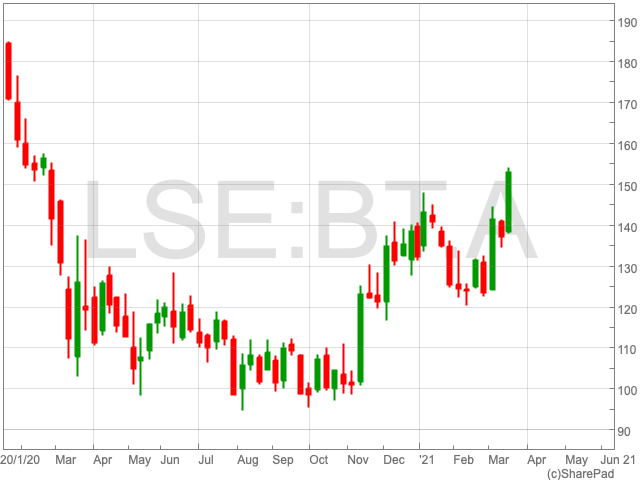
After a sustained period of decline, BT’s share price (LSE:BT.A) has displayed signs of a steady recovery. Over the past five days it has jumped by 12% to 152.15p per share as news emerged that the network secured a bargain deal in the latest auction of 5G airwaves. While over the last 12 months, BT shares are up by 20%.

BT Share Price

BT Performance

There are a number of areas for concern when it comes to the company’s balance sheet. BT has a debt to total equity of 175.40 and a long-term debt to equity of 150.65 which is a cause for concern for the future prospects of the company. The company’s net debt, while still high at £17.3bn, fell by £940m, according to the most recent trading update. BT’s high debt levels could factor in to its decision making over dividend payments in the coming years.

The company’s profit also fell by 17% Q3 up to 31 December 2020, down to £1.591bn. BT put the drop down to reduced EBITDA.

BT also has a questionable track record in terms of paying dividends out to its shareholders. The media company axed its dividend due to the pandemic and has confirmed it does not intend to pay a dividend for the current financial year. Prior to 2020, BT paid three consecutive total dividends of 15.4p.

Outlook

BT announced in its most recent trading update that it will be implanting a modernisation strategy. This includes selling off business units in Italy which has previously been a troublesome asset.

In addition, the company has made efforts to boost its exposure to high-growth sectors. This includes the hire of Bharti Airtel in India to head up its cloud computing, artificial intelligence, and machine learning operations.

“This is more than a leadership announcement, it’s an important statement of intent. 2020 saw a number of major BT innovations enter the marketplace but there’s opportunity to go much further,” said BT’s CEO Philip Jansen at the time.

The BT share price comes across as cheap with a price-to-earnings ratio of 6.5. However, this could also be a reflection of the company’s limited earning potential, and the impact of its high debt on future dividends.

Bank of England keeps interest rate at 0.1%

0

Bank of England maintains bond buying programme at £895bn

On Thursday the Bank of England (BoE) upgraded its outlook for the UK economy, while reaffirming it is in no rush to reduce the levels of support it has been providing to buoy a recovery from the Covid-19 crisis.

The BoE also passed an unanimous 9-0 vote to keep interests rates at 0.1%, as expected, as well as maintaining its bond buying programme at £895bn.

The UK central bank drew attention tp recent bond market selloffs, suggesting that the rise in bond yields largely reflects improved economic prospects.

“[Since the February forecasts] developments in global GDP growth have been a little stronger than anticipated, and the substantial new US fiscal stimulus package should provide significant additional support to the outlook,” the BoE said.

However, the bank did add that the UK’s outlook remained uncertain, and would depend on the evolution of the pandemic and how various segments of the UK economy respond as time progresses.

The BoE said the Monetary Policy Committee (MPC) stands ready to “take whatever additional action is necessary to achieve its remit,” if the outlook for inflation weakens.  

It added that there was no intention to tighten monetary policy until it is clear that progress is being made in “eliminating spare capacity and achieving the 2% inflation target sustainably”.

Laith Khalaf, financial analyst at AJ Bell, retraced the BoE’s steps over recent weeks, drawing the conclusion that things are looking up.

“Since the beginning of last month, markets have gone from worrying about negative interest rates in the UK, to pondering when monetary policy might tighten. The Bank of England provided a pretty bullish assessment of the prospects for economic recovery in its February monetary report and since then the outlook has got even better,” said Khalaf.

“Further support from the Chancellor in the Budget, a roadmap out of lockdown and fiscal stimulus spilling over from the US, all support the case for a robust bounceback, as the UK economy opens up in the coming months.”

Khalaf also drew attention to the risk of rising inflation under the BoE’s current interest rates policy, as well as the central bank’s approach.

“But the message coming through from the Bank of England is that interest rates are going to remain nailed to the floor for the foreseeable future, despite the improving economic picture. The only thing that might prise rates upwards is a bout of inflation, but that would need to be both sustained and structural to compel the Bank of England to tighten policy.”

“The Bank will look through rising inflation caused by temporary factors, such as recovering energy prices and would only deem inflation to be problematic if the UK was near full employment, which isn’t going to happen this year, or probably next.”

The FTSE 100 held steady today in the aftermath of yesterday’s announcement by the US Federal Reserve and the Bank of England’s update.