Driver Group shares (LON: DRV) surged over 11% on Monday as the group said it expects pre-tax profit to be £2.5m for the year to September 30.
Due to challenges around the pandemic, profit will be a 16% decrease from last year’s £3m total.
“Since January 2020 Driver Group has been managing the impact of Covid-19 on the business and by adopting a flexible home working model has continued to service its clients effectively and sustainably with the minimum of business interruption. Activity levels overall have been broadly consistent with those achieved in the first half, with a strong performance in the UK and Europe offset by a weaker result in the Middle East and Asia Pacific regions,” said the group in a statement.
Driver Group has opened a new office in New York which will enhance the group’s ability to service its clients in North America and provides improved access to the important South American markets.
The firm has also restructured the Middle East and the Asia Pacific operations so it can meet the changing business demands in those regions.
Mark Wheeler, chief executive of Driver Group, said: “I am pleased to be able to report that Driver Group has performed well during the year and has managed the uncertainty caused by the Covid-19 pandemic to ensure the business remained profitable and cash generative throughout the year in spite of a reduced level of activity.
“I am confident that the reduced cost base and renewed focus on our core business of higher margin expert witness and dispute resolution in both APAC and the Middle East will deliver improved operating performance. Alasdair and Stefan have proven track records in our business and I look forward to working with them and with our new colleagues in our operations in America and South Africa over the next few years to deliver significant progress,” he added.
Driver Group shares (LON: DRV) are 8.09% higher at 48,10 (1054GMT).
New aircraft orders have hit a record low over September.
No new orders were placed during the month of September and just 13 orders were made over the whole quarter – a 91.4% fall compared to the same period last year.
July saw four orders, whilst in August there were nine. It is the worst three-month since records began.
ADS chief executive Paul Everitt said: “The aerospace and aviation industries have invested in robust health and safety measures as part of aircraft design which makes the risk of transmission when travelling aboard an aircraft extremely low.
“We need to continue to work together internationally to improve consumer confidence and encourage a return to the skies.
“The quarantine period that passengers face when they return home is one of the main barriers to UK aviation’s recovery and testing can play a major role in reducing this.
“The government should rapidly implement a testing regime so that the 14-day quarantine period can be shortened. This will help improve confidence amongst travellers and in turn put the aviation and aerospace sectors on a path towards recovery.”
Ministers have said that are looking at reducing the UK quarantine period from 14 days to between 10 days and a week.
Shares in airline groups have plummeted over 2020 as the sector has been hit by travel restrictions and a fall in journeys amid the Coronavirus pandemic.
The union, Unite, estimated that in June 12,000 jobs had been lost in the sector, which supports around 110,000.
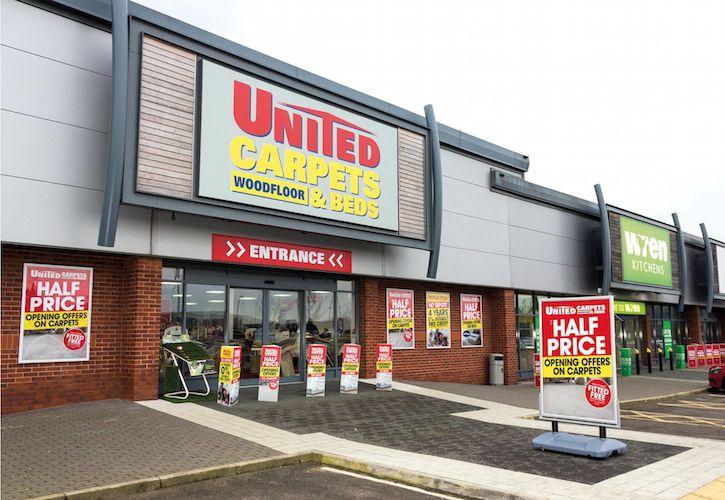
United Carpets shares (LON: UCG) surged +15% on Monday’s opening after posting a 24% increase in sales for the 19 weeks to 1 October 2020.
The specialist retail carpet and floor covering retailer said that despite no revenue generated during the eight weeks over lockdown, strong sales since have kept the group in a strong financial position.
United Carpets expects further challenges to arise from the pandemic and Brexit, which may deter demand.
The group warned that a “no-deal” Brexit may result in additional import tariffs on flooring products, and the longer-term impact from Covid-19 on unemployment and economic recovery may lead to a challenging retail environment in the next year.
Paul Eyre, the chief executive of United Carpets, said, “Since our stores were allowed to re-open, we have been encouraged by a strong period of trading. Customers appear to have been making up for the purchases they would have made during lockdown, with an increased focus on home improvements.
“Looking ahead, however, there are a number of significant, potential headwinds facing our sector and the UK economy in general strong demand for home improvement products combined with disrupted production due to Covid-19, have led to raw material shortages and, consequently, increased input prices across our sector.”
United Carpets had cash and cash equivalents of £5m from the end of September. Of this, £2m was received under the Coronavirus Business Interruption Loan, and the group also gained from the deferral of £1m of tax payments.
“Accordingly, the Board believes that the Group has sufficient capital to support the business through the current challenges, and is well placed in the event of any further restrictions due to the ongoing Covid-19 crisis,” said the group in its trading update.
United Carpet shares (LON: UCG) are currently trading +19.69% at 3,89 (1017GMT).
Tighter restrictions across Europe led to stock markets opening significantly lower on Monday morning.
UK’s FTSE 100 index down 0.8% at 5,812, Germany’s Dax fell 2.7%, France’s CAC was down 1.3%, and Spain’s Ibex fell by 1.3%.
“Restrictions are continuing to tighten around the world, especially in Europe, where Spain just entered a state of emergency, and Italy has introduced its most severe measures since the end of its national lockdown in May,” said Connor Campbell from Spreadex, commenting on stock markets across Europe.
“And the pace of the virus is showing no signs of slowing down, with a new record number of daily cases in the US, and confirmation of 137 local cases in China,” he added.
Markets also fell in response to US stimulus talks – where an agreement has still not been reached.
“Time is fast running out, if it hasn’t already – why would either side want to get a deal done, especially blue wave-praying Democrats, when the country’s political landscape could’ve completely shifted in a week and a half’s time?” said Campbell.
In Asia, China’s SSE composite index fell 0.8% while Japan’s Nikkei was down by 0.1%.
The price of oil has also fallen. Brent crude 2.27%, to $40.82 a barrel whilst the price of US light crude fell 2.43% at $38.88 a barrel.
“Oil is under pressure on the back of concerns that supply from Libya will rise as rival factions have called a ceasefire and that should pave the way for an increase in output. The worries about rising coronavirus cases in Europe and the US has sparked demand concerns,” said David Madden, market analyst at CMC Markets UK.
Yourgene Health Plc shares (LON: YGEN) plunged 11.54% on Monday’s opening bell after the group shared results for the half-year ended 30 September 2020.
Revenues for the half-year were up 5% to £8.2m with “strong European revenues offsetting the headwinds from COVID-19 on international sales.”
Impacts from the pandemic were offset by the strong UK and European growth. UK growth was primarily driven by Corona related products and services.
Revenue across Europe surged by 80% to £2.9m from the £1.6m in the same period a year previously.
International markets were affected by the enforced lockdowns, which inhibited cross-border shipments and in-country non-COVID-19 testing, especially in Japan and India.
Lyn Rees, Chief Executive Officer of Yourgene, commented: “I am pleased to report continued year-on-year growth in the first half in the most challenging of circumstances, and it goes to show the core resilience that Yourgene has developed through its greater geographic and business diversity.
“With the US and Japan now reopening for business, I expect to see International revenues growing rapidly around our core products and we are busy recruiting commercial resource to support the growth in activity from existing customers and to drive the on-boarding of new ones. In our UK service laboratory we have successfully achieved our initial capacity objective of 10,000 COVID-19 tests per month and are now focussed on delivering 20,000 tests per month, which we hope to have in place by January 2021.
“Furthermore, our acquisition of Coastal Genomics in this period demonstrates our continued ability to execute on select, highly attractive inorganic growth opportunities. Our full year outlook remains in line with management expectations and we look forward to updating investors again when we publish our half-year results in December,” added Rees.
Yourgene Health Plc shares (LON: YGEN) are currently 7.54% down at 18,03 (0836GMT).
The Hut Group shares (LON: THG) opened higher on Monday morning after the group’s trading statement for the three months ending 30 September 2020.
The online retailer listed on the stock exchange last month +38.6% year-on-year revenue growth for Q3 with a +51.3%, year-on-year growth in online revenues to £320.2m.
The Hut Group has raised full-year 2020 revenue guidance to between £1.48bn and £1.52bn.
Matthew Moulding, the group’s chief executive and executive chairman commented:
“I am pleased to report a strong period of trading in our first quarterly update as a public company, including an upgrade to revenue growth guidance for 2020. I would like to thank all our colleagues for their huge contribution to date. Our strong organic revenue growth across all divisions, numerous THG Ingenuity partnership deals, and the recent acquisition of luxury skincare brand Perricone MD, demonstrates our strategic direction and progress in the period.
“Our decision to list on the London Stock Exchange provides us with a strong platform to raise the profile of both Ingenuity and our Brands, and further supports their strong organic growth. Our acquisition strategy remains unchanged, with a focus to complement organic growth with brand IP and Ingenuity infrastructure additions.
“THG has a very strong balance sheet, enabling us to further invest across each of our growth pillars. THG’s core competencies leave it exceptionally well placed and we are witnessing increased opportunities, in scale and volume, for selective acquisitions across all our divisions and geographies.
“I am delighted to announce the establishment of our Advisory panel with the first three appointments made to provide additional counsel and support to THG’s Board sub-committees. This is a transformational step for THG and we look forward to making additional appointments over the medium term,” he added.
Floorcoverings and tiles manufacturer Victoria (LON: VCP) is getting rid of a share overhang and bringing in a new investor that is injecting cash into the company so it can make more acquisitions in the European floorcoverings sector.
Invesco owns nearly 20% of Victoria, but this stake has been an overhang for more than one year. New investor Koch Equity Development will buy just below 10% of Victoria from Invesco at 350p a share – the level at which the shares were trading when the deal was agreed. Spruce House Partnership will buy a 2.87% stake from Invesco and the rest of the stake will be...
Having bounced back from a five-month low on Thursday, the FTSE decided it would spend Friday in full rebound mode, thanks to banking stocks.
Enjoying a financial sector surge, the FTSE 100 gleefully watched Lloyds, HSBC, and Standard Chartered all rally more than 4% apiece. The real winner, though, was Barclays (LON:BARC), having booked a £1.1 billion profit, the bank watched its shares jump 7%.
These gains saw the FTSE add 1.29% on Friday, pushing it up from 5,723 on Thursday morning, to 5,860 points as trading came to a close on Friday – the biggest one-day gain seen since the start of September.
Likewise, the Eurozone equities joined in on the fun, with the CAC posting a 1.20% rise, up to 4,909 points, while the DAX rose by a hardly shabby margin of 0.82%, up to 12,645.
The gains across Europe were sorely needed after a week of lockdown fears hampering market sentiment. And while FTSE equities likely rallied off of a mixture of positive summer performance data and a weak pound, today’s rally was impressive, given that it required European equities to ignore the sluggish start of the Dow Jones during the afternoon.
Speaking on the Dow’s performance, and the uncertain outlook for the US index, Spreadex financial analyst, Connor Campbell, stated:
“A negative start in the US failed to dent Europe’s gains this Friday, while the Dow Jones [struggled] following the latest stimulus update.”
“Despite Nancy Pelosi stating that she and Treasury Secretary Steven Mnuchin are ‘just about there’ regarding a covid-19 relief plan, Trump’s economic advisor Larry Kudlow has claimed ‘the ball’s not moving much right now’, once again casting doubt on the chance of a pre-election package.”
“The concern is that, though a Joe Biden victory would potentially lead to a larger stimulus bill, it would also leave tight-fisted Republicans with little impetus to do anything that might help the incoming President during the ‘lame-duck’ period between November and January. And that could mean no economic relief until the New Year.”
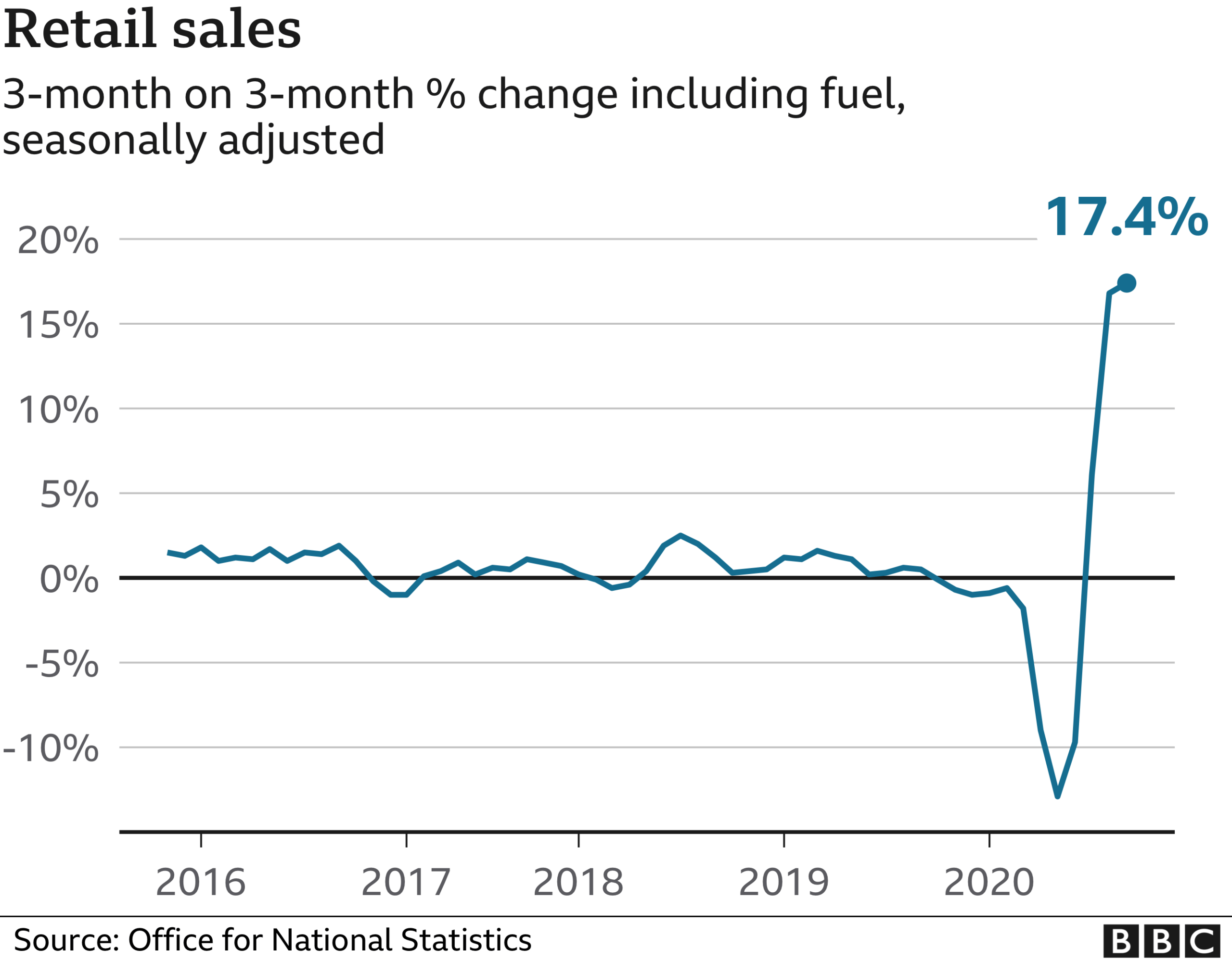
As reported by the BBC and many other major outlets, UK retail sales increased for the fifth consecutive month in September, with sales volumes rising by 1.5% mon-on-month, according to the ONS.
While fuel sales remained down, the growth was led by higher-than-average consumer spend on groceries, DIY goods and garden supplies.
According to the latest statistics, retail sales are now 5.5% higher than pre-pandemic levels in February, with the three months to September illustrating the biggest jump, up 17.4% versus the previous quarter.
The problem with this positive way of thinking is that retail sales aren’t actually experiencing exponential growth, Instead, September’s growth was lower than the previous month, there appear to be challenges ahead, and the growth is not being experienced by retailers across the board.
Indeed, new lockdown restrictions will have the double-edged-sword effect. The first half of this will be a reduction in customers and potential closure of some shops. As stated by Kingswood CIO, Rupert Thompson:
“Retail sales posted an unexpectedly strong gain in September, rising 1.5% m/m to be up 4.7% from a year earlier. However, this is only encouraging up to a point as this strength was prior to the introduction of the new lockdown/social distancing measures. Business confidence fell back in October with the decline led by the services sector, the area the most vulnerable to the latest restrictions. This fall highlights the need for the new package of support measures announced by the Chancellor yesterday.”
The second consideration will be a change in consumer behaviour, with customers focusing on outlets perceived to be selling essential and cut-price goods, as will as outlets offering online retail opportunities. As said by Mark Lynch, Partner at Oghma Partners:
“While these figures highlight British stoicism in supporting a fragile economy, it is important to note that these retail sales figures might be slightly misleading in terms of giving an impression of the strength of the consumer economy as a whole. UK shoppers have been buying more food and drink at supermarkets because they have been spending less on eating out. The Government’s lockdown restrictions have re-emphasised earlier trends that we saw around Spring which showed positive sales growth for direct to consumer and supermarket companies. We have already seen a significant shift in consumer behaviour which has boosted growth for those companies in Q2 and to a lesser extent in Q3 but which now look to boost growth again in Q4.”
“We are sadly seeing more and more long term problems for Food to Go and food service providers that are unable to service clients as per normal. The fact is that more end user businesses will go bust, including pubs, restaurants and the more food service manufacturing capacity and, to a lesser extent, Food to Go capacity we will see taken out of the market.”
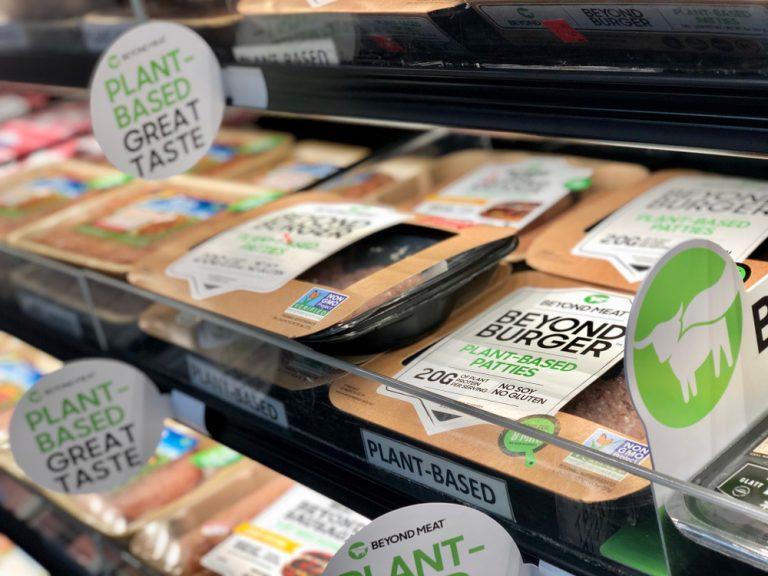
A trending sector that looks like its here to stay. Despite many people’s reluctance to give up their traditional preferences, European sales of plant-based meat and dairy alternatives have grown by around 10% per year over the course of the last decade.
According to ING (AMS:INGA) Food and Agri Senior Economist, Thijs Geijer, this change is being led by a combination of tastier and more-cost effective plant-based alternatives entering the market, alongside the growth of consumer trends such as health, animal welfare and sustainability.
Despite the rise of these considerations in shoppers’ decision-making, plant-based substitutes still represent a small base, with alternatives making up just 0.7% of the market for meat and 2.5% of the dairy market.
The bulk of the demand for these new products differs greatly from region-to-region, and the UK stands as Europe’s most-developed market, with sales of almost €1 billion, while France and Germany follow close behind. Consumption per head, though, is highest in Scandinavian countries and the Benelux (the Netherlands, Belgium and Luxembourg).
To see the plant-based market grow, Geijer identifies three challenges that its products will have to overcome: cost, user experience and availability. Not only do plant-based alternatives remain comparatively expensive – likely due to their trending status – but they often have less desirable tastes and textures than their meat and dairy counterparts, and few outlets offer an expansive range of different brands and products.
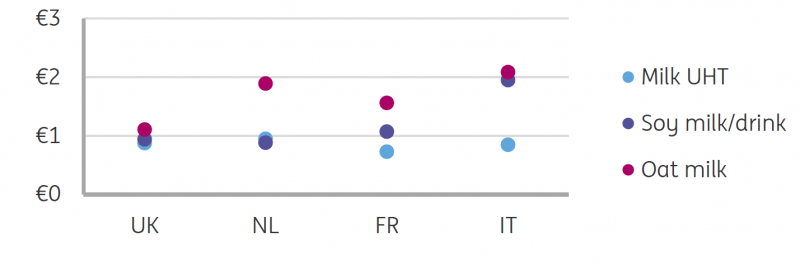
Milk alternatives pricing, Tesco and Carrefour data, ING graphic
With the plant-based market being more mature in the UK, prices have already begun to lower, and there is a greater scope of choices, creating a ‘highly competitive’ retail environment. This differs greatly from markets such as Italy, where these alternatives are still marketed at consumers willing to pay above the odds to access plant-based goods.
Despite these challenges, the prevalence of sustainable themes, and the level of investment and innovation that these trends are inviting, mean that the barriers to plant-based alternatives are likely to subside ‘substantially’ over the next five years.
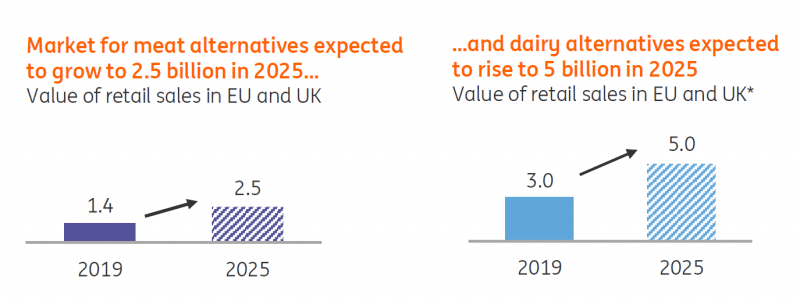
Because of this, ING estimates that the meat and dairy alternatives market will be able to maintain its 10% annual growth rate towards 2025. With this being the case, retail sales of meat alternatives could increase to €2.5 billion, while sales of dairy alternatives grow to €5 billion in 2025. In other words, the market share for meat substitutes will almost double, to 1.3%, while dairy alternatives’ share will rise to 4.1%.
Plant-based alternatives market, Euromonitor data, ING graphic
Speaking on the growth of the plant-based alternatives sector, and the work that still needs to be done, Tribe Impact Capital CIO, Amy Clarke, comments:
“Shifting consumer preferences combined with the increasing awareness of the role of a more plant-rich diet in tackling some of the key ecological and health consequences of our current global food system has led to the rise of plant-based alternatives, both as stand-alone businesses as well as existing businesses pivoting into this space. At Tribe, we have found a clear expansion in the number of opportunities to support this transition as an investor over the last couple of years.”
“Plant-based meat and dairy is now disrupting the food production industry in many of the same ways that renewables disrupted the energy market over the last 30 years. The annual growth rate European retail sales of meat and dairy alternatives of 10% between 2010 and 2020 though does compare favourably to the 3.3% growth in renewables in a similar period1, showing the size of the potential opportunity for investors in new food developments.”
“As this shift continues, we also have to commit to managing and reducing the impacts that such a wholesale change in agriculture can create – for example, the issues with soy production leading to deforestation is documented. Investors must be aware of the impact and sustainability issues associated with plant-based food too, if they are to identify those companies who are managing themselves for this transition sustainably. Those companies who have adopted frameworks that help them navigate the complex issues embedded in agriculture, for example the Natural Capital Protocol or the Regenerative Organic certification scheme, are better placed to manage the sustainability issues associated with this transition.”










 The problem with this positive way of thinking is that retail sales aren’t actually experiencing exponential growth, Instead, September’s growth was lower than the previous month, there appear to be challenges ahead, and the growth is not being experienced by retailers across the board.
Indeed, new lockdown restrictions will have the double-edged-sword effect. The first half of this will be a reduction in customers and potential closure of some shops. As stated by Kingswood CIO, Rupert Thompson:
“Retail sales posted an unexpectedly strong gain in September, rising 1.5% m/m to be up 4.7% from a year earlier. However, this is only encouraging up to a point as this strength was prior to the introduction of the new lockdown/social distancing measures. Business confidence fell back in October with the decline led by the services sector, the area the most vulnerable to the latest restrictions. This fall highlights the need for the new package of support measures announced by the Chancellor yesterday.”
The second consideration will be a change in consumer behaviour, with customers focusing on outlets perceived to be selling essential and cut-price goods, as will as outlets offering online retail opportunities. As said by Mark Lynch, Partner at Oghma Partners:
“While these figures highlight British stoicism in supporting a fragile economy, it is important to note that these retail sales figures might be slightly misleading in terms of giving an impression of the strength of the consumer economy as a whole. UK shoppers have been buying more food and drink at supermarkets because they have been spending less on eating out. The Government’s lockdown restrictions have re-emphasised earlier trends that we saw around Spring which showed positive sales growth for direct to consumer and supermarket companies. We have already seen a significant shift in consumer behaviour which has boosted growth for those companies in Q2 and to a lesser extent in Q3 but which now look to boost growth again in Q4.”
The problem with this positive way of thinking is that retail sales aren’t actually experiencing exponential growth, Instead, September’s growth was lower than the previous month, there appear to be challenges ahead, and the growth is not being experienced by retailers across the board.
Indeed, new lockdown restrictions will have the double-edged-sword effect. The first half of this will be a reduction in customers and potential closure of some shops. As stated by Kingswood CIO, Rupert Thompson:
“Retail sales posted an unexpectedly strong gain in September, rising 1.5% m/m to be up 4.7% from a year earlier. However, this is only encouraging up to a point as this strength was prior to the introduction of the new lockdown/social distancing measures. Business confidence fell back in October with the decline led by the services sector, the area the most vulnerable to the latest restrictions. This fall highlights the need for the new package of support measures announced by the Chancellor yesterday.”
The second consideration will be a change in consumer behaviour, with customers focusing on outlets perceived to be selling essential and cut-price goods, as will as outlets offering online retail opportunities. As said by Mark Lynch, Partner at Oghma Partners:
“While these figures highlight British stoicism in supporting a fragile economy, it is important to note that these retail sales figures might be slightly misleading in terms of giving an impression of the strength of the consumer economy as a whole. UK shoppers have been buying more food and drink at supermarkets because they have been spending less on eating out. The Government’s lockdown restrictions have re-emphasised earlier trends that we saw around Spring which showed positive sales growth for direct to consumer and supermarket companies. We have already seen a significant shift in consumer behaviour which has boosted growth for those companies in Q2 and to a lesser extent in Q3 but which now look to boost growth again in Q4.”
 The problem with this positive way of thinking is that retail sales aren’t actually experiencing exponential growth, Instead, September’s growth was lower than the previous month, there appear to be challenges ahead, and the growth is not being experienced by retailers across the board.
Indeed, new lockdown restrictions will have the double-edged-sword effect. The first half of this will be a reduction in customers and potential closure of some shops. As stated by Kingswood CIO, Rupert Thompson:
“Retail sales posted an unexpectedly strong gain in September, rising 1.5% m/m to be up 4.7% from a year earlier. However, this is only encouraging up to a point as this strength was prior to the introduction of the new lockdown/social distancing measures. Business confidence fell back in October with the decline led by the services sector, the area the most vulnerable to the latest restrictions. This fall highlights the need for the new package of support measures announced by the Chancellor yesterday.”
The second consideration will be a change in consumer behaviour, with customers focusing on outlets perceived to be selling essential and cut-price goods, as will as outlets offering online retail opportunities. As said by Mark Lynch, Partner at Oghma Partners:
“While these figures highlight British stoicism in supporting a fragile economy, it is important to note that these retail sales figures might be slightly misleading in terms of giving an impression of the strength of the consumer economy as a whole. UK shoppers have been buying more food and drink at supermarkets because they have been spending less on eating out. The Government’s lockdown restrictions have re-emphasised earlier trends that we saw around Spring which showed positive sales growth for direct to consumer and supermarket companies. We have already seen a significant shift in consumer behaviour which has boosted growth for those companies in Q2 and to a lesser extent in Q3 but which now look to boost growth again in Q4.”
The problem with this positive way of thinking is that retail sales aren’t actually experiencing exponential growth, Instead, September’s growth was lower than the previous month, there appear to be challenges ahead, and the growth is not being experienced by retailers across the board.
Indeed, new lockdown restrictions will have the double-edged-sword effect. The first half of this will be a reduction in customers and potential closure of some shops. As stated by Kingswood CIO, Rupert Thompson:
“Retail sales posted an unexpectedly strong gain in September, rising 1.5% m/m to be up 4.7% from a year earlier. However, this is only encouraging up to a point as this strength was prior to the introduction of the new lockdown/social distancing measures. Business confidence fell back in October with the decline led by the services sector, the area the most vulnerable to the latest restrictions. This fall highlights the need for the new package of support measures announced by the Chancellor yesterday.”
The second consideration will be a change in consumer behaviour, with customers focusing on outlets perceived to be selling essential and cut-price goods, as will as outlets offering online retail opportunities. As said by Mark Lynch, Partner at Oghma Partners:
“While these figures highlight British stoicism in supporting a fragile economy, it is important to note that these retail sales figures might be slightly misleading in terms of giving an impression of the strength of the consumer economy as a whole. UK shoppers have been buying more food and drink at supermarkets because they have been spending less on eating out. The Government’s lockdown restrictions have re-emphasised earlier trends that we saw around Spring which showed positive sales growth for direct to consumer and supermarket companies. We have already seen a significant shift in consumer behaviour which has boosted growth for those companies in Q2 and to a lesser extent in Q3 but which now look to boost growth again in Q4.”