After global equities enjoyed cheer and recovery last week, the first half of this week was mired by the wince before the pain – as markets recoiled in anticipation of the Fed 2020 economic projections.
“Clearly shaken by the OECD’s own set of dire forecasts, the tentative gains that had started the day were nowhere to be seen by the afternoon session.” said Spreadex Financial Analyst Connor Campbell.
As the afternoon progressed, the looming Fed projections saw equities continue their slide, with the Dow Jones shedding 250 points to below 27,000.
“This [came] as US inflation fell for a 3rd consecutive month – the latest figure came in at -0.1% – nixing hopes of a flat reading.” added Campbell.
Emulating the losses of its US counterpart, the Eurozone also suffered. The DAX dropped 0.9%, while the CAC shed 0.8%. Meanwhile, the FTSE managed to restrain its losses to a decline of only 0.2%.
Despite being among the ‘worst hit’ developed nations in the OECD’s analysis, the organisation’s forecast of an 11.5% contraction in 2020 was less severe than the 14% fall estimated by the Bank of England.
Additionally, Connor Campbell added that “[BoE] governor Andrew Bailey also gave the FTSE a bit of a boost, suggesting in a private event that the economy will see a faster-than-usual recovery due to the specifics of the current situation.”
FTSE 100 construction company Taylor Wimpey showed its desire to return to business as usual, as it announced gradual returns to regular construction work alongside some areas of healthy activity.
The company said that the entirety of its staff had returned from furlough, while the majority of its English and Welsh sites had resumed regular construction work. It added that its Scottish sites were preparing to resume construction in line with Scottish Government guidance.
It continued, saying that the ‘majority’ of its show homes and sales centres were open in England on an appointment basis, with these appointments achieving a ‘very high level’ of demand.
Regarding its performance, Taylor Wimpey stated that it was ‘active’ in the land market, and that it had begun exchanging on a number of sites. It added that its order book remained strong and that reservations had seen a healthy increase in recent weeks.
Finally, it reported a ‘good’ level of interest in its 5% discount scheme for NHS and care workers – which it launched in recognition of health workers’ contribution to fighting Coronavirus – alongside a commitment to new working practices it has put in place to ensure the health and safety of its employees.
Taylor Wimpey comments
On the safety of its construction activities, the company’s statement expanded,
“We have now restarted construction on the majority of our sites in England and Wales. Our first priority remains the health and safety of our customers, employees, subcontractors and wider communities, and we are extremely proud of the way our teams have adapted to the new ways of working. Our new site protocols have been implemented successfully and the new Taylor Wimpey COVID-19 Code of Conduct continues to receive strong support from our employees and subcontractors. These measures include detailed signage, phased sign-in times, strict protocols for social distancing, modification of welfare facilities and additional customised Taylor Wimpey PPE.”
On its staff returning to work, the group continued,
“All of our employees have now returned to work as of the beginning of June with none remaining on furlough. Many are still working from home, including those shielding or those who are shielding someone vulnerable. It remains our policy not to ask anyone to return physically to work, if they do not feel it is safe for them to do so. Our offices remain closed to all but essential visits and our office-based employees and a large number of our Sales Executives continue to work remotely from home. We continue to regularly communicate with our employees through a number of different channels and are pleased that engagement remains at a very high level.”
Investor insights
Following Wednesday’s update, the company’s shares dipped slightly, by 1.70% or 2.70p, to 156.30p per share 16:35 GMT 10/06/20. Taylor Wimpey’s p/e ratio is 7.83, while its dividend yield stands at an impressive 4.89%.
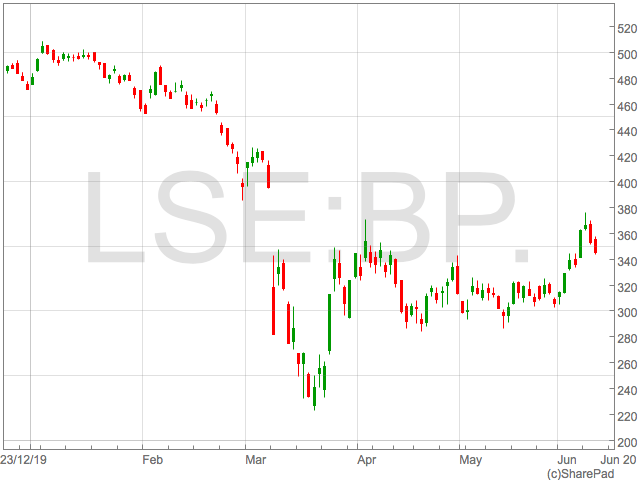
The future of the BP share price (LON:BP) will be dictated by how efficiently the company transitions towards cleaner renewable forms of fuel.
BP has set a target to become net-zero by 2050 and the achievement of this goal is not only important for the environment, but the returns of the BP share price.
It has already be demonstrated by countries such as Costa Rica that entire nations can power themselves without the need for fossil fuels.
Costa Rica powered has itself for an entire year solely by renewable energy. As more countries increase the percentage of energy produced from renewable sources, fossil fuel demand will fall.
Whilst renewable power will hit thermal coal, the wider adoption of electric vehicles significantly threatens demand for oil through gasoline and fuel, which is the largest end use of oil.
The price of oil will be inextricably effected over the long term and if BP are not able to convert their business model, shareholder returns will deteriorate.
The impact on BP of a lower oil price has already been highlighted by the company in an email from the BP CEO to employees when he said:
“The oil price has plunged well below the level we need to turn a profit. We are spending much, much more than we make – I am talking millions of dollars, every day.”
The email was sent as BP announced 10,000 job cut and said the reduction in head count was needed to make BP a “leaner, faster-moving and lower carbon company.”
Market Dynamics
In addition to the demand for renewable fuels changing, the market dynamics behind BP shares are starting to shift.
BP has been a favourite among fund managers for years because of its strong dividend and stable cash flows.
This is has provided a reliable demand for BP shares as money managers allocate inflows to the stock.
However, this is set to change with a seismic shift in the attitudes of the asset management industry towards investments in fossil fuels.
BlackRock, the world’s largest asset manager, announced in January 2020 they would begin to reduce exposure to thermal-coal, firing the starting gun on a movement away from fossil fuel investments.
In an open letter, BlackRock said that they saw sustainable investments providing stronger returns than fossil fuels.
“Our investment conviction is that sustainability-integrated portfolios can provide better risk-adjusted returns to investors,” BlackRock said in a letter to clients.
“And with the impact of sustainability on investment returns increasing, we believe that sustainable investment will be a critical foundation for client portfolios going forward.”
This mean if fossil fuel companies, such as BP, aren’t able to transition to cleaner forms of fuel, they will soon see interest from the asset management industry drying up.
So no matter the underlying profitability of BP, if the significant buying pressure from institutions diminishes, the BP share price will ultimately suffer.
BP Investments
Fortunately, BP has already started the transition to renewable power through investment in clean energy and the acquisition of a number of companies operating in the sector.
BP’s joint venture Lightsource BP has been busy in the renewable sector with plans outlined for a range of projects including an Australian hydrogen plant, American solar projects and Brazilian biofuel capacity.
BP are also supporting innovation through BP Launchpad that set’s out to provide support for clean technology and digital infrastructure.
Although the recent investment in clean energy is promising, for the BP share price to provide investor return in the long term, BP need to produce more tangible results than the ‘Beyond Petroleum’ scheme announced more than 20 years ago and labelled obvious ‘greenwashing’.
Shaftesbury posted a £287m first-half loss on Wednesday after being impacted by the Coronavirus pandemic.
The West-End landlord, which owns pubs, shops, workspaces, and restaurants in central London said a “collapse” of footfall from February and the closure of shops in March has affected tenant’s ability to pay rent.
The £287m loss is compared to the £38.7m profit made in the same period a year earlier.
“Although our business performed well during the first four months of the period, the growing impact of the measures to address the pandemic are having a material impact on normal patterns of life and commerce, both for our occupiers and on the near-term prospects for our business and financial performance,” said Brian Bickell, the group’s chief executive.
“The economies of London and the West End have a long history of structural resilience, having weathered many episodes of near-term challenges and uncertainties. Their unique features come from a culture of constant evolution across a broad-based economy, attracting talent, creativity, innovation and investment from across the world and reinforcing their enduring appeal to businesses, visitors and as great places to live.”
“In the post-pandemic recovery, these fundamental advantages will underpin their return to prosperity and growth,” he added.
The group has said that it aims to collect 50% rent from tenants that is owed between April-October.
Shares in Shaftesbury (LON: SHB) are trading down 4.94% at 616.00 (1031GMT).
The transition into an independent global media marketing consultancy took its final shape in the finals to December 2019, which were reported last month. Now, under the new CEO, Ebiquity (LON:EBQ) sold its commoditised Advertising Intelligence business (Adintel) to Nielsen for around £20m in January 2019.
The outlook contained Covid adjusted caution and the proposed dividend of 0.85p was postponed. Results were broadly in line, with revenue down 1% to £68.7m and the underlying PBT was up slightly to £5.3m with EPS of 3.6p. This would give a P/E of 8x and a 2.8% yield, however the accounts are mudded by eight kitchen sink items the largest is the £6.8m Goodwill impairment from closing a US subsidiary.
The ongoing higher margin consultancy practice covers; Media Management, Performance and Contract Compliance. The new CEO reported that business operations and service delivery are being maintained at a normal level during Covid. Revenue, however, was impacted as some clients and sectors hibernated and forward guidance was withdrawn.
The media market continues to undergo significant changes as it shifts from traditional media into the increasingly complexity of the digital media value chain.
This provides the Consultancy business with opportunities to address advertisers’ requirements and to map into the key stages of client’s media cycles using their global media expertise. It’s clients are 70 of the world’s 100 leading advertisers including Sony, L Oreal and Subway. Few can doubt these companies demand as marketing strategies are reappraised.
Initially the CEO’s focus is on improving the profitability by increasing efficiency and expanding the range and value generated by the consultancy. The acquisition of complementary Digital Decisions helps the measurement and advisory services and further deals can be anticipated. Profits to the year-end December 2020 were forecast a £6.5m for a P/E of 6x and a 3% yield and cost reductions have been made. The shares are tightly held with over 60% with institutions; Artemis holding 19%, Canaccord on 13% and JO Hambro with 12%. After the finals Directors brought share at up 30p.
Financials
There is strong cash conversion and net debt is down to £5m in an agreed Banking facility.
Trading Strategy
EBQ are comparatively cheap and set to be re-rated, which could be helped by the AGM statement at the end of this month. Buy
Ebiquity (LSE: EBQ)
29.5p (29-30p)
Mkt Cap: £24m
Next Announcement AGM Friday June 26th – then Interims in September
This tip is from the OGM Newsletter by Jon Levinson and Andrew Hore
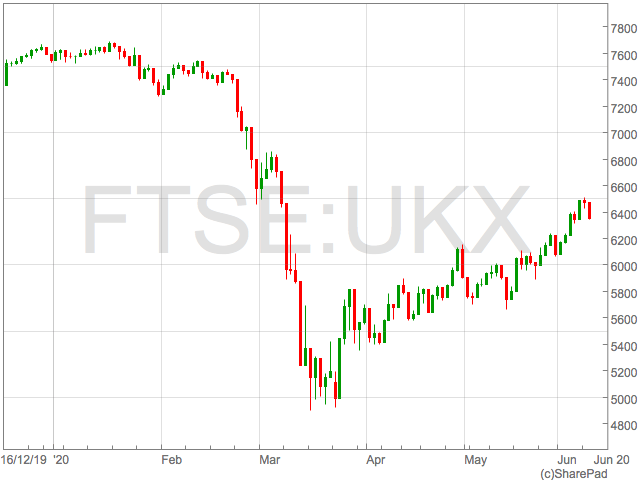
The FTSE 100 paused on Tuesday following a strong session on Monday that saw the index touch the highest levels for three months.
Steam ran out the rally caused by a strong jobs report as investors awaited further insight to the thinking of the Federal Reserve who were set to begin their FOMC meeting on Tuesday.
“The rally looks a little tired, as might be expected after the first week of June saw such a strong move higher. The positive impact from the ECB meeting and Friday’s US jobs report has waned, with no fresh bullish news to take their place,” said Chris Beauchamp, Chief Market Analyst at IG.
Analysts also pointed to decoupling of equity markets and the underlying economy in the middle of the coronavirus pandemic which is only just starting to show signs of recovery.
Economic V-Shaped Recovery?
Global equity markets have certainly produced a V-Shaped recovery with the S&P 500 erasing all of 2020’s losses when it closed on Monday, despite economic data only just starting to show signs of improvement.
“Those long- and short-term records…may well have inspired Tuesday’s losses. Investors might be questioning the wisdom of such highs in a world still very firmly in the middle of a pandemic,” said Connor Campbell, Analyst at Spreadex.
There was also another instalment of sobering German data that highlighted the impact coronavirus had on the European economy.
“It appears the collapse in German trade – exports plunged 24% in April, while the country’s trade surplus saw a staggering decline, from €12.8 billion to €3.2 billion month-on-month – has sparked Europe’s rather significant wobble,” said Connor Campbell.
FTSE 100 movers
Most sectors were down in London in a broad selloff that targeted some of the better performing stocks in lasts week’s surging rally. Travel shares and the financials were among the biggest fallers on Tuesday.
The FTSE 100’s housebuilders fell Bellway after revealed sales figures for the coronavirus lockdown period declined, but didn’t completely collapse.
“The 3% drop in Bellway’s shares might been a bit of an over-reaction to a fairly anodyne statement, but the similar or bigger losses for Taylor Wimpey and Barratt points to a sector-wide malaise this morning,” said Chris Beauchamp.
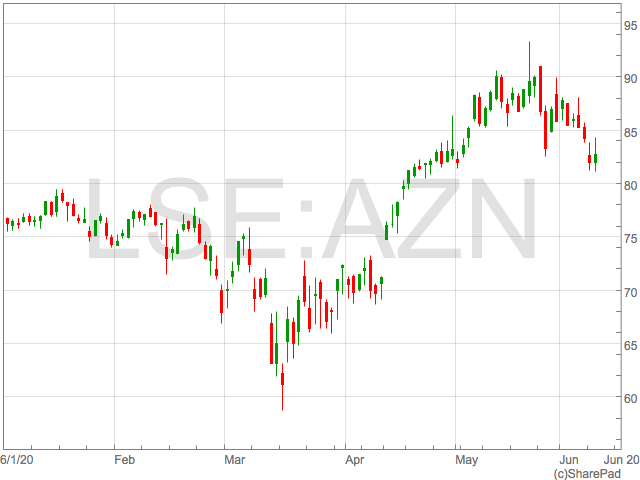
Until recently, AstraZeneca shares (LON:AZN) had been one of the quiet outperformers of the FTSE 100 during the coronavirus volatility.
As cyclical shares were ravaged by concerns over worst recession in recent history, AstraZeneca was among the shares possessing enough defensive qualities to outperform the benchmark as investors sought out quality.
This reversed in the risk-on rally through May and early June when cyclical equities took charge and those companies that were bought into as a safe havens gave up gains as the market rotated into companies perceived to benefit from economic reopenings.
AstraZeneca shares were on the list of ‘lockdown’ shares’ that suffered during the rotation into cyclical shares.
We feel provides the opportunity to buy AstraZeneca given the potential for the pharmaceutical company to lose its ‘defensive’ tag and become a real growth stock.
Gilead Merger
It has been reported AstraZeneca approached Gilead about a possible merger which would have been the largest Pharma deal in history.
However, such a deal looks unlikely in the short-term as both companies focus on their own pipeline of drugs and shareholder value creation.
“We believe such a transaction, which would likely effectively be an equity merger of equals, is unlikely given limited strategic rationale for AstraZeneca at this time and our US biotech team’s view that Gilead is still in the midst of a turnaround,” said Jefferies Analyst Peter Welford.
The initial market reaction to a potential merger was for shares to fall reflecting the market’s scepticism over the deal.
Should the deal not materialise AstraZeneca’s shareholders will receive a greater proportion of the upside in Astra’s current drug pipeline.
Drug Pipeline
AstraZeneca’s pipeline of drugs holds the potential for a number of blockbusters that would be transformational to the company.
The foremost trail is that of Lung Cancer drug Tagrisso which has had a series of statistically significant results in the elimination of the disease in early stage cases.
José Baselga, Executive Vice President, Oncology R&D at AstraZeneca even said the drug provided hope for a cure.
“The momentous results of the Phase III ADAURA trial for Tagrissodemonstrate for the first time in a global trial that an EGFR inhibitor can change the course of early-stage EGFR-mutated lung cancer and provide hope for a cure,” said José Baselga.
AstraZeneca are also developing testicular cancer drug Lynparza which has had positive findings from trials.
Heart failure drug Farxiga has just received approval from the FDA, providing the potential to treat million of people in the United States.
There has also been progress in a number of the other 167 drugs in the AstraZeneca pipeline.
Dividend
The dividend seems secure enough for AstraZeneca shares to be classed as an income play, even if the current drug pipeline doesn’t provide a huge boost to revenue in the medium term.
In the full year results the board reaffirmed their progressive dividend policy, and with revenue growing 17% in Q1, the financial position is sufficiently robust to support this.
With a AstraZeneca share price of 8,293p, the current yield is 2.8% and more than respectable given the recent dividend cuts to FTSE 100 companies.
Vaccine Production
The UK-based drug company is preparing for the production and distribution of 2 billion doses of a COVID-19 vaccine that would be monumental for the fight against COVID-19.
However, vaccine production is not taken into consideration as a reason to buy shares due to no profit approach being employed by Astra.
AstraZeneca is one of hundreds of companies in a race to find a vaccine and although the vaccine is not yet proved having received significant funding from governments.
AstraZeneca’s vaccine is using the common cold virus combined with COVID-19 proteins to induce a immune response from the body.
The StepChange debt advice charity has warned that households in the UK are expected to build up £6bn in debt amid the Coronavirus pandemic.
Due to the growth of households falling behind on credit card payments and utility bills, a total of 4.6m households could risk dangerous levels of debt.
In response, the Treasury has said they plan to fund debt advice services by an additional £38m.
“We know that some people are struggling with their finances during this difficult time, which is why we want to make sure people can access the help and support they need to manage their debts and get their finances back on track,” said John Glen, economic secretary to the Treasury.
Research by YouGov has shown that each affected adult has accumulated an additional £1,076 of arrears and £997 of debt since the start of lockdown.
The chief executive of StepChange, Phil Andrew, said: “We were already dealing with a debt crisis, but COVID has so far added another four million people and counting to the number who are going to need help finding their way back to financial health. With £6bn of additional household debt directly attributable to the effects of the pandemic, this is a problem that isn’t going to solve itself.”
“As a charity, we have our own part to play. Like other debt charities, we are gearing up for a significant increase in demand for our usual services. We are also working on a specific solution to help people whose finances have been hit by the pandemic and who need a short term helping hand to get back on track without jeopardising their credit status.”
“The false calm in which we find ourselves while furlough and forbearance take the strain will not last indefinitely. We will be ready to help as more people find their debt problems crystallising over the coming months.”
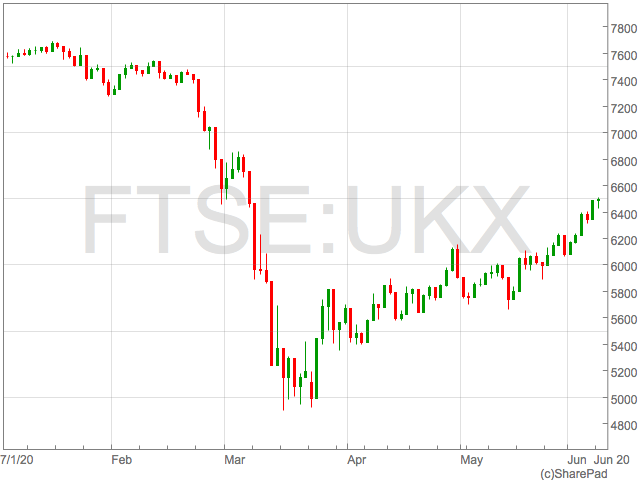
The FTSE 100 continued it’s march higher on Monday as London’s large cap index briefly traded above 6,500, the highest levels for three months.
The rise in equities follows a bumper US jobs report that pointed to 2.5 million jobs being added to the US economy in May, as opposed to a loss of 8 million jobs.
The shock jobs data suggests the post-coronavirus lockdown is well ahead of all economist expectations, and has fuelled appetite for risk assets such as equities.
However, not all economic data has been as positive with Eurozone GDP falling 3.2% in the first quarter and German export data showed further economic contraction with exports falling 15% in April.
Nonetheless, analysts see these softer economic readings as being largely priced into equity markets and instead are focusing on the reopening of economies and associated recovery.
“The market continues to view all of these economic reports as rear-view mirror stuff, as optimism over economic re-openings continues to drive sentiment,” said Michael Hewson, chief market analyst at CMC Markets.
Global jobs
The US jobs report has caused short term optimism but multinational companies are still navigating lower demand. Government schemes such a the UK’s furlough scheme have provided support to employers thus far but will soon evaporate.
Signalling the longer term impact of the coronavirus lockdown, markets assessed further job cuts to major global brands listed on the UK’s exchanges.
FTSE 100 oil major BP announced they were to cut 10,000 of their global workforce whilst luxury fashion brand Mulberry said they were going to slash their staff by 25%.
The BBC reported BP CEO said in an email to staff: “The oil price has plunged well below the level we need to turn a profit.”
“We are spending much, much more than we make – I am talking millions of dollars, every day.”
If this proves to be a theme throughout other industries, the US jobs report and subsequent optimism in stock markets could prove premature.
Travel and leisure shares
The FTSE 100’s travel shares have flown over the past week and were again among the risers on Monday despite a 14-day quarantine coming into effect.
“The surge in travel- and airline-related names comes on the day when the UK implements a quarantine for overseas travel, perhaps the very definition of shutting stable doors after the horse has bolted,” said Chris Beauchamp, Chief Market Analyst at IG.
“With lockdowns easing across Europe and no sign of a second infection wave, this move has been staunchly opposed by airlines, and it looks like the market expects the restriction to remain in place for only a limited time,” Beauchamp said.
After a fall in demand amid the Coronavirus pandemic, Mulberry (LON: MUL) has announced plans to cut its global workforce by 25%.
The luxury handbag maker employs 1,500 people globally. The redundancies will affect people across the head office, stores and manufacturing.
Thierry Andretta, the group’s chief executive, said in a statement: “Launching a consultation process has been an incredibly difficult decision for us to make but it is necessary for us to respond to these challenging market conditions, protect the maximum number of jobs possible and safeguard the future of the business.”
“In spite of the good performance of our sector-leading digital and omni-channel platform, and our global network of digital concessions, the shutting of all our physical stores has had, and will continue to have, a marked effect on our business.”
“We remain confident in the strength of the Mulberry brand and our strategy over the long-term,” he added.