UBS (SWX: UBSG) profits soared 99% over the third quarter.
The Swiss lender saw a net profit total $2.1bn (£1.62bn) in the three months ending in September thanks to the investment banking arm.
Pre-tax profit at the group’s investment banking arm jumped 268% to $632m.
Sergio P. Ermotti, the group’s chief executive, said: “Our third-quarter results continue to demonstrate that our strategy is differentiating us as we continuously adapt and accelerate the pace of change.
“I am proud of the contributions all of our employees have made day in and day out over the years, particularly in the current challenging environment. Our ability to focus on clients and achieve such strong financial performance over the first nine months of this year speaks to this.”
UBS remains cautious over its outlook amid the Corona uncertainties and the group said factors are “making reliable predictions difficult.”
Ermotti is due to leave the bank this month and will be replaced by Ralph Hamers from 1 November.
Ermottis said: “UBS has all the options open to write another successful chapter of its history under Ralph’s leadership.”
“UBS has all the options open to write another successful chapter of its history under Ralph’s leadership,” Ermotti said in a statement accompanying the results.
UBS shares (SWX: UBSG) crept on on Tuesday morning and are trading +2.65% at 11,22 (0905GMT).
European markets have all started in the red on Tuesday morning amid new Coronavirus restrictions and lack of a US stimulus deal.
The FTSE 100 fell 0.3% to 5,867 points. France’s CAC and Germany’s Dax were both 0.5% lower on Tuesday.
Markets are slipping as Coronavirus cases are on the rise and there is a tightening of restrictions.
Connor Campbell from Spreadex commented on this morning’s fall on the blue-chip index: “Covid-19 crisis is intensifying – and remember, we aren’t in the acute months of winter yet either – with the ominous shuttering sounds of more restrictions in Europe joined by rising positivity rates in several prominent US states.
“Yesterday saw the markets swing from green to red, with the Dow staying there by the end of the session as it fell more than 400 points.
“And though they weren’t as bad this morning, the European indices nevertheless struggled to find a reason not to slump even lower,” he added.
In the US, investors remain concerned whether US lawmakers can reach a stimulus deal.
Speaker of the House Nancy Pelosi’s spokesperson said on Monday that the two sides “continued to narrow their differences”, however, they only have until 3 November to reach a deal before the presidential election.
In Asia, China’s SSE composite index saw gains of 0.5% overnight. Japan’s Nikkei 225 closed 0.4% lower.
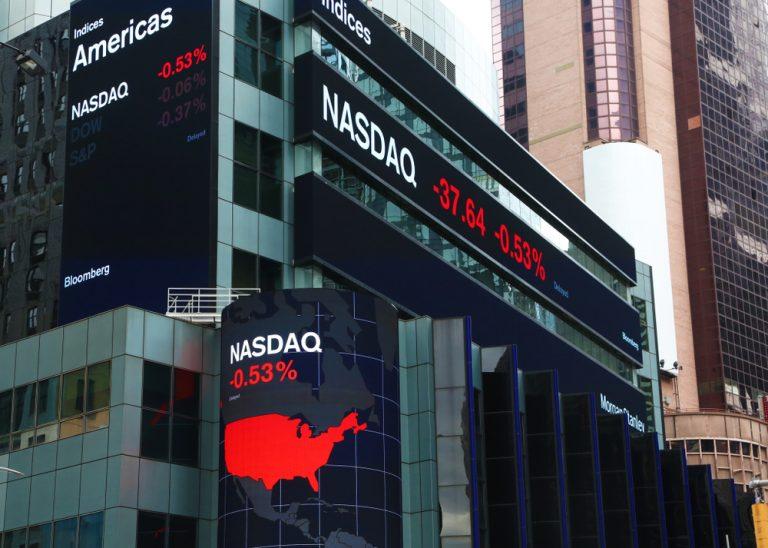
Between the US economy being among the worst-hit by the COVID pandemic; the Biden poll lead narrowing; and Nancy Pelosi implementing a deadline for new stimulus measures to be announced, all US equities suffered on Monday. However, the Nasdaq led Monday’s losers, with the tech-laden index weighed down by the falls posted by big tech stocks.
Falling by 1.77%, the Nasdaq shed more than 200 points, down to 11,465 points. Shedding 1.76%, the S&P 500 was close behind, falling some 60 points down to 3,422. Likewise, the Dow Jones dropped 1.60%, down to 28,147 points.
US equities were all weighed down by the recent data illustrating the harsh realities of third quarter trading. However, according to Kingswood CIO, Rupert Thompson:
“The US elections remain a major focus. The markets seem to have taken a liking to the idea of a Biden victory and possible clean sweep by the Democrats because it would lead to a sizeable fiscal boost. However, this result is still not a done deal with the betting odds of a Biden victory narrowing back down to 60% from 65% a week ago. The final Presidential ‘debate’ on Thursday may be Trump’s last chance to narrow the polls which still favour Biden.”
Nasdaq suffers sour Apple
However, leading the particularly sharp drop suffered by the Nasdaq, were the drops posted by big tech stocks during Monday trading. One notable fall was posted by Apple (NASDAQ:AAPL), down by around 2.70%, at US $115.68, following its first weekend of iPhone 12 pre-orders.
With its lower price model not launching for a little while longer, it was the standard model and the Pro launching on Thursday night last week.
And, while sales of 2 million in the first 24 hours were up from 800,000 for the iPhone 11, TF International Securities analyst, Ming-Chi Kuo, believes that the iPhone 12 launch will trail its predecessor considerably, regarding first full weekend pre-orders. While the 11 sold 12 million over its first weekend, Kuo expects the 12 to sell 9 million, with many consuemrs waiting for the cheaper model to be released.
Nasdaq may see Amazon out of its Prime
Secondly, Monday saw Amazon (NASDAQ:AMZN) shed 2.00%, down to US $3,207.21. According Citi Analyst Jason Basinet, this might have been led by worse-than-hoped-for Amazon Prime Day trading.
Though it’s expected that Amazon grossed some $10.6 billion in merchandise sales over the two-day sale, period, the Citi analyst notes that this may be the first time since 2015, that the Prime Day sale didn’t break an Amazon inhouse record. In 2016 and 2017, the company consecutively boasted ‘the best day’ in its history, and then ‘the biggest shopping event’ in its history, in 2018 and 2019. However, in 2020, it merely said that the sale was ‘the biggest day ever for third party sellers’.
“Based on the language of Amazon’s press releases and SimilarWeb data, it appears that Prime Day 2020 was not the ‘biggest day ever,’”
“We don’t want to make mountains out of mole hills,” Bazinet wrote. “We still like Amazon’s stock and the long-term story. However, against a backdrop of heightened investor expectations for robust e-commerce trends, we thought the shift in commentary was noteworthy and may temper [fourth quarter] expectations a bit.”
Elsewhere, Microsoft shed 2.48%, Facebook dropped 1.70%, and Alphabet fell by 2.41%.
Having been extremely sensitive to Brexit developments, the Pound Sterling remained fairly calm, even as Boris Johnson officially walked away from trade talks.
The British PM walks away in a show of force that acts more as an invitation for future concessions, than a door closing on negotiations. Even with the 15th of October acting as a provisional cut-off point for deal-making, the opportunity for compromise remains on the table – or at least that’s how currency markets appear to have read it.
Falling 0.13% during the day, and down as far as 0.27% later in the evening, the point still remains above 1.10 against to euro, and in fact, rose 0.18% against the dollar, comfortably above 1.29.
Though just below the the Pound to Euro exchange rate seen for most of October, there is certainly some room for further downside on the Sterling, as Boris has to keep up the Brexit bluster (both for concessions sake, and to keep his core of support happy).
Speaking on the Pound’s lack of sensitivity to recent Brexit developments, Kingswood CIO, Rupert Thompson, said:
“The pound in the past has been very sensitive to the changing odds of a Deal or No-Deal but last week it hardly moved. If we do end up with No-Deal, sterling will very likely fall although maybe by not that much as the difference between the two options now on the table – No-Deal or a very minimalist Deal – is not really that large. As regards the continuing underperformance of UK equities, this probably reflects the view that Brexit, whatever form it ends up taking, is the last thing the economic recovery needs right now.”
“If there is No-Deal, the impact may be more visible in intra-market moves rather than on the market overall. A fall in the pound would provide some protection to the FTSE 100 as around 75% of its revenues come from abroad. These earnings will not be that exposed to the UK economy and be worth rather more in sterling terms. Mid and small cap stocks, by contrast, will be rather more vulnerable. They have a little less than 50% of their earnings coming from overseas and could give back some of their recent outperformance.”
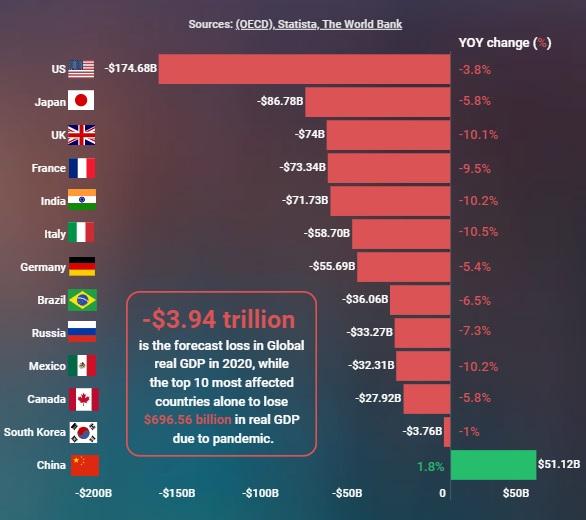
According to data from the OECD, Statista and the World Bank, the global economy is set to lose $3.94 trillion in ‘real GDP’ in 2020, due to the COVID pandemic.
We should understand real GDP as a measure of the sum of goods and services produced by a country, with factors such as inflation factored into price changes, which would skew production and consumption data and prevent year-on-year proportional analysis.
According to the data posted by IGOs and presented by BuyShares, the ten most impacted countries will lose a combined $696.56 billion in real GDP during 2020.
The worst-hit is expected to be the US, with the country expected to lose $178.4 billion. They are followed by Japan at $86.78 billion, and then the UK in third place, lumbered with a GDP hit of $74 billion. Close behind is France, at $73.34 billion, while India will be the fifth-most impacted at $71.73 billion.
Other countries to record notable losses in real GDP include Italy,($58.70 billion) Germany ($55.69), Brazil, ($36.06 billion)Russia,($33.27 billion) Mexico, ($32.31 billion)Canada, ($27.92 billion), and South Korea ($3.76 billion).
National GDP growth 2020 OECD data, Buyshares graphic
Based on the data, China is the only country set to post real GDP growth in 2020, with a $51.12 billion jump.
Already the world’s leading manufacturer, the country’s COVID containment measures allowed them to resume normal operations sooner, with fewer imports leading to the creation of more domestic employment, and expanded exports of PPE, consumer electronics and other goods in high demand during the pandemic.
The research report also added that the evolution of the COVID pandemic will continue to affect GDP projections:
“The economic projections remain conditional as they largely depend on the evolution of the pandemic and measures put in place to contain the crisis. For example, the development of a vaccine will spur rapid recovery. On the other hand, with some countries like the United States facing a second wave, they might revert to severe containment measures like lockdowns, slowing down the recovery. However, it is largely expected that most governments will be prepared for local sporadic outbreaks giving way for targeted local containment measures as opposed to a national outlook.”
According to Tribe Impact Capital, half of the World Economic Forum’s ‘Top 10 Risks’ for the coming decade are environmental issues. The company say that, by exceeding nature’s capacity to support us, we now face the twin threats of climate change and an unprecedented decline in biodiversity. What we all need to do now, is support the effort to build back better, with investment in sustainable companies being the ultimate form of advocacy.
Circularity
According to Tribe, there are four key themes that need to be championed in order to bolster planetary resilience. The first of these is based on the term ‘circularity’, or the ‘circular economy’, which focuses on repairing and refurbishing products, reusing and recycling ‘end-of-life’ materials and diverting organic waste from landfill in favour of composting.
By reducing the demand for new materials to enter our consumption cycle, and by returning nutrients (or simply value) back to the earth, circular practices such as these can help natural systems to recover from overexploitation, and regenerate, so that they can produce new resources. As stated by Tribe:
“The circularity transition will be enabled by increasing modularisation within products, as well as a shift away from asset ownership towards product-as-a-service business models.”
“[…] Circular investment opportunities exist within multiple industries. Some include the reclamation and recycling of plastic, metal, paper and food waste, the production of recycled-content and recyclable materials for use in packaging, construction and textiles, and the provision of refurbishment or repair services.”
While there are thousands of companies now actively recycling and composting, there is one that currently sticks out to me. Connected Energy recently received £350k in investment from the government-managed Low Carbon Investment Fund 2, to bolster its projects. The company focuses on repurposing electric vehicle batteries and turning them into grid-scale power storage systems, used to store power from renewable sources, to smooth out fluctuations in supply. Their upcoming project will be a 12MW grid power system.
A second company to consider is Covanta Holdings (NYSE:CVA) – a Group specialising in helping communities manage their waste and turn waste into energy. Aiming to protect natural assets and generate renewable energy, Covanta’s sites across the world convert around 20 million tonnes of waste into energy every year.
Pollution Control
The second, and well-documented, way to build back better is by companies reducing their pollutants, which contaminate air, land and water. Pollutants don’t just contribute to the greenhouse effect, but can be toxic for marine and terrestrial ecosystems, with The Lancet stating that exposure to contaminated air, water and soil resulted in 16% of all global premature deaths in 2015. Tribe stated that:
“As investors seeking solutions, we look for companies that offer waste treatment services, environmental remediation and clean-up services and pollution testing services. Other investment opportunities include utilities that provide sewerage services, and pollution control technologies like catalytic converters and scrubber systems which help eliminate harmful air pollution from industrial processes and transportation.”
For me, there are two key routes for investors to pursue, in order to support companies reducing pollution: those finding low-pollution alternatives, and those getting rid of pollution.
Fitting into the first category is Meridian Energy Limited (NZE:MEL), which is a Rainbow Tick certified, New Zealand-based energy company, currently acting as one of the country’s largest energy companies, and providing power from 100% renewable sources.
Another noteworthy project is Polymateria’s Biotransformation tech, which, with a £15 million investment from Impact Investors, Plant First Partners, will enable tough plastics to decompose into non-harmful wax-like substances.
Preservation of nature’s capital
Building on the principles already discussed, Tribe Impact Capital says that that in order to build back better, investment is needed to protect frontline biodiversity, and to help social-ecological systems regain resilience.
Examples of investment sectors involved in these processes include sustainable forestry and agriculture. On the forestry front, some companies use timber while planting a surplus of trees in place of what is taken, while others plant trees in addition to their other business practices.
In agriculture, regenerative and organic agribusiness can assist in the reuptake of greater biodiversity, while the Netherlands’ innovative and efficient greenhouse agriculture sector uses land and water efficiently, and thus uses a lot less land than most mainstream agribusinesses. According to Tribe, when done right:
“These activities help to regenerate degraded land, support biodiversity and draw carbon down into trees and soils. In the interests of ecological resilience, these kinds of activities should be conducted with an understanding of local ecological conditions; they should prioritise sustainable land management practices and should involve a diversity of tree and crop species, including those which are adapted to withstand different pests and to tolerate climatic changes like droughts and flooding. In the case of forestry, the end product should be intended to provide long-term carbon sequestration, for example in the construction industry as opposed to the biomass industry.”
While Dutch agriculture may be the model that more countries should try to adopt, investors should take an interest in B-Corps such as Ecosia – a search engine currently using its profits to plant trees – and BioCarbon Engineering, a company which uses specialized drone technology to reforest remote landscapes.
Expanding clean water resources
Finally, Tribe thinks that to build back better, we need to invest in sustainably-managed, safe and affordable water. At present, water risks include over-abstraction, pollution and climatic changes, which are all adding pressure to the fight to alleviate water scarcity. To combat these risks, investment in upgrading and extending global wastewater treatment and distribution infrastructure is key, as well as tech which facilitates greater water efficiency and reuse. As said by Tribe:
“In addition to sustainable water utilities, technologies like closed-loop water systems for industrial cooling, micro-irrigation technologies to reduce agricultural water use and water-efficient bathroom and kitchen appliances are all investible solutions.”
Two companies operating in this field include Xylem (NYSE:XYL), a company focused on the design, manufacture and service of engineered solutions for water and wastewater applications, and Suez Environnement S.A. (EPA:SEV), who provide water management, recycling and waste recovery, water treatment, and consulting services, across four European business segments.
The build back better path
With many companies now undertaking measures to implement sustainability criteria into their business models, it would seem that the build back better mantra has taken hold. Indeed, with the ECB and Bank of England declaring that environmental risk will now be factored into their bond-buying and QE programmes, a cultural shift is certainly underway.
However, companies adhering to limited ESG criteria, and pledging to change their practices, are very different from sustainability in actuality. The best way to pressure large corporations to change the way they do business, is to invest in the companies currently leading the way. Investors really do vote with their feet, and the greater the number that invest in sustainable alternatives (such as the ones listed), the better the chance we’ll have to build back better, and change the behaviour of high-carbon blue chips.
Research and development focused biotechnology firm, Midatech Pharma (AIM:MTPH) published ‘encouraging headline results’ from the Phase I study of its MTX110 drug, which is used to treat patients with the rare Diffuse Intrinsic Pontine Glioma brain tumour.
DIPG is a primary brain tumour arising in the middle of the brain stem, and cannot be surgically removed. This particular tumour occurs primarily in children, with a median survival rate out of a cohort of 316 cases being no more than 10 months, with only 35% surviving to 12 months.
Though radiotherapy prolongs survival, the majority of patients die within a year of being diagnosed, with systemic chemotherapy proving ineffective for the roughly 1,000 individuals diagnosed with the aggressive DIPG each year.
Fortunately, Midatech Pharma and their MTX110 treatment, appear to be making some headway towards tackling DIPG, with positive data being recorded during Phase I trials at the University of California.
The function of this phase of trials was to determine the dosage regimen appropriate for Phase II, with seven patients receiving focal external beam radiation prior to receiving the MTX110 treatment. Once the trial began, each patient received up to 12 cycles of the treatment every four to eight weeks, through a micro-catheter using convection enhanced delivery, with gadolinium-enhanced intra-operative MRI to guide and track drug distribution to the tumour.
Throughout the cycles, dosage was escalated between and within patients according to their tolerance, with infusion volume being increased from a concentration of 30μM, and then 60μM and 90μM as the sixth and seventh dose increments, respectively.
However, while indicating appropriate dosages for Phase II, the Phase I trial data also appeared to indicate some encouraging potential efficacy of the MTX110 treatment. At the interim cut-off date, median overall survival based on Kaplan Meier analysis was 26.06 months, with the number of patients surviving beyond 12 months more than doubling, to 71.4%.
Midatech Pharma said that five out of seven patients survived for 12 months, and that three out of the original seven remain alive and continue to be monitored.
The company did note that survival was not the endpoint of the initial study, and therefore no definitive conclusions can be drawn from the data. That is where Phase II comes in, with 19 patients being evaluated for overall survival at 12 months. The next phase will directly compare historical survival data to patient data, where MTX110 is expected to be delivered using an alternative convection-enhanced delivery catheter system that enables regular drug infusions directly into the tumour without a need for repeated surgery.
Commenting on the Phase I trial, Sabine Mueller MD PhD, Principal Investigator of the UCSF study, said: “The study has determined a proposed dose range for MTX110 for Phase II and has shown that repeated delivery of MTX110 via CED is feasible and safe. In an upcoming Phase II study efficacy in this patient population will be assessed.”
Steve Damment, EVP R&D of Midatech, added: “DIPG is a devastating pediatric brain cancer with limited treatment options and very poor outcomes. The overall survival data from this Phase I study are encouraging, although further study of MTX110 in DIPG is required to establish whether it can make a difference to these patients and their families.”
Following the uplifting Phase I of MTX110, Midatech Pharma shares rallied 24.39% or 8.05p, to 41.05p a share 19/10/20 13:00GMT.
IG Design shares (LON: IGR) have surged over 13% on Monday as the group said its interim performance was ahead of expectations.
In a trading update, the manufacturer of craft, and stationery products, revealed that it is expected to deliver a 40% year on year increase in reported revenue to approximately $435m.
Revenues at IG Design for the six months to 30 September 2020 was down 8.3%, reflecting the impact of the pandemic. The group said the second quarter showed a strong recovery.
IG Design has significantly reduced net-debt from $106.1m to $23.2m. The group commented: “This very strong performance reflects effective cash management across the Group during the first half of the year with the team remaining focused on all aspects of working capital including inventory which was lower than last year (proforma), and reduced receivable balances reflecting the focus on managing credit risk and collections.”
Looking ahead, IG Design said they remain cautious in relation to a full-year outlook. The Company expects to report its interim results at the end of November.
IG Design shares (LON: IGR) are currently trading +13.14% at 470,68 (1255GMT).
The FTSE 100 rose 0.3% after the bell on Monday amid news that the US stimulus bill might be possible.
Despite the small rise, increases in the blue-chip index remained muted fears of new Coronavirus restrictions and Brexit concerns.
The FTSE 100 had slower growth as the pound shot 0.3% higher against the dollar and 0.4% against the euro after Michael Gove claimed that the door is still ‘ajar’ for a post-Brexit trade agreement between the UK and EU.
Investors were positive over the news that Nancy Pelosi, speaker of the US House of Representatives, setting a 48-hour deadline for a bi-partisan stimulus deal to be agreed upon if a package is to be put in place before the election.
Stocks in Ocado and Next helped bolster the FTSE on Monday’s opening. Shares in property groups including British Land, Land Securities and Rightmove also rose, thanks to the continued boom in the housing market.
In China, stocks were also higher as new figures showed the economy to have grown by 4.9% between July and September.
It is the second consecutive quarter of growth and whilst it is lower than analyst expectations of 5.2%, the figures suggest economic recovery from the pandemic.
Connor Campbell, financial analyst at Spreadex, commented: “The Chinese economy grew by 4.9% in the third quarter, well up from Q2’s 3.2% increase, and Q1’s 6.8% contraction. And though that was notably below the 5.5% forecast, any ill-feeling was tempered by improving industrial production and unemployment rate numbers, and, crucially, a far better than expected retail sales reading.
“That metric – which, after the GDP figure, is the most important for investors – surged from 0.5% in August to 3.3% in September, marking the 2nd positive reading in a row.”
Aeorema Communications shares (LON: AEO) fell almost 5% on Monday as the group swung to a loss for the year ending 30 June 2020.
The AIM-traded live events agency reported a pre-tax loss of £175,043, compared to last year’s profit of £384,483.
Revenues at Aeorema Communications fell from £6.8m to £5.5m.
Amid the pandemic, the group has said they are increasingly focusing on digital and hybrid events.
“We have launched a robust and flexible technology platform to help run virtual events and this has had a very positive response from clients,” said Aeorema Communications.
The company’s cash position remains strong with in excess of £1m. However, given continuing uncertainties, the Board has not recommended the payment of a full-year dividend.
The group’s chief executive said: The development of the Group’s offering to now include strategy and virtual experiences as chargeable avenues has reignited opportunities across the board. Excitingly and off the back of this, we are seeing bigger conversations and a bigger ‘piece of the pie’ with returning and new clients alike.
“I am optimistic that the momentum already seen in Q1 2020-2021 reflects continued positive growth ahead for both operating businesses. A strong finish to a challenging year, we continue to make waves in the UK and globally as Game Changers in purpose, strategy, creative and value,” he added.
In March this year, Aeorema Communications acquired Eventful Ltd, which provides venue sourcing, strategic event planning and management and incentive travel services.
Aeorema Communications shares (LON: AEO) are -1.43% at 20,70 (1047GMT).