Train fares are expected to rise 2.5 percent in from 2019, according to economists.
This follows thousands of delays and cancellations over the course of the year from many train operators, causing chaos for commuters across the UK.
This follows a 3.6 per cent rise at the start of the year, already marking the highest rise in the last five years.
The exact details of the rise will be revealed on Wednesday following the publication of official inflation figures from the Office of National Statistics (ONS).
Economists expect the Retail Prices Index measure of inflation, which is used by the Department for Transport, to have risen 3.5 percent in July.
News of the rise comes after Which?, the consumers association, found train firms to be the second least-trusted industry in the country.
Specifically, satisfaction with train companies had dipped to 72 per cent from 62 per cent a decade ago.
Overall, customer satisfaction with value for money rested at an average of 46 percent in the year to spring 2018.
This proved even lower for commuters, with a marginal rise from 30 percent to 31 percent across the same period.
In addition, approval of handling of delays has remained persistently low for train operators, with Which? noting a four percentage point increase in satisfaction.
Peter Vicary-Smith, Which? chief executive, commented on the findings:
‘With persistent poor service, delays, cancellations and the hassle of getting compensation for journeys, it’s unsurprising that trust in the rail industry has been consistently low and only getting worse.
‘Passengers expect increased satisfaction to come with the hike in their ticket prices, not a decade of disappointment and unprecedented disruption like many faced this year.’
UK retail spending fell for July, according to Visa, as the high street continues to struggle.
Visa said despite optimism that the heatwave would spur on consumers, spending was down 0.9 percent in July compared with the same month a year previously.
The steepest fall was in “face to face” spending in retail outlets, which dropped by 1.2 percent, with footfall continuing to dip.
Whilst consumer trends have shown a marked switch to online avenues, even online spending fell by 0.5 percent.
The warmer weather helped boost food, drink and restaurant spending, however, this did not extend to transport and household goods, which ultimately fell.
Mark Antipof, the chief commercial officer at Visa, commented: “Retailers had a difficult time in early 2018, and while there was some respite in May and June, July’s fall in spending is concerning, particularly as we look ahead when the impact of the interest rate rise and back-to-school costs will likely put further pressure on Britons’ wallets.”
The UK high street is increasingly facing pressure as high inflation levels continue to outpace wage growth.
As a result, shoppers are increasingly tightening their purse strings, shunning some of the nation’s most-loved retailers.
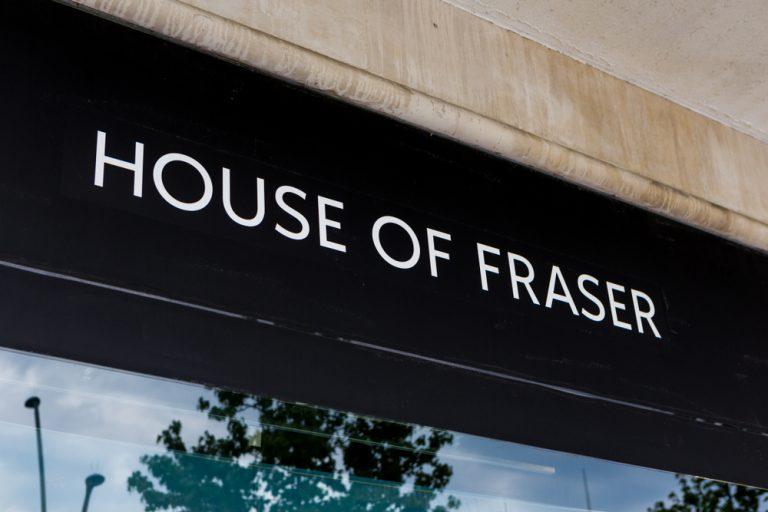
Most recently, department store chain House of Fraser has felt the pinch, narrowly avoiding administration.
After initially failing to find a buyer last week, House of Fraser collapse seemed imminent.
However, Sport Direct’s Mike Ashley has since struck a £90 million deal to rescue the troubled retailer.
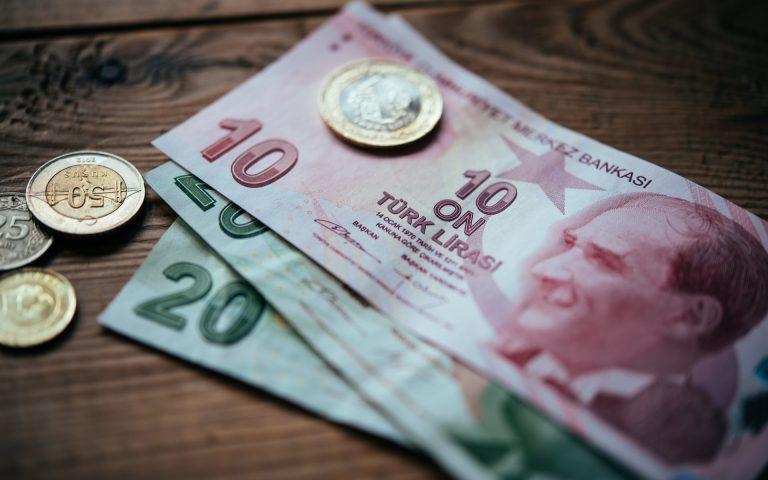
Turkey’s central bank has said that it will take “all necessary measures” for financial stability in Turkey following the collapse of the lira.
The lira hit a new record low of nine percent against the dollar before recovering slightly to be six percent lower in late morning trading in Turkey.
“[We] will closely monitor the market depth and price formations, and take all necessary measures to maintain financial stability, if deemed necessary,” said Turkey’s central bank.
Financial analyst at trading platform Spreadex, Connor Campbell, said: “One of the key sticking points is the intransigence from president Erdoğan – whose appointment of his son-in-law as minister of finance and Treasury has cast doubt on the independence of the Turkish central bank – over keeping interest rates unchanged despite eye-wateringly high inflation and the lira’s heavy losses.”
“That means the various non-rate hike measures announced on Monday to stabilise the currency – including the promise to provide ‘all the liquidity the banks need’ – will likely be limited in their effect,” he added.
Experts are blaming the fall in Turkish lira on fears that the country is descending into an economic crisis.
The stock markets in Europe and Asia also fell.
The Nikkei in Japan felly by 1.7 percent, Hong Kong was down 1.8 percent, Shanghai fell 1.7 percent, Sydney fell 0.5 percent and the Taiwanese bourse was down by three percent.
In Europe, London’s 100-share index was down 0.5 percent. The German and French markets also fell by similar amounts.
Andrew Kenningham, the chief global economist at Capital Economics, said: “The plunge in the lira which began in May, now looks certain to push the Turkish economy into recession and it may well trigger a banking crisis.”
“This would be another blow for emerging markets as an asset class, but the wider economic spillovers should be fairly modest, even for the eurozone.”
The founder and chief executive of Tesla is facing a lawsuit from investors after he said he might take the firm private.
Elon Musk said that de-listing the group from the stock exchange could be the “best path forward” for the firm.
Musk wrote in a letter to employees: “Earlier today, I announced that I’m considering taking Tesla private at a price of $420/share. I wanted to let you know my rationale for this, and why I think this is the best path forward.”
“First, a final decision has not yet been made, but the reason for doing this is all about creating the environment for Tesla to operate best. As a public company, we are subject to wild swings in our stock price that can be a major distraction for everyone working at Tesla, all of whom are shareholders.”
“I fundamentally believe that we are at our best when everyone is focused on executing, when we can remain focused on our long-term mission, and when there are not perverse incentives for people to try to harm what we’re all trying to achieve. This is especially true for a company like Tesla that has a long-term, forward-looking mission.”
Kalman Isaacs is the plaintiff in the lawsuit and has said that Musk’s plans to take the tech firm off the stock exchange are aimed at “completely decimating” short-sellers.
Short-sellers have claimed to have lost millions thanks to Mr Musk’s comments.
Musk hopes that making Tesla private will ease off the pressure for the tech group to meet quarterly financial targets and end distractions of share volatility.
Musk has faced plenty of controversies so far this year. In July the group’s CEO apologised to a British cave diver he called “pedo guy”.
David Jones, Chief Market Strategist at Capital.com, said of Musk’s comments: “If the market thinks that this is merely Elon Musk venting his frustration at the amount of scrutiny his company – and its share price – comes under on a weekly basis, then investors may well take some of this week’s windfall profits, and the share price will be under pressure once more.”
“As ever with Tesla and Mr. Musk, there is seldom a dull moment and it is likely to be even more closely tracked now than ever before,” he added.
Shares in Tesla (NASDAQ: TSLA) are currently trading at 355.49 (1229 GMT).
Ticketmaster plans to close its two controversial resale sites, GetMeIn and Seatwave.
The decision came after mounting criticism that the secondary sites had become a target for “professional sellers”, who would sell tickets at huge markups.
Ticketmaster, which is owned by Live Nation (NYSE:LYV), said the platforms would be replaced with a fan-to-fan exchange, selling tickets at face value or lower.
“We know that fans are tired of seeing others snap up tickets just to resell for a profit on secondary websites, so we have taken action,” commented Andrew Parsons, head of Ticketmaster UK.
From today, there will be no new events listings on Get Me In or Seatwave.
However, the sites will continue to operate until October in the UK and Ireland, and closing later in the year for the rest of its European operations.
Sellers and Fans will still be able to re-sell tickets on rival platforms such as Viagogo and Stubhub, which is owned by Ebay.
Last November, the offices of both companies were raided by the Competition and Markets Authority (CMA), as part of its investigation into suspected breaches of consumer law.
The Society of Ticket Agents and Retailers welcomed the decision by Ticketmaster, commentating that ticket buyers would “have another safe and trusted place to resell their tickets”.
Shares in Live Nation are currently trading +0.12 percent as of 11.23 (GMT).
House prices in England and Wales have fallen for the fifth month in a row, according to new data.
Figures by Your Move showed an average fall of 0.2 percent over the month of July to £302,251. House prices are still 1.6 percent than the same period last year.
Despite the average fall, cities including Leicester recorded fast growth. Regions including the West Midlands recorded growth whilst the South East and East of England grew at a slower rate of 0.5 percent.
The City of London saw the biggest drop and was down 19.4 percent. Hammersmith and Fulham, and Southwark, were both down 11.7 per cent.
The prices in Kensington and Chelsea were down 1.9 percent on an annual basis to £1,765,033 and remain London’s most expensive boroughs. The cheapest borough is Barking and Dagenham, where the average price of a property is 308,547.
The average price of a property in the capital is currently £625,529.
While the Bank of England raised interest rates in August, it is not yet known how it will affect the housing market.
When announcing the rise of the UK interest rate, the bank’s governor Mark Carney said: “Rates can be expected to rise gradually. Policy needs to walk, not run, to stand still.”
“There are a variety of scenarios that can happen with Brexit … but in many of those scenarios interest rates should be at least at these levels and so this decision is consistent with that.”
“In those scenarios where the interest rate should be lower, well then the MPC which meets eight times a year would, I’m confident, take the right decision to adjust interest rates at that time,” he added.
House of Fraser has been bought by Mike Ashley’s Sports Direct (LON:for £90m.
Having earlier announcing its was going into administration the department store was in dire straits after a potential Chinese buyer pulled out.
Had Sports Direct not swooped in, 17,500 jobs were at risk of being lost.
In addition, Mike Ashley was at risk of taking a hit on an existing 11% stake in House of Fraser.
Sports Direct also has a stake in Debenhams and now has a significant exposure to the UK high street.
Sports Direct said in a release:
“The group has acquired all of the UK stores of House of Fraser, the House of Fraser brand and all of the stock in the business.”
Sport Direct has been in a bullish mood recently with House of Fraser adding to a recent acquisition of shares in Iconix Brand Group. Iconix Brand Group is a predominately US facing group with brands such as Lee Cooper, Echo, Rocawear, Zoo York and Umbro.
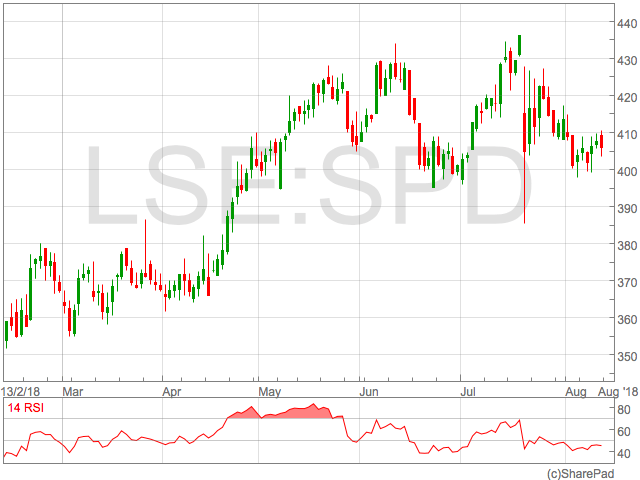
Sports Direct share fell on Friday morning trade, down 0.7% to 404p.
UKOG plc (LON:UKOG) has found support over the past week after a significant drop.
UKOG plc operates a number of licenses in the south of England, one of these being the famed Gatwick Gusher.
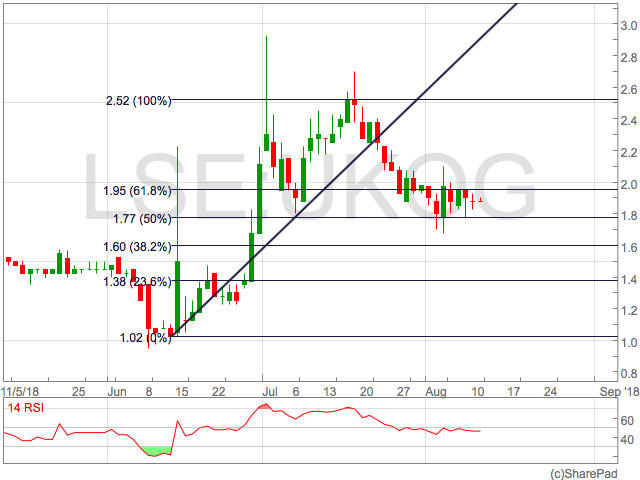
Having hit closing highs of 2.50p in July, the share price has fallen back to support at 50% Fibonacci Retracement of a month long rally which saw the price rise from just under 1p to an intraday high of 2.9p.
Support in the UKOG plc share price was triggered by an update last week on the progress of flow testing in the Weald Basin.
The firm said it had achieved flow of a stable implied equivalent daily rate of 401 and 414 barrels of oil per day.
The comply said further tests are to start in the foreseeable future.
CEO Stephen Sanderson commented on the results:
“HH-1 continues to deliver positive results that exceed the 2016 Portland test outcomes. The excellent short-term high rate test results, combined with pressure build up data, provide further confidence that the next phases of the Portland test can deliver both an optimal sustainable long-term flow rate and deliver the primary objective of confirming the Portland’s commercial viability.
Whilst the potential future near-term cash flow from the Portland is very important to UKOG, we should not lose sight of the significance of the potential prize that lies in the underlying primary Kimmeridge objective, the long-term testing of which will follow directly after the Portland programme.
Following our readmission to AIM as an operating company, a major corporate milestone, we are also delighted that Allen Howard has been appointed as non-executive chairman and Nicholas Mardon Taylor has joined the board as a non-executive director. Nicholas’ depth and breadth of financial experience in both oil and gas and other sectors will be a highly valuable addition to the Company.”
Shares in UKOG changed hands at 1.8p in Friday morning trading.
House of Fraser has announced it will be calling in administrators after recent talks failed to secure a buyer.
The department store is the latest casualty of a shift in consumer trends that has ravaged the UK high street.
House of Fraser had been in talks with a Chinese company to secure the funds required to save the business but these proved fruitless.
Hopes were raised when it was reported Mike Ashley’s Sports Direct would provide an injection of cash but these have also fizzled out despite Sports Direct having an 11% stake in House of Fraser.
The failure to secure solvency puts 17,500 jobs at risk.
CEO Alex Williamson said “We are hopeful that the current negotiations will shortly be concluded. An acquisition of the 169-year-old retail business will see House of Fraser regain stability, certainty and financial strength.”
Ernst & Young have been appointment as administrators and will continue to explore the sale of the store or assets.
UK Retail Sales
The failure of major high street brands isn’t so much a signal of a weakening UK economic picture but more a change in consumer habits.
Broad UK retail sales are robust with a year-on-year rise of 2.9% in June and 4.1% in May.
Companies such as House of Fraser have run in trouble due to the fact much of this spending is now taking place online and the combination of both the failure to adapt to this through seamless online shopping experiences and high overheads demanded by the rental value for large department stores, has taken its toll.
The failure of House of Fraser, BHS, Maplins, Toys R’ Us, and Poundworld and the destruction of the share prices of Mothercare, Next, Card Factory and Marks and Spencer has been a long time coming.
Consumers have been long shifting their purchasing online and these groups were slow to increase their presence losing out of companies such as ASOS, Boohoo and Amazon.
Snap Inc (SNAP:NYSE) have seen their share price dip as figures for the second quarter reveal that their Snapchat app has lost over 3 million daily active users.
The results come after software updates this year, which have changed the format of the app and driven some users away.
While the company were able to defy analysts with revenues of $262 million for Q2 – up $80 million on-year – they were unable to cancel out the six percent share price dip that followed the announcement of lost users.
Chief executive of Mindshare’s Worldwide Central, Nilufar Fowler, said, ”The drop in Snap’s share price will almost certainly be linked to the decline in DAUs – a loss of 3m daily users since Q1. The loss is relatively small, and it’s certainly too early to say that it signals a trend, we’ll have to wait and see whether the decline is repeated in the next quarter’s results.
“It’s unlikely that any single factor could be blamed for the decline in DAUs – more likely is a combination of factors, including the impact of GDPR in Europe, a potential decline in overall social media usage, the negativity around the infamous redesign, and the plateauing growth of overall social media users.
“It’s likely that some of those lost DAUs will be spending more time on Facebook-owned Instagram, which has introduced Instagram Stories and IGTV to compete directly with Snap Stories.”
On the same day, Saudi Arabian Prince Alwaleed bin Talal snapped up a 2.3% stake in the company for $250 million. Following the news, Snapchat’s share price recovered from Wednesday’s dip, however, it fell 6% again in the first hour of trading this morning.



 Support in the UKOG plc share price was triggered by an update last week on the progress of flow testing in the Weald Basin.
The firm said it had achieved flow of a stable implied equivalent daily rate of 401 and 414 barrels of oil per day.
The comply said further tests are to start in the foreseeable future.
CEO Stephen Sanderson commented on the results:
Support in the UKOG plc share price was triggered by an update last week on the progress of flow testing in the Weald Basin.
The firm said it had achieved flow of a stable implied equivalent daily rate of 401 and 414 barrels of oil per day.
The comply said further tests are to start in the foreseeable future.
CEO Stephen Sanderson commented on the results: