
AstraZeneca shares rise on US approval of new drug
Shares in AstraZeneca (LON:AZN) rose 2 percent in early trading on Monday, after US authorities approved a new drug for hyperkalaemia.
The drug, Lokelma, is designed for high potassium levels in the blood and was given marketing authorisation by the European Commission in March.
The group also submitted a new application to Japan’s Pharmaceuticals and Medical Devices Agency for Forxiga, which provided reduced blood pressure and causes weight loss in adult patients with type-2 diabetes. This comes after regulatory submission for the drug was accepted in Europe earlier this year.
Shares in AstraZeneca (LON:AZN) are currently up 2.02 percent at 5,347.00 (0818GMT).
Ryanair posts 10pc profit as passenger numbers soar

Ryanair (LON:RYA) posted a 10 percent increase in annual profit on Monday, despite a rota blunder resulting in hundreds of cancelled flights.
Profits after tax came in at €1.45 billion in the 12 months to 31st March, boosted by a 9 percent rise in passenger numbers to 130.3 million. On average, its planes were 95 percent full over the period.
For the 2019 financial year, the company forecast pre-tax profit to fall to a range of €1.25 billion and €1.35 billion.
However, the group warned that it expected profit to fall in the 2019 financial year due to higher staff and fuel costs.
“Our outlook for the 2019 financial year is on the pessimistic side of cautious,” chief executive Michael O’Leary said.
“While still too early to accurately forecast close-in summer bookings or second half fares, we are cautiously guiding for broadly flat average fares for FY19,” he said.
Staff costs are set to rise at the airline, after it was forced to offer new contract terms to its pilots in the wake of its decision to cancel thousands of flights from the winter schedule. It is now working on union recognition and new pay deals with staff.
At market open shares begun by trading down, currently at 15.40 (0803GMT).
Carpetright reveals recovery plan, shares rise 11pc
Carpetright has revealed new plans to raise £60 million to help restructure the group.
The struggling company will divide the £60 million to cover the costs of implementing the CVA, repay loans, fund spending under the firm’s new business plan, and ongoing working capital requirements.
Following the details of the fundraising, shares rose 11 percent.
Carpetright recently announced plans to close 92 stores in the UK, putting 300 jobs at risk.
“The £60 million proceeds from the placing and open offer will give us the resources we need to complete our restructuring and accelerate our recovery plan,” said Wilf Walsh, the group’s chief executive.
“As well as funding implementation of the CVA to create a right-sized estate of stores on sustainable rents, it will provide the necessary capital to refurbish and modernise the ongoing store estate and to upgrade our digital platform – both vital investments in our future.”
“We believe that a recapitalised market leader will ultimately be better for customers, suppliers, landlords and shareholders,” he added.
This week Mothercare revealed a restructuring agreement, where they plan to close 50 stores sending up shares 25 percent.
One incredibly powerful advantage, that most retail investors overlook

Sponsored by Reid Green & Co
Please read this entire article because you will find how even the most modest value retail investor can create his own competitive advantage in the market place from the simple understanding of these facts.
We would like to begin by saying that finding obviously mispriced stocks or undervalued companies, while very doable is by no means easy. Often the obvious bargains are not around for long as they are quickly competed away by the legions of funds, analysts, activists and insiders who understand and continuously hunt for value.
However it is possible to find and profit from those obvious but temporary bargains, as well as the ones not so visible to the naked eye, if one possesses, creates and maintains an investment advantage. Or better yet a confluence of advantages.
A good way to gain an advantage is to do opposite of the crowd. If they lower their standards, increase yours, if they become impatient, become more patient, if they seek more information, seek better conclusions.
Reid Green & Co seeks and advantage otherwise known as an edge in 3 different ways. Firstly, gaining unique insights derived from a better approach to analysis, secondly understanding how opportunities are created and knowing where to look and finally which brings us to one of the most powerful, and penetrating but overlooked advantages – having a longer time horizon than the competition.
The best way to introduce this topic is demonstrate how much the average stock holding period has declined in the last 65 years.
 According to the New York and London Stock Exchange the average holding period for a stock has declined from 8 years in 1940 down less than 1 year in 2005. The World Bank estimates it is now closer to 4 months.
So as the general investing population develops an ever-decreasing time horizon, Reid Green & Co maintains a long-term orientation focused on values, which are outside of the average investor’s time horizon.
Reid Green & Co typically thinks about a company’s value over a 1, 3 and 5 year period, and compares that value to today’s stock price, to look for substantial mis-pricings.
To demonstrate Reid Green & Co’s perspective on time horizon, we are going to use an example.
Glencore Plc
An investment idea we covered for our subscribers in 2016, when the stock was trading at a 50% discount to its book value.
Although Glencore announced it would slash its debt by 30%, monetise its non-core assets and reduce its operating costs over the next 12 – 18 months, the market was gripped by its fear by the short-term outlook concerning the record low oil prices.
The value investor does not necessarily have to wait for market crashes or corrections. Thinking about long-term values when others are obsessed with the short term should be sufficient to gain an advantage.
How can you start to ethically exploit this advantage for your own investment gain?
You can take the lessons from this article, read it, re-read it and then find a way to start looking for situations where you understand the long-term values of a company better than the market does. Or… you can find a source who sends you investment ideas which already meets this criteria, such as Reid Green & Co.
Founded in 2016, Reid Green & Co is a Value Investing research firm which publishes and distributes reports on deeply undervalued companies, which are listed in the UK and the US.
Experience our investment research, up-front, for free
We allow you to experience our investment research service up-front without paying for it via our no risk 30-day free trial
During the free trial on top of being able to examine the quality and nature of our reports you will receive at least 1 actionable investment idea you can take advantage of right now.
At any point in the free trial you can cancel your subscription. No questions asked. No payment required.
According to the New York and London Stock Exchange the average holding period for a stock has declined from 8 years in 1940 down less than 1 year in 2005. The World Bank estimates it is now closer to 4 months.
So as the general investing population develops an ever-decreasing time horizon, Reid Green & Co maintains a long-term orientation focused on values, which are outside of the average investor’s time horizon.
Reid Green & Co typically thinks about a company’s value over a 1, 3 and 5 year period, and compares that value to today’s stock price, to look for substantial mis-pricings.
To demonstrate Reid Green & Co’s perspective on time horizon, we are going to use an example.
Glencore Plc
An investment idea we covered for our subscribers in 2016, when the stock was trading at a 50% discount to its book value.
Although Glencore announced it would slash its debt by 30%, monetise its non-core assets and reduce its operating costs over the next 12 – 18 months, the market was gripped by its fear by the short-term outlook concerning the record low oil prices.
The value investor does not necessarily have to wait for market crashes or corrections. Thinking about long-term values when others are obsessed with the short term should be sufficient to gain an advantage.
How can you start to ethically exploit this advantage for your own investment gain?
You can take the lessons from this article, read it, re-read it and then find a way to start looking for situations where you understand the long-term values of a company better than the market does. Or… you can find a source who sends you investment ideas which already meets this criteria, such as Reid Green & Co.
Founded in 2016, Reid Green & Co is a Value Investing research firm which publishes and distributes reports on deeply undervalued companies, which are listed in the UK and the US.
Experience our investment research, up-front, for free
We allow you to experience our investment research service up-front without paying for it via our no risk 30-day free trial
During the free trial on top of being able to examine the quality and nature of our reports you will receive at least 1 actionable investment idea you can take advantage of right now.
At any point in the free trial you can cancel your subscription. No questions asked. No payment required.
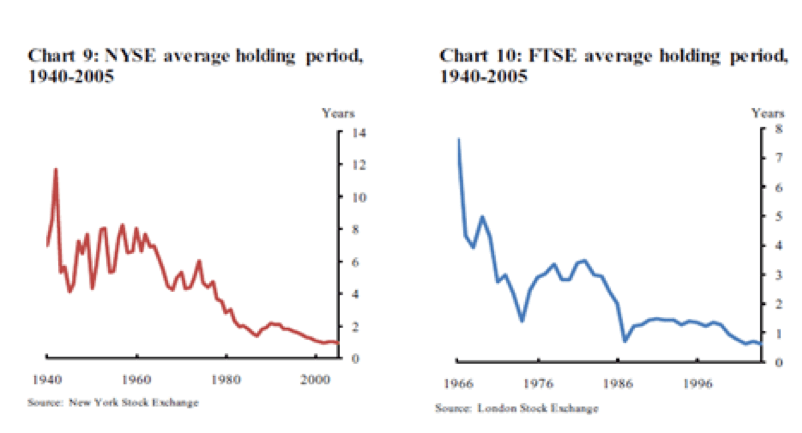 According to the New York and London Stock Exchange the average holding period for a stock has declined from 8 years in 1940 down less than 1 year in 2005. The World Bank estimates it is now closer to 4 months.
So as the general investing population develops an ever-decreasing time horizon, Reid Green & Co maintains a long-term orientation focused on values, which are outside of the average investor’s time horizon.
Reid Green & Co typically thinks about a company’s value over a 1, 3 and 5 year period, and compares that value to today’s stock price, to look for substantial mis-pricings.
To demonstrate Reid Green & Co’s perspective on time horizon, we are going to use an example.
Glencore Plc
An investment idea we covered for our subscribers in 2016, when the stock was trading at a 50% discount to its book value.
Although Glencore announced it would slash its debt by 30%, monetise its non-core assets and reduce its operating costs over the next 12 – 18 months, the market was gripped by its fear by the short-term outlook concerning the record low oil prices.
The value investor does not necessarily have to wait for market crashes or corrections. Thinking about long-term values when others are obsessed with the short term should be sufficient to gain an advantage.
How can you start to ethically exploit this advantage for your own investment gain?
You can take the lessons from this article, read it, re-read it and then find a way to start looking for situations where you understand the long-term values of a company better than the market does. Or… you can find a source who sends you investment ideas which already meets this criteria, such as Reid Green & Co.
Founded in 2016, Reid Green & Co is a Value Investing research firm which publishes and distributes reports on deeply undervalued companies, which are listed in the UK and the US.
Experience our investment research, up-front, for free
We allow you to experience our investment research service up-front without paying for it via our no risk 30-day free trial
During the free trial on top of being able to examine the quality and nature of our reports you will receive at least 1 actionable investment idea you can take advantage of right now.
At any point in the free trial you can cancel your subscription. No questions asked. No payment required.
According to the New York and London Stock Exchange the average holding period for a stock has declined from 8 years in 1940 down less than 1 year in 2005. The World Bank estimates it is now closer to 4 months.
So as the general investing population develops an ever-decreasing time horizon, Reid Green & Co maintains a long-term orientation focused on values, which are outside of the average investor’s time horizon.
Reid Green & Co typically thinks about a company’s value over a 1, 3 and 5 year period, and compares that value to today’s stock price, to look for substantial mis-pricings.
To demonstrate Reid Green & Co’s perspective on time horizon, we are going to use an example.
Glencore Plc
An investment idea we covered for our subscribers in 2016, when the stock was trading at a 50% discount to its book value.
Although Glencore announced it would slash its debt by 30%, monetise its non-core assets and reduce its operating costs over the next 12 – 18 months, the market was gripped by its fear by the short-term outlook concerning the record low oil prices.
The value investor does not necessarily have to wait for market crashes or corrections. Thinking about long-term values when others are obsessed with the short term should be sufficient to gain an advantage.
How can you start to ethically exploit this advantage for your own investment gain?
You can take the lessons from this article, read it, re-read it and then find a way to start looking for situations where you understand the long-term values of a company better than the market does. Or… you can find a source who sends you investment ideas which already meets this criteria, such as Reid Green & Co.
Founded in 2016, Reid Green & Co is a Value Investing research firm which publishes and distributes reports on deeply undervalued companies, which are listed in the UK and the US.
Experience our investment research, up-front, for free
We allow you to experience our investment research service up-front without paying for it via our no risk 30-day free trial
During the free trial on top of being able to examine the quality and nature of our reports you will receive at least 1 actionable investment idea you can take advantage of right now.
At any point in the free trial you can cancel your subscription. No questions asked. No payment required.
Click here to learn more about the 30-day free trial
CMA launches investigation on Sainsbury’s-Asda merger

The Competition and Markets Authority has launched an investigation into the proposed deal between Sainsbury’s (LON: SBRY) and Asda.
The competition watchdog has invited interested parties to comment on the impact of the deal and will investigate whether the deal will result in a substantial lessening of competition.
Those affected could include suppliers, competitors, industry bodies and consumer organisations.
The watchdog said it is “likely to proactively contact companies and organisations that are active in the markets affected by the proposed merger, or have valuable insights or evidence that could assist the CMA’s investigation”.
A deal between the second and third biggest UK supermarkets would create a grocery giant and overtake Tesco as the market leader.
Once a first phase of the investigation is complete the CMA will decide whether to move to “phase two”.
The combined group would have 2,800 stores across the UK and a combined revenue of £51 billion.
Depending on the outcome of the investigation, the group may have to dispose of stores or the deal might be blocked entirely.
The CMA has set a deadline on Monday 4 June for its initial information gathering process.
Maximise UK, a retail consultancy, said last week that the watchdog could force Sainsbury’s and Asda to sell up to 245 supermarkets across the UK.
Research by the group showed the number of stores at risk is the very least six percent of the group’s combined total. This is 73 stores but the number could increase depending on the CMA calculations.
“There hasn’t been a retail deal like this in more than a decade. The real focus will be on how Sainsbury’s and Asda’s main supermarkets operate at a local level and how they overlap. The CMA will be concerned about whether the deal reduces the number of competing brands within a 10 or 15 minute drive time.” said David Haywood, founder of Maximise UK.
The group’s executives have said there are not any plans to close stores under the deal.
The merger, which was agreed last month, will see Asda valued at £7.3 billion.
Grainger reports 23pc increase in profits

Grainger (LON:GRI) reported a 23 percent increase in profit in its half-year results, on the back of a ‘strong’ trading performance.
Pre-tax profits rose to hit £50.6 million, up from £41.2 million a year ago, with adjusted earnings up 20 percent to £34.1 million. The results were underpinned by a 9 percent jump in rental income, with a 4.1 percent like-for-like rental growth across its entire portfolio.
Results were also boosted by the group’s attainment of £756 million of private sector investments, with £258 million in the planning or legal process and a further £519 million under consideration.
“We are a business on a strong growth trajectory and the opportunity in the UK PRS market is vast. We are uniquely placed given our market leading position and our in-house capability to originate, invest and operate homes for rent,” said Helen Gordon, Grainger’s CEO.
The group raised its interim dividend by 9 percent to 1.74 pence from 1.6 pence. Shares in Grainger (LON:GRI) are largely flat, currently up 0.32 percent at 314.80 (1021GMT).
Tencent posts record profit in Q1 as user base continues to grow

Chinese tech giant Tencent Holdings posted a record profit in the first quarter of the year, boosted by a 55 percent increase in advertising revenue.
The group behind the popular messaging app WeChat, similar to WhatsApp, saw shares rise over 5 percent on Thursday morning, after the group’s year-on-year profit rose 61 percent to 23.29bn yuan.
WeChat’s monthly users grew to one billion for the first time earlier this year, boosting advertising revenue by 55 percent to 10.69 billion yuan in the first quarter. Most of the group’s growth came from the gaming apps it owns and in-game purchases by players. The chat app offers other services for users, including the possibility of booking a taxi, ordering food or paying for goods online. Revenue from other businesses within Tencent, including its cloud services, grew by 111 percent year-on-year in the period. Shares in Tencent are currently up 3.74 percent at 411.00 (HKG:0700).Ocado shares up 50pc on Kroger deal
Ocado (LON:OCDO) shares jumped over 50 percent in early trading on Thursday, after the online grocery retailer confirmed a deal with US giant Kroger.
Ocado’s technology will be used by Kroger in the US, where they have annual sales of $122 billion, with the US group taking a 5 percent stake in Ocado.
Ocado has reached four similar agreements over the last six months, with Kroger being its first in the US. Ocado will build around 20 robotic warehouses in the US, and Kroger has also acquired use of its online shopping and logistics technology.
Ocado chief executive Tim Steiner said: “As we work through the terms of the services agreement with Kroger in the coming months, we will be preparing the business for a transformative relationship which will reshape the food retailing industry in the US in the years to come.”
Ocado has been at the forefront of technological development in the grocery industry, trialling robot deliveries and packing technology for warehouses.
Shares in Ocado (LON:OCDO) are currently up 41 percent at 780.40 (0933GMT).
Countryside Properties boosted by increase in profits and completions

Countryside Properties (LON:CSP) posted a 24 percent increase in its dividend on Thursday, after an increase in both profits and completions.
Adjusted profit rose 7 percent in the six months to the end of March, driven by a 15 percent jump in completions.
Adjusted revenue rose 7 percent to £468.0 million, up from from £435.4 million the same period a year ago. Pretax profit hit £73.7 million, with adjusted operating margin up 0.9 percent to 17.2 percent.
The home builder completed 1,655 homes, up 15 percent, despite the average selling price falling from £441,000 to £392,000.
“We enter the second half in great shape and our acquisition of Westleigh will further increase our momentum by expanding our geographic reach and mixed tenure delivery’ said Ian Sutcliffe, the group chief executive of Countryside.
“We remain confident of delivering on expectations for both the current year and the medium-term,” the firm said.
Shares in Countryside Properties are currently trading up 1.14 percent at 374.20 (1024GMT).
Mothercare shares up 25pc on restructuring agreement

Mothercare (LON:MTC) shares shot up 25 percent on Thursday morning, after setting out the measures it intended to take to restructure its UK store portfolio through company voluntary arrangements (CVAs) of certain subsidiaries.
Mothercare will access £113.5 million in funding through a refinancing, which will comprise of a proposed equity capital raising of £28 million expected to be launched in July 2018, alongside revised committed debt facilities of £67.5 million and a new £8m shareholder loans.
Clive Whiley, the company’s interim executive chairman, said the recent financial performance of the business, impacted in particular by a large number of legacy loss making stores within the UK estate, had resulted in an “unsustainable situation for the Mothercare brand”.
“These comprehensive measures provide a renewed and stable financial structure for the business and will drive a step change in Mothercare’s transformation. The potential for the Mothercare brand in the UK, benefitting from a restructured store estate, and internationally remains significant”
Mothercare shares lost a quarter of their value in January after the group issued a profit warning, after sales dropped 7.2 percent over Christmas.
Shares in Mothercare are currently trading up 24.41 percent at 26.50 (LON:MTC).