
Londoners pay four times more Stamp Duty than rest of UK

Londoners pay on average four times more Stamp Duty than the rest of UK, according to research from London Central Portfolio.
According to the data, Greater London proved the biggest contributor to Stamp Duty at around 39 percent.
The research revealed that the Royal Borough of Kensington and Chelsea and the City of Westminster alone contributed in excess of £0.6 billion.
The data also found that whilst the average basic rate Stamp Duty paid by buyers in England and Wales came in at £7,161, London buyers pay four times that figure, coming at £27,232.
Naomi Heaton, CEO of London Central Portfolio, said: “Despite the continued rumble around whether the richest are paying their ‘fair share’, it is clear that they are the main contributor to Stamp Duty revenue. ”
She added: “LCP’s findings indicate that the majority of the Exchequer’s £9.5bn tax take is being generated by the 10% most expensive sales and that buyers in London are paying 4 times more Stamp Duty than the national average.”
As it stands, the average house price in the UK is £218,255, whilst London property prices prove substantially higher at £490,718.
Nevertheless, the property market in the UK continues to stagnate as Brexit negotiations continue to play out.
The housing market in the capital continues to be the worst hit by economic uncertainty that has ensued, with prices falling more than 15 per cent in the last 12 months.
Government figures reveal that the number of completed house sales in England dropped by 21.2 per cent to 62,482, compared with 79,243 back in November 2015.
Meanwhile, the number of completed house sales in London fell by 34.8 per cent to 6,394 compared with 9,806.
This week the government announced several measures with the aim of tackling improving the housing sector.
Yesterday housing and communities secretary Sajid Javid announced that real estate agents in the UK will now be required to hold a professional qualification in order to practice.
Alongside this, Javid pledged the government’s commitment to crackdown on the practice of “gazumping”, where sellers accept higher offers than necessary.
Read more about the government proposals here.
Rolls-Royce sell L’Orange in £610m deal

Rolls-Royce (LON: RR) will sell the technology firm L’Orange to America’s Woodward (NASDAQ: WWD) in a £610 million deal.
The engine maker is taking steps to “to improve the resilience of the balance sheet” and will use proceeds of the deal to reinvest in the group.
“This transaction builds on the actions we have taken over the last two years to simplify our business,” said Warren East, chief executive of Rolls-Royce.
“The divestiture of L’Orange enables Rolls-Royce Power Systems to focus on other long-term, high-growth opportunities and our company to allocate our capital to core technologies and businesses that drive greater returns for the group.”
L’Orange is a subsidiary of Rolls-Royce and has 1,000 employees in Germany, the US and China.
After the sale, L’Orange has agreed to a 15 year supply agreement with Rolls-Royce Power Systems, so the groups can remain “important” partners.
“As well as providing a healthy boost to the balance sheet, (the sale) suggests chief executive Warren East is not sitting on his hands despite reporting good progress on a transformation of the business at last month’s full-year results,” said Russ Mould, an investment director at AJ Bell.
“East has now been in charge at Rolls for more than two years having previously earned a stellar reputation at British technology champion ARM. His successful rehabilitation of a fallen corporate titan is only bolstering that reputation.”
The deal is expected to close later this year and has been approved the boards of both companies.
Andreas Schell, president and chief executive of Rolls-Royce Power Systems, said: “Rolls-Royce Power Systems will remain a key customer of Woodward L’Orange.
“We have enjoyed working with L’Orange who have a leading position in their markets, excellent technology, a skilled workforce and strong leadership. We wish them well as they join the Woodward organisation.”
French Connection shares jump 20pc after group sells stake in Toast
Shares in French Connection (LON: FCCN) soared on Monday morning after the group revealed plans to sell Toast for £23.3 million.
The fashion retailer will be selling it’s majority stake in the brand to Bestseller United, which owns several brands including Vero Moda.
Toast founders Jamie and Jessica Seaton are also selling their 25 percent stake in the group.
The price achieved for Toast reflects the strength of the brand and the business we have built behind it,” said Stephen Marks, chairman and chief executive of French Connection.
“French Connection will use the transaction proceeds to underpin its core business, allowing us to focus on our priority of returning to sustainable profitability and growth.”
“I would like to extend my thanks to all of the Toast management team for their commitment and dedication to the Toast business. We wish them every success in the future,” he added.
The sale is expected to be completed by the end of April. Toast’s chief executive, Suzie de Rohan Willner, will continue in the role after the deal has taken place.
Toast was founded by Jamie and Jessica Seaton in 1997 and has 12 shops in the UK. The group also sells its products online and through John Lewis (LON: JLH).
Shares in French Connection has climbed over the course of the year. The group’s full-year profits, which were revealed in March, reported an increase in revenue of 0.5 percent to £154 million.
Government announces crack down on ‘rogue’ real estate agents

The UK Government has announced plans to “professionalise” the real estate sector, requiring all agents to hold a qualification.
On Sunday, Housing & Communities Secretary Sajid Javid announced the introduction of extra protections for buyers, as the government looks to crack down on “rogue” real estate agents.
As it stands, anyone can practice as a real estate agent, with an estimated 20,000 active real estate agent businesses across the UK.
According to the newly announced plans, agents will also be required to reveal the fees they receive for referrals to solicitors, surveyors and mortgage brokers, in a bid to encourage greater transparency across the sector.
In addition, the government said it plans to tackle “gazumping”. This refers to when a seller backs out of a sale, in an attempt to secure a higher bid from the buyer.
Buyers and sellers will now be asked to sign lock-in agreements, with the risk of incurring costs, if they back out of a deal without justification.
Mr Javid said the government plans aim at making the housing market “cheaper, faster and less stressful” for buyers.
Mr Javid commented: “We want to help everyone have a good quality home they can afford, and improving the process of buying and selling is part of delivering that.
“Buying a home is one of life’s largest investments, so if it goes wrong it can be costly.
“That’s why we’re determined to take action to make the process cheaper, faster and less stressful.
“This can help save people money and time so they can focus on what matters – finding their dream home. I want to hear from the industry on what more we can do to tackle this issue.”
According to figures, “gazumping” tactics by real estate agents contribute to over a quarter of house sales falling apart every year.
https://platform.twitter.com/widgets.js This comes amid a year of difficulty for the UK housing market, as Brexit uncertainty continues to stunt house price growth and the sector more generally. In particular, the housing market in London has stagnated, with house prices across the capital falling more than 15 per cent in the last 12 months. Despite an increasingly subdued housing market, UK house prices in the first three months of the year were up 2.7 per cent, according to the latest house price index from Halifax. This marked an increase on February’s figures, up from the 1.8 per cent growth recorded a month earlier..@SajidJavid has announced plans to improve the home buying and selling process by cracking down on rogue estate agents and putting consumers back in control https://t.co/JfCdUkU3MU pic.twitter.com/NXlMtnDHrY
— Ministry of Housing, Communities and Local Govt (@mhclg) April 8, 2018
Deutsche Bank oust CEO John Cryan amid continued losses

Deutsche Bank (ETR:DBK) has ousted its chief executive John Cryan amid continued losses in the last few years.
Germany’s biggest lender announced the decision after an emergency meeting was held late into Sunday evening.
The move comes amid three years of reported losses and a series of scandals damaging the reputation of the bank.
Back in February, the bank reported pre-tax profits of 1.3 billion euros, and a net loss of 0.5 million euros for the year.
John Cryan had been at the helm of the bank since 2015, with his contract was due to expire in 2020.
However, with little signs of improvement, pressure had been mounting on Yorkshire-born Cryan, who had originally been tasked with overhauling the bank.
The bank’s troubles follow a series of legal difficulties and heavy penalties relating to mortgage backed securities dating back to before the financial crisis.
Specifically, the bank had been hit with a $7.2 billion (£5.9 billion) fine by US authorities back in 2016.
The series of challenges led the IMF to label Deutsche Bank as the riskiest bank that year, alongside failing US-based stress tests.
Deutsche chairman Paul Achleitner commented that Mr Cryan had “laid the groundwork for a successful future of the bank” despite a “relatively short tenure” in the role of chief executive.
“However, following a comprehensive analysis we came to the conclusion that we need a new execution dynamic in the leadership of our bank.” He added.
Co-deputy chief executive Christian Sewing is set to take over the position, effect immediately.
Cryan’s successor has been at Deutsche Bank for the majority of his career, specifically overseeing the bank’s private and commercial operations.
In a letter published on Deutsche Bank’s website, Mr Sewing stated:
“The priority is to leverage our strengths and to allocate our investments accordingly. And at the same time we will look to free up capacity for growth by pulling back from those areas where we are not sufficiently profitable”.
Shares in the bank are currently trading +4.33 percent as of 10.29 AM (GMT).
FTSE 100 flat after Non-Farm Payrolls as dollar adds to gains
The United States added 103,000 jobs in March, falling well short of the 193,000 expected.
Despite the big miss on the headline figure the US jobs picture remains relatively robust with unemployment steady at 4.1%.
Analysts at Faraday Research noted downward revisions to previous months releases but the market took the disappointment in it’s stride with US equity futures little changed.
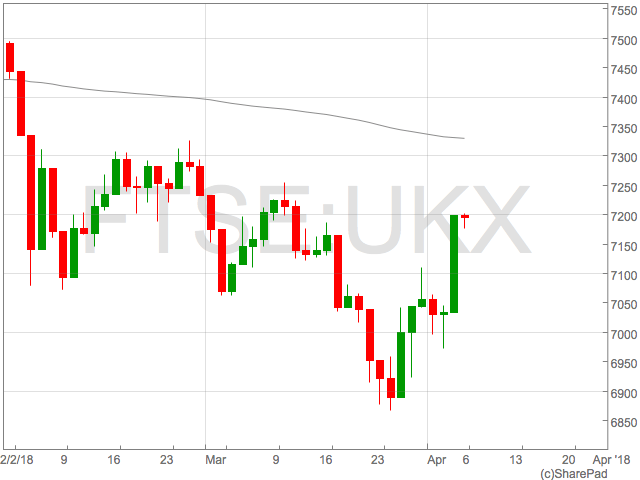
 Today’s move sustains a week of gains for the FTSE 100 which managed to shrug of the fears of a trade war and continue its rebound from sharp declines through February and March.
FX markets remained subdued with GBP/USD showing no signs of breaking the tight range 1.4000-1.4100 in has traded in for most of the week.
“Currency markets have taken on the role of a casual observer, with the initial trade war firing shots taking place on the equity market battlefield,” said Viraj Patel, strategist, ING Bank NV.
Today’s move sustains a week of gains for the FTSE 100 which managed to shrug of the fears of a trade war and continue its rebound from sharp declines through February and March.
FX markets remained subdued with GBP/USD showing no signs of breaking the tight range 1.4000-1.4100 in has traded in for most of the week.
“Currency markets have taken on the role of a casual observer, with the initial trade war firing shots taking place on the equity market battlefield,” said Viraj Patel, strategist, ING Bank NV.
In the immediate aftermath the FTSE 100 rallied back to flat for the day while the dollar index added to gains.Adding to the NFP disappointment, there were -50k negative revisions to the last two months’ reports.
— Faraday Research (@FaradayResearch) 6 April 2018
Today’s move sustains a week of gains for the FTSE 100 which managed to shrug of the fears of a trade war and continue its rebound from sharp declines through February and March.
FX markets remained subdued with GBP/USD showing no signs of breaking the tight range 1.4000-1.4100 in has traded in for most of the week.
“Currency markets have taken on the role of a casual observer, with the initial trade war firing shots taking place on the equity market battlefield,” said Viraj Patel, strategist, ING Bank NV. UK car sales plunge 15pc

Sales of new cars in the UK plummeted in March, down by 15.7 percent compared with March last year.
Figures from the Society of Motor Manufacturers and Traders (SMMT) showed the biggest drop in demand since April 2017 and point toward the broader trend seen over the past year.
Mike Hawes, chief executive of SMMT, said: “Consumer and business confidence has taken a knock in recent months and a thriving new car market is essential to the overall health of our economy.”
“This means creating the right economic conditions for all types of consumers to have the confidence to buy new vehicles,” he added.
The knock on sales has taken a particular dent from the fall in demand for diesel cars. Sales in diesel cars dropped 37.2 percent in March.
March regularly sees positive results, driven by the higher demand for the new number plates. However, Hawes said it would have been difficult to beat last year.
“March’s decline is not unexpected, given the huge surge in registrations in the same month last year,” he said.
“Despite this, the market itself is relatively high with the underlying factors in terms of consumer choice, finance availability and cost of ownership all highly competitive. Consumer and business confidence, however, has taken a knock in recent months and a thriving new car market is essential to the overall health of our economy.”
Despite the fall in diesel car sales, the sale of petrol and plug-in and hybrid sales increased in March by 0.5 percent and 5.7 percent respectively.
“All technologies, regardless of fuel type, have a role to play in helping improve air quality while meeting our climate change targets, so government must do more to encourage consumers to buy new vehicles rather than hang on to their older, more polluting vehicles,” said Hawes.
Rank group shares fall 15pc amid profit warning

Shares in Rank group (LON: RNK) tumbled 15 percent to a three-year low following a profit warning on Thursday.
The leisure group announced profits of £77 million, as opposed to the analyst expectations of £83 million.
“The board is cautious about the UK consumer outlook and as a result expects venues to continue to be impacted for the remainder of the 2017-18 financial year and into 2018-19,” said the Rank.
The group have blamed poor weather for the falling number of visitors in Mecca bingo halls, which declined by two percent in the 13 weeks to 1 April. Visiting numbers have fallen by nine percent at Grosvenor Casinos.
Revenues at the group’s digital business did better and the group saw a 17 percent rise over the period.
“Both UK venues businesses have been impacted by weaker than expected visits which have been compounded by two periods of cold weather. Grosvenor Casinos’ underperformance has also been exacerbated by a negative contribution from its VIP players,” said Rank.
Rank group are hoping to counter the recent decline in consumer spending and launched a high street bingo chain called Luda. Luda, which is also a coffee shop and bar, is aimed at a younger audience and has three branches with mixed results.
The poor results for the group come at a difficult time. The chief executive, Henry Birch, announced last month he was leaving Rank to run the online retailer Shop Direct.
The decline in consumer spending has hit the high street this year, also affecting the restaurant sector. Restaurant chains including Jamie’s Italian and Prezzo have axed a large number of stores.
Shares in Rank closed at 180 pence on Thursday – the lowest since February 2015.
Pamm Beverages has launched Ginger & Citrus as well as Ginger & Pineapple non-alcoholic juice drinks

Pamm Beverages is medium -scale juice drink limited company that is located in London and an online independent beverage wholesaler distributor.
The brand launch is focused to meet the demand of the market for unique flavours and healthy juice drinks.
A new range of two deliciously exotic juice drinks comes with distant peppery sweet taste, to revitalize yourself inside with a rich source of antioxidants vitamins c and low sugar. This excellent mix juice drink creates a great taste for making various new wine cocktail and cocktail mixer for a long drink.
The beverage comes as a non-alcoholic juice drink, it will be made from Australian ginger roots pairing with citrus and pineapple concentrate juice drinks, product are available in 275ml glass bottles with plastic screw cap.
All ingredients are natural ingredients. Both juice drinks are going to give consumers another option of luscious and unique in taste as well as health benefits.
Our juice drink is a good source of health diet with hectic and busy lifestyle, people are now more interested to be physically fit and healthy.
The overall goal of this brand is to develop juice drink that will be accepted by individuals of all ages in the following segments based on teens, younger working individuals, adults, elderly.
Most importantly, Pamm beverages is designed to be able to meet the needs of simple dinners, parties, events, and every kind of occasions, just as they are going to every available hotels, pubs, airport, restaurants, supermarket stores and international.
Pamm beverages create a pleasant, enjoyable and refreshing quality juice drinks sourced by SALSA production company UK. we are sensitive to the taste, look and feel of good healthy juice drink, we provide healthier taste, mellow and refreshing juice drink flavours with great nutritional energy.
Hence our value proposition is to sell the benefit of enjoyment to our various consumers at reasonable prices.
Pamm beverages is planning a crowdfunding raise to fund further production expansion.
Please visit Pamm Beverages here.
AdEPT shares up 5pc on strong predicted figures

AdEPT Telecoms (LON:ADT) saw shares rise nearly 5 percent on Thursday morning, after confirming that its underlying earnings are likely to be slightly ahead of market expectations.
Markets had expected a 23 percent rise year-on-year, meaning underlying earnings have risen significantly over the past year to beat targets. Turnover is also expected to be above market consensus expectation of a 29 percent rise year-on-year.
The firm said it recommended an increased final dividend of 4.50p per share, up from 4.00p in 2017, taking total dividends for year to 8.75p per share, up 13% over the prior period.
AdEPT also said that the deferred consideration of Our IT Department Limited of £3.65 million will be paid in early April 2018.
Shares in AdEPT (LON:ADT) are currently up 4.28 percent at 338.90 (1022GMT).