Since the referendum, several Blue Chip companies are offering surprisingly good value for money for investors. Below is UK Investor Magazine’s list of the top ten cheapest stocks in the FTSE 100, based on forward price-to-earnings ratio using next year’s earnings estimates.
International Consolidated Airlines Group SA (LON:IAG)
IAG, the owner of airlines including British Airways, Iberia and Aer Lingus, has seen its share price drop over the past six months making it the cheapest on our list. Its shares dropped dramatically after the referendum result and are still struggling to recover, hovering around the 403.20 mark.
P/E ratio: 5.41
Berkeley Group Holdings (LON:BKG)
Berkeley is one of the UK’s biggest property developers, with a focus on London. London’s housing shortage has been a blessing for the Group, redeveloping several ‘brownfield’ sites including the area around Woolwich Arsenal, and South East London’s Kidbrooke village. Again, however, the referendum caused a big drop in shares for the group – which are now just beginning to recover. It is currently trading at 2,612.36, down from their six month high of 3375.00.
P/E ratio: 6.59
Lloyds Banking Group (LON:LLOY)
High street bank Lloyds, often a safe bet for investment, takes third place on the list due to a sharp drop in price in the wake of the referendum.
P/E ratio: 7.73
Barratt Developments (LON:BDEV)
The second housebuilder to make the list, Barratt Developments shares have been shaky due to the uncertain effect of the referendum on the housing market. However, their figures look strong; the average selling price on their homes rose 10.6 percent, with profit before tax set to increase by 20 percent year on year. Barratt are currently trading at 429.40, down from their six month high of 599.50.
P/E ratio: 8.06
Aviva PLC (LON:AV)
International insurance group Aviva saw shares weaken significantly in the wake of Brexit, but have now climbed back to almost where they were before the vote. Just last month the insurance group promised its investors higher dividends, alongside the reporting of a 13 percent rise in group operating profits. If CEO Mark Wilson is to be believed, the group is set to deliver “consistent, sustainable and predictable growth”.
P/E ratio: 8.85
Persimmon PLC (LON:PSN)
Yet another housebuilder, Persimmon have had a slow recovery since the Brexit vote. However, its share price is now climbing and with positive news coming in thick and fast for the UK construction industry, now’s a good time to buy.
P/E ratio: 8.93
Taylor Wimpey PLC (LON:TW)
A national developer operating 24 regional businesses across the UK, as well as some in Spain, shares are now relatively cheap – they are recovering slower than other housebuilders on the list, perhaps due to the uncertain effect on its operations abroad. Shares are currently at 152.30, down from its one year high of 210.00 reached in May.
P/E ratio: 8.94
Legal & General Group PLC (LON:LGEN)
Insurance group Legal & General saw a 10 percent rise in half-year operating profits on Tuesday, which inexplicably saw its shares sink over 5 percent. However, it has shown one of the fastest recoveries in the wake of the referendum of those on the list, making it a firm favourite for investment.
P/E ratio: 9.79
TUI AG (LON:TT)
Travel company TUI, owner of Thomson Travel and First Choice, takes ninth place on our list. The company offers significant returns over the medium term, and despite the referendum result causing uncertainty in the near term, has potential.
P/E ratio: 9.87
easyJet PLC (LON:EZJ)
Budget airline easyJet had a steady few months before the Brexit vote, which sent shares tumbling on worries that an exit from the European Union would cause European flight prices to soar. Share prices still remain extremely low, showing little recovery since June 28th; the company is currently trading at 1,072.89, down from a six month high of 1556.00.
P/E ratio: 9.95
Prudential Insurance released impressive half year results on Wednesday, with a 6 percent increase in operating profits causing shares to jump.
Earnings came in above analysts’ expectations at £2.06 billion for the half year period. The company had strong success in its Asian arm, where profits rose 15 per cent, posting an operating profit of £743 million.
Prudential plc (LON:PRU) is currently up 1.90 percent at 1,419.00 (1041GMT).
G4S shares fly on half year results
G4S shares are trading up nearly 20 percent this morning after a strong set of half year results.
Revenue rose to £3.53 billion, with profits before tax rising to £115 million – up from just £80 million last year. The company has shrugged off various scandals over the past few years, including the recent revelation that the Orlando nightclub killer was an employee. Despite this the company insisted that demand has “remained positive”, with CEO Ashley Almanza saying the company has “delivered tangible results”.
G4S (LON:GFS) shares are currently up 18.30 percent at 231.20 (1048GMT).
Bank of England struggles to find sellers for debt plan
The Bank of England has struggled to find enough sellers of debt to meet its target to buy over £1 billion of long-dated government debt.
The ambitious target was set just last week, but has got off to a rocky start. The statement, released today, was unclear as to the state of the plan moving forward.
The Bank has said it will make up the shortfall in the second half of the year. The failure has had a negative effect on bond yields, causing the yeild on 10-year gilts to drop 0.56 percent overnight.
Entertainment One declines ITV offer, shares rise
Entertainment One, the owner of popular kids programme Peppa Pig, has rejected a takeover bid from ITV.
Shares in Entertainment One closed up 10 percent on Tuesday after speculation that ITV may bid again with a higher offer. In contrast, ITV shares fell this morning, before recovering back into positive territory.
Entertainment One’s board unanimously rejected the bid, saying that “it fundamentally undervalues the company and its prospects”.
Asian shares hit one year high
Asian shares soared on Wednesday, in sharp contrast to a slide in the dollar and Treasury yields after poor US data.
The Hang Seng index closed up 0.12 percent at 22,492.43, with the MSCI’s index of Asia-Pacific shares rising to its highest point in a year. However, the Nikkei closed in negative territory, down 0.18 percent, pulled down by a troubled yen.
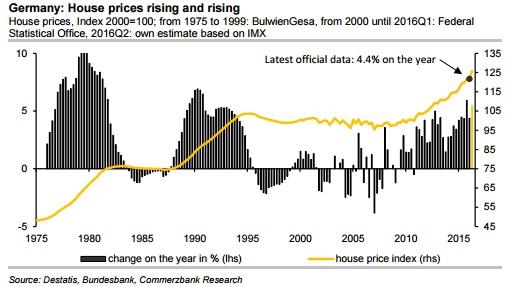
The question of whether Germany’s growing property prices constitute a new housing bubble has been debated for over half a year now, and was recently reignited by data showing that Germany’s building permits on flats were at a ten year high in January this year. Commerzbank has now published a report detailing their assessment of the danger lying in the German property market. The results constitute a mixed view.
Worries about the German housing market persisted since late 2015
Worries about the growing volume of demand and rising property prices in Germany already came up late last year when economists warned that the ECB’s monetary expansion program could cause bubbles in the housing market of the UK, Germany and Norway.
Germany has historically been a country less prone to volatile cyclical developments in the housing market due to having a more prevalent renting culture than other European countries. According to Eurostat only 52.5% of German households owned their own home in 2014, compared to 64.8% in the UK and 70.1% in the European Union collectively.
However, in the last three months of 2015, construction expanded to become one of the country’s biggest contributor to growth fuelled by higher demand for individual home ownership. New mortgages jumped 22% over the course of 2015 after years of 3% growth or below.
Data on 2016 developments in the housing demand and property prices reinforced concerns
Fears persisted after Destatit published data which showed that in January this year building permits for flats rose by 34.5% compared to the same month the previous year. Numbers of new building permits therefore reached record highs last seen a decade ago.
Economists also observed that house prices have risen by over 5% year on year in the first half of 2016, levels similar to the housing boom the country experienced in the late 1980s and early 1990s corresponding with the fall of the Berlin Wall and subsequent unification of West and East Germany. Bloomberg in May published figures suggesting that housing prices in major cities such as Berlin, Hamburg and Munich grew as much as 30% over a 5-year period.
New Commerzbank report discusses the extend of the issue
Commerzbank now published its own assessment of the likelihood that growing property prices in Germany will turn the property market into a volatile time bomb and its views are mixed.
Commerzbank first warned of worrying developments in the country’s housing market at the beginning of the year when its Real Estate Monitor started to indicate imbalances in the German housing market. The research department of the bank has now stated that such indicators have since worsened further.
The report argues:
“The housing boom in Germany is looking increasingly like a bubble as house prices steadily decouple from the fundamental factors. – Since 2010, prices have risen faster than rents, consumer prices and private household income.”
The imbalance between the rise in property prices to rents, inflation and income may be the first sign that Germany’s housing market is well on its way to balloon.
ECB expansionary monetary policy is to blame
Driving the growing housing demand in Germany is the ECB’s expansionary monetary policy that Mario Draghi committed himself to in order to recover the Euro Zone economy from the Euro Crisis.
Quantitative easing and low interest rates have encouraged lower mortgage rates and enabled German households to afford their own homes. But, as it could be observed in the US in the years before the US housing crisis, the probability that rates can drop much further is now extremely low, which could start to grind demand to a halt when rising housing prices are no longer rebalanced by lower interest rates. In the US this development ultimately led to a sharp correction in demand and pricing, followed by growing default rates on mortgages which ignited the start of one of the worst financial crisis to shake the global economy.
In Germany, growing house prices were outweighed by lower interest rates and rising income, making the financing of housing easier, until the beginning of 2015. However, since then rises in house prices have started to exceed both growth in income and decreases in the interest rate and housing is becoming less affordable.
Commerzbank said:
“According to our own index – which is not comparable 1:1 with the US index – the costs of financing an average house relative to average private household incomes are still much lower than [in the US] in 2009. However, as a further sharp fall in interest rates is now unlikely, the unfavourable trend in housing affordability should continue if the recent trend in prices continues as it has done recently.”
“The tensions on the housing market are generally rising, albeit from quite a low level.”
German ten-year yields and construction boom now eyed as future indicators
One important indicator to keep an eye on now is the German ten-year bond yield. If they should rise – and mortgage rates follow – the tensions in the housing market are likely to increase.
The risk could also increase if we were to observe a further construction boom in Germany which would resolve current housing shortages in some regions, reducing upwards pressure on property prices. However, so far there is little evidence of such developments as Commerzbank reports. Although building investment has outpaced GDP in growth since 2010, its’ share in GDP only rose to 6%, well below the benchmark of 7.5% which was reached during the 1990s housing boom.
While construction orders have increased realty in volume, production has largely failed to respond to the increase in demand. This is attributed to a lack in capacity to deliver on a higher volume overturn. Therefore, the deciding factor will be whether companies increase their capacity to cater to the higher demand on new constructions.
Low private debt ratio eases concerns
On a positive note, Commerzbank and other analysts acknowledged that there is so far no sign of ballooning private debt, such as was observed in the US and Spain before the latest crisis. The private debt ratio has in fact decreased in the first seven months of 2015. This suggests that the German private debtors are in a considerably better position than mortgage holders were in the US and Spain around a decade ago.
Therefore, although it is worth keeping an eye on the developments in the German housing market, as well as debt levels, it is unlikely that the current rise in demand for private property in Germany will develop into housing boom and consequential bust as in the USA and Spain.
British industrial output grew in the second quarter of year, according to new figures from the Office for National Statistics, becoming the latest in a string of positive economic figures since the EU referendum.
Second quarter industrial output in Britain grew 2.1 percent on the first quarter, the fastest growth rate since 1999. However, the data does highlight a slowing in industrial output throughout the quarter, with the rate in April at over 2 percent slowing to 0.1 percent in June.
In a separate report also released today the ONS showed a widening in the trade deficit over the same quarter, growing to £5.1 billion in June from £4.2 billion the month before. Imports are also set to reach a record high of nearly £49 billion.
New regulations are set to come into force that will enable customers to choose the cheapest lender, after a review by the Competition and Markets Authority said consumers are paying more than they should be for banking.
From 2018, banks will have to share customers’ data with third parties who can then show how much could be saved by using other lenders. Several online ‘challenger banks’ have sprung up recently, offering prices far cheaper than those of the main “big four” lenders – Lloyds, RBS, HSBC and Barclays – but figures suggest that only 3 percent of consumers take advantage of these lower prices by changing bank.
As part of the new regulations, banks will also have to have a cap on monthly fees for unarranged overdrafts. However, reactions to the news have been less than positive; Alex Neill, director of policy and campaigns at consumer group Which? said, “it is questionable whether these measures will be enough.”
“It is disappointing that the monthly charge cap is not actually a cap and banks will be allowed to continue to charge exorbitant fees for so-called unauthorised overdrafts, rather than protect those customers that have been identified as among the most vulnerable.”
The CMA is hoping it will give a boost to the Fintech sector, powering growth in the area as investment falters post-Brexit. Jamie Campbell, Head of Customer Experience at Bud, a start-up allowing millennials to manage all their banking from one place, says Fintech is the “people’s champion” of finance. He agrees that Fintech companies are increasingly becoming the better way of banking, continuing, “all of this will lead to better products and services for individuals”.
FinTech is a sector that has grown up within the EU – in fact, it has never functioned without it. Within the climate of openness and cross-border investment cultivated by the European Union, London’s has become the EU’s undisputed Fintech capital. But after Brexit, is London likely to keep the top spot?
Rightly, many are worried about the effect Brexit will have on the city’s booming industry. London’s Fintech companies were strong remainers; a survey by Tech London Advocates, a body that represents about 2,700 of the British capital’s tech sector, found 87 percent of its members polled wanted to remain in the EU. London has been the most friendly climate towards start-ups, and fintech firms in particular; ex-mayor Boris Johnson, along with George Osborne, championed the development of the Silicon Roundabout area. But now all this is at risk – and many new firms are considering whether it would be better to move abroad.
‘Silicon Roundabout’ at Old St in LondonMarket access
One of the obvious benefits that the European Union brings the Silicon Roundabout is access to markets throughout Europe. For Fintech start-ups, this is key – EU rules mean that the UK has “passporting” priviledges, allowing a bank to operate in all European countries so long as it has a licence from an EU member state. Having the opportunity to operate in 28 countries is clearly invaluable to a start-up business.
Similarly, freedom of movement widens the pool of talent and allows fintech firms to hire the brightest developers from all over Europe. According to Innovate Finance, 30 percent of people employed in Fintech in the UK are from overseas; if the UK is facing a skills gap in areas that start-ups need, Europe is the best solution to the problem.
EU Investment
The European Investment Fund (EIF) is a huge source of investment for British businesses – last year, the UK benefited from £559 million from the fund. Once Britain formally leaves the EU, it seems unlikely that it will still be allowed to benefit.
In 2015, the British Fintech sector generated £6.6 billion in revenues and attracted £524 million in investment. According to a report from Accenture, in 2013 the UK and Ireland represented 53 percent of Europe’s rounds and two-thirds of the total raised by Fintech startups – investment that came from investors all over Europe, wanting to put their money into a leading Fintech firm. For them, London is the best bet – after Britain leaves the EU and loses the benefits of the single market, this may no longer be the case. Fintech firms in other European capitals are rapidly catching up with London – including Berlin, Dublin and Stockholm, who have all seen a growth in their Fintech sector over the last year – why would investors put money in British firms when other countries have the benefit of Europe on their side?
Until Article 50 is invoked and Britain agrees its terms for leaving the EU, investment is likely to be impacted by uncertainty.
So – a possible move to Europe?
Given the possible repercussions of Brexit on Fintech firms, many are considering moving their headquarters to Europe in order to maintain access to EU benefits. Just last month, a German sponsored truck rode the streets of London with a colourful placard reading “Dear startups, keep calm and move to Berlin”.
“Keep calm and move to Berlin” truck in London
Whilst this may sound like a laugh, moving business to Berlin is not. According to German senator Cornelia Yzer, more than 100 startup companies in London are looking into relocating to Germany’s capital. In fact, every time she speaks in the UK a number of start-up companies approach her with questions about the feasibility of relocating.
During a presentation at the financial technology industry’s conference London Fintech Week 2016, Senator Cornelia Yzer said every time she speaks publicly about Berlin post-Brexit, a number of startup companies approach her office about moving to Berlin.
“Not 10 or 20 or 30, more, over 100,” she said, according to International Business Times.
Just a week after the referendum the co-founder of TransferWise, Taavet Hinrikus, tweeted about the possibility of moving abroad:
Ireland, Switzerland, others reaching out and tempting @TransferWise to start/move operations there – competition between states is good 🙂
However, not all Fintech firms are worried. James Johnson, Group CEO of Nicoll Curtin, a global FinTech and Change recruitment agency, believes London’s sector will be largely unaffected: “Brexit will just accelerate the focus on technological solutions to problems. Technology crosses borders easier than people! This will increase tech hiring.”
He added, “Brexit could even accelerate the focus on and progress of London’s fintech sector because the solutions they’re creating could address some of the challenges of Brexit.”
Alex Crocombe, CFO or start-up Goji, has a similarly positive outlook despite experiencing some post-Brexit wobbles when looking for investment. He said, “initially, we thought it would be fatal to our business and the many other startups looking for funding, as investors evaluated the damage to their current Fintech investments and paused on marking new investments. Although there is still real uncertainty as to the medium to longer term effects Brexit will have on the UK and Global economy and our sector, we have actively seen investors return to the market and commit funds.”
Like so much of the UK post-Brexit, the outcome for London’s Fintech sector remains to be seen – with any luck, Silicon Roundabout’s success will continue to grow as Britain becomes an independent country.
The Pound fell to a new one-month low against the Dollar on Tuesday morning after UK manufacturing data on June missed estimates and ignited new worries about the strength of the UK economy.
UK manufacturing production in June miss estimates by 0.4%
National Statistics this morning reported that manufacturing production only grew by 0.9% in June compared to the same month last year. The figure represents a 0.6% decline from the measure recorded in May and missed estimates by 0.4%.
The institute also reported that compared to the previous month, manufacturing production fell by 0.3% in June. Although this measure halved the decline in manufacturing recorded in May, when the figure stood -0.6%, it missed estimates by 0.1%.
UK trade balance declines
Data on trade was similarly discouraging. The goods trade balance declined to -£12.409 billion in June. This represents a growth in the current account deficit of £883,000 million. Analysts previously estimated that the deficit would shrink to -£10 billion in June.
The trade balance with excluding European countries also declined by £599,000 million, to -£4.159 billion. The figure missed estimates by £1.659 billion, as analysts expected the deficit of non-European trade to decline to -£2.500 billion.
Worries about strength of UK economy prevail
The data showed that in the month of the UK referendum the country’s economy was not as strong as expected and the trade balance worsened instead of a predicted reduction in deficit. Such figures add to the worries about about the performance strength of the UK economy amid a growing volume of data suggests that the UK economy will suffer from economic uncertainty after the decision to leave the European Union. Investors in the FX market responded to the new data by pulling out of the Pound.
Pound fall on back of worse than expected UK data
In early morning trading the GBP fell to a new one-month low against the USD, dropping all the way to 1.29719. It managed a slight recovery in later hours.
At 10.58am the GBP/USD traded at 1.29806.
Legal & General saw shares sink over 5 percent on Tuesday, becoming the biggest loser in the FTSE 100 despite a healthy rise in pre-tax profits.
The group’s half year operating profit rose 10 percent to £822 million, coming in above analysts estimates, with the investment arm seeing assets under management rising 18 percent.
However, a 3 percent fall in operating profit hit share prices, causing LON:LGEN to sink 6.05 percent (1034GMT). The insurance arm of the business also saw operating profit drop by 26 percent.
Chief Financial Officer Mark Gregory commented on the results, saying, “it’s not a shoddy effort.” He confirmed that markets had been weak in the first half of the year, but he expected to see growth going forward to the end of 2016.
China factory-gate deflation eases further, relieving pressure on policy makers
China’s factory price deflation eased further in July, the latest in a string of evidence that China’s falling prices are beginning to pick up.
Factory-gate deflation moderated for the sixth month in a row, falling just 1.7 percent in July, up from a 2.6 percent drop in June. Increased demand for construction materials, higher commodity prices and pick-up in property sales have led to speculation that the Producer Price Index may well push into positive territory later this year.
The PPI rise will ease pressure on policy-makers in China, decreasing the necessity to cut rates and turning their focus to structural reforms allowing the deflation to ease further.
Warm July weather boosts retail sales
Retail sales rose 1.9 percent in July, according to the British Retail Consortium, alleviating fears of a post-Brexit slump.
The survey, carried out by the BRC and KPMG, cited warmer weather as the cause for the spending increase. David McCorquodale, head of retail at KPMG, said good weather had “boosted the UK feelgood factor”, showing consumers that “life goes on” post-Brexit.
Barclaycard also released a report this morning showing that spending in restaurants and pubs has also risen moving into summer.
China warns on Hinkley Point turnaround
The Chinese ambassador to the UK has warned British leaders about the repercussions failing to go ahead with the Hinkley Point nuclear plant may have on their trade relationship.
Since taking power, Prime Minister Theresa May has put the brakes on the £18 billion project after citing “security concerns”. She has pushed her final decision back to the autumn, to give her government another chance to scrutinise the deal.
However, Chinese ambassador Liu Xiaoming warned the UK that “mutual trust” could be in danger should Britain back out of the agreement, endangering the new relationship between the two countries.






 Therefore, although it is worth keeping an eye on the developments in the German housing market, as well as debt levels, it is unlikely that the current rise in demand for private property in Germany will develop into housing boom and consequential bust as in the USA and Spain.