




Scottish Mortgage Investment Trust share price is a long-term investment

Scottish Mortgage Investment Trust Share Price
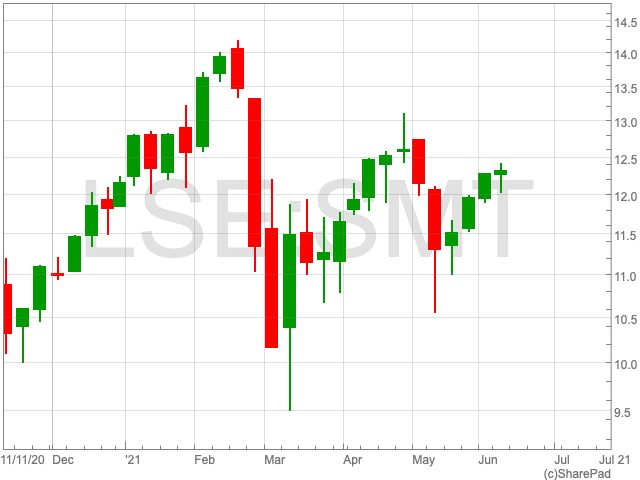
The Scottish Mortgage Investment Trust share price (LON:SMT) performed outstandingly well during 2020. However, the company faced some bumps in the road early this year, during the tech sell-off and when James Anderson, one of the fund managers, announced he would be stepping down. At the time of writing, the Scottish Mortgage Investment Trust share price is at 1,229p, nearly 200p down from its all-time-high in February. The fund seems to have responded well following its mid-February dip, and now could represent an opportune time for investors while the share price is low.
Volatility
Following a tumultuous year, the Scottish Mortgage Investment Trust share price, with both peaks and troughs along the way, is up by 0.98%. In addition to this, the short-term volatility that has occurred may serve to put investors off.
The FTSE 100 company has a high exposure to tech firms which makes it vulnerable to mass sell-offs. In addition, it seeks out companies in the early period of their growth with massive potential. For example, it bought Tesla shares as early as 2013.
More recently it confirmed it has invested £72m in Blockchain.com, the UK’s largest cryptocurrency company, which could be a sign of things to come. It is important for investors to consider the longer-term with the Scottish Mortgage Investment Trust share price for this reason.
“The managers are true long-term investors since they believe it’s the best way to capture the potential growth of their companies. Currently the trust invests in around 95 companies, eight of which have been held for over ten years, including technology firms Amazon and Tencent, and French luxury goods company Kering,” said Hargreaves and Lansdown investment analyst Henry Ince.
Over the past 12 months the Scottish Mortgage Investment Trust share price is up by 70%, while going back as far as five years, it has gained 387%.
James Anderson stepping down does remain a long-term risk as he led he trust to make some excellent decisions over the past decade. Although he will not depart until April 2022 and will be replaced by Lawrence Burns who joined Baillie Gifford in 2009 straight from the University of Cambridge where he studied geography.
Arrival share price flirting with $20 mark as company agrees new partnerships

Arrival Share Price
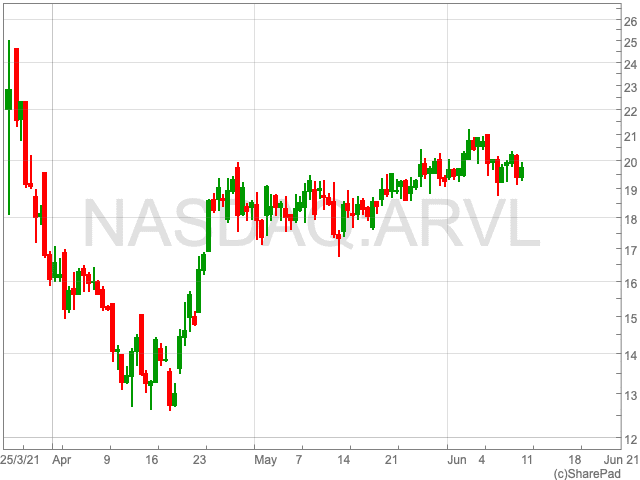
The Arrival share price (NASDAQ:ARVL) crept above $20 this week following weeks of steady gains since the middle of April. It is the first time it has looked like getting back to $22, its level when the electric vehicle manufacturer made its stock market debut in March. Between then and now there has been a steady stream of positive news from the company, as well as wider macro-trends, that suggest its future looks bright. However, investors remain curious about its ability to compete in what is an intensely competitive and increasingly saturated market.
Partnership with Here
The electric vehicles manufacturer confirmed in May that it has established a partnership with Here Technologies, a digital mapping company, to install both location and cloud services in its vehicles.
Arrival says that the technology will improve the performance of its vehicles, thereby reducing its carbon emissions. Tesla and BMW are onboarding similar technologies despite the high costs, as the industry increasingly tightens emissions standards in its major markets.
Here’s capabilities include route calculation, location search and turn-by-turn navigation, Arrival said.
It is the latest partnership from Arrival that serves to show the company’s adaptability and forward-mindedness. Another is its cooperation with Hitachi.
Hitachi
Arrival has joined Hitachi Europe in aiming to deliver new bus and infrastructure solutions across Europe. The partnership’s goal is to merge Arrival’s first-rate products with Hitachi’s digital and operational strengths.
“As governments look to phase out petrol and diesel vehicles in the next decade, providing the wide range of necessary solutions and technologies in an integrated, streamlined and operationally-manageable way will be vital for bus operators and municipalities across Europe,” said Mike Nugent, Head of EV, at Hitachi Europe.
“Arrival’s vehicles already provide a much lower total cost of ownership for customers, and when incorporated into Hitachi’s business model we can see an even more compelling business case for companies to transition their fleets to electric more rapidly,” Hamish Phillips, Head of Sales, UK, at Arriva added.
Hitachi and Arrival have shown intent to create an ecosystem of solutions across the electric vehicle landscape. This could make it easier for customers to navigate the inevitable transition away from fossil fuel vehicles. It appears to be yet another important step in Arrival’s wider plan of gaining market share across vehicle types and geographic boundaries.
Outlook
These deals, in addition to backing from Hyundai and Kia Motors, and orders from UPS and Uber, is shining a pretty bright light on the prospects of the British company. However, the electric vehicle maker’s sales forecasts are ambitious, at $1bn in 2022, and $5bn in 2023, and may have been factored into the Arrival share price. Nonetheless, the company is still early on in its development. While it will have to perform outstandingly well to outperform expectations, the early indicators suggest it is capable of doing so.
Oil prices at multi-year high with demand set to exceed pre-pandemic levels by 2022

Brent crude oil futures made it to $72.73 per barrel on Friday
Demand for oil is expected to surpass pre-pandemic levels before the end of 2022, according to the International Energy Agency (IEA).
The Financial Times reported that consumption fell by a record 8.6m barrels per day in 2020 as lockdowns were mandated across the world.
The IEA anticipates an additional 3.1m barrels per day increase in 2022, bringing the average to 99.5m barrels per day, with an increase towards the end of the year that will go past the level of demand last seen before the coronavirus pandemic.
However, the agency also said that oil’s recovery is likely to be “uneven” among both different regions and business sectors. While any delays in the vaccine roll-out could lead to further issues.
Oil prices also jumped to a multi-year high on Friday look set for a third consecutive week of gains as nearer-term expectations are that there will be a recovery in demand across the world as restrictions are eased.
Brent crude oil futures made it to $72.73 per barrel, one day after closing at its highest point since 2019.
Analysts at Goldman Sachs believe that Brent crude oil could reach $80 per barrel this summer.
Support for the price of oil also came as talks between Iran and other nations over a nuclear deal stalled.
Gold touches $1,900 on fastest US inflation since 1992

Over the past three months gold is now up by 10% as inflation fears mount
The price of gold soared yesterday following three consecutive days of losses as America revealed its inflation rate rose during May at the fastest pace in nearly 13 years.
Compared to the same month a year ago, consumer prices increased by 5% in May, according to the Bureau of Labor Statistics.
It is the most significant increase since August 2008, when prices rose by 5.4%, and is 0.8% higher than April’s price rise.
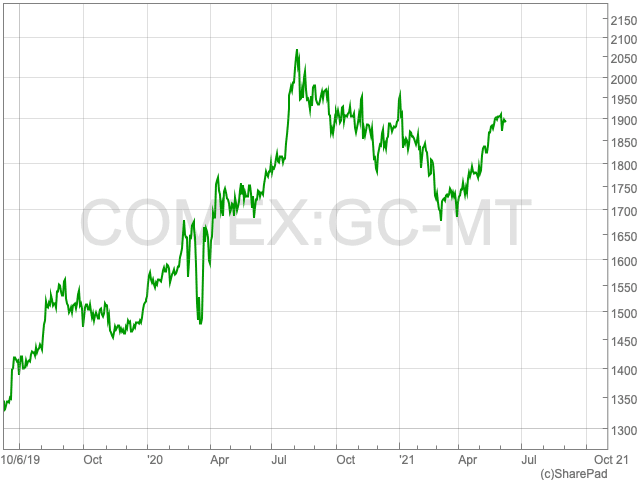
While rising prices are not having a negative impact on equities at the moment, gold is starting to enjoy a decent run. The precious metal price is back above $1,900 per ounce and if it can maintain its recent momentum, traders may start to eye last year’s record highs.
Over the past three months gold is now up by 10%.
Along with the inflation figures coming out of the US, wage data is showing “the biggest decline in real average earnings since ’08,” according to Bloomberg columnist John Authers.
“Gold thrived during the 1970s, when inflation was rampant (although it could be argued that stagflation was the problem then), and then fell right out of favour in the early 1980s after the Paul Volcker-led Federal Reserve clubbed it into submission with brutal interest rate increases,” says Russ Mould, investment director at AJ Bell,
“The tide turned again after 2000, since when the precious metal has outperformed even the S&P 500, as gathering Government budget deficits and then record-low interest rates and Quantitative Easing have persuaded some investors to abandon ‘paper’ money and ‘fiat’ currencies in favour of ‘real’ assets.”
“A vindication of central bankers’ view that the current inflationary spike is transitory, or an unexpected tightening of monetary policy, or a new round of tax-rises and hair-shirt fiscal policy could all stop gold in its tracks, and by implication make gold mining stocks less appealing,” Mould said.
FTSE 100 shrugs off inflation fears to trade above 7,125 for first time in a month
While the rest of Europe took a nap, the FTSE 100 continued to ascend on Friday morning despite some mixed data coming from the UK.
The FTSE 100 is now trading above 7,125 for the first time in a month and is around 40-50 points away from the then-14 and a half-month peak struck in early May.
“Most of the big figures underperformed. Industrial production for April contracted by 1.3%, against the 1.2% expansion forecast and the 1.8% managed in March. The slowdown in manufacturing production wasn’t quite as severe, but even then, it came in at -0.3%, well off both the 1.5% estimate and March’s 2.1%,” said Connor Campbell, financial analyst at Spreadex.
The monthly GDP reading for the three months to the end of April was slightly more promising, rising from 2.1% to 2.3%, though it did fall short of the 2.4% forecast.
“Yet neither the pound nor FTSE 100 seemed bothered by these misses. Sterling was unchanged against the dollar and down just 0.1% against the euro, while the index climbed 0.6% thanks to its miners,” Campbell added.
Looking to this afternoon and the Dow Jones is heading for another static start, with the futures suggesting an unchanged open just under 34,500.
“Investors may have been nervous ahead of yesterday’s US inflation numbers but despite consumer prices rising at their fastest rate since 2008, and more than economists expected, shares were up,” according to AJ Bell investment director Russ Mould.
“Perhaps central banks really have convinced the markets that any rise in inflation will be short-lived and will not force them to ramp up rates too rapidly.
FTSE 100 Top Movers
Halma (2.76%), along with mining companies, Fresnillo (2.38%) and Glencore (2.27%), headed up the FTSE 100 during the morning session on Friday.
Trailing at the back of the pack are Just Eat (-2.36%), Ashtead (-1.78%) and BT (-1.18%).
Trident Royalties anticipates rise in production at Mimbula copper mine

Trident expects the production of copper to reach a yearly run rate of 30,000 metric tons by the end of 2022
Trident Royalties (AIM:TRR), announced on Friday a $73 million equity financing for its Mimbula Copper Royalty and the project operator, Moxico Resources.
The mining royalties company also said the move will lead to a substantial increase in production.
Trident has confirmed it will build a self-operated solvent extraction and electrowinning processing facility. This, the firm expects, will allow the production of copper to reach a yearly run rate of 30,000 metric tons by the end of 2022.
Adam Davidson, Chief Executive Officer of Trident commented:
“We are incredibly pleased to see such a significant development for a key asset within Trident’s royalty portfolio. The financing conducted by Moxico to materially expand copper production at the Mimbula copper mine underscores the value of acquiring royalties over quality assets being advanced by experienced management teams,” said Davidson.
“The Mimbula Copper Royalty provides Trident’s investors with long-life copper exposure – a key base and battery metal – from an operating asset with further upside potential located in a prolific copper district.”
Trident Royalties are mining royalties and streaming company with a diverse range of royalties covering precious, base and battery metals.
Having presented at the December UK Investor Magazine Virtual Investor Conference, Trident Royalties returned to update investors of recent progress at the company.
Trident Royalties are on a path achieving critical mass with robust pipeline of deals having already acquired 12 mining royalties.