Cornerstone FS has a buy and build strategy in the international payments sector. It has invested in cloud-based technology that can handle a significant multiple of current levels of business with little additional cost. Cornerstone FS does not take on any risk with its foreign exchange trades.
There was £876,000 raised from 229 investors via Crowdcube in the original business owned by the holding company which was used as a shell to acquire the current business. They invested in a shaving products company and are not necessarily interested in the current business.
The original shareholders a...
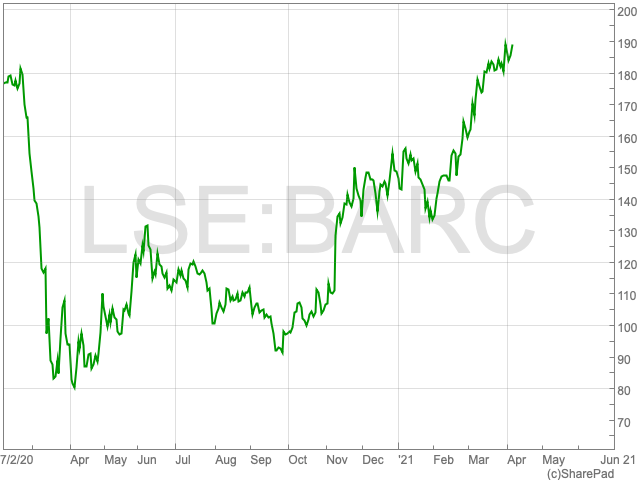
Having surged since the beginning of February, the Barclays share price (LON:BARC) has now fully recovered to its pre-pandemic level. Since the turn of the year, Barclays stock is up by 30% to 187.76p per share. The question now is how much further the share price can go after an impressive recovery.
Good Value?
Going by the price-to-earnings ratio, Barclays, at 19.5, is cheaper than its main competitors, HSBC and Lloyds, at 30.9 and 26.8 respectively. With a relatively low price-to-earnings ratio compared to their peers, investors could consider Barclays if they are looking for the lowest valued bank based on earnings.
UK Recovery
Barclays announced a 68% loss in Q4 in February in net profit following the company’s decision to set aside funds as an insurance for bad loans which came about as a result of the pandemic. Barclays also announced a 30% dip in pre-tax profits to £3.1bn for the year, down from £4.3bn in 2019.
However, like the bank took a beating from the pandemic, it will stand to benefit from a recovery in the UK economy. Only yesterday the IMF upgraded its forecast for the UK economy, predicting a return to a pre-pandemic level of activity in 2022. The new UK forecast is for growth of 5.3% this year and 5.1% in 2022.
Dividend
Despite the fall in profits in 2020, Barclays confirmed it would be resuming dividend payments. The bank’s previous dividend payments were 3p, 2.5p and 1p in December of 2019, 2018 and 2017 respectively. With the recent growth of its share price, as well as its historically generous dividend, Barclays could prove to be a shrewd buy for income investors in 2021.
Risks
While the bank’s recovery has been so far so good, and the UK looks set to continue its roadmap out of lockdowns, there are risks to buying Barclays shares.
The damage of the pandemic on the bank was somewhat offset by strong results from its investment banking arm. However, there is no guarantees that the tables will not not turn in the coming year. If its investment banking arm is unable to maintain its performance then other major banks which are not diversified in the same way could prove a better option.
The Bank of England (BoE) urged banks to be ready in the event of negative interest rates later in the year. While it is not certain that the BoE will implement such a policy, it does however pose an ongoing threat to the Barclays share price going forward.
The UK services sector made a return to growth last month as unemployment, business activities and new orders returned to growth from February.
Data that emerged on Wednesday shows that the UK’s so far successful roll-out of vaccines has led the economy to bounce back quicker than first expected.
The IHS Market purchasing managers index (PMI) for services came in at 56.3 for March, which indicates growth as it is above 50, the marker for stagnation.
In February the service sector contracted slightly, scoring 49.5 on the PMI.
The 56.3 score in March is the first time PMI has been above 50 since October 2020.
In a positive sign for employment figures, the number of staff hires increased overall for the first time since the pandemic started.
Tim Moore, Economics Director at IHS Markit, which compiles the survey, provided further context to the positive service sector news:
“UK service providers were back in expansion mode in March as confidence in the roadmap for easing lockdown restrictions provided a strong uplift to new orders. Total business activity increased at the fastest rate since August 2020 and this return to growth ended a four-month sequence of decline,” Moore said.
“Forward bookings for consumer services and rising optimism about recovery prospects resulted in extra staff hiring across the service economy for the first time since the start of the pandemic. Business optimism improved for the fifth month running in March and was the highest since December 2006.”
“Around two-thirds of the survey panel forecast an increase in output during the year ahead, which reflected signs of pent up demand and a boost to growth projections from the successful UK vaccine rollout. Of the small minority citing downbeat expectations in March, this was often linked to uncertainty about international travel restrictions.”
“There were further signs that strong cost pressures have spilled over from manufacturers to the service economy, especially for imported items. Higher prices paid for raw materials, alongside rising transport costs and utility bills, meant that operating expenses across the service sector increased at the strongest rate since June 2018.”
Good news from narrowband radio frequency communications networks developer CyanConnode (LON: CYAN) where full year revenues have soared in the past year. More importantly, the cash position is positive.
Revenues are better than expected. In the year to March 2021, revenues will be more than double the £2.5m achieved in the 15 months to March 2020. Arden had forecast a figure of £5.8m for 2020-21, but it will be around £6.2m. That is an impressive second half performance considering that interim revenues were £1.5m.
Management has been promising growth in demand and contracts have been won, bu...
Jamie Dimon’s letter showed support for high government spending
The chief of JP Morgan, Jamie Dimon, has said a vast increase in US government spending will boost the US economy over the next 24 months.
Dimon provided a positive outlook in his yearly letter to his company’s shareholders. He noted that high savings rates, stimulus programmes, a potential infrastructure package and the mood around the pandemic coming to an end would combine to get the US economy moving.
“It is possible that we will have a Goldilocks moment — fast growth, inflation that moves up gently (but not too much) and interest rates that rise (but not too much),” said the banker, who believes a sustained spending could to lead to an extended period of growth.
Dimon said that both companies and consumers were in good shape as the US begins to emerge from the coronavirus crisis.
Prior to the President’s $1.9trn stimulus package passing in March, the investment bank suggested that retail customers were storing around $2trn in extra savings.
Dimon also stated that the expansionary policies carried out by central banks across the globe will have a “compounding global affect”.
If Dimon’s prediction of a boom does come to fruition then high valuations equity markets could be justified, though it would be difficult to support the price of Treasury bonds due to an oversupply of US debt, he said.
A key theme within Dimon’s letter was his support for high government spending as a means to addressing some of the country’s issues, including ageing infrastructure, expensive healthcare and economic inequality.
“Spent wisely, it will create more economic opportunity for everyone,” he said, while including that there are risks it can be ineffective when tied up in bureaucracy.
Dimon’s points come as Joe Biden is seeking to pass a $2trn infrastructure plan following his $5.8trn stimulus outlet designed to stimulate the economy during the pandemic.
Recent data from the The Investment Association revealed UK retail investors took a further £1 billion out of UK Equity Funds in February. This means retail investors have removed a total of £18 billion from UK Equity Fund since 2016 and the decision to leave the EU.
We question whether Retail investor are simply driven more by sentiment around the UK or misunderstand the composition of UK markets given the significant level of revenue earned outside of the UK by FTSE 100 companies.
Whilst investors took cash out of UK Funds they added to Global Funds meaning UK Retail investors may be under exposed to rerating in UK Equity as its lags other major indices that have enjoyed recent rallies.
We discuss Ananda Developments (LON:ANA), Kavango Resources (LON:KAV) and Mosman Oil and Gas (LON:MSMN).
As it did on Tuesday, the FTSE 100 led the way after the bell, adding another 0.8%. Touching 6,875, the index is at a near 3-month high. If it can add another 40 or so points in the coming days, it will hit its best levels in over 13 months.
“Despite the third wave in Europe, concerns over the AstraZeneca vaccine, and reported worries about an incoming slowdown in the UK’s vaccination programme, yesterday’s IMF growth upgrades have helped keep the markets feeling fresh,” said Connor Campbell, financial analyst at Spreadex.
While its gains were half of that of its blue-chip big brother, the FTSE 250’s 0.4% rise put it above 22,000 for the first time in history.
“That, more so than the gains made by the multinational-focused FTSE 100, is a sign of investor optimism over a post-covid recovery in the UK,” Campbell added.
FTSE 100 Top Movers
Land Securities (3.47%), British Land (2.49%) and Taylor Wimpey headed up the FTSE 100 early on Tuesday.
Avast (-1.76%), Flutter Entertainment (-1.56%) and Evraz (-1.00%) are the day’s biggest fallers so far.
Shell
Royal Dutch Shell today confirmed that the impact of the Texas winter storm will see the company lose out on $200m in the first quarter of 2021. This is despite the crude oil price rising over the same period.
The FTSE 100 company’s production of oil was reduced by between 10,000 to 20,000 barrels per day, however the company is still anticipating average output to come in between 2,400,000 and 2,475,000 barrels per day. This would result in a swing to a profit following a prior Q4 loss.
Total supermarket sales were down by 2.9% from the year before
Clothing sales at supermarkets surged in March as shoppers took advantage of the opportunity to buy garments in-person while other non-essential outlets remained closed.
The figures come as a signal of pent up demand as shops get ready to reopen across the UK.
In the four weeks ended 27 March sales at supermarkets doubled to £313m.
Additionally, home and garden sales also boomed to £175m in anticipation of outdoor socialising ahead of spring and into summer.
Total supermarket sales were down by 2.9% from the year before, according to Nielsen research. In March 2020 many people were stockpiling and panic buying, fearing the worst ahead of the oncoming lockdowns.
UK shoppers spent £1bn more on goods compared to the same period in 2019, which was before the coronavirus pandemic.
The fastest grown supermarket over the past three months was Lidl, followed by Iceland and Aldi.
Out of the big four supermarkets, Asda and Morrisons grew the fastest.
Mike Watkins, NielsenIQ’s UK head of retailer and business insight, commented: “It’s clear that as we draw ever closer to the end of lockdown, consumers have been looking ahead to spring and indulging in some retail therapy, ranging from Easter chocolate to some new clothing or accessories for the home and garden.”
finnCap Group (LON:FCAP), provider of strategic advisory and capital raising services to growth companies, today confirmed its results for the year ended on 31 March 2021.
The company said its unaudited total income for the year is around £47.3m, up 83% from the year before.
finnCap said its performance had been stronger than expected in March across the company, thanks to successful completion of further equity fundraisings, private M&A transactions and the company’s fourth IPO of the year.
Among projects the AIM-listed firm advised on in March was ready meals group Parsley Box’s London float.
Sam Smith, CEO of finnCap, commented on the company’s recent performance.
“The Group continued to perform strongly in March, surpassing our expectations. We acted on secondary equity issues raising a total of £66m, completed the £83.8m IPO of Parsley Box PLC, advised on several private M&A transactions including the sale of David Rubin & Partners, and secured £52m of debt funding for Rockpool Investments’ acquisition of Cambridge Maintenance Services,” Smith.
“This performance is testament to the platform that we have built to service the strategic and financial needs of ambitious growing companies and their management teams. Our pipeline for Q1 is healthy and I look forward to announcing our full year results in July.”
finnCap provides financial services to growth companies both public and private. It provides advisory, broking and research services to companies on AIM and on the London Stock Exchange Main Market and also advises on M&A, with a specialism in sell-side M&A through Cavendish, as well as arranging corporate debt and private company fundraisings.
Shell average output to be between 2,400,000 and 2,475,000 barrels per day
Royal Dutch Shell (LON:RDSB) today confirmed that the impact of the Texas winter storm will see the company lose out on $200m in the first quarter of 2021.
This is despite the crude oil price rising over the same period.
Shell’s production of oil was reduced by between 10,000 to 20,000 barrels per day, however the company is still anticipating average output to come in between 2,400,000 and 2,475,000 barrels per day. This would result in a swing to a profit following a prior Q4 loss.
Crude oil prices rose to $59.5 per barrel from $48, with every extra $10 adding $3bn to the company’s revenue.
Shell says its integrated gas production will be between 920,000 and 960,000 barrels per day, which is up on previous estimates, however LNG volumes will be lower at 7.8m-8.4m tonnes.
This division was relatively unimpacted by the weather in the Lone Star State although Shell did confirm that its results had come in below average.
Refinery utilisation was lower than expected in the last update at 71-75%, as was oil product sales and chemical plant throughput.