Flutter Entertainment considers listing FanDuel

0

Flutter Entertainment would have to sell part of its holding in FanDuel to support an IPO

Flutter Entertainment (LON:FLTR) confirmed on Monday that it is thinking about the prospect of listing a small share of its holding in FanDuel.

The Irish gambling company – which owns Ladbrokes, Coral and Bwin – said that it “regularly evaluates its organizational and capital structure to assess how best to position itself to deliver upon the group’s strategy.”

Analysts at Peel Hunt valued FanDuel at around £12bn of Flutter’s £27bn market cap, adding that FanDuel’s smaller rival, DraftKings, trades at a market value of $28.5bn which they said “appears to support the argument that FanDuel is undervalued”.

AJ Bell investment director Russ Mould believes a listing would make sense for Flutter Entertainment.

“Flutter potentially listing its sportsbook and daily fantasy sports betting business FanDuel in the US makes perfect sense for two reasons.”

“First, it is likely to get a much higher valuation than is currently attributed to the operation as part of the Flutter group.

“Second, this is arguably the most exciting part of its group and it seems logical to want to capitalise on positive momentum and give investors an opportunity to invest purely in this bit. It also helps there is already a listed peer in the form of DraftKings.

Mould adds that the company would have to sell part of its holding in FanDuel to support an IPO:

“Flutter would have to sell part of its holding in FanDuel to facilitate an IPO. On one hand this means giving up some of the potential future gains, but it could also generate a significant chunk of cash to help pay down debt.

“Importantly, Flutter has indicated it would only sell a small part of FanDuel to support an IPO. That would suggest that FanDuel would still play an important role within the larger group and be able to access funding.

FTSE 100 set to gain as Americans spend stimulus checks on stock market

0

The FTSE 100 briefly crept over the 6,800 mark for the first time since January on early Monday morning as figures emerged from China and the US stimulus package was signed into law by Joe Biden. According to a Deutsche Bank survey of online brokerage users, Americans are planning to use 37% of their cheques to buy equities.

Russ Mould, investment director at AJ Bell, commented on the results and their potential implications for a recovery.

“It is like the markets have remembered to be happy about economic recovery again. For a time the focus was so fixed on accompanying inflation risks, the upside from a rebound in the economy as countries reopen was lost,” said Mould

“Impressive growth figures from China and the passage of Joe Biden’s $1.9 trillion stimulus package in the US helped briefly launch the FTSE 100 over the 6,800 mark for the first time since January on Monday morning.”

“The scale of China’s recovery from the pandemic, which beat analysts’ expectations, offers an imperfect trailer for what might happen when there is a full reopening in the West.”

FTSE 100 Top Movers

Flutter Entertainment (6.96%), BT Group (2.70%) and Kingfisher (2.49%) are the day’s biggest risers at early morning trading on Monday.

At the bottom, Standard Life Aberdeen (-1.73%), Evraz (-1.68%) and Morrison Supermarkets (-1.39%) saw the biggest drop in their share prices.

Deliveroo

Deliveroo confirmed on Monday morning that it will sell £1bn ($1.4bn) in new shares ahead of its initial public offering (IPO) on the London Stock Exchange.

The confirmed also announced in a statement that its listing would also include the sale of shares by some existing shareholders. 

Bitcoin

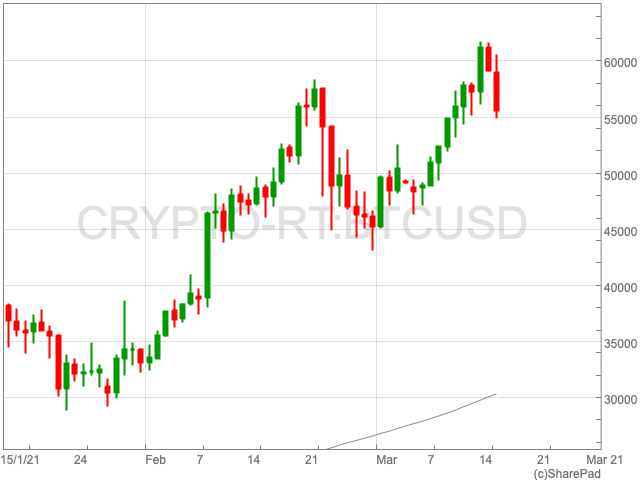
After getting close towards the end of February, bitcoin broke above $60,000 over the weekend.

The cryptocurrency’s previous all-time high of $58,332 was just under a month ago and has threatened on a number of occasions since to go past the $60,000 mark.

Bitcoin breaks $60,000

Bitcoin’s market cap worth $1trn

After getting close towards the end of February, bitcoin broke above $60,000 over the weekend.

The cryptocurrency’s previous all-time high of $58,332 was just under a month ago and has threatened on a number of occasions since to go past the $60,000 mark.

While previous milestones have been surpassed in a mild manner, bitcoin went past its recent marker with conviction. However, the digital currency has fallen by 8.83% in the past 24 hours to $55,528.

Bitcoin/USD

Over the past four months, bitcoin has quadrupled in value, while a year ago, it was valued at less than $5,000.

Nigel Green, chief executive and founder of deVere Group, says regulation must now become a major priority as the price of bitcoin hit a new record high, surging past $61,000 on the deVere Crypto exchange on Sunday for the first time.

“Whether crypto cynics like it or not, there’s no getting away from the fact that Bitcoin is becoming an increasingly important part of the global financial system,” Green said.

“Bitcoins in circulation are now worth $1 trillion, with prices having rallied 890% over the last year. Most major financial institutions, including investment giants and payment companies, are now backing the world’s largest cryptocurrency, and there’s ongoing soaring interest from retail investors.”

“The move towards digital currencies is going to increase – and at pace – over the next few years. This is why financial regulators must now make regulation of the crypto sector a major priority.”

“With a growing dominance, Bitcoin and other cryptocurrencies must be held to the same standards as the rest of the financial system with a robust, workable international framework.”

It was a similar story for the other major cryptocurrencies, including Ethereum, which surged before dropping by over 7% in the last 24 hours.

Octopus Renewables records ‘strong performance’ for inaugural year

0

Octopus Renewables confirms dividend of 3.18p per share

Octopus Renewables Infrastructure Trust (LON:ORIT) confirmed its results on Monday for “the period from incorporation” on 11 October 2019 to 31 December 2020.

The company announced that 100% of its net proceeds from IPO are now committed following its IPO on 10 December 2019 which raised £350 million.

Octopus Renewables’ Net Asset Value (NAV) per ordinary share is at 98.3p as of 31 December 2020, a £344m total NAV. Its total NAV return is 2.4% over the period since its IPO.

The company announced a dividend of 3.18p per share, while reaffirming its dividend target for 31 December 2021 at 5p per share.

Octopus Renewables made five acquisitions during the period, with diversification across 24 assets, four countries, onshore wind and solar PV, and operational and construction assets.

The company also confirmed that construction of the Ljungbyholm wind farm in Sweden is on schedule.

Octopus Renewables announced in November that it had acquired 100% of the Cerisou wind farm, a construction-ready project in the Vienne department of France.

Chris Gaydon, Investment Director at Octopus Renewables, commented on the company’s performance following its inaugural year.

“I am pleased that ORIT is reporting a strong performance for its inaugural year. Over the period the team has fully committed the net proceeds of the IPO and delivered on the first-year dividend target of 3.18p per share,” said Gaydon.

“For the year to come we remain focused on delivering on the targets set out to investors, strengthening ORIT’s position as an impact investment trust and continuing to drive the energy transition towards a net-zero future. As we emerge from the Covid-19 crisis, and the electrification of transport and heat accelerates creating greater demand for renewable energy, we continue to see opportunities for further growth in the Company.”

Deliveroo confirms sale of £1bn worth of shares ahead of IPO

0

Deliveroo to issue two separate classes of shares

Deliveroo confirmed on Monday morning that it will sell £1bn ($1.4bn) in new shares ahead of its initial public offering (IPO) on the London Stock Exchange.

The confirmed also announced in a statement that its listing would also include the sale of shares by some existing shareholders.

Deliveroo confirmed there will be two separate classes of shares. Founder and chief executive Will Shu will be the only holder of “class B” stock, which means each of his shares gets 20 votes, while all other shares will get one vote.

The takeaway company will open the listing up to retail investors, making £50m worth of shares available to customers. Each person will be able to apply for up to £1,000 worth of shares. 

Shu has confirmed he will offer the company’s top riders £10,000 each following the IPO, as part of a £16m “thank you” fund.

Just last week Deliveroo revealed plans for its initial public offering (IPO), while confirming a 54% growth in sales and £224m of losses in 2020.

Transactions surged to over £4bn during the pandemic however Deliveroo is still a loss making business.

Oilex swings to profit

0

Oilex reduced its explorations costs by over 50%

Oilex (LON:OEX) confirmed on Monday that the company made a post-tax profit for the six months up to 31 December 2020 of $418,881, up from a loss of $2,023,782 the year before.

Oilex reduced its explorations costs by over 50% to $256,917, as well as its care and maintenance costs to $63,765, and its administration costs to $424,297.

The cash and cash equivalents held by the AIM-listed company fell to $102,901 from $173,816 at the end of June 2020.

Oilex confirmed in its report that its objective is to maximise shareholder value from its principal asset in the Cambay Basin, located onshore Gujarat State in India, whilst also continuing to review other opportunities to create value and diversify risk by adding new assets to the company’s project portfolio.

The company’s plans at Cambay are well advanced and include the drilling of up to two vertical wells, subject to, among other things, securing the necessary funding.

The Oilex share price is down by 1.25% to 0.16p on early morning trading. In mid-February the company’s share price jumped from 0.10p to 0.21p.

Oilex has performed well on the AIM exchange recently as oil and gas companies have specifically benefitted from the resurgence in oil prices.

Avingtrans pinpoints disposal gain

Engineer Avingtrans (LON: AVG) is showing the success of its strategy with the £35m sale of the Peter Brotherhood business that came with the acquisition of Hayward Tyler in September 2017.
This is part of the strategy of management. It pinpoints businesses that are attractively valued and/or provide a good fit with existing operations. In many cases these are loss-making businesses. Investment is injected into the acquired business in order to improve performance.
A recent example is specialist doors manufacturer Booth Industries, which has shed lower margin work and is back in profit. It is ...

Aquis new admission: Rogue Baron

Rogue Baron is a drinks brands developer, and its focus is a Japanese whisky and a specialist tequila. The idea is to build these and other niche brands to the point where larger drinks companies will want to acquire the brand. This has been difficult because of the lack of cash, but the money raised before and during the flotation will help to accelerate progress.
Covid-19 has hampered short-term progress, but Shinju Japanese whisky has a good base in the US from which to grow. There will also be geographic expansion. Sales channels built up for the initial brands can be used for additional b...

AIM new admission: AMTE Power

Cleantech is back in fashion on AIM with ITM Power, Ceres Power and Proton Power surging in price over the past 12 months. AMTE Power arrives on AIM when that momentum has eased but the sector remains attractive to investors.
AMTE raised more than initially expected in the flotation and this should provide the cash required for investment in the business. Founding shareholders, including chief executive Kevin Brundish, raised £743,000 in the flotation.
The strategy is to focus on niche markets that are being ignored by rivals. The battery cells in development are based on licensed technology, ...

Berkeley Group Share Price: at risk of being outperformed by competition

0

Berkeley Group Share Price

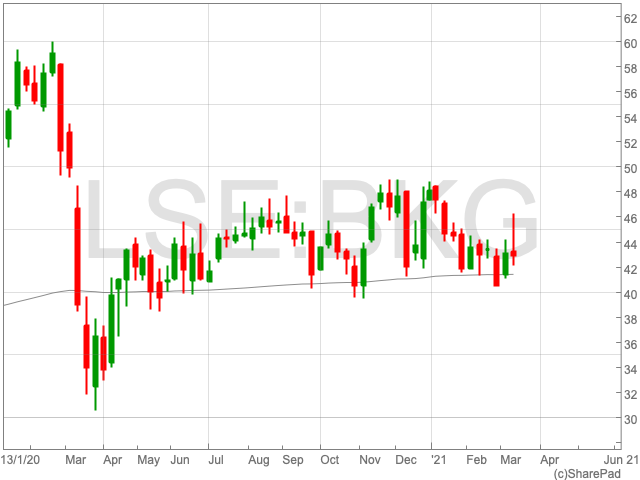
From an all-time high of 5,470p in February 2020, Berkeley Group’s share price plummeted to 3,131p before the end of March, as the pandemic took a stranglehold of the UK economy. Since then the housebuilder’s stock has recovered steadily, reaching as high as 4,889p in December, before coming back down to 4,286p in March.

Government Support for Homebuilders

Property companies received a great deal of support from Rishi Sunak’s budget announcement that could see them to the end of the pandemic.

The Chancellor pledged to “stand behind home buyers”, extending the stamp duty holiday to June. The point at which stamp duty will be paid will remain at £250,000, double its standard level, until the end of September. The budget also included assurance that the government will guarantee mortgages up to 95% of a home’s value.

The policies, in particular the stamp duty waiver, proved to be a success before the pandemic as house prices hit record numbers.

Mark Peck, director at Cheffins, commented on the impact of Sunak’s announcements on the property industry.

“Stamp duty has long been the Treasury’s golden goose and has filled government coffers for centuries, and whilst the lack of stamp duty paid over the past year will have been felt by the government in terms of income, this extension will ensure that the property industry continues its current bull run over the next three months,” Peck said.

The continued support by the government, in addition to the UK economy emerging from lockdown, could make Berkley Group an attractive proposition over the coming months.

Risks

Berkley Group shares took a tumble on Friday as the company’s forecasted profit was downgraded.

The developer predicts it will record a profit of about £504m for the year ending in April, around the same level it generated in 2020, but £20m lower than initially expected.

Berkeley Group also confirmed its reservations are set to fall by 20% during the current financial year as the housebuilder delayed opening sites due to lockdowns.

This is in contrast to its rivals that have wasted no time in building sites to capitalise on the sector’s bright outlook. Russ Mould, investment director at AJ Bell, suggested the stock was less well positioned than its competitors.

“Of all the housebuilders Berkeley seems the least bullish. A flat performance in its financial year to February 2021 is testament to how impressively the business recovered from the pandemic in the second half.

“But while Berkeley still has strong levels of enquiry it is phasing developments to coincide with a reopening of the economy. This may look very clever in time if it sees Berkeley deliver a smoother flow of profit and cash flow than its peers, many of which seem to be operating at 100 miles an hour.

While Berkeley is well poised to capitalise from favourable policies and perpetual demand for housing, the company does risk being outperformed by its competitors over the coming months.