SigmaRoc Plc reveals “very strong” performance, shares rise

0

SigmaRoc shares (LON: SRC) are trading over 5% higher on Wednesday after the group’s revenue surged by 78%.

The construction materials group posted a rise in revenue to £114m for the 11 months to the end of 30 November 2020.

Full year underlying results are expected to be ahead of current market expectations, commenting in an update: “The Group is optimistic as to the potential normalising market conditions in 2021 and has been buoyed by the UK Government’s commitment to infrastructure investment as part of its COVID-19 recovery strategy.”

SigmaRoc has reported strong cash generation, which has resulted in an increase in cash and equivalents to £14.5m at 30 November 2020, subsequent to acquisition of the remaining 60% equity interest in GDH from cash reserves.

The company plans to repay £250,000 in UK funding assistance.

The SigmaRoc chief executive, Max Vermorken, commented: “The Group’s performance for the eleven months to 30 November 2020 is very strong given the context and risks we faced. The Group has continued to demonstrate that a decentralised business model focussed on local markets is a robust approach in our industry, particularly in challenging times. The Group is supported by a solid asset base and will continue to confront all challenges head-on while executing on its buy-and-build strategy to deliver further shareholder value.”

SigmaRoc shares (LON: SRC) are trading +6.07% higher at 55,95 (1437GMT).

FTSE 100 & pound see gains on vaccine and Brexit hopes

0

The FTSE 100 is trading higher on Wednesday amid Brexit deal hopes, vaccine optimism and US stimulus talks.

Although still 13% down for the year, the blue-chip index hit its highest level since early March today thanks to top risers including BP and Royal Dutch Shell.

In Europe, stocks were also looking positive with Germany’s DAX up 1% and France’s CAC trading 0.6% up.

Neil Wilson of Markets.com commented on the vaccine news and how it is impacting the markets: “As the UK’s vaccination programme begins, the Oxford University and AstraZeneca vaccine has been confirmed as being safe and effective in a Lancet study. The news further underpinned confidence in the reopening trade.

“Meanwhile the FDA has confirmed the efficacy and safety of the Pfizer/BioNTech vaccine, clearing the way for its imminent approval for use in the US.”

The pound is also continuing to climb and has up almost a cent against the US dollar.

The pound is likely to be impacted by today’s talks with Boris Johnson and Ursula von Der Leyen.

“It’s clear that some political impetus will be required for the talks to make any more progress. If we can make progress at a political level it may allow Lord Frost and his team to resume negotiations over the coming days. But we must be realistic that an agreement may not be possible as we will not compromise on reclaiming UK sovereignty,” said a UK government source.

British American Tobacco raises full-year revenue guidance

0

British American Tobacco (LON: BATS) has raised its full-year revenue guidance.

Previously, the group estimated a 3% fall in revenue. The expected fall in revenue is now 2.5%. Meanwhile, global cigarette and tobacco sales are expected to fall by a smaller 5%.

Jack Bowles, the group’s chief executive, said in a statement: “We are transforming our business in order to build A Better Tomorrow. Reducing the health impact of our business through providing a range of enjoyable and less risky products is the
greatest contribution we can make to society. We continue to be clear that combustible cigarettes pose serious health risks, and the only way to avoid these risks is not to start or to quit.

“British American Tobacco encourages those who would otherwise continue to smoke to switch completely to
scientifically substantiated reduced risk alternatives. We are growing our New Category
business as fast as possible and we are proud to now have around 13 million non-combustible
product consumers. We are continuing to increase investment in our three New Categories of
potentially reduced risk cigarette alternatives, capitalising on our momentum, while continuing
to deliver on our financial commitments.”

British American Tobacco has seen strong trading in the US market with continued strong value share performance.

The group has announced a dividend pay-out ratio of 65%.

British American Tobacco shares (LON: BATS) are trading 0.14% at 2.898,00 (1044GMT).

Stagecoach shares rise as sales recover

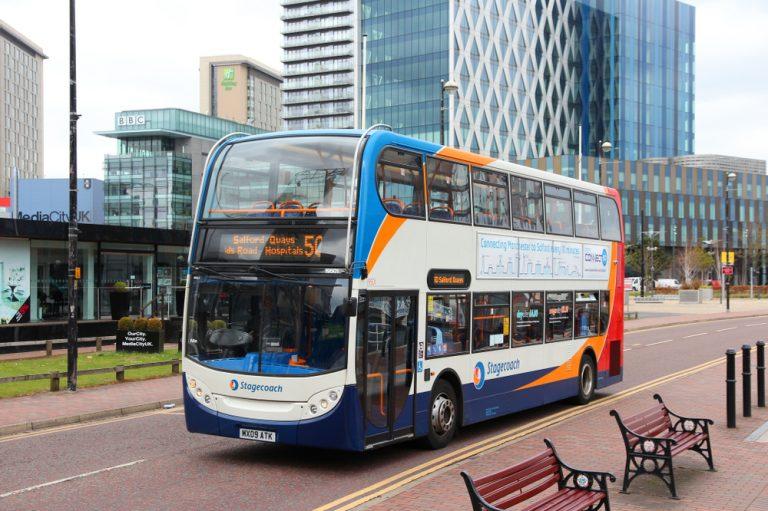
Stagecoach Group profits plunged from to £65.9m last year to £5.4m in the six months to 31 October.

The bus operator posted a fall in revenue from £800.2m to £454.6m, as the group was hit by the pandemic and the group was forced to close of regional bus and tram services.

Since the initial lockdown, the group is seeing significant improvement. Regional buses are currently operating around 91% of prior year vehicle mileage and with commercial sales have recovered to almost 60% of prior year levels.

Stagecoach will not pay an interim dividend due to “continuing uncertainties”.

Martin Griffiths, the Stagecoach chief executive, said: “The safety and wellbeing of customers and our people remains our absolute priority as we continue to navigate the COVID-19 pandemic. While the situation remains fluid, we have made progress in the restoration of our networks to close to pre-COVID levels and in growing passenger volumes safely.

“We have a strong business, with good liquidity, devolved operating companies closely focused on our customers and local communities, and a supportive relationship with government and our local authority partners.

“We welcome the UK, Scottish and Welsh governments’ recognition of the importance of bus and tram services, as evidenced by the sector-specific actions they have taken to support the continuation of vital services during the COVID-19 pandemic. We are working closely with our government and sector partners on a new framework to ensure the country’s public transport networks adapt to new working and travel patterns, are fit for the post-COVID world, and meet the continuing needs of our customers and communities.”

Stagecoach shares are trading +8.18% at 80,00 (1013GMT).

Ripple Energy – helping you create a greener, brighter future

The UK Government recently announced it wanted enough offshore wind farms to power every home in the UK by 2030. But how can households actually play their part?  Switching to a ‘green tariff’ may seem the obvious choice, but most green tariffs on the market will do very little to make it happen.

Step in Ripple.  

Ripple enables consumers to part own new wind farms and solar parks and have the green, low cost electricity they produce supplied to their homes. It enables people to make a real impact with their energy choice.

Find out more here.

The global shift to zero carbon energy system is well underway and is set to accelerate over the next 10 years.  The UK, China, Japan, the EU and South Korea have all set net zero targets.  When it rejoins the Paris climate agreement, America will too.  

Yet the barriers to ownership of the world’s clean energy assets remain high. Too high for household consumers.  Ripple wants to change that.  

Until now, consumers had been excluded from owning energy assets, except for expensive, small scale technologies like rooftop solar.  It can cost up to £8,000 to install solar on a house, and it’s not a viable option for those who rent, live in flats or plan to move home. 

Ripple’s clean energy ownership platform enables everyone to part own large scale, low cost renewable energy assets and have the green, low cost electricity they generate, supplied to their home via the grid.

It’s a simple, flexible and easy way for people to act on climate change and share in the benefits of clean energy ownership direct.

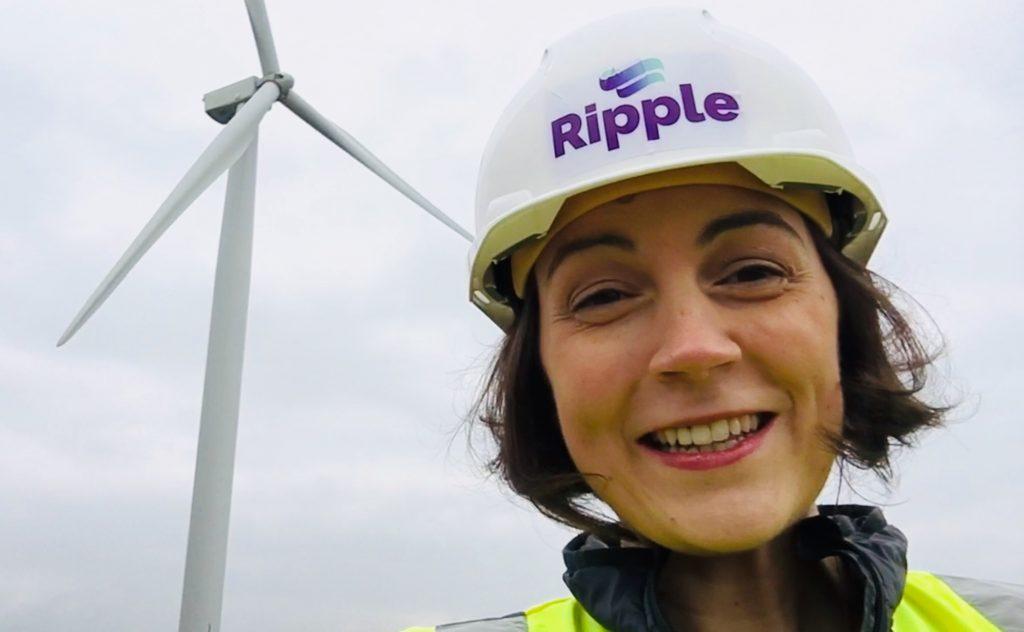
Sarah Merrick, CEO and founder of Ripple, had the idea when she led the wind industry’s strategy group looking at the post-subsidy world. Sarah recalls “The industry was keen to sell their electricity to Google and Facebook.  That’s great, but wind had just become the UK’s cheapest source of electricity. I thought it was unfair that big corporates could access the cheapest electricity around, but ordinary household consumers couldn’t.  I thought someone would plug the gap in the market, but a year or so went by and still no one had. So I decided to do it myself and set about launching Ripple.”

Ripple launched the first, pilot wind farm in summer 2020. Once operational, it will be the UK’s first wind farm to be owned by the consumers it supplies. 

Ripple estimates customers will save around 25% on their electricity bill over the 25 year lifetime of the wind farm, for an upfront cost of £1800, roughly 65% cheaper than the equivalent rooftop solar system.

So far the platform has handled over £1.1m of transactions from more than 500 consumers. Having been selected from over 850 global startups to take part in the Free Electrons program, Ripple is exploring opportunities with ESB in Ireland and Origin in Australia to launch further pilot projects.

According to Bloomberg, $11tr of investment in wind and solar will be required globally by 2050 to meet net zero targets. Ripple is enabling consumers to access the market direct for the first time ever.

Voted Startup of the Year 2019 by both Seedrs investors and Business Green Technology Awards, Ripple is currently fundraising to continue its growth, launch its second project and expand its offering to business customers.

Interested to learn more, take a look at Ripple’s latest campaign on Seedrs

A one-off wealth tax could “transform lives”

A group of leading tax experts and economists are calling on the government to launch a one-off wealth tax to raise money amid the Coronavirus pandemic.

The Wealth Tax Commission has said that taxing the richest in society is the most fair and efficient way to respond to the impact of the pandemic and that by taxing millionaires an extra 1% above a £1m threshold could raise £260bn over just five years.

“We’re often told that the only way to raise serious tax revenue is from income tax, national insurance contributions, or VAT. This simply isn’t the case, so it is a political choice where to get the money from, if and when there are tax rises,” said Arun Advani, assistant professor at the University of Warwick.

A 1% per year tax rate would be the equivalent of raising VAT by 6p or the basic rate of income tax by 9p.

Rebecca Gowland is the head of inequality campaigning at Oxfam. She commented: “At a time when so many people are facing hardship as a result of the pandemic, this feasible and deliverable one-off wealth tax could transform lives – an uncomfortable truth for vested interests that are likely to resist it.

“The difference this revenue could make for the most vulnerable in society is staggering. Just a quarter of the extra money raised would be enough to keep and extend the social security weekly uplift and allow us to meet our lifesaving aid promise to the world’s poorest people.”

The UK government’s budget deficit is on track to hit almost £400bn this year.

Global equities flat despite US stimulus hopes

0

Finishing the day without making any notable ground, global equities appeared largely unphased by the positive chatter surrounding US stimulus talks.

In spite of fresh calls for stimulus, there seems to be some disagreement over whether there’s a total gridlock, or whether we’ll see a new deal tabled within the next week or so.

Responding to the stimulus whispers, and a lack of ground-breaking corporate or economic news, global equities struggled for a reason to move on Tuesday – with the Monday drift continuing, alongside a lack of motivation to push higher.

Speaking on the stimulus hopes, and a quiet day for global equities, IG Chief Market Analyst, Chris Beauchamp, said: “A host of indicators suggest stock markets around the globe are stretched to the upside, and probably vulnerable to a near-term correction, but for now sellers do not seem to be able to summon up the necessary momentum to provide the spark for a big drop.”

“The rise in cases across the US seems finally to have galvanised American lawmakers into action, although the $900 billion discussed is certainly well below the mooted levels of late summer, and even this amount may not make it through unscathed.”

“Even if the bill does go through, the lack of a ‘trillion’ in the headline could mean markets greet it with a collective shrug, deeming it insufficient to provide a real boost for the US economy.”

Providing some glimmer of hope were US equities, with the Dow Jones opening with a 0.38% rally, keeping it above the 30k benchmark. Just short of last Friday’s all-time-high, the index sits at 30,183 points.

Elsewhere in global equities, Eurozone equities were all spurred on by the cheery US index open. The FTSE and DAX both finished up by 0.05%, having recovered 40 and 75 points, to finish at 6,558 and 13,278 points respectively. Meanwhile, even having recovered by 38 points, the CAC finished down by 0.23%, at 5,560 points.

EQTEC WTE acquisition could power 37.5k homes

0

Gasification tech solutions company, EQTEC plc (AIM:EQT), announced that it has signed a Share Purchase Agreement to take full ownership of the Deeside Refuse Derived Fuel Project, via the acquisition of Logik WTE Limited.

The company said this latest acquisition is part of a portfolio under review of waste to energy infrastructure. Assuming the requisite financing is in place, EQTEC expects to act as the project’s developer, providing design and core advance gasification tech, and retaining a portion of the O&M contract.

EQTEC said that conversations with potential EPC companies are ongoing and the documentation required for tendering the EPC contract for the first phase of the Deeside RDF Project is currently being produced. Once EPC offers are reviewed, the company will reach a final decision on the project’s funding structure.

Further, the company and Logik are also in discussions about a framework collaboration agreement, covering proposed cooperation for the development of a portfolio of waste to energy projects Logik is currently pursuing across the UK.

Commenting on today’s acquisition, David Palumbo, CEO of EQTEC, said: “We are pleased to have signed this SPA to acquire the Project SPV for the Deeside RDF Project after completing our due diligence, making good progress on funding discussions and shortlisting EPC companies for the Project. We estimate that, with the application of EQTEC’s advanced gasification technology, the Project would convert hundreds of thousands of tonnes per year of non-recyclable everyday household and commercial waste otherwise destined for landfill or incineration.”

“In this way, EQTEC expects to be able to significantly improve both the economics and the environmental impact of this plant and many traditional waste-to-energy facilities, bringing employment to the local area and economic and environmental benefits to both the local community and large industrial energy users, whilst delivering attractive returns to EQTEC’s shareholders.”

The Deeside RDF Project is made up of 6.27 hectares of land at the Deeside Industrial Estate. The company said that its seeking additional planning permission, in order for its gasification etch to be applied to the project, and reduce its potential environmental and cost impact.

At present, EQTEC predicts the project will convert hundreds of thousands of tonnes of non-recyclable waste per year, into 20MW of green electricity – enough to power 37,500 homes and 27MW of thermal heat production. 

The company said that the electricity and heat could be exported to the grid or sold locally. It added that its preference would be to create private wire and heat networks using the surplus electricity and heat, as it is already aware of interest from a large industrial energy user in the area.

The company’s statement added that: “EQTEC estimates that the additional capacity for the thermal conversion of waste, utilising the Group’s advance gasification technology, would generate additional revenues for the Project SPV of c.£16 million in gate fees, c.£6 million in electricity sales and up to £1.5 million in heat sales.”

The SPA is set to take place for an initial consideration of £2.31 million, with a £300,000 deposit and the outstanding balance payable within 12 months of signing the SPA. Following this, there will be a deferred conditional consideration of £2.29 million which will be paid upon the project achieving certain milestones.

Additionally, a fixed dividend share will be issued to Logik, giving it the right to 5% of distributable EQTEC profits – though no voting rights in the company. Finally, there will be an additional development premium or overage payment, ‘subject to a maximum further amount’ of £5.4 million, payable on the achievement of two financial conditions. 

Neil Spencer, Director of Logik, added: “LOGIK secured planning on the proposed project site over 12 months ago and, together with EQTEC, we look forward to continuing to work closely with all local stakeholders to help ensure this project gets built and secures additional planning that will further enhance the benefits to the local community.” 

“We are very encouraged to be working with a team with the experience and credibility of EQTEC and remain optimistic of what we expect to achieve in Deeside and in further potential collaborations with EQTEC on a portfolio of waste to energy projects that Logik is currently progressing in the north of England and across the UK.”


Coral Products return to profit, shares surge

0

Coral Products shares were 31.46% higher on Monday after the group revealed its half yearly report for the six months ended 31 October 2020.

The specialist in the design, manufacture and supply of plastic products reported a 2,064% growth in reported pre-tax profits from £25,000 to £541,000 in the six months to the end of October.

Underlying earnings per share surged 257.7% to 0.93p and Underlying EBITDA was up 21% to £1.62m.

Coral Products said in the update that they had returned to profit despite the impact of the pandemic and ongoing Brexit uncertainty.

“Particularly pleasing is the Group’s return to profit when considering the huge negative impact of the Covid-19 pandemic on our customer base has meant that the new business expected from the new and improved food packaging and the 23 litre/55 litre recycling products have not been realised in the current period. It is expected that both will positively impact the business in the final quarter of this financial period,” said the group in a statement.

Joe Grimmond, Coral’s Chairman, said: “In my Chairman’s statement that accompanied the release of the 2020 accounts I expressed concerns over the uncertainties associated with the ongoing Brexit situation and coronavirus pandemic. Despite these concerns I am encouraged with the level of sales and profitability achieved over the period”.

Coral Products shares are trading 27.14% higher at 6,77 (1548GMT).

LSE listed companies fell by 396 since 2015

0

Data from financial education service, Buy Shares, indicated that the number of companies trading on the London Stock Exchange (LON:LSE) dropped by 396 – or 16.63% – between the Novembers of 2015 and 2020.

In 2015, the number of companies listed on the LSE stood at 2380, though this number had fallen to 1984 by last month. During the period, the highest number of monthly trades took place in March 2020, with an average of 2.03 million, versus the lowest number, 760,180, recorded in August 2020.

According to Buy Shares, a reason for the shift in the number of companies traded on the world-famous exchange is (perhaps inevitably) Brexit uncertainty, which has at the very least seen many companies take up additional listings at alternative exchanges.

Further, the company said that listings demands high fees, represent a regulatory burden, and comparatively high costs versus private markets – to the extent that small and mid-cap companies have found it more difficult to justify LSE entry.

A key driver behind this data, though, is the particularly adverse effect that the COVID-Brexit combination has had on UK securities in 2020. Between “a wipe-off [of] billions in stock values alongside extreme volatility and sell-offs”, the LSE was host to some of the worst-afflicted pandemic sectors, including air travel, energy and financial services.

Speaking on the reduced number of companies listed on the LSE, Buy Shares Editor, Justinas Baltrusaitis, said: “The relentless rise of private equity has given companies an attractive alternative to listing on a major platform like the London Stock Exchange. Companies are going private at a high rate due to depressed share prices, low-interest rates, and the massive attraction of Private Equity. Attractive valuations have enabled Private Equity funds to acquire companies with strong fundamentals at prices below recent norms.”

“However, the declining number of companies on LSE might increase in the future, considering that there are calls for government help. There are calls for the government to step in, especially in the backdrop of Brexit. With help from the government, LSE can attract global businesses to list in London, knowing they have access to the deepest capital pool, against a fair and consistent regulation.”

Further, the LSE will continue to benefit from its prime location, history, and social infrastructure, which other indexes will find hard to replicate.