
Costain Group shares down 10% on profit plunge

Costain Group shares (LON: COST) fell over 10% on Monday after the group revealed a first-half loss.
The smart infrastructure solutions company released results for the half-year ended 30 June 2020, which showed a 73% fall in operating profits to £5.7m.
Adjusted revenue fell by 8% to £549m.
The group took the brunt of a terminating contract and was on the wrong side of an arbitration decision over the A465 road-building contract in Wales.
Costain Group’s chief executive, said: “We are clearly disappointed with the recent arbitration outcome in relation to the A465 contract which, together with the mutual termination of the Peterborough & Huntingdon contract, has resulted in significant revenue adjustments for these long-standing projects.”
“Looking ahead, assuming no further sustained Covid-19 lockdowns, we are confident of delivering growth in profits and margins next year,” he added.
The company said in a statement: “As a result of the arbitration award and on the basis of the uncertainty of recovery of such costs, and subject to reaching a final settlement, the group’s half year results include a charge to the income statement of GBP45.4 million to adjust the revenue recognised based on the level of cash received to date under the contract. Costain will continue to fulfil its obligations under the contract, with completion scheduled in 2021.”
Costain Group shares (LON: COST) are trading -10.70% at 42,15 (1316GMT).
Why you shouldn’t be concerned IAG shares fell 30%

International Consolidated Airlines Group (IAG) (LON: IAG) shares plummeted 30% on Monday morning.
The British Airways owner saw shares fall, however, it was not due to troubles at the airline group. Instead, is linked to a technical issue as the shares trade ex-rights.
Last week, the airline group launched a heavily discounted rights issue to raise €2.74 billion. Investors taking part in the new rights issue have to do so at a price that is 35.9% lower than Thursday’s closing price.
Shares are trading at their lowest since the 2009 financial crash.
British Airways has been hit hard by the pandemic. The group has said that quarantine rules will mean that this Autumn will see travel rates at a 60% reduced compared to this time in 2019.
The airline revealed plans to shed up to 13,000 jobs this year and normal passenger numbers are not expected to return until 2024.
Chief executive Luis Gallego said: “Where travel markets have reopened without border restrictions and quarantine requirements, IAG has been encouraged by the level of pent-up demand that exists for air travel.”
The airline sector is calling on the government to end quarantine rules to encourage flight travel. Heathrow’s chief executive, John Holland-Kaye, said:
“Britain’s economic recovery is falling behind. Heathrow’s traffic figures for August demonstrate the extent to which quarantine is strangling the economy, cutting British businesses off from their international markets and blocking international students, tourists and investors from coming here to spend money.”
IAG shares (LON: IAG) are trading -28.66% at 138,55 (1255GMT).AstraZeneca shares begin rally as Oxford vaccine trial resumes

Shares at Cambridge-based biopharmaceuticals firm AstraZeneca (LON:AZN) have begun a modest rally on Monday as the company resumes its high-stakes coronavirus vaccine trial.
Clinical trials of AstraZeneca’s joint venture with Oxford University were forced to halt last week after it emerged that an anonymous participant had suffered from an alleged “adverse reaction”.
A New York Times article reported that a volunteer from the UK branch of the project had been diagnosed with transverse myelitis – an inflammatory syndrome that can be caused by viral infections – but AstraZeneca have so far not confirmed the speculation.
The trial was routinely paused while an independent body reviewed the incident to determine if it was safe to continue with the late-stage human studies.
Oxford University announced over the weekend that the trial was cleared to resume after regulators gave it the go-ahead, and it has been confirmed that the ill participant is expected to make a full recovery.
AstraZeneca shares were trading at 8,431p at GMT 08:33 14/09/20, giving the FTSE 100 its biggest boost of the morning, but the rally was swiftly tempered by concerns from investors that US President Donald Trump’s executive order to lower drug prices could hurt global pharmaceutical stocks.
By lunchtime, AstraZeneca’s share price had slipped back into the negative at -0.66% to 8,373p, but is still up 3.79% over the past week as investors’ fears that the trial could be scrapped were consoled by regulatory approval to resume studies.
Surface Transforms wins £27.5m contract and sees shares accelerate by 87%

Carbon ceramic brake disc manufacturer, Surface Transforms (AIM:SCE), saw its shares rally by almost 87% on Monday morning, as the company announced a big contract win.
The company said that the contract had been won with a car company – that they term ‘OEM 8’ – and detailed pricing, volume and payment terms. It added that it had also received an order for engineering samples from OEM 8 to complete their homologation activity on their new high-performance car.
Surface Transforms also stated that the contract means they’ll be the standard fit, sole supplier of carbon ceramic brake discs on both axles of OEM 8’s new car.
The anticipated lifetime revenue on this specific contract is around £27.5 million, with an estimated income of £8 million per year for three years from the contract’s commencement date in the summer of 2021.
The contract is currently expected to extend until 2024, but the company noted that there is potential for it to be extended. It also said that the estimated contract revenue will more than double its previously projected contracted turnover in 2022. It added that in anticipation of further contract awards, it would be increasing its manufacturing headcount each year, with costs increasing by £0.5 million in 2020, £1.3 million in 2021 and £2.0 million in 2022. Also in light of the new contract award, and in spite of COVID hampering the trading environment, Group expected annual revenues now stand at £2 million, some £400,000 ahead of original market expectations.Surface Transforms response
Responding to the positive news, CEO Kevin Johnson stated:“This, truly game changing, award builds upon the recent trend of significant contract wins with mainstream automotive manufacturers. The award, which on its own, doubles previous revenue projections for FY22 and accelerates Surface Transforms’ transition into profitability and operational cash generation.”
“The Board is delighted with this award and want to particularly thank both our employees and the customer for their considerable efforts in concluding the work needed for nomination against the background of the Covid 19 pandemic and lockdown.”
“This is a very good day for Surface Transforms and we look forward to further extending our relationship with this major new customer and making further contract announcements with both OEM 8 and other, existing and new, customers.”
Investor notes
Following the uplifting news, Surface Transforms shares rallied by 86.69% or 21.24p, to 45.74p a share 14/09/20 12:00 GMT. This price represents a high point which bucks the trend for the company’s year-to-date, and far ahead of its 2020 low price of 14.00p on April 17. The company’s p/e ratio is currently -24.74.
Leading investors pile on net-zero pressure for world’s biggest polluters

Climate Action 100+ – a group which represents investors with a combined portfolio worth more than $47 trillion – has written an open letter to the world’s top greenhouse gas-emitting corporate bodies in a drive to encourage more companies to adopt net-zero carbon emissions targets by 2050.
The campaign, backed by 518 investor organisations around the world, wrote to 161 companies to convince them to implement 30 climate conscious measures which are set to be assessed in a new report due in the new year.
Among the demands is for companies to reduce their carbon emissions by 45% by 2030, compared to levels recorded in 2010.
The 161 companies which received Climate Action’s letter make up the vast majority of industrial greenhouse gas-emissions worldwide (up to 80%), and one of the new demands requires that companies release medium-term objectives to cut back on their carbon footprint while also demonstrating that their longer-term goals are achievable.
Climate Action said that companies’ responses would dictate how investors orchestrate business with them going forwards, “particularly for unresponsive or poorly performing companies”, and warned that there could be repercussions for those that fail to meet demands at future annual general meetings.
Stephanie Pfeifer, CEO of the Institutional Investors Group on Climate Change (part of the CA100+ coalition), commented on the news and welcomed the announcement of a new climate report in early 2021:
“Companies across all sectors need to take more ambitious action to ensure otherwise devastating impacts of climate change are avoided while they still can be.
“The benchmark will ensure it’s clear which companies are acting on climate change as a business-critical issue and embracing a net-zero future.
“Investors will be paying particular attention to those shown to be falling short”.
A number of household names make up the companies targeted by Climate Action’s campaign, including Royal Dutch Shell and BP. It comes amid a wider drive by climate-concerned investors to keep companies in line with the demands of the 2015 Paris climate agreement, as the burgeoning climate crisis gathers pace.
Last week, record-breaking wildfires cloaked the entire US state of California under a haze of red smoke. Michael Gerrard, director of the Sabin Center for Climate Change Law at Columbia University, heeded a stark warning in the Los Angeles Times:
“We’ve seen this long freight train barreling down on us for decades, and now the locomotive is on top of us, with no caboose in sight”.
If the USA decouples from China, Vietnam will be a winner

Sponsored by Vietnam Holding
In 2019 when US President Trump initiated the trade war with China, Vietnam emerged as a winner, with several multinational companies looking to relocate some or all of their manufacturing outside of China to mitigate political risk and avoid penalties and higher tariffs. This became known as a ‘China-plus-one’ strategy. In 2020, COVID-19, and Vietnam’s quick and effective responsive to the pandemic, further strengthened the case for including Vietnam as part of a diversified supply chain. Trump’s pre-election rhetoric of ‘decoupling from China’ included the need to identify alternative countries to supply inputs to the US economy. If this thinking persists into a second Trump term, or a first Biden term (and China bashing has bi-partisan support) then we can expect rapid expansion of investment in manufacturing capacity in Vietnam.
Vietnam is a country of almost 100 million people and is a fast-growing economy with multi-decade growth rate in GDP of more than 6%. Much of this growth has resulted from an increasingly open approach to global trade since it became the seventh member of the Association of Southeast Asian Nations (ASEAN) in July 1995 and the 150th member of the World Trade Organization (WTO) in 2007. In the same month Vietnam joined ASEAN, the United States re-established diplomatic relations, putting the Vietnam War behind them and developing strong bilateral and economic ties. The opportunities for the development of the Vietnam Economy and for US enterprises to invest in the country had been identified in the late 1960s, as reported to me by an early investor in Vietnam Holding (LSE: VNH) who was stationed in Vietnam at the time.
2020 marks the 45th anniversary of the end of America’s war with Vietnam, the 25th anniversary of diplomatic ties between the two countries, and the US even congratulated Vietnam on its ASEAN chairmanship. Bilateral trade between the US and Vietnam has increased from US$450 million in 1994 to US$77 billion in 2019 and the US is now Vietnam’s largest export market.
 Vietnam – the beneficiary of trade and foreign direct investment (FDI)
In 2019, Vietnam saw record levels of Foreign Direct Investment (FDI) – almost USD 20 billion. The coronavirus pandemic has impacted this in 2020, in part as there have been fewer flights into the country since the imposition of quarantine, but the trend is still very favourable. In the first eight months of 2020, FDI into Vietnam dropped 5.1 percent from a year earlier to USD 11.35 billion. The manufacturing and processing sector is set to receive about 48% of pledged investment.
Vietnam also enjoyed a record trade surplus in 2019 which has continued into 2020. In August the Trade Surplus was close to USD 4 billion, the largest monthly level since 1990, taking the surplus for the first eight months to USD 12 billion.
The combination of FDI, Trade Surplus and the significant inward remittances of money from the millions of Vietnamese who live and work outside of the country, contributed to a record level of foreign reserves, which is forecast to reach USD 100 billion by the end of 2020. This financial strength has helped Vietnam to buffer the impact of COVID-19, and to keep its currency, the Vietnamese Dong, stable against the US Dollar. Many analysts consider the Vietnamese Dong, and other emerging currencies, to be likely beneficiaries of a weakening US dollar. In a country where interest rates are around 3%, and with forecast economic growth of 2.5% to 3.0% (one of few economies with positive growth this year), Vietnam could attract further money flows.
What sectors to invest in to take advantage of Vietnam’s opportunities?
Vietnam’s per capita GDP has now passed USD 3,000. This is seen as an inflection point in an emerging consumer society. When Thailand reached this level, its per capita GDP doubled again in seven years, and when China reached this level it saw a doubling in five years. More money in the pocket of consumers, more choice in where and how to spend it, means the consumer sector and the companies operating in the space will see tremendous growth in the mid-term. The banking sector is also set to benefit as currently almost 70% of adults in Vietnam (that’s 50 million people) are unbanked. As affluence increases – and a further 35 million middle class consumers are added to the population by 2035 – omni-channel banking (branches, ATMs and online apps).
The rise in foreign direct investment means that there is greater opportunity for investment in the process of industrialization. The price of industrial land is set to increase and there will be greater domestic and foreign investment in infrastructure, which has a multiplier effect in emerging markets. Much of the investment is expansion of existing capacity and ‘green-field’ development of new capacity. Not only does this put money in the economy in the form of employment and consumption of materials (steel, concrete et cetera), but improved infrastructure makes the economy more efficient with faster transportation of goods, shorter commute times, lower costs and the opening up of new areas to live and work, and the industrial and residential services that this creates demand for.
The changing demographics and increasing levels of wealth also create a trend to more urbanization. This is reflected in the demand for better housing, demand for better utilities (clean water and electricity, the latter increasingly produced from wind and solar), modern transportation, healthcare and convenience stores.
How to invest in Vietnam?
Many of the world’s sovereign wealth funds, and large global investment firms have significant investments in Vietnam. For most individuals living outside of Vietnam, it can seem to be a daunting process to invest. To buy Vietnamese stocks directly you need to have a trading code, a local bank account and a custodian for your shares. You need to bring in foreign currency, convert to local Vietnamese Dong, and then select some stocks to buy, or buy a local exchange traded fund (ETF). This is possible, but by no means easy or realistic for most UK investors.
Another way is to buy a passive ETF listed in the UK. While this can appear to be a relatively low-cost way to try and get some exposure to Vietnam, it can have some unintended consequences. One of the problems in this approach is that many of the ETFs are ‘synthetic’ in that they don’t actually hold the underlying stocks, but instead, try to replicate the performance of an index using derivative instruments, or participatory notes that try to track the performance. This can lead to significant differences in the performance of the ETF and the Vietnam market as a whole, as reflected in an index. Another problem is that there is no active stock selection or little screening in an ETF, meaning that you get the good, the bad, and the ugly. With more investors seeking sensibly to align their investment objectives with their desire to invest responsibly, an active fund that applies sound Environmental, Social and Governance (ESG) screening and monitoring may be a better choice.
Once such fund is Vietnam Holding (LSE: VNH), a closed-ended investment company listed on the London Stock Exchange. VNH has been a signatory of the United Nations Principles for Responsible Investing (UNPRI) for over a decade, and features ESG thinking into its investment decisions. It was recently awarded top marks by the UNPRI. VNH is an actively managed fund, supported by a Vietnam-specialist fund manager with a team of 12 professionals on the ground. It is entirely invested in Vietnam, with a portfolio of 24 leading companies, following the core themes of Industrialization, Urbanization and Domestic Consumption. Over the last decade the fund’s Net Asset Value has outperformed the Vietnam All-Share index (VNAS), increasing by 90% versus 46% for the VNAS.
Shares in Vietnam Holding can be bought and sold through your stockbroker or wealth management advisor. There is no minimum investment size and the Company publishes its performance (movements in the value of the underlying portfolio of stocks) on a daily basis. A three-to-five-year investment horizon is recommended for investors.
This article was written by Craig Martin, Chairman of Dynam Capital Limited. Dynam is the Guernsey regulated fund manager for Vietnam Holding (LSE: VNH). Investors should do their own research or consult with their advisors before making a decision to invest in stocks, and the value of investments can go down as well as up.
Vietnam – the beneficiary of trade and foreign direct investment (FDI)
In 2019, Vietnam saw record levels of Foreign Direct Investment (FDI) – almost USD 20 billion. The coronavirus pandemic has impacted this in 2020, in part as there have been fewer flights into the country since the imposition of quarantine, but the trend is still very favourable. In the first eight months of 2020, FDI into Vietnam dropped 5.1 percent from a year earlier to USD 11.35 billion. The manufacturing and processing sector is set to receive about 48% of pledged investment.
Vietnam also enjoyed a record trade surplus in 2019 which has continued into 2020. In August the Trade Surplus was close to USD 4 billion, the largest monthly level since 1990, taking the surplus for the first eight months to USD 12 billion.
The combination of FDI, Trade Surplus and the significant inward remittances of money from the millions of Vietnamese who live and work outside of the country, contributed to a record level of foreign reserves, which is forecast to reach USD 100 billion by the end of 2020. This financial strength has helped Vietnam to buffer the impact of COVID-19, and to keep its currency, the Vietnamese Dong, stable against the US Dollar. Many analysts consider the Vietnamese Dong, and other emerging currencies, to be likely beneficiaries of a weakening US dollar. In a country where interest rates are around 3%, and with forecast economic growth of 2.5% to 3.0% (one of few economies with positive growth this year), Vietnam could attract further money flows.
What sectors to invest in to take advantage of Vietnam’s opportunities?
Vietnam’s per capita GDP has now passed USD 3,000. This is seen as an inflection point in an emerging consumer society. When Thailand reached this level, its per capita GDP doubled again in seven years, and when China reached this level it saw a doubling in five years. More money in the pocket of consumers, more choice in where and how to spend it, means the consumer sector and the companies operating in the space will see tremendous growth in the mid-term. The banking sector is also set to benefit as currently almost 70% of adults in Vietnam (that’s 50 million people) are unbanked. As affluence increases – and a further 35 million middle class consumers are added to the population by 2035 – omni-channel banking (branches, ATMs and online apps).
The rise in foreign direct investment means that there is greater opportunity for investment in the process of industrialization. The price of industrial land is set to increase and there will be greater domestic and foreign investment in infrastructure, which has a multiplier effect in emerging markets. Much of the investment is expansion of existing capacity and ‘green-field’ development of new capacity. Not only does this put money in the economy in the form of employment and consumption of materials (steel, concrete et cetera), but improved infrastructure makes the economy more efficient with faster transportation of goods, shorter commute times, lower costs and the opening up of new areas to live and work, and the industrial and residential services that this creates demand for.
The changing demographics and increasing levels of wealth also create a trend to more urbanization. This is reflected in the demand for better housing, demand for better utilities (clean water and electricity, the latter increasingly produced from wind and solar), modern transportation, healthcare and convenience stores.
How to invest in Vietnam?
Many of the world’s sovereign wealth funds, and large global investment firms have significant investments in Vietnam. For most individuals living outside of Vietnam, it can seem to be a daunting process to invest. To buy Vietnamese stocks directly you need to have a trading code, a local bank account and a custodian for your shares. You need to bring in foreign currency, convert to local Vietnamese Dong, and then select some stocks to buy, or buy a local exchange traded fund (ETF). This is possible, but by no means easy or realistic for most UK investors.
Another way is to buy a passive ETF listed in the UK. While this can appear to be a relatively low-cost way to try and get some exposure to Vietnam, it can have some unintended consequences. One of the problems in this approach is that many of the ETFs are ‘synthetic’ in that they don’t actually hold the underlying stocks, but instead, try to replicate the performance of an index using derivative instruments, or participatory notes that try to track the performance. This can lead to significant differences in the performance of the ETF and the Vietnam market as a whole, as reflected in an index. Another problem is that there is no active stock selection or little screening in an ETF, meaning that you get the good, the bad, and the ugly. With more investors seeking sensibly to align their investment objectives with their desire to invest responsibly, an active fund that applies sound Environmental, Social and Governance (ESG) screening and monitoring may be a better choice.
Once such fund is Vietnam Holding (LSE: VNH), a closed-ended investment company listed on the London Stock Exchange. VNH has been a signatory of the United Nations Principles for Responsible Investing (UNPRI) for over a decade, and features ESG thinking into its investment decisions. It was recently awarded top marks by the UNPRI. VNH is an actively managed fund, supported by a Vietnam-specialist fund manager with a team of 12 professionals on the ground. It is entirely invested in Vietnam, with a portfolio of 24 leading companies, following the core themes of Industrialization, Urbanization and Domestic Consumption. Over the last decade the fund’s Net Asset Value has outperformed the Vietnam All-Share index (VNAS), increasing by 90% versus 46% for the VNAS.
Shares in Vietnam Holding can be bought and sold through your stockbroker or wealth management advisor. There is no minimum investment size and the Company publishes its performance (movements in the value of the underlying portfolio of stocks) on a daily basis. A three-to-five-year investment horizon is recommended for investors.
This article was written by Craig Martin, Chairman of Dynam Capital Limited. Dynam is the Guernsey regulated fund manager for Vietnam Holding (LSE: VNH). Investors should do their own research or consult with their advisors before making a decision to invest in stocks, and the value of investments can go down as well as up.
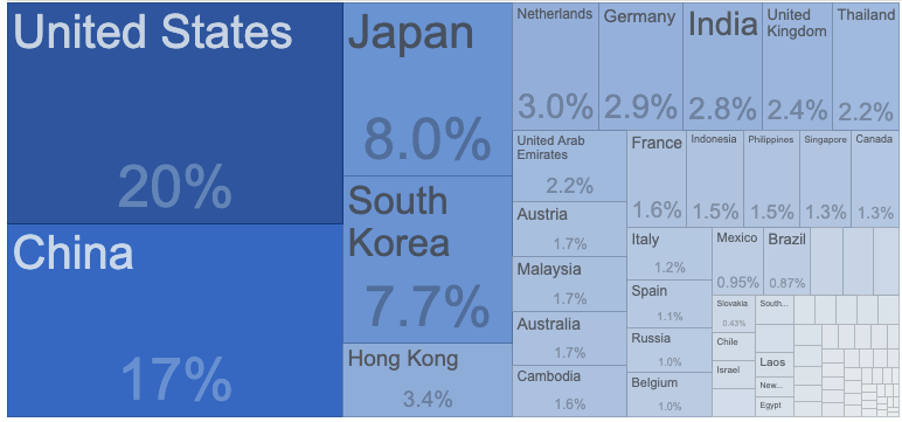 Vietnam – the beneficiary of trade and foreign direct investment (FDI)
In 2019, Vietnam saw record levels of Foreign Direct Investment (FDI) – almost USD 20 billion. The coronavirus pandemic has impacted this in 2020, in part as there have been fewer flights into the country since the imposition of quarantine, but the trend is still very favourable. In the first eight months of 2020, FDI into Vietnam dropped 5.1 percent from a year earlier to USD 11.35 billion. The manufacturing and processing sector is set to receive about 48% of pledged investment.
Vietnam – the beneficiary of trade and foreign direct investment (FDI)
In 2019, Vietnam saw record levels of Foreign Direct Investment (FDI) – almost USD 20 billion. The coronavirus pandemic has impacted this in 2020, in part as there have been fewer flights into the country since the imposition of quarantine, but the trend is still very favourable. In the first eight months of 2020, FDI into Vietnam dropped 5.1 percent from a year earlier to USD 11.35 billion. The manufacturing and processing sector is set to receive about 48% of pledged investment.
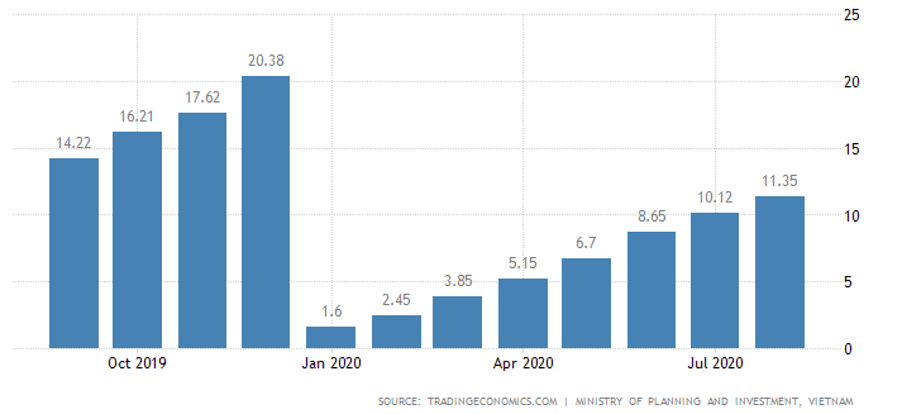 Vietnam also enjoyed a record trade surplus in 2019 which has continued into 2020. In August the Trade Surplus was close to USD 4 billion, the largest monthly level since 1990, taking the surplus for the first eight months to USD 12 billion.
The combination of FDI, Trade Surplus and the significant inward remittances of money from the millions of Vietnamese who live and work outside of the country, contributed to a record level of foreign reserves, which is forecast to reach USD 100 billion by the end of 2020. This financial strength has helped Vietnam to buffer the impact of COVID-19, and to keep its currency, the Vietnamese Dong, stable against the US Dollar. Many analysts consider the Vietnamese Dong, and other emerging currencies, to be likely beneficiaries of a weakening US dollar. In a country where interest rates are around 3%, and with forecast economic growth of 2.5% to 3.0% (one of few economies with positive growth this year), Vietnam could attract further money flows.
What sectors to invest in to take advantage of Vietnam’s opportunities?
Vietnam’s per capita GDP has now passed USD 3,000. This is seen as an inflection point in an emerging consumer society. When Thailand reached this level, its per capita GDP doubled again in seven years, and when China reached this level it saw a doubling in five years. More money in the pocket of consumers, more choice in where and how to spend it, means the consumer sector and the companies operating in the space will see tremendous growth in the mid-term. The banking sector is also set to benefit as currently almost 70% of adults in Vietnam (that’s 50 million people) are unbanked. As affluence increases – and a further 35 million middle class consumers are added to the population by 2035 – omni-channel banking (branches, ATMs and online apps).
The rise in foreign direct investment means that there is greater opportunity for investment in the process of industrialization. The price of industrial land is set to increase and there will be greater domestic and foreign investment in infrastructure, which has a multiplier effect in emerging markets. Much of the investment is expansion of existing capacity and ‘green-field’ development of new capacity. Not only does this put money in the economy in the form of employment and consumption of materials (steel, concrete et cetera), but improved infrastructure makes the economy more efficient with faster transportation of goods, shorter commute times, lower costs and the opening up of new areas to live and work, and the industrial and residential services that this creates demand for.
The changing demographics and increasing levels of wealth also create a trend to more urbanization. This is reflected in the demand for better housing, demand for better utilities (clean water and electricity, the latter increasingly produced from wind and solar), modern transportation, healthcare and convenience stores.
How to invest in Vietnam?
Many of the world’s sovereign wealth funds, and large global investment firms have significant investments in Vietnam. For most individuals living outside of Vietnam, it can seem to be a daunting process to invest. To buy Vietnamese stocks directly you need to have a trading code, a local bank account and a custodian for your shares. You need to bring in foreign currency, convert to local Vietnamese Dong, and then select some stocks to buy, or buy a local exchange traded fund (ETF). This is possible, but by no means easy or realistic for most UK investors.
Another way is to buy a passive ETF listed in the UK. While this can appear to be a relatively low-cost way to try and get some exposure to Vietnam, it can have some unintended consequences. One of the problems in this approach is that many of the ETFs are ‘synthetic’ in that they don’t actually hold the underlying stocks, but instead, try to replicate the performance of an index using derivative instruments, or participatory notes that try to track the performance. This can lead to significant differences in the performance of the ETF and the Vietnam market as a whole, as reflected in an index. Another problem is that there is no active stock selection or little screening in an ETF, meaning that you get the good, the bad, and the ugly. With more investors seeking sensibly to align their investment objectives with their desire to invest responsibly, an active fund that applies sound Environmental, Social and Governance (ESG) screening and monitoring may be a better choice.
Vietnam also enjoyed a record trade surplus in 2019 which has continued into 2020. In August the Trade Surplus was close to USD 4 billion, the largest monthly level since 1990, taking the surplus for the first eight months to USD 12 billion.
The combination of FDI, Trade Surplus and the significant inward remittances of money from the millions of Vietnamese who live and work outside of the country, contributed to a record level of foreign reserves, which is forecast to reach USD 100 billion by the end of 2020. This financial strength has helped Vietnam to buffer the impact of COVID-19, and to keep its currency, the Vietnamese Dong, stable against the US Dollar. Many analysts consider the Vietnamese Dong, and other emerging currencies, to be likely beneficiaries of a weakening US dollar. In a country where interest rates are around 3%, and with forecast economic growth of 2.5% to 3.0% (one of few economies with positive growth this year), Vietnam could attract further money flows.
What sectors to invest in to take advantage of Vietnam’s opportunities?
Vietnam’s per capita GDP has now passed USD 3,000. This is seen as an inflection point in an emerging consumer society. When Thailand reached this level, its per capita GDP doubled again in seven years, and when China reached this level it saw a doubling in five years. More money in the pocket of consumers, more choice in where and how to spend it, means the consumer sector and the companies operating in the space will see tremendous growth in the mid-term. The banking sector is also set to benefit as currently almost 70% of adults in Vietnam (that’s 50 million people) are unbanked. As affluence increases – and a further 35 million middle class consumers are added to the population by 2035 – omni-channel banking (branches, ATMs and online apps).
The rise in foreign direct investment means that there is greater opportunity for investment in the process of industrialization. The price of industrial land is set to increase and there will be greater domestic and foreign investment in infrastructure, which has a multiplier effect in emerging markets. Much of the investment is expansion of existing capacity and ‘green-field’ development of new capacity. Not only does this put money in the economy in the form of employment and consumption of materials (steel, concrete et cetera), but improved infrastructure makes the economy more efficient with faster transportation of goods, shorter commute times, lower costs and the opening up of new areas to live and work, and the industrial and residential services that this creates demand for.
The changing demographics and increasing levels of wealth also create a trend to more urbanization. This is reflected in the demand for better housing, demand for better utilities (clean water and electricity, the latter increasingly produced from wind and solar), modern transportation, healthcare and convenience stores.
How to invest in Vietnam?
Many of the world’s sovereign wealth funds, and large global investment firms have significant investments in Vietnam. For most individuals living outside of Vietnam, it can seem to be a daunting process to invest. To buy Vietnamese stocks directly you need to have a trading code, a local bank account and a custodian for your shares. You need to bring in foreign currency, convert to local Vietnamese Dong, and then select some stocks to buy, or buy a local exchange traded fund (ETF). This is possible, but by no means easy or realistic for most UK investors.
Another way is to buy a passive ETF listed in the UK. While this can appear to be a relatively low-cost way to try and get some exposure to Vietnam, it can have some unintended consequences. One of the problems in this approach is that many of the ETFs are ‘synthetic’ in that they don’t actually hold the underlying stocks, but instead, try to replicate the performance of an index using derivative instruments, or participatory notes that try to track the performance. This can lead to significant differences in the performance of the ETF and the Vietnam market as a whole, as reflected in an index. Another problem is that there is no active stock selection or little screening in an ETF, meaning that you get the good, the bad, and the ugly. With more investors seeking sensibly to align their investment objectives with their desire to invest responsibly, an active fund that applies sound Environmental, Social and Governance (ESG) screening and monitoring may be a better choice.
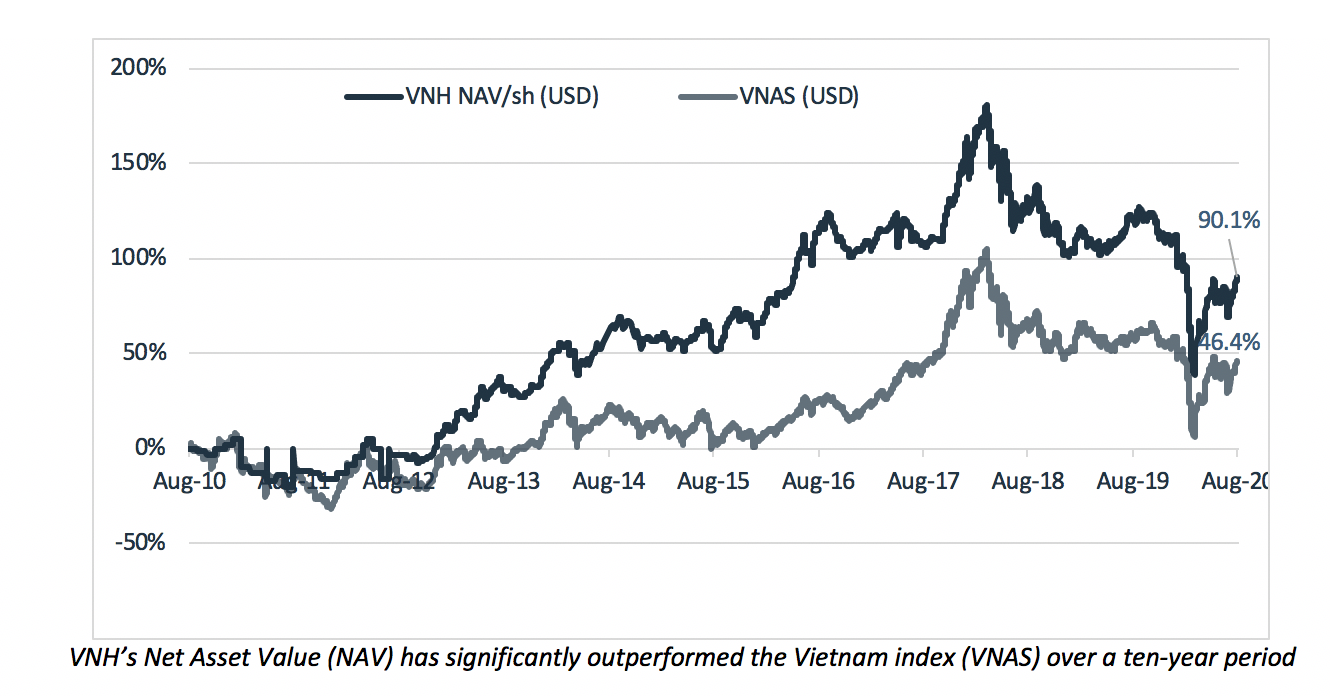
 Once such fund is Vietnam Holding (LSE: VNH), a closed-ended investment company listed on the London Stock Exchange. VNH has been a signatory of the United Nations Principles for Responsible Investing (UNPRI) for over a decade, and features ESG thinking into its investment decisions. It was recently awarded top marks by the UNPRI. VNH is an actively managed fund, supported by a Vietnam-specialist fund manager with a team of 12 professionals on the ground. It is entirely invested in Vietnam, with a portfolio of 24 leading companies, following the core themes of Industrialization, Urbanization and Domestic Consumption. Over the last decade the fund’s Net Asset Value has outperformed the Vietnam All-Share index (VNAS), increasing by 90% versus 46% for the VNAS.
 Shares in Vietnam Holding can be bought and sold through your stockbroker or wealth management advisor. There is no minimum investment size and the Company publishes its performance (movements in the value of the underlying portfolio of stocks) on a daily basis. A three-to-five-year investment horizon is recommended for investors.
This article was written by Craig Martin, Chairman of Dynam Capital Limited. Dynam is the Guernsey regulated fund manager for Vietnam Holding (LSE: VNH). Investors should do their own research or consult with their advisors before making a decision to invest in stocks, and the value of investments can go down as well as up.
Shares in Vietnam Holding can be bought and sold through your stockbroker or wealth management advisor. There is no minimum investment size and the Company publishes its performance (movements in the value of the underlying portfolio of stocks) on a daily basis. A three-to-five-year investment horizon is recommended for investors.
This article was written by Craig Martin, Chairman of Dynam Capital Limited. Dynam is the Guernsey regulated fund manager for Vietnam Holding (LSE: VNH). Investors should do their own research or consult with their advisors before making a decision to invest in stocks, and the value of investments can go down as well as up. N4 Pharma shares plunge 37%

N4 Pharma shares (LON: N4P) have plummeted over 37% on Monday’s opening.
Following news that recent research didn’t produce positive results, the company said it would be moving onto a new study of treatment into Covid-19.
In mid-August, the pharmaceutical company said stage two of the studies had been successfully completed, however, latest news shows that stage three was not as successful.
“Following the completion of stage-three of the proof-of-concept work and a review of the results, the company is continuing to explore the utility of Nuvec with the coronavirus plasmid and will progress to an in vivo study in due course,” said N4 Pharma on Monday.
“Whilst the single intradermal injection used in the stage-three pre in vivo study did not result in a measurable expression of the spike protein in the target cells of the murine target, neither did the positive control.
“Additional exploratory studies will continue to understand the translation potency of the coronavirus plasmid including optimisation of Nuvec plasmid loading.
“With this in mind and taken together with previous positive data, the company has decided to proceed to a full in vivo study to demonstrate the capability of Nuvec to generate Covid-19 specific antibodies.”
Nigel Theobald, the group’s chief executive, commented: “The initial pilot work of stage 3 of the Covid-19 proof of concept work was narrow in its scope and, having reviewed the results, we have taken the decision to move to a full in vivo study to establish an immune response through the production of antibodies.
“In undertaking the work we aim to demonstrate Nuvec(R)’s capabilities both as a potential delivery technology for multiple vaccines as well as for Covid-19 specifically. I look forward to providing further updates in due course,” he added.
N4 Pharma shares (LON: N4P) are currently trading -32.29% at 6,50 (0841GMT).
New Look plans CVA to avoid collapse
New Look is warning that unless it receives further rent cuts, it could go bust.
The retailer has seen sales suffer amid the coronavirus pandemic and is in the process of proposing a second company voluntary arrangement (CVA).
New Look employs 12,000 people across the UK and has 500 stores.
It will be the group’s second CVA in just two years.
The retailer will propose to pay rent at 400 of its stores based on two to 12% of its turnover.
Melanie Leech, Chief executive of the British Property Federation, said that changes to retail leases must be “underpinned by transparency and fairness, not as part of an underhanded attempt to exploit a legislative loophole to simply get out of leases freely agreed and signed by both parties”.
The retailer has seen a 30% year-on-year fall in sales, whilst sales have plummeted since shops have reopened since the lockdown.
Chief executive Nigel Oddy said in August: “Covid-19 has changed the retail environment beyond recognition, accelerating the permanent structural shift in customer spend and behaviour from physical retail to online, which we have seen in recent trading. Despite this, we still fundamentally believe the physical store has a significant part to play in the overall retail market and our omnichannel strategy.”
“However, the magnitude and speed of the shift in consumer behaviour and confidence nationwide requires a change in the way leases are structured in order to manage uncertainty so that stakeholders share both risk and upside, and to ensure continued business viability.”
The meeting date to decide on the CVA will be held on 15 September and will require a 75% vote.
Post Office in talks to sell telecoms and insurance arms
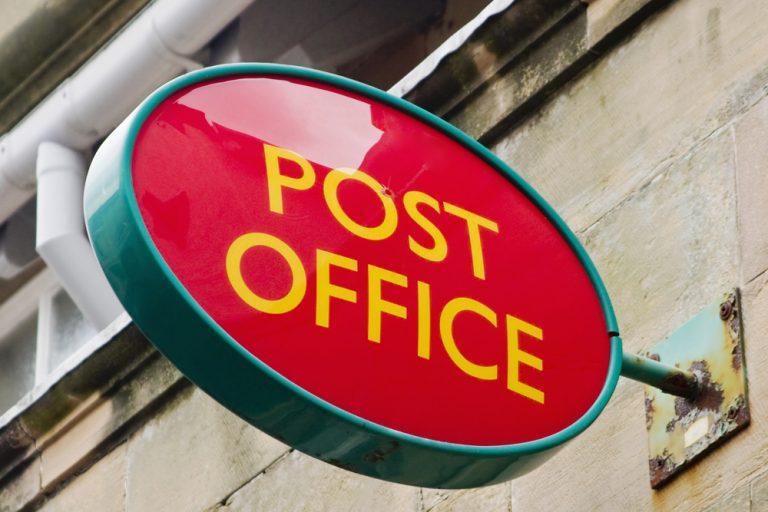
The Post Office is in talks over selling its telecoms arm and its insurance business.
The new chief executive, Nick Read, hopes to shake things up as he was appointed just last year at the government-owned business.
The Post Office is reportedly selling the telecoms arms, which has 500,000 customers and an annual revenue of £150m, for £100m. Meanwhile, the insurance arm of the business has 300,000 customers.
A source told Sky News that selling both of the divisions will allow the group to focus on mail, parcels, cash and banking services.
Read joined the Post Office almost a year ago from the Nisa convenience store group. He continues to deal with the effects of the major scandal that saw Post Office branch managers wrongly sent to prison.
Last year the group agreed to pay £58m to settle a legal claim brought by a group of 550 branch managers.
The group has declined to comment.
US budget deficit hits record highs
The US budget deficit has hit a record high of over $3tn (£2.3tn), as the government continues to spend billions on coronavirus relief.
Within the first 11 months of the financial year, the US government spent a total of $6tn – $2tn of which was on Coronavirus relief.
The country only took in $3tn worth of taxes during this same period of time, leaving a difference that is over double what it was during the 2009 financial crisis when the full fiscal 2009 deficit totaled $1.4 trillion.
Nancy Vanden Houten of Oxford Economics said in a research note: “While we expect policymakers to enact another fiscal relief package, it won’t come soon enough to have an impact on this year’s deficit.”
There is one month left in the US’ financial year, which could see the budget deficit grow even higher.
Alan Blinder, a professor of economics and public affairs at Princeton University, told the BBC earlier this year: “So far, the answer has been everything is fine, as to how much borrowing the United States government can do before investors start to feel satiated with US debt. But there is a legitimate question.”
The non-partisan Congressional Budget Office has estimated the full-year deficit in the US to reach $3.3tn.