
UK housing: August sees total sales of £37bn

The latest figures from Rightmove have revealed a “mini-boom” in the UK’s housing market.
This August saw the highest number of monthly sales in over 10 years as the usual summer rest was replaced by high levels of activity.
As pent-up demand from lockdown is released and more properties come onto the market, total monthly sales reached £37bn and were 37% higher than the same month in 2019.
During the UK lockdown, the housing market was put on pause and reopened in mid-May. Since, activity levels have been high – helped by a stamp duty holiday on homes costing up to £500,000 in England and £250,000 in Wales and Scotland.
“There have been many changes as a result of the unprecedented pandemic, and these include a rewriting of the previously predictable seasonal rulebook for housing market activity and prices,” said Miles Shipside, a Rightmove director.
“Rather than just a release of existing pent-up demand due to the suspension of the housing market during lockdown, there’s an added layer of additional demand due to people’s changed housing priorities after the experience of lockdown.”
“Patience will be required, especially with some lenders limiting their product ranges due to capacity constraints in their ability to process mortgages.”
Despite the flurry in activity seen in the housing market, Nationwide has warned that the increase in sales will be shortlived. As the furlough scheme ends in October and a new wave of people will be made redundant, the market will start to slow down.
“Most forecasters expect labour market conditions to weaken significantly in the quarters ahead as a result of the after-effects of the pandemic and as government support schemes wind down. If this comes to pass, it would likely dampen housing activity once again in the quarters ahead,” said Robert Gardner, Nationwide’s chief economist.
Will Amazon overtake Tesco in the UK grocery market?
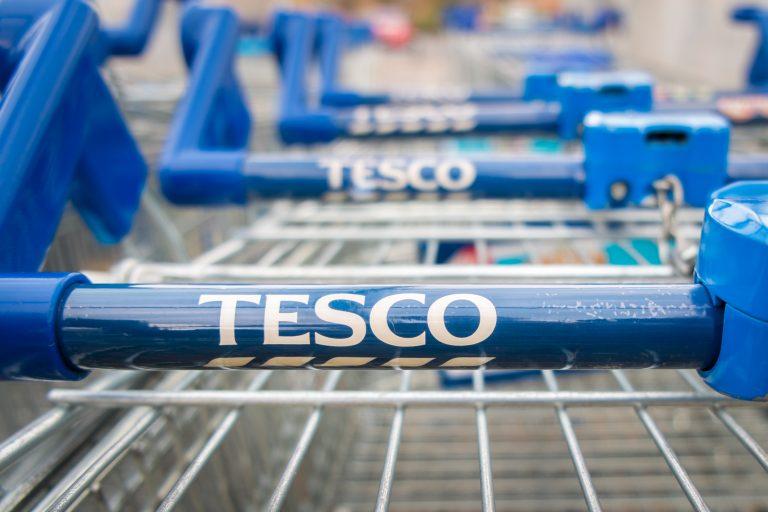
In an attempt to keep Amazon at bay from taking more of the UK grocery market, Tesco has announced plans to scrap delivery fees to members of its Clubcard Plus loyalty scheme.
Although the supermarket normally charges customers a standard £4.50 for a delivery slot, the group hopes to introduce free delivery for premium members.
The news comes one month after it was revealed that Amazon plans to offer free delivery of its Amazon Fresh scheme to 15m Amazon Prime members.
The Amazon fresh service offers cheese and bakery, fruit, and vegetable items to customers.
To try and keep Amazon from stealing a huge portion of the grocery market, Tesco last month introduced Clubcard Plus. The scheme costs £7.99 a month and includes perks such as 10% off two shops per month.
Dave Lewis, Tesco’s chief executive, said in an interview with the Sunday Times: “I understand the move [from Amazon]. The idea of Prime is very similar to where we are in Clubcard Plus, in terms of bringing a whole bunch of benefits together. So an opportunity into the future for us is to think about how we put delivery into Clubcard Plus. That’s always been the direction of travel.”
Is Amazon likely to overtake Tesco?
Currently, no. According to data from market researcher Mintel, Tesco has 30% of the UK grocery market whilst Amazon has just 3%. Amazon’s share is likely to grow, however, as the retail-giant has boomed throughout lockdown. The online grocery market is also expanding, as lockdown saw shopping habits change. “It is interesting to see Tesco these days following Amazon on deliveries and Aldi on price,” said retail expert Richard Hyman. “I think Tesco needs to invest in its own strengths, set its own agenda, and not be seduced into following theirs,” he added.


FTSE 100 sinks on travel restrictions and US stimulus stalemate
The FTSE 100 sank on Friday and in the process wiped nearly wiped the entire weeks gains as the latest round of UK travel restrictions, poor Chinese data, and a stalemate in the US stimulus debate sapped confidence from the market.
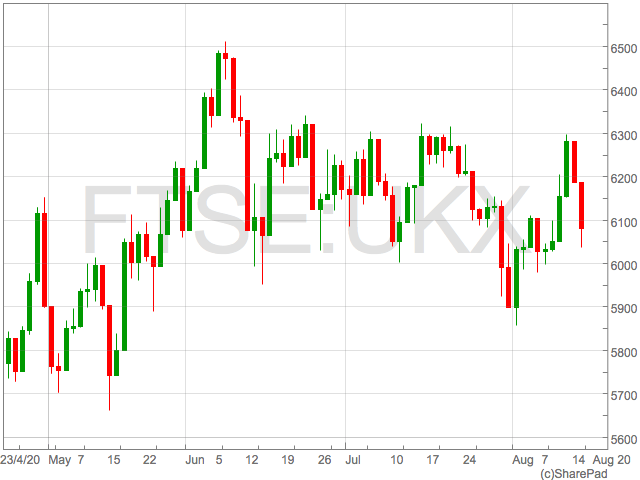
The FTSE 100 traded as low as 6,033 in morning trading on Friday, before recovering some of the losses as US markets opened.
The implementation of fourteen day quarantines for UK citizens returning from France, Holland and Malta sparked negativity in markets as airline International Consolidated Airlines crashed over 6% whilst aircraft engine maker Rolls Royce shed 4%.
 There was little in the way of positivity from FTSE 100 shares with only minor gains noticeable in packaging company Smurfit Kappa and a number house builders.
 There was little in the way of positivity from FTSE 100 shares with only minor gains noticeable in packaging company Smurfit Kappa and a number house builders.
Stimulus stalemate
In addition to concern around further restrictions on travel, the US Congress has taken leave without finalising a $1 trillion stimulus package to support the US economy through the coronavirus pandemic. There are currently no talks scheduled to break the stalemate between Democrats and Republicans. With Congressmen going on their vacation, a deal over potential stimulus will be postponed. This has left a vacuum in US politics and attention has shifted towards the upcoming US election in November and the possibility of Joe Biden taking the White House. The market has mixed feeling about Joe Biden who is seen to be a negative force through tax increases but its also likely to enact significant infrastructure spending which will provide support for the US economy.Chinese data
Chinese data was also a cause for concern as consumer activity remained soggy and industrial production missed estimates. “Once again Chinese retail sales became a sticking point for the markets. Though an improvement on June’s -1.8%, July’s -1.1% reading marked the 2nd month in a row that retail sales in the country had failed to climb back into positive territory as expected,” said Connor Campbell, analyst at Spreadex. “Combine that with an industrial production reading that remained unchanged at 4.8%, missing the forecast 5.1%, and there are signs of a stalling recovery in the superpower.”Travel shares tumble on new quarantine rules, dragging down FTSE 100
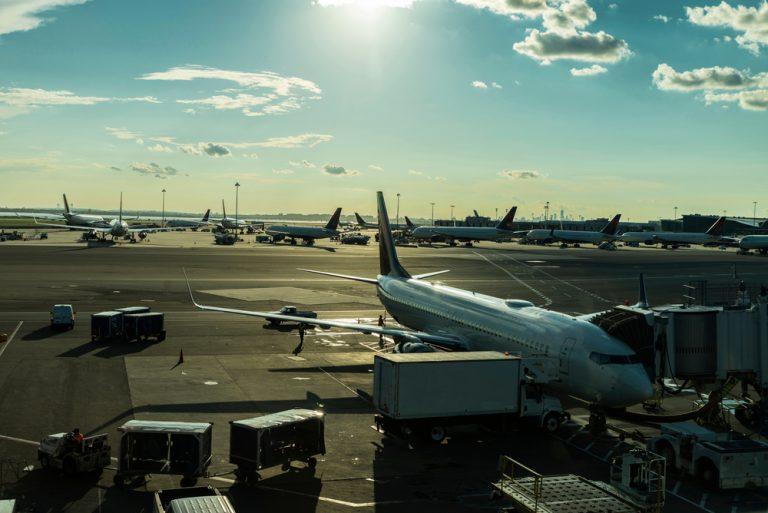
Shares in Easyjet (LON: EZJ), Ryanair (LON: RYA) and IAG (LON: IAG) are down on Friday morning as the UK government announced France to be removed from the UK’s travel corridor list.
From 4 am on Saturday, travellers will have to quarantine for 14 days or face a fine due to a spike in new Coronavirus cases. France and the Netherlands have joined Spain, Belgium and Luxembourg on the list of countries that are on the quarantine list.
Easyjet shares fell over 7% on the news, following the news that the budget airline had finished the sale and leaseback of 23 aircrafts to raise a total of £608m amid the pandemic.
Easyjet has already withdrawn £600m from the Bank of England’s Covid Corporate Financing Facility, as well as raise £419m through the issue of new equity.
On Friday morning shares fell 49.42 points to 6140.28. Neil Wilson, chief market analyst at Markets.com, said that adding new countries to the quarantine list would “force a large swathe of cancellations right at the peak of the summer holiday season for one of the largest markets for UK tourists”.
IAG (LON: IAG) shares were also down over 6%, whilst Ryanair shares are trading down over 4%.
Michael Hewson, chief market analyst at CMC Markets, remains positive despite the fall.
“It’s also important to remember that for all of the weakness of the last 24 hours that markets here in Europe remain on course for their second successive weekly gain, despite some anxiety about rising infection rates across various parts of Europe, as well as here in the UK,” he said.
GVC cancels its dividend with half-year profits falling 13%

Gaming and sports betting company GVC (LON:GVC) announced it would cancel its dividend after a challenging half-year of pandemic trading.
The company saw first-half revenues fall year-on-year by 11% from £1.78 billion to £1.58 billion. This drop led to similar drops including a slide in earnings, with underlying EBITDA falling 5% from £367 million to £349 million. Similarly, the company reported a gross profit of £1.03 billion, contracting 13% year-on-year from £1.18 billion during the first half of FY19.
GVC stated, however, that the difficult trading period had been somewhat cushioned by strong activity in its online gambling division, with the company’s online earning rising by 53% during the period.
Despite this, the company said it recognised the difficulties it would face in what would continue to be an uncertain market, and as such, it had decided to conserve cash by cancelling its interim dividend, which had stood at 17.6p a share at the end of H1 FY19. Similarly, shareholders would see their dividend cover shrink further with basic EPS falling from a 0.6p loss per share, to 1.0p loss per share, while adjusted diluted EPS fell from 31.3p to 28.7p year-on-year.
GVC response
Commenting on the results and outlook, company CEO Shay Segev stated:“Given the unprecedented trading environment, GVC has delivered an encouraging performance in the first half, underlining the strength of our diversified business model and the expertise, adaptability and dedication of our people.”
“These results show that we have a strong foundation. As a technologist, I have huge admiration for what Kenny and the rest of my colleagues have achieved but I am also determined to pursue a programme of continuous improvement as we focus on our four technology-enabled priorities.”
“These are leading the US market, organic growth, expanding into new markets, and being the most responsible operator in our industry. Our industry-leading technology will enable us to grow responsibly and sustainably, using our data-driven customer insights to ensure all of our customers have an enjoyable and safe experience while gaming with us. That is how we will deliver greater and more sustainable value for all our stakeholders.”
Investor insights
Following the announcement, GVC shares dipped slightly by 0.61% or 4.80p, to 780.60p per share 13/08/20 12:59 BST. This is comfortably below its 12-month target price of 1,080.00p, while also a 40% increase on its price on this day last year. The company’s p/e ratio stands at 12.06.RA International shares rally 24% on ‘major’ contract win

Construction, facilities management and supply chain services provider, RA International Group PLC (AIM:RAI) saw its shares spike on Thursday, as the company announced it had been awarded a ‘significant’ contract.
The contract was signed with an undisclosed, ‘large’, ‘global’ construction firm with a focus on the oil and gas sector. It spans over a two year period and is expected to be worth a minimum of US$60 million dollars over that time frame.
RA International stated that under the agreed terms, it would be fulfilling its integrated facilities management capacity in Southern Africa. It added that the contract’s nature means that activity will escalate as time passes, with the provision of the company’s services expected to commence within a year of the contract being awarded.
The company also said that today’s contract award represents a ‘significant’ contribution to its order book, now standing at US$188 million.
Commenting on the news, company CEO Soraya Narfeldt, stated:“This is an important contract win for RA International that underlines the strengths of our business and our growing reputation for managing and delivering large, complex projects for commercial clients in the energy sector.”
“It is testament to our capability to provide a full service offering to our clients’ personnel, to the value of our long-term, strategic approach to planning and to our focus on delivering resourceful solutions for clients notwithstanding COVID-19 and project specific challenges.”
Following the contract announcement, RA International shares rallied by a healthy 23.92%, or 11.05p, to 57.25p a share 13/08/20 12:00 BST. This rally saw the company take the top spot as Thursday’s biggest riser. It also sees the company beat its previous year-to-date high, which was set on Wednesday when the company hit 46.2p a share. The Group’s p/e ratio is currently 8.15, its dividend yield stands at 2.17%.UK job vacancies on the rise, new figures show

New data from the Office of National Statistics has revealed UK job vacancies to be increasing.
Between 31 July and 7 August 2020, the total volume of online job adverts increased from 53% to 62% of its 2019 average. This is the largest weekly increase in 2020.
Whilst unemployment is on the rise and companies continue to announce large-scale redundancies, job adverts are on the rise.
According to Jonathan Planner, an independent head hunter, the new figures should be taken with a “pinch of salt”.
“Pretty much all of my clients have shut up shop until next year so the increase in the number of online job ads is an enigma,” he said.
“I can only think that some employers are having to hire additional junior staff as people who have been working for them over the summer start heading off to university.”
The largest rise in UK vacancies was in transport, logistics and warehousing, which boasts a 117% rise in the 2019 figures amid the pandemic.
Meanwhile, job vacancies in media, arts, and culture have fallen by 41%.
London mayor, Sadiq Khan, has called on Boris Johnson to do more to protect the sector.
“Until we have an operational vaccine in place social distancing will have to continue to protect people’s health, and with employers planning to continue home-working well into next year, the numbers of people visiting the West End will be reduced for many months ahead,” he said.
“As Mayor I’m doing all within my powers to help.”
Watches of Switzerland shares soar on “strong performance”
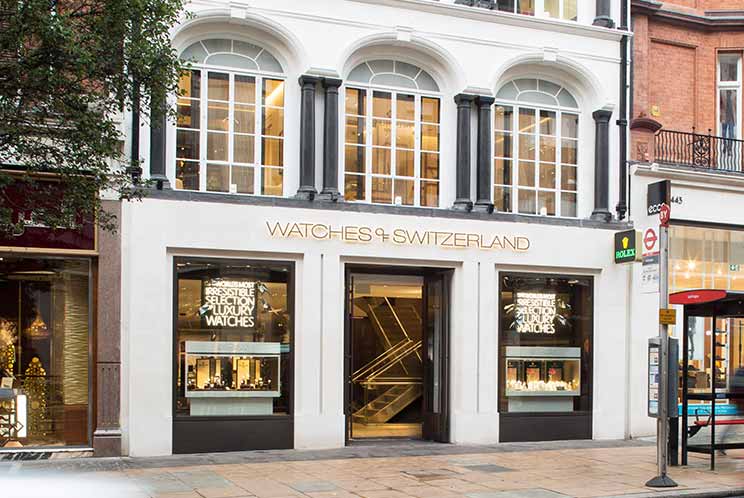
Shares in Watches of Switzerland (LON: WOSG) have soared 25% on Thursday after the group posted a sales growth in June and July.
Despite a fall in sales during the lockdown and 27.6% fall in revenue in the three months to 26 July, the luxury watch retailer said it was “delighted” with sales since the reopening of stores.
Whilst stores were closed over the lockdown revenue fell, online sales jumped 79.3% in the quarter.
In the year to April 26, revenue grew by 5.9% to £819.3m.
“I am delighted with our achievements during FY20, our first year as a public company. We delivered a strong performance during the first 46 weeks of the year before adapting with speed and agility to the challenges presented by the COVID-19 pandemic. Momentum accelerated in our US business adding to the positive performance in the UK and we remain confident in our strategy to drive profitable growth in both markets,” said Brian Duffy, the chief executive officer.
“Looking ahead, we will continue to invest in delivering on our strategic priorities to leverage our leading position in the UK and to become a leader in the US luxury watch market. We are confident that we are well-positioned to emerge even stronger from these uncertain and challenging times,” she added. The company is off to a promising start after floating in London last May. Watches of Switzerland (LON: WOSG) shares are currently trading +21.86 at 319.26 (1117GMT).