Grafton see better trading in November and December in “subdued” market

0

Grafton Group Plc (LON:GFTU) have said that their trading in November and December has been better than expected in an update on Tuesday.

Grafton said that the home building and property market still remains “subdued”.

The building materials supplier expects to report adjusted operating profit of about £202 million for 2019, compared to £194.5 million in 2018.

The firm added that it expects 2019 revenue from continuing operations to be £2.67 billion, a stat which will please shareholders.

In the first half, Grafton totaled revenues of £1.44 billion from current operations, however the firm noted the sale of its specialist UK plumbing and heating business Plumbase and its Belgian Merchanting unit.

Daily like for like revenue is expected to climb 1.9% higher in 2019, compared to one year ago. However fourth quarter like for like revenue did slip 1.8%.

In the UK Grafton remained cautious in a property market which had been hit by both political and economic shocks.

The weak markets of September and October continued into November and December but did not deteriorate further, Grafton noted.

Grafton’s Merchanting unit in Ireland saw volumes recover in November, with its Chadwicks business ended the year on a “firm note”.

Gavin Slark, Chief Executive Officer of Grafton Group plc commented today:

“2019 was a year of significant strategic progress with the acquisition of Polvo in July which increased our scale and consolidated our market leading position in the Netherlands. We also reshaped our portfolio of businesses with the successful disposal of Plumbase and the Belgian Merchanting business in October. “

“While we remain cautious about the timing of any recovery in the UK merchanting market at this very early stage in the New Year, our expectations for 2020 are positive for the overall Group and we are optimistic about growth opportunities. We are well placed to continue to successfully implement our development strategy supported by very cash generative businesses and a strong balance sheet.”

Progress from October update

In October, the firm issued a statement warning shareholders that profits may be significantly lower than expected.

Grafton announced they would miss annual profit expectations as the UK construction sector comes to grips with Brexit uncertainties.

The Irish company added that trading had been slow despite a good performance in the home market.

Additionally, Grafton said that demand for materials has been hit by legislation in the Netherlands, with limits Nitrogen emissions. This has delayed the granting of permits for new construction periods.

Grafton operate across the the merchanting, retailing and manufacturing sectors have speculated full year profits of £193.5 million, significantly lower than expected.

The FTSE250 company concluded, that there was signs of recovery with an encouraging start, but trading towards the end of the quarter had been impacted by sombre activity.

How are competitors performing?

B&Q who are owned by Kingfisher plc (LON:KGF) have also seen a tough time of trading over the last few months.

The FTSE 100 listed firm said trading in the three months to October was “disappointing”, with sales falling 3.7% to £2.96 billion.

Like-for-like revenue slipped 3.7%. Kingfisher said this “reflects continuing disruption from new range implementations, lower promotional activity and ongoing operational challenges in France, and softer market conditions in our main markets”.

B&Q sales sank 3.5% year on year to £820 million, slightly offset by an eight per cent rise in Screwfix sales to £477 million.

Additonally, Barratt Developments (LON:BDEV) reported lower sales and a fall in the value of homes sold in their October trading update.

Barratt have said they expect the volume of house sales to grow toward the end of the of their medium-long term target range of 3-5% annually.

Total sales rose to 12,963 units from 12,903 earlier this year.

However, this was offset by a fall in the value of these homes by 2.4% to £3.07 billion.

Interest rates are still low by historical standards, giving an opportunity for new homeowners to pounce on this opportunity.

Looking at the state of the property market, Grafton have performed relatively well and shareholders should not be too worried as political uncertainties continue to hit the property market.

Shares in Grafton trade at 899p (+4.84%). 14/1/20 11:16BST.

AnaCap invests in Parisian redevelopment project

French private equity firm AnaCap Financial Partners announced on Tuesday that it had invested in a newbuild Grade A office in Paris. The acquisition is being made through an off-plan forward contract of the 16,300 square metre asset in Bobigny. This allows the company to add a presence within the active Paris property market, which currently has a vacancy rate of 1.8%. The building was designed by Leclercq Associés and developed by BNP Paribas Immobilier Promotion (ENP: BNP) and GA Smart Building. It serves as part of a wider redevelopment project in Bobigny, with plans for 140,000 square metres of office, 1,380 new residential units, 8,000 square meters of public services and 20,000 square metres of public space as ‘tenants seek larger scale, affordable properties close to the centre of Paris’. It is located near Bobigny metro, and is expected to enjoy access to three further transportation lines by 2025.

AnaCap comments

Sébastien Wigdo, Investment Director at AnaCap Financial Partners, stated, “This investment represents the opportunity to develop a high-quality property adjacent to a Paris metro station, in an emerging area that is enjoying a meaningful transformation. It is also part of our strategy to continue to build upon AnaCap’s well established investment track record in both France and more broadly across Europe by carefully selecting assets which we believe offer exceptional risk-adjusted returns.” Elsewhere in property; Schroder Real Estate Investment Trust (LON: SREI) disposes of its lower yield assets, Land Securities Group plc (LON: LAND) posted underwhelming financial results, Shaftesbury plc (LON: SHB) booked robust leasing activity and Berkeley Group Holdings Ltd (LON: BKG) restated its confidence in the South-East market.  

Boohoo shares spike over 5% after annual guidance is lifted

2
Boohoo (LON: BOO) have once again pulled out an impressive set of results in their update on Tuesday morning. The firm updated the market this morning saying that it has raised its annual guidance following strong revenue growth. Also in the update, the firm said that it had appointed former JD Sports (LON:JD) chief financial officer as its new deputy chair. Brian Small, will take up this position with immediate effect having held executive positions at Mothercare (LON:MTC) and Pendragon (LON:PDG). For the four month period, which ended on December 31, the firm said that its revenue had jumped 44% to £473.7 million from the £328.2 a year ago. Boohoo said that it expects revenue growth for its financial year, which ends on February 29 to be between 40% and 42% ahead of their previous guided range of 33% to 38%. The firm added that t expects adjusted earnings before interest, taxes, depreciation and amortisation margin to be 10% to 10.2%, beating its previous guidance of around 10%. John Lyttle, CEO, commented: “I am delighted to report the group has enjoyed record trading in the last four months of 2019. All of our brands have performed exceptionally well and delivered strong market share gains. We have continued to see operating leverage in our more established brands, and will continue to invest into them and our newly-acquired brands. The newly-acquired brands, MissPap, Karen Millen and Coast, are showing great promise and open different target markets for the group, in line with our strategy to build our multi-brand platform.” Analysts have praised BooHoo for their performance in a market which seems to be slumping. John Woolfitt, Director of Trading at Atlantic Capital Markets: “Its not all doom and gloom for retail, well at least not if you are operating online. The fast fashion king Boohoo has today hiked guidance after a record quarter and investors will be pleased with the progress the group has made in 2019.” “The integration of new acquisitions such as Miss Pap, Karen Millen and Coast will add to earnings potential over the coming year to build on what has been a very successful festive trading period.” “Investors will take results from Boohoo as additional confirmation that if you are investing in the UK retail sector, you have to focus on the online retailers.”

Boohoo only get stronger

Boohoo have gained strength and consolidated their position in the fashion wear industry. Just over a month ago, the firm saw their shares soar following reports of record number sales across the Black Friday weekend. Boohoo said that it saw a record performance over the Black Friday weekend, as trading since the half year period had remained strong. “Both warehouses have had a strong operational performance,” the online fashion retailer added. Boohoo said: “Our new brands, Karen Millen, Coast, and MissPap, have been successfully integrated onto our platform. Initial ranges have been very well received, and we continue to broaden our product ranges as we progress our multi-brand strategy.” In the year to the end of February, boohoo reported 38% growth in pretax profit to £59.9 million, as revenue rose 48% to £856.9 million. Revenue growth across all territories and brands was strong, the company noted, with UK revenue up 37% and international revenue up 64%. Boohoo are continuing to defy the odds and theories which suggests that the retail market is slumping, and shareholders will only be getting more and more impressed with the firms performance. Shares in Boohoo trade at 334p (+5.19%). 14/1/20 10:56BST.

Markets unphased by US-China trade deal progress

Markets dipped slightly on Tuesday morning, despite what appeared to be a warming up of good sentiments between the US and China, and the expected passing of the first phase of a trade deal. Progress was largely priced in by markets, and thus the news didn’t have quite the impact it would have done a few months ago. The good news stories this morning came from the FTSE, which was able to outperform its counterparts following a disheartening GDP reading on Monday, which pushed Sterling down. Elsewhere, Boohoo (LON: BOO) saw its revenues bounce 44% during the final four months of 2019, which saw the online fashion retailer buck the cheerless trend set by its peers. Elsewhere in retail and the highstreet, Christmas proved costly; Marks and Spencer (LON:MKS) issued an underwhelming update, Tesco (LON: TSCO) suffered in Europe though it reported a potential sale of its Asian business, and Sainsbury’s (LON:SBRY) saw a drop in quarterly sales. Speaking on trade deal progress and the morning’s updates, Spreadex Financial Analyst Connor Campbell stated,

“The markets didn’t really get anything from the newly revealed details of the US-China trade deal, instead drifting lower after the bell.”

“With the agreement all ready to be signed tomorrow, Washington removed the ‘currency manipulator’ label from China – a symbolic gesture rather than tangible one, but nevertheless another example of thawing relationships between the two superpowers.”

“This helped send the yuan to a 5-month high, but did little for the Western indices. Instead the DAX and CAC fell 0.5% apiece, with the Dow Jones set to drop 0.4% later this afternoon. The FTSE avoided the same kind of losses, though was still down a handful of points.”

“The trouble is, the positive aspects of the trade deal are pretty thoroughly priced in. In contrast, any rogue comments from Donald Trump in the coming days – especially those related to ‘phase two’, if the US and China ever get to that point – may then have a disproportionate impact on the markets, good or bad.”

“The reason the FTSE was able to outperform its peers was the continued weakening of sterling. The pound lost another 0.2% against dollar and euro alike, the ongoing speculation of an incoming interest rate cut, heightened by Monday’s dreadful GDP reading, weighing on the currency.”

“It was, broadly, a terrible Christmas for UK retailers. However, as is often the case, boohoo managed to buck the trends that have afflicted its high street peers, crying tears of joy after a record quarter. For the 4 months to the end of 2019 revenue jumped 44%, causing it to lift its forecast growth for the year to 40-42% against previous estimates of 33-39%. That increase was enough to send the stock to a fresh all-time high, the fashion brand rising 3.3% to strike £3.28.”

Taylor Wimpey expect results to be steady following turbulent 2019

2

Taylor Wimpey plc (LON:TW) have told the market that they expect their results to be in line with expectations.

The firm had alluded to both political and economic complications across the 2019 trading year, as the property market was hit by external shocks.

The FTSE 100 trader said that the housing market remained stable in the last year, however there were challenges faced in London and the South East.

Taylor Wimpey noted that total house completions in 2019 has increased by 5% to 15,719 which included joint ventures.

“While 2020 will continue to be a year of change for the UK, we welcome the increased political stability following the general election,” the company said.

“We start the year with a strong order book and continue to target a smoother profile of completions throughout the year but expect 2020 to continue to be second half weighted,” the housebuilder said.

2019 ended with a record total order book valued at £2.17 million, which showed a ruse from the £1.78 figure a year ago.

The house builder said that it remains cash generative and intends to return £610 million to shareholders in a dividend form.

Pete Redfern, Chief Executive, commented:

“Our results for the year to 31 December 2019 will be in line with our expectations. Despite an uncertain political and economic backdrop in 2019, we have continued to experience a good level of demand for our homes and trading in the second half of the year was as anticipated. The Group has again delivered a record sales rate and we increased home completions by c.5% in the year.

In 2019, our focus was on strengthening the long term sustainability of the business, further improving our build quality and customer offering, as well as increasing operating capacity and flexibility. In 2020, we will continue with these initiatives and will also prioritise a renewed cost focus and process simplification improvements.”

Operating profit for the period was down 9.4% to £311.9 million, however this was attributed to higher build costs and geographic mix.

Market analysts have been somewhat impressed with the performance of Taylor Wimpey, which will please shareholders.

John Woolfitt, Director of Trading at Atlantic Capital Markets commented

“Today’s figures show, that despite political uncertainty, the sector is still performing well. Record sales rates for Taylor Wimpey and an increase in home completions all bode well for the builder’s shares which are shaking off any concerns over slowing house prices.”

“This, and a positive outcome for the conservatives in the December election, has also led to further upgrades for the whole sector and a positive outlook for the year ahead.”

“Dividends increased significantly to £600m in 2019 and although dividends are not set to jump to the same degree in 2020, investors can look forward to a similar payout of around £610m from Taylor Wimpey in the year ahead.“

Wimpey build from November

In November, the firm reported strong demand in their second half update.

Taylor Wimpey did warn homebuilders about potential rising costs in 2020, however in the Wednesday statement, the firm speculated that cost inflation may reduce in 2020 instead.

The FTSE 100 listed home builder, reported a 12.5% rise in its orders, to £2.7 billion as it exploited strong demand coupled with lower interest rates and the governments Help to Buy scheme boosting demand.

Total order book, excluding joint ventures, stood at 10,433 homes as at November 10 from 9,843 homes a year earlier.

The Homebuilding market – Boris Bounce wears off

Just as the election results were hitting news headlines on 13th December, many of the British Home builders saw their shares in green.

Notable rises came from Berkeley Group Holdings PLC (LON:BKG) whose shares spiked 13.06%, whilst Barratt Developments Plc (LON: BDEV) shares rose 12.52% to 755p.

MJ Gleeson (LON:GLE) updated the market last week saying that they remained confident in a home building market that was still facing uncertainty.

The householder said that its Homes unit had sold 811 units during the half year period to end 2019, which saw a 17% climb year on year from the 691 figure.

Additionally, Gleeson said that the demand for its low cost homes remains strong and is on track to deliver full-year unit completions in line with expectations.

For financial 2019, the firm reported pretax profit of £41.2 million, which showed growth by 11% from the £37 million a year ago.

The results today posted by Taylor Wimpey are impressive, and shareholders will be keen to see how 2020 unfolds as the Brexit negotiations take their turn and hopefully many political uncertainties are cleared.

Shares of Taylor Wimpey trade at 205p (+1.88%). 14/1/20 10:34BST.

Uncertain future for Lekoil after facility fraud

Nigeria-focused oil company Lekoil Ltd (LON: LEK) thought it had the cash to exploit its OPL310 project. It turns out that the funder was a fraud and it puts in question the prospects for Lekoil.
An appraisal drilling programme is planned on the Ogo prospect, which is part of the OPL310 licence area, where Lekoil has a 17.14% participating interest. Two wells are planned and the first should be drilled in the second half of 2020. Alternative funding is required.
Fraud
On 2 January, Lekoil believed it had agreed a $184m facility with Qatar Investment Authority, but it says that certain individ...

Will Bidstack shares overcome this hurdle in their business model?

Bidstack (LON:BIDS) are expanding into the very exciting gaming industry and have recently announced agreements with a major agency, a key step to future success. However, Bidstack are attempting to enter an extremely competitive programmatic advertising network market and will be taking on some of the world’s largest technology companies. Although Bidstack are providing innovations through the context of in-game displays such as football hoardings, they lack a significant function other digital advertising in direct engagement. The Beauty of advertising networks run by Google, Amazon and Facebook at is the ability to drive and track engagement with adverts. Whether it be display banner adverts run by Google or an advert to download an App through Instagram, advertisers are able to measure the effectiveness of their adverts by tracking clicks, downloads or sign ups and analysing the cost per engagement.

Bidstack Business Model

Here lies the fundamental flaw in Bidstack’s model. Adverts run through Bidstack’s inventory is void of opportunity for engagement. Bidstack have said they don’t want to ruin the immersive experience of gaming. This is attractive to the game developer, but not so much to potential advertisers. Can you imagine a gamer playing Fifa online and pausing their match mid flow to interact with an advert and buy a product? It seems unlikely. Firstly because the functionality isn’t there and it is very doubtful to ever be there at a meaningful scale. Secondly, and most importantly, gamers are going to have little propensity to stop their game and make third part purchases, even if they could. This removes a lot of the potential value from Bidstack’s business model when compared to the traditional digital advertising networks. However, it doesn’t render it completely worthless. The attention of gamers carries significant value. Twitch is an example of this. The challenge for Bidstack is their inventory merely replicates an out-of-home advertising model but places it in a digital environment, without the interaction enjoyed by other forms of digital advertising. This may raise questions among the major agencies when creating plans for the world’s leading advertisers.

Demographics

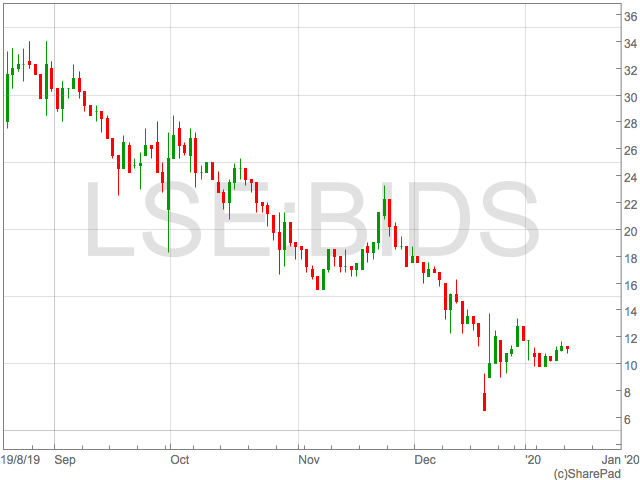
Despite engagement presenting a potential hurdle, Bidstack does provide value to advertisers in the form context and the ability to gain the attention of a specific demographic. Harnessing this effectively is where long term shareholder value should be created given the recent decline in social media users. The recent slow down could signal a top in advertising growth through Facebook, Instagram and Twitter. This is of course a high risk assumption given the resources of the social media giants, but it may play into Bidstack’s hands. “Bidstack is a very interesting proposition and appeals to me as a more speculative aim stock. They look to have coupled up two sectors in a partnership that will see advertising delivered to a huge demographic in a new, unique and very passive way,’ said John Woolfitt of Atlantic Capital Markets. Summarising the potential risk of Bidstack’s model John Woolfitt continued “with any company like this you must see it for what it is, this is no defensive income share and it will need potential investors to understand the concept. Shares like this should occupy the smaller more speculative section of your overall portfolio.” “That all being said the company is well positioned to take advantage of the evolving technology, and as a lot of gamers globally are now in their 30’s and have disposable income they are well positioned to catch the opportunity at a time that has now seen the consumers become a valid audience for advertising.” Bidstack (LON:BIDS) listed in 2018 at 6p per share and currently trade at 11p, having reached highs of 42p in June.

City Pub Group fall 8% following festive slow down

1
City Pub Group PLC (LON:CPC) have said to shareholders on Monday that they will miss market expectations, leaving shares in red. The firm said that they experienced “subdued” trading across the festive period, which dampened expectations. In its financial year, which ended on December 29 the firm said that it had performed relatively well. The firm saw its revenue rise 31% to £59.8 million, as like for like sales jumped 1.7%. Following the slower Christmas period, the firm said that adjusted earnings before interest, tax, depreciation, and amortisation for the year is now expected to be slightly below market expectations, between £9.1 million and £9.2 million. Notably this would see a 15% rise year-on-year, which is something for shareholders to be pleased about. The pub chain also said that the 2018 festive period was a busy one compared to this year, where business slowed. However, a number of one-off factors in the last quarter of its year held back fourth-quarter performance. “The Rugby World Cup did not have the impact that we expected. Political uncertainty culminating in the December election held back sales until the result was known and unhelpful weather during November and December dampened trading further,” said the company. “There were also disruptions on South West trains throughout December due to industrial action, which had an impact on our London estate.” “The group has a strong business model that is quick to respond to the more normal trading conditions now prevailing,” it continued. “Efforts too refocus on operating margins are already underway and this year’s performance should see the benefits of this. In addition, there are two underperforming sites that have been earmarked and actively marketed for disposal.” Looking to its new financial year, City Pub Group noted it will benefit from some recently opened pubs. It also has three large developments which will open later in the year.

Generally successful year for City Pub

In September, the firm saw its profit rise as it posted impressive financial results for the first half of FY19. In spite of their trading performance following the announcement, the Company performed well during the first half, with like-for-like sales increasing by 2.6% and revenues spiking 36% on a year-on-year basis, to £27.1 million. This led the Group’s 20% EBITDA surge, to £3.6 million, and a 19% hike in adjusted profit before tax, to £1.9 million. City Pub Group said they had opened four new pubs during the period, with their in development becoming their main focus, in lieu of further acquisitions. The Company added that it had reaped the rewards of its new regional management structure and Weekly Employee Bonus Scheme, both of which the Group said would bolster growth and incentivise staff.

Competitors – JD Wetherspoon still leads the market

In November, J D Wetherspoon plc (LON:JDW) saw their shares spike following a bullish update. The British pub chain boasted strong sales figures, which increased across the quarter as customers spent more its nearly 900 pubs across Britain and Ireland. The company reported higher demand for coffee, pink gin, real ale and breakfast. Additionally beer sales rose significantly as British consumer trends changed by the quarter. J D Wetherspoon’s like-for-like sales rose 5.3%, which exceeded both market and analyst expectations. Additionally, the firm pledged to create 10,000 new jobs over the next four years in December. Wetherspoon updated the market by saying that they plan to open between 50-60 new pubs and hotels. These new branches will be located within in small and medium-sized British towns and cities but also in London, Edinburgh, Glasgow, Birmingham and Leeds as well as the Irish cities of Dublin and Galway. “Wetherspoon will not be entering into any deal like everyone else,” a company spokesman said.

Fuller, Smith & Turner experience turbulence

Another name in the industry, in Fuller, Smith and Turner (LON:FSTA) saw their shares crash a few weeks back. In January, pub operator Fuller’s agreed to sell its historic brewing operations to Japanese brewer Asahi Group Holdings Ltd (TYO:2502) for £250 million. Fuller’s expects the higher overhead levels to remain in place until the services agreement ends in May. Following this, the now pure-play pubs and hotels operator will be able to transition its costs structure to this new focused business. The statement provided updated shareholders saying that annual profit was set to be unchanged.The firm alluded to costs with the separation of its brewing business came in significantly higher than expected. Certainly, City Pub have performed well across their financial year. The firm still has lots of growth and development to undertake, but shareholders can remain confident that 2020 will be a productive year for the firm. Shares in City Pub Group trade at 198p (-8.97%). 13/1/20 14:28BST.

British economy sees weakest period of Economic Growth since 2012 in November

The British Economy has seen its weakest period of economic growth since 2012 in November. Figures released on Monday morning showed the British people that the economy in November had grown a modest 0.6%, which was the weakest figure since June 2012. This figure also represented a slowdown from the 1% annual growth figure in October, which has been hampered by both political and economic stresses. Output in November fell by 0.3% which was the biggest drop since April, and certainly the pre-election caution had hit both consumers and investors. In November, notable slumps came from British supermarkets and the Big Four saw their profits slump. Sainsbury’s (LON:SBRY) saw their profits fall across the Christmas period. n the 15 weeks to January 4, total retail sales, excluding fuel, were down 0.7% from last year. Including fuel, sales were down 0.9%, which has seemed to edge shareholders. In the three months to November, the economy grew 0.1% which was a positive note to take however the future of British retail and the British high street has never looked so glum On a more positive note, grocery sales rose 0.4% from a year ago with online grocery sales up 7.3% an area which the firm has looked to expand over the last few years. Additionally, Morrisons (LON:MRW) have reported that their sales have fallen in their update dating to January 5. The firm said that challenging trading conditions coupled with consumer uncertainty were the largest contributors to the slump in sales. Morrison’s said that said like-for-like sales, excluding fuel, were down 1.7% year-on-year. Additionally the decline was further accelerated by a fall in retail sales, as a like for like performance in the wholesale unit remained flat. Notably, fuel sales declined 2.8% year on year across the 22 weeks period, and total sales dipped 2.9% but the figure totaled 1.8% without fuel sale considerations. The weak data, reflected the uncertainty of last autumn about Brexit and the election, said John Hawksworth, chief economist for accountants PwC. “It is too early to say for sure if economic momentum will pick up in the new year now the political situation is clearer, but our latest survey of the financial services sector with the CBI does suggest some boost to optimism since the election,” he said. The British public are still in a stalemate and do not know which direct Brexit negotiations are heading towards. Indeed, the victory by the Conservatives has given British politics some clarity however the Boris Bounce has seemed to fade. PM Johnson is planning to take his deal to the EU this week, and the deadline set at January 31 still could be pushed further back if the EU stipulate against terms of the exit deal.

Caledonia Mining shares bounce over 5% following record production figures

0
Caledonia Mining (LON:CMCL) have seen their shares bounce on Monday afternoon following record production figures from its Blanket Mine. The firm said that it is considering to revise future dividends, and following the update today these could rise. At the start of the month, Caledonia said it would be paying $0.075 quarterly dividend, which was 9.1% higher than the previous figure. The firm said that it had delivered strong performance from the Blanket Gold Mine in Zimbabwe. The mine produced 16,875 ounces of gold in the last quarter of 2019, a record for the firm. The figure was 24% higher than the quarter before and 13% higher year-on-year The firms total production in 2019 was 55,182 beating internal guidance which was pitched between 50,000 and 53,000 ounces.

Caledonia remain optimistic in future outlook

Looking to 2020, the Jersey-based company sees gold production between 53,000 ounces and 56,000 ounces. Chief Executive Steve Curtis said: “I am delighted to report a production record at Blanket of 16,867 ounces in the fourth quarter. An improvement in the electricity supply and vigilant focus on grade control and production tonnage have resulted in an excellent production result for the final quarter of which our entire operational staff can be justifiably proud. “The impressive operational turnaround was achieved without any compromises on safety. This is a commendable achievement given the distractions posed by the challenging conditions experienced by our workers due to the economic environment in Zimbabwe.” “I am also pleased to see we have not lost this momentum as we start 2020 with the mine continuing to perform very well into the new year. With the improved operational performance and the current buoyant gold prices leading to healthy operating margins we expect Caledonia to continue its track record of strong cash generation,” Curtis continued. “I expect 2020 to be a landmark year for our business: we look forward to commissioning the central shaft later in 2020 which we anticipate will then deliver increased operating cash flows and reduced capital expenditure will follow.”

Shareholders remain impressed after beating annual guidance

In July, the firm said that it planned to retain its full year guidance as it updated shareholders on its Q2 activity. The Company stated that 12,712 ounces of gold were produced during Q2, which represented a 6.4% rise on the 11,948 ounces for Q1. Caledonia Mining retained its full year guidance of 53,000 – 56,000 ounces despite H1 output standing at just 24,660 ounces; this was 3.4% lower than last year’s volume of 25,582 ounces. The Company currently holds a 49% in Blanket Mine, but has penned a conditional agreement to expand this to 64%. It said it remained on target to reach its 80,000 ounces per annum target for 2022. “As at March 31, 2019, Caledonia had cash of approximately US$9.7 million. The Company plans for Blanket to increase gold production from 54,511 ounces in 2018 to approximately 75,000 ounces in 2021 and approximately 80,000 ounces by 2022,” the Company said.

Zimbabwe Operators

Firms that hold operations in Zimbabwe have also given the market solid updates over the last few months. Notably, Botswana Diamonds PLC (LON:BOD) and Vast Resources PLC (LON:VAST) have announced a deal to replace the Heritage concession agreement between the two firms. The new agreement outlines the formation of a new company which holds the interest of Vast Resources,the Chiadzwa Community joint venture and Katanga Mining (TSE:KAT). Additionally, the agreement expresses the intent to issue new shares representing 2.5% of the newly formed company to Botswana Diamonds once the detailed agreement between Katanga and Zimbabwe Consolidated Diamond Co becomes effective. Shareholders of Caledonia Mining will be pleased with the update today, as 2020 could be a year of growth and expansion for the London listed miner. Shares in Caledonia Mining trade at 668p (+5.20%). 13/1/20 13:49BST.