
FTSE 100 finishes 2018 down 12%
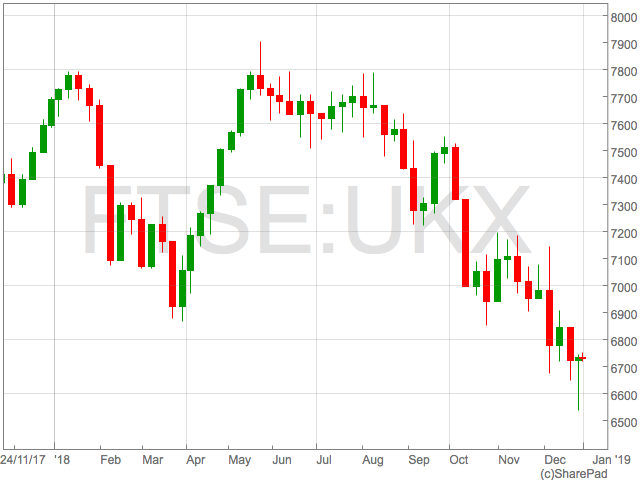
The FTSE 100 has posted a 12% drop in 2018 after suffering set backs from Brexit, US/Sino trade wars and the global tightening of monetary policy.
Despite finishing 2018 in the red, the FTSE 100 reached all time record highs of 7,859 in May having enjoyed a strong rally on hopes of US fiscal stimulus from the Trump administration.
This proved to be short-lived with the second half of 2018 painting a dramatically different picture.
Fine wine market 2018 review and 2019 outlook

Wine market performance for 2018
As we finish it is an ideal time for investors to reflect on the performance of the fine wine market over the past 12 months and use those findings to hone our strategy for the coming year.
A buoyant Liv-ex 1000
The big picture view for fine wine in 2018 is looking exceptionally positive. According to a recent report by Liv-ex the market has outperformed global equities with the Liv-ex 1000 reporting a 9% gain for the year. This is a welcome piece of news for investors nervous about the poor performance of the FTSE 100, S&P 500, DAX, and Hong Kong’s Hang Seng, and a reminder of how fine wine can weather stock market storms and provide an excellent option for portfolio diversification.
Bordeaux shrinks while Burgundy grows
Following the trends of recent years, 2018 has seen Bordeaux lose market share while Burgundy makes significant gains. Bordeaux accounted for 68% of the fine wine market in 2017, but this is down to 57% for 2018. Things are looking much rosier for Burgundy which has risen from 12.7% in 2017 to 15% of the fine wine market in 2018. Burgundy also claims all of the top 10 performers on the Liv-ex 1000 in terms of value thanks to the relative scarcity and high demand for these limited-production, rare wines from producers like Armand Rousseau and Domaine de la Romanée-Conti.
Italy and New World on the rise
This year has also witnessed the continued rising prominence of Italian and New World wines.
Of particular note is the Sassicaia 2015 which was revealed as Wine Spectator’s Wine of the Year. Following the announcement the wine became the top traded wine on Liv-ex both in terms of value and volume, giving Italian wine a 11.8% share of total trade.
For the New World the big news earlier in the year was the launch of California 50, the new index dedicated to wines from the United States. The California 50 will track the last 10 vintages for five of the state’stop fine wines; Dominus, Opus One, Screaming Eagle, Harlan Estate, and Ridge Monte Bello. According to Liv-ex, when tracked from 2003 these wines have offered impressive returns of 207% combined with very low volatility.
Interestingly, over the period July 2017 to July 2018 the California 50 is up 15.8% which puts it high above other Liv-ex indices. In comparison the second best performing index over that period is the Liv-ex 50 with a modest 5.2% increase. When combined with the US’s growing market share which has rocketed from 0.5% in 2013 to 3.7% in 2018, these dynamic performance figures suggest a very bright future for fine wine from the appropriately-named Golden State.
Looking forward to a prosperous 2019
2018 has undoubtedly been an exciting year for fine wine investors with Burgundy, Italy and the New World continuing to offer plenty of excitement. Although Bordeaux remains the cornerstone of the market, it is becoming increasingly evident that prudent investors should look beyond the traditional options. Going into 2019 market trends strongly suggest top wines from Italy, Burgundy and the New World are set to perform well and should offer a solid alternative to diversify portfolios hit by a yet another tumultuous year for the stock market.
Frontier IP announces roll out of water testing kit

Frontier IP Group has announced that subsidiary of FTSE 100 group Halma plc, Palintest, has begun commercial roll out of the rapid water testing kit named Siren. The technology used in the water testing kit is developed by the portfolio company Molendotech Ltd.
“It is a great achievement for the applications of our research to be commercialized with the launch of the first bathing water testing kit by Palintest that will allow a rapid assessment of bathing water quality. Molendotech researchers are working on further developments of the assay that will have many applications in a range of settings and benefit both industry and the public,” said Molendotech’s Chief Executive Officer, Professor Simon Jackson.
The group identifies strong intellectual property and accelerates its development through a variety of commercialisation services.
The commercial roll out of the water testing kit will focus on the UK and Ireland initially.
Currently, it can take over two days for local authorities and regulators to assess the quality of recreational water. This is because samples must be sent to a laboratory and undergo a complex analysis. But, with the new Siren kit, this process can now take place on location, producing results within 20 minutes.
Frontier IP owns a 14.1% stake in Molendotech.
Ian Leahy, Palintest’s open innovation manager, commented on the announcement: “It sounds strange to be discussing bathing water quality in the middle of a British winter but the fact is that people want to enjoy safe and high quality bathing water all year round – even on Boxing Day! By combining Palintest’s core competence of simplifying water safety validation with Molendotech’s technology we can finally deliver a screening tool that matches the behavior of recreational water users.” Additionally, Chief Executive Officer of Frontier IP Group, Neil Crabb, said: “We’re delighted with the rapid progress the agreement with Palintest is making. It has taken less than 18 months from when Molendotech was first incorporated to the full commercial roll out of the first product based on its novel intellectual property. We are confident the Company will continue to make strong progress.” Thursday’s stock market news also includes the FTSE 100 opening roughly 0.5% higher this morning following the Christmas break. Elsewhere, Visa will buy Earthport in a £198 million deal and the UK High Street’s £675 million fund will aim to create “community hubs”. At 16:30 GMT today, shares in Frontier IP Group plc (LON:FIPP) were trading at -0.66%. At 16:35 GMT today, shares in Halma plc (LON:HLMA) were trading at -0.52%.Visa to buy Earthport, shares surge 261%

Visa will be buying Earthport in a £198 million deal.
Shares in Earthport, the cross-border payment services group, surged after the announcement on Thursday.
The US-based payments group offered 30p for each Earthport share. This was four times the stock’s closing price on Monday of 7.45p.
“The Earthport board believes the offer by Bidco represents an opportunity for shareholders to realise an immediate and attractive cash value in Earthport today,” said Earthpot’s chairman, Sunil Sabharwal.
“Visa shares our vision of growth and expansion for Earthport and, as such, we believe it is a suitable and appropriate partner for our employees, partners, customers and other stakeholders.”
The group’s chief executive, Amanda Mesler, said on Thursday: “My focus, following a full strategic review, has been to rapidly implement a transformational growth strategy.”
“Whilst I believe Earthport is well positioned to deliver the potential it has always possessed, the all-cash offer from Visa represents a very attractive and immediate return for our shareholders.”
“Visa shares our commitment to operational and technological excellence in cross-border payments, and completion of the transaction would mean that Earthport and its customers will benefit from new opportunities arising from being part of a larger group with a shared vision,” she added.
Shares in Earthpot have fallen over 28% over the year.
Shares in Visa (NYSE: V) are trading +6.89% (1139GMT). Shares in Earthpot are trading +261.48% at 26.70 (1141GMT).
High Street’s £675m fund hopes to create “community hubs”

The government is inviting local councils to bid for a share in a government fund, aimed to help the struggling high street.
Chancellor Philip Hammond announced the £675 million fund during his October budget and bidding opened on Boxing Day.
The retailer Sir John Timpson, who owns the shoe repair chain, called on the government for more money to be invested into the high street to transform them into “community hubs” and shift the focus from just shopping.
“We all know high streets are changing, we can’t hide from this reality. But we’re determined to ensure they continue to sit at the heart of our communities for generations to come,” he said.
“To do this we have to support investment in infrastructure, boosting local economies and ensuring people are able to get the most out of their local high streets.”
This year has seen troubling conditions for the UK high street, where retailers including Poundworld, Maplin and Toys R Us have collapsed into administration.
Many retailers, including Marks & Spencer (LON: MKS) and Carpetright (LON: CPR), have suffered and have closed stores using CVAs and issued profit warnings.
High streets minister Jake Berry said: “We all know high streets are changing, we can’t hide from this reality. But we’re determined to ensure they continue to sit at the heart of our communities for generations to come.”
“To do this we have to support investment in infrastructure, boosting local economies and ensuring people are able to get the most out of their local high streets. Empowering leaders on the ground is key too – they best understand the challenges facing their areas.”
“Our future high streets fund will drive forward this change, transforming our town centres into the thriving community hubs of the future,” he added.
One of the biggest challenges to high street shopping is online shopping, which in August 2018 accounted for almost a fifth of retail sales.
Resolution Foundation: BAME employees face £3.2bn pay gap

A new report from the Resolution Foundation has found that the UK’s black and ethnic minority (BAME) workers earn less than their white colleagues in the same jobs.
Using data by 100,000 people over 10 years, the survey has calculated BAME employees to be paid a total of £3.2 billion less than white colleagues every year.
The difference in pay largely represents differences in qualification levels. The calculation takes into account various factors including contract types, education level, degree attainment and industry sector.
The group most affected by the “pay penalty” are black male graduates. According to the report, this group of people are paid an average of 17% or £3.90 an hour less compared to fellow white employees.
“A record number of young BAME workers have degrees, and a record number are in work,” said Kathleen Henehan, research and policy analyst at the Resolution Foundation. “However, despite this welcome progress, many… face significant disadvantages in the workplace.”
“After the successful steps taken to expose and tackle the gender pay gap in 2018, we now need greater accountability on the ethnic pay gap in 2019. The government can make this happen by requiring large firms to report their BAME pay gaps alongside the reporting they’re already doing on gender.”
“The results should give firms an extra incentive to tackle these issues,” she added.
The report is calling on the government to act on the new initiative requiring companies with over 250 employees to publish gender pay gaps to publish data on ethnic groups.
A government spokesperson said: “We’ve introduced new laws to help companies ensure the make-up of their boards and senior management is representative of their workforces and we’re currently consulting on proposals for mandatory ethnicity pay reporting as part of a series of measures to help employers tackle ethnic disparities in the workplace.”
Londoners snapping up property outside of capital at record pace

A new report from estate agent Hamptons International has revealed that Londoners are leaving the capital in huge numbers to avoid the high property prices.
The estate agent found that the value of property bought outside of London is currently the highest since 2007.
This year, Londoners bought property totalling £30 billion outside of the capital. In 2007, this totalled £37 billion.
Those leaving the high property prices of the capital are remaining in the South of the country. Around 77% left London for the south-east, south-west or east of the country.
Whilst house prices in London have dipped over the year, property remains the most expensive in the country. The average property price is £398,910.
Whilst property prices is a top attraction for many Londoners, it is also a slower pace of life.
“Historically most people moving out of London have done so because of changing priorities, such as starting a family or generally wanting a slower pace of life,” said Aneisha Beveridge, who is the head of research at Hamptons International.
“But increasingly as affordability in the capital is stretched, more households are looking beyond the confines of London to buy their first home. For many this means moving further afield to areas such as the Midlands and North where they can get more for their money.”
“Despite a rise in the number of London leavers this year, 2018 is likely to be a peak. A slower housing market in 2019 will likely mean that we see fewer Londoners buying homes outside of the capital than in 2018,” she added.
A report revealed earlier this month by the Royal Institution of Chartered Surveyors (RICS) said that house prices are expected to continue to stagnate into the new year.
RICS economist, Tarrant Parsons, said that the uncertainty surrounding Brexit has caused “greater hesitancy” in the property market.
“That said, the current political environment is far from the only obstacle hindering activity with a shortage of stock continuing to present buyers with limited choice, while stretched affordability is pricing many people out.”
FTSE 100 up following news from Wall Street

The FTSE 100 has opened roughly 0.5% higher on Thursday morning following the Christmas break. This is following an overnight surge on Wall Street as the Dow Jones had a strong recovery with a 1,000 points jump.
New York’s Dow Jones Industrial Average increased by 5% – 1,086 points – yesterday. This is the first time the index has increased by over 1,000 points in a single session.
The S&P 500 and NASDAQ were also up. This is following Wall Street’s poorest ever Christmas Eve performance. MasterCard’s promising retail data drove the New York rally. The rally knocked onto Japan as Nikkei increased by 4% overnight. Chinese stocks, however, were lower. French Cac 40 opened over 1% higher, but the German Dax dropped behind.
The FTSE 100 has opened roughly 0.5% higher following the Christmas break.
Mike van Dulken, Head of Research at Accendo Markets, commented on the data: “Data suggests heavier than usual post-Christmas equity buying and rebalancing of US portfolios, likely exacerbated by recent share price declines offering more attractive entry points (oversold?) being capitalised upon while ‘normal’ trading volumes are holiday-thinned. The bounce by consumer discretionary and Tech supports this theory.” Despite the positive open, UK retailers experienced a poor turnout at the Boxing Day sales. Indeed, the number of people visiting retailers on Boxing Day dropped for the third year in a row. The final sales boost from the festive period was not enough to end the year on a high for UK retail. Average footfall across the UK dropped 3.1%, with out of town retail parks and shopping centers suffering more than the High Street. This poor turnout and footfall may be considered an indication of a greater sector-wide crisis, spurred on by Brexit, smarter shopping habits and changing weather patterns. The rising shares follow a shocking pre-Christmas run. Instead of seeing a “Santa rally”, they experienced a “Santa rout”.Gatwick: Vinci Airports to buy majority stake

Global Infrastructure Partners (GIP) is selling a 50.001% stake in Gatwick airport to Vinci Airports.
The deal is expected to close in the middle of next year and Global Infrastructure Partners will still keep a 49.99% stake in the group.
Vinci is not new to the airport business and owns Lyon-Saint-Exupéry Airport, Nantes Atlantique and Grenoble Alpes Isère in France as well as airports in Portugal and Japan.
“We expect the transaction to be completed by the middle of next year, with the senior leadership team remaining in place,” said Michael McGhee, a partner at Global Infrastructure Partners.
“Their focus, along with everyone at Gatwick, obviously remains on doing their very best for customers over the busy holiday period after the challenges of recent days.”
Nicolas Notebaert, who is the president of Vinci Airports, said: “As Gatwick’s new industrial partner, Vinci Airports will support and encourage growth of traffic, operational efficiency and leverage its international expertise in the development of commercial activities to further improve passenger satisfaction and experience.”
Gatwick faced heavy disruption in the runup to Christmas following reports of drone sightings.
A couple were arrested in relation to the drone sightings but were released without charge.
Chief Executive of Global Infrastructure Partners, Stewart Wingate, said of the drone chaos caused at Gatwick: “I know this unprecedented criminal activity caused huge inconvenience to thousands of people – many of whom missed important family events in the run up to Christmas. We have appreciated the understanding and tolerance shown at what was a really challenging time for everyone, and we are grateful that passengers recognised that we should never do anything that might jeopardise their safety.”
Gatwick is the eighth busiest airport in Europe based on passenger numbers. Around 46 million passengers travel to and from 74 countries through the London-airport every year.
Boxing Day sales: prices and footfall drops

The number of people visiting retailers on Boxing Day has dropped for the third year in a row. The disappointing turnout reflects the broader sector-wide crisis that has hit retailers in 2018. Clearly the final sales boost from the festive season is not enough to end the year on a high.
Experts have said that the average footfall across the UK dropped by 3.1%. This is despite retailers offering generous discounts on their goods. The average reduction of products was a record breaking 43%, according to the Telegraph.
The areas worst hit by the poor turnout are out of town retail parks and shopping centres where footfall dropped by an average of 5%. The high street, on the other hand, only saw a drop of 1.1%.
A retail analyst from LovetheSales.com, Liam Solomon, commented:
“Since late December discounts have remained uncharacteristically high – we’re expecting this trend to continue deep into January with better discounts, as retailers try to shrug off a tough 2018. We expect the best bargains will be predominantly in fashion and in particular warm clothing.”
The poor turnout is likely to lead to prices being slashed even further by retailers as January develops.