Tech stocks – slow-down or slump?

Synopsis

With the COVID-19 pandemic accelerating the shift towards a digital-first world; technology stocks rose to all-time highs in 2020, as people spent more time online.1 However, as economies have begun to reopen following the rollout of highly effective coronavirus vaccines; tech stocks sold-off as investors rotated towards sectors set to benefit from reopening. In this article, we discuss the recent volatility in the tech space – highlighting recent performance, valuations and outlook for the sector.

Until relatively recently, one would have been forgiven for believing that technology stocks were unstoppable. The extraordinary events of 2020 may have taught us many things, but they also reinforced the fact that we struggle to function without the inter-connectivity that the world’s big tech businesses provide. Whilst the pandemic has had a profoundly detrimental effect on many businesses, with those in the leisure, travel or retail sectors seeing revenues collapse,technology companies have been the winners, securing online sales at the expense of their ‘bricks and mortar’ counterparts and connecting people in isolation through their software.

Many of the nascent trends of recent years towards remote working, streaming and digitalisation have accelerated markedly through the lockdown, driving sales relentlessly higher for the tech sector. Its investors were – again – rewarded handsomely: the tech-heavy NASDAQ Composite was up over 40% for the year, whilst the ‘FAANG’ powerhouse of five – Facebook, Apple, Amazon, Netflix and Google (now known as Alphabet) – were up an average of over 55%. Shareholders in Microsoft – by market cap, the world’s largest technology business – saw the stock price climb by almost 40%.2 In tandem, an emerging group of younger, innovative and irrepressible leaders – from cloud-based service providers and fintech players to e-commerce enablers – have also shown impressive growth, their progress fuelled by rapid societal changes catalysed by the pandemic.

Read more about our latest insights

Hot stocks can cool down, however. With the ‘re-opening trade’ dominating the market, and positive vaccine data focusing attention less on growth stocks and more on cyclicals – and those that have been beaten down by COVID-19 but are now emerging from hibernation – recent months have seen a marked slowdown in the tech space. The NASDAQ in mid-May was some 7% off the two historic highs it achieved earlier in the year in mid-February and the end of April. It’s up less than 10% over the last six months and trails the broader S&P 500, which is up over 13%.3This has prompted some to question whether the lull is transient or more structural, with valuations seemingly stretched. In September of last year, Apple became the first company to exceed a market capitalisation of $2 trillion, surpassing the entire value of the UK’s FTSE 100 Index.Moreover, the sector faces some headwinds with regulators concerned by the dominant market share of the larger technology businesses, their at times aggressive plans for growth, and the privacy of data. More recently, the prospects of higher interest rates should inflation run hotter than expected and proposed tax reform from G7 countries have also caught investors’ attention. 

It’s worth noting, of course, that the vernacular use of the term ‘tech sector’ requires closer examination: whilst Apple and Microsoft are encompassed by the official tech sector classification, Facebook and Alphabet sit within the ‘communications services’ sector whilst Amazon inhabits the ‘consumer discretionary’ sector. Despite technological innovation being the unifying force which drove the meteoric success of these businesses, they have no simple, collective gathering place and any analysis of their performance and prospects requires a nuanced approach.

Overpriced? Maybe not

With the likes of Netflix and Amazon down 16% and 5% respectively since their 2020 share price highs4, the fundamental question is: does the undeniable weakness in tech stocks suggest they are overpriced and, therefore, may correct further?

A closer look at the data proves to be revealing. Whilst their share prices have  underperformed over the last few months, the consensus earnings estimates for the ‘big growth’ tech brands have climbed noticeably since last August 2020, such that their price earnings ratios have been dropping, as illustrated by the examples in the table below.

Consensus earnings estimates for 2021 & P/E ratios – change since 01.09.205

 Earnings per sharePrice/earnings (P/E) ratio
Alphabet+54%-10%
Apple+34%-27%
Facebook+29%-17%
Microsoft+20%-11%
Median+31.5%-14.0%

It would seem that, at least on the fundamental P/E measure, these tech goliaths are not as overpriced as one might have imagined. Anticipated profits for the four businesses have grown 31% on average since the beginning of September 2020 whilst their P/E has fallen 14%. Interestingly, the median share price increase was 7% versus the S&P 500’s 18% climb.5

Further insights emerge by taking a longer-term retrospective. Despite recent volatility, the sector’s valuation premium – on a price/forward earnings basis – relative to the MSCI World Index, at circa 1.3x, is still broadly in line with its historical average, having been north of 2.3 during the tech bubble, as shown in the table below.6
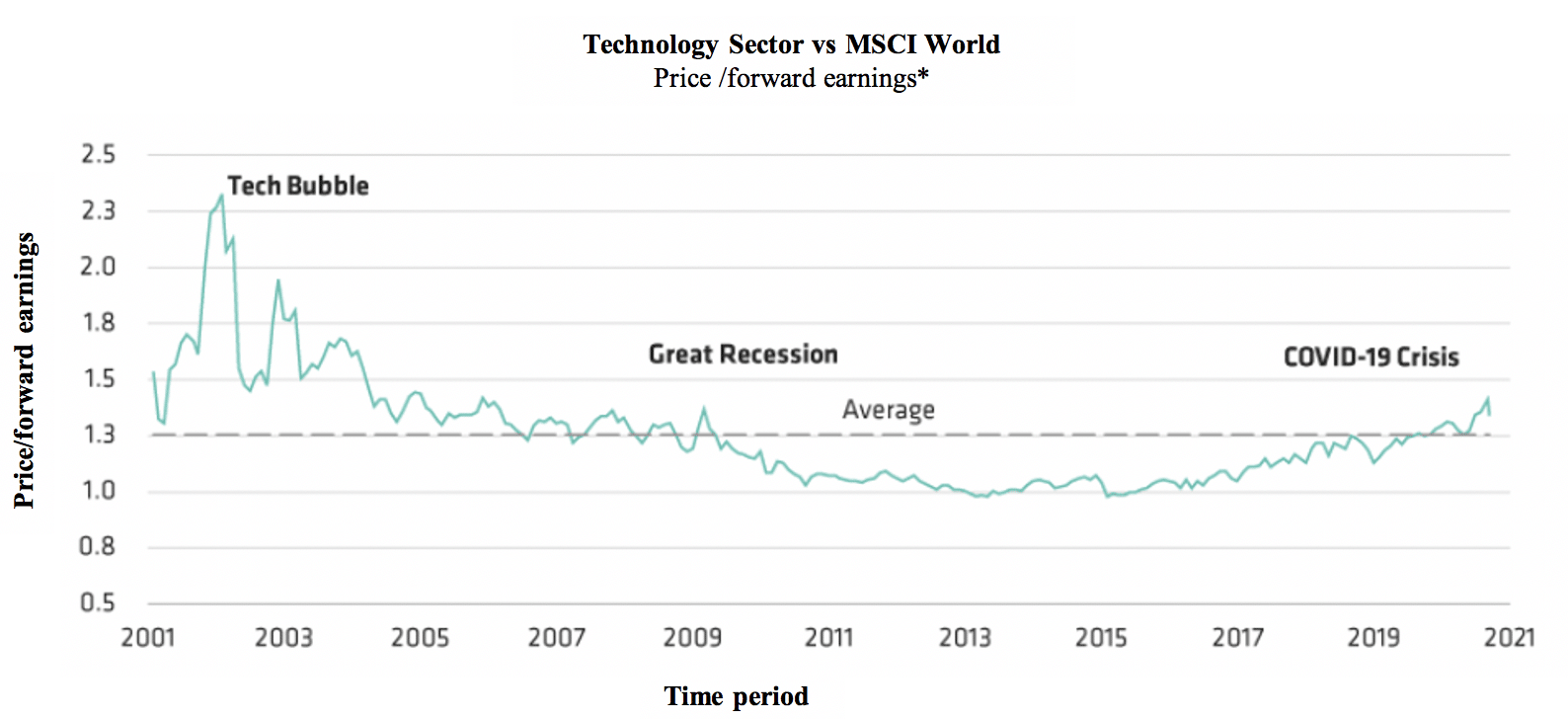
Through September 11, 2020

*Based on estimated earnings for the next 12 months

Source: Factset, MSCI World Index and AllianceBernstein (AB), 

Does high valuation equate to high risk?

Paying more for a stock isn’t intrinsically riskier, particularly when one takes into account the fact that the underlying drivers of an elevated valuation may be many and varied. Tech companies subject to secular growth drivers are perceived to have more predictable earnings growth than those with cyclical drivers. Those with cyclical drivers have a greater dependence on macro-economic forces adversely affected by the pandemic and are therefore deemed to be much riskier. As recent earnings seasons have shown, tech businesses are among the very few in a position to report year-on-year revenue and earnings growth. Innovative tech companies may appear overvalued if viewed only on the basis of consensus estimates at a fixed point in time and, therefore, it may simply be that valuations are the wrong debate, leading to an unhelpfully heavy focus on price rather than on the potential for earnings growth. 

Read more about our latest insights

An obvious, but seminal, example is Amazon. What began as a conventional, e-commerce bookseller has transformed itself into a technology powerhouse that now embraces retail, advertising, entertainment media, logistics and cloud-based services. Tellingly, throughout this metamorphosis, the market consistently underestimated the business’s growth potential and its powers of endurance by under-appreciating its earnings trajectory. Technology, as a sector, is difficult to avoid of course. Invest in the S&P 500 and over a quarter of your holdings will be in the information technology sector, the top five stocks by weight being Apple, Microsoft, Amazon, Facebook, and Alphabet.6If you favour a more global approach, you’ll see that over 60% of the FTSE World Index is invested in the US, and those top five holdings are exactly the same, making up over 12% of the index by weight.7

Yesterday’s growth, tomorrow’s value?

The Bankers Investment Trust– managed by Alex Crooke and part of the Janus Henderson managed investment trust stable – adopts a measured approach to the sector. The trust has the flexibility to invest in any geographic region and any sector (it’s a member of the Association of Investment Companies’ Global sector) with no set limits on individual country or sector exposure and, therefore, the make-up of the portfolio generally differs materially from its FTSE World Index benchmark. Currently, its North American weighting (dominated by the US) is circa 34% and, whilst its exposure to the technology sector is circa 17%, only one of the “major tech” businesses – Microsoft – appears in the top 10 holdings.8

In Alex’s view, we are experiencing a change in market leadership, with growth names, particularly FAANG stocks beginning to lose their leadership. In the low-growth world of recent years, the growth offered by tech businesses – and fuelled by the pandemic tailwind – has been significant, and clearly reflected in prices. He is keen to point out that more time spent online during 2020 has proved to be a metaphorical shot in the arm for technology businesses, but with actual shots now heavily insulating people from the effects of the coronavirus, companies with more to gain from economic ‘re-opening’ are increasingly favoured, with the tech sector experiencing its fair share of volatility in recent months. Nevertheless, there are solid reasons for the sector’s continuing appeal, although the blind optimism that fuelled the last tech boom in the 90s is noticeably absent.

There can be little doubt that the tech and communications service sectors will, in all probability, grow earnings at a faster pace than, say, airlines, industrials and large banks over the long term. Moreover, it’s probable that only government intervention to break up these companies will derail their domination of certain segments of the economy. Despite that, the impressive Q1 results delivered by a host of those tech stocks have done little to catalyse much in the way of investor enthusiasm, and it is exactly this form of market apathy that sometimes presents opportunities.

An approach some technology businesses may well contemplate is to begin returning cash to shareholders through the payment of dividends, as Microsoft and Apple currently do.

Who knows … could it be that the tech titans become the new income stocks of 2021?

Source: CNBC, 09.06.20 – Amazon, Apple, Facebook, Microsoft close all-time high: Big Tech rally (cnbc.com)

2Source: NASDAQ Composite Index, 01.01.20 to 31.12.20


3Source: Bloomberg: 31.12.20 to 11.06.21

4Source: Bloomberg: as at 11.06.21


5Source: CNBC, 01.09.20 to 20.05.21 – https://www.cnbc.com/2021/05/20/op-ed-this-is-what-investors-are-misunderstanding-about-tech-stocks.html


6Source: FactSet, to 11.09.20 – https://www.alliancebernstein.com/library/Debunking-the-Myths-of-High-Priced-Tech-Stocks.htm

7Source: S&P 500 Index factsheet, 28.05.21 


8Source: FTSE World Index factsheet, 31.05.21

9Source: The Bankers Investment Trust PLC factsheet, 30.04.2

Glossary Terms

Bricks and Mortar

The term “brick-and-mortar” refers to a traditional street-side business that offers products and services to its customers face-to-face in an office or store that the business owns or rents. The local grocery store and the corner bank are examples of brick-and-mortar companies.

Cyclical

A cyclical stock is a stock that’s price is affected by macroeconomic or systematic changes in the overall economy. Cyclical stocks are known for following the cycles of an economy through expansion, peak, recession, and recovery. Cyclical stocks are the opposite of defensive stocks.

Earnings per share (EPS)

The portion of a company’s profit attributable to each share in the company. It is one of the most popular ways for investors to assess a company’s profitability.

Forward price-to-earnings (forward P/E)

Forward price-to-earnings (forward P/E) is a version of the ratio of price-to-earnings (P/E) that uses forecasted earnings for the P/E calculation.

Growth stock

A growth stock is any share in a company that is anticipated to grow at a rate significantly above the average growth for the market.

Inflation

The rate at which the prices of goods and services are rising in an economy. The CPI and RPI are two common measures. The opposite of deflation.

Market Capitalization

Market capitalization refers to the total dollar market value of a company’s outstanding shares of stock. Commonly referred to as “market cap,” it is calculated by multiplying the total number of a company’s outstanding shares by the current market price of one share.

Macro-economic

Macroeconomics is a branch of economics that studies how an overall economy—the market or other systems that operate on a large scale—behaves. Macroeconomics studies economy-wide phenomena such as inflation, price levels, rate of economic growth, national income, gross domestic product (GDP), and changes in unemployment.

Price-to-earnings (P/E) ratio

A popular ratio used to value a company’s shares. It is calculated by dividing the current share price by its earnings per share. In general, a high P/E ratio indicates that investors expect strong earnings growth in the future, although a (temporary) collapse in earnings can also lead to a high P/E ratio.

Valuation metrics

Metrics used to gauge a company’s performance, financial health and expectations for future earnings e.g., price to earnings (P/E) ratio and return on equity (ROE).

Valuation premium

A valuation premium refers to the excess in value that a buyer estimates for a company compared to its peers in the same industry.

Volatility

The rate and extent at which the price of a portfolio, security or index, moves up and down. If the price swings up and down with large movements, it has high volatility. If the price moves more slowly and to a lesser extent, it has lower volatility. It is used as a measure of the riskiness of an investment.

Read more about our latest insights

Before investing in an investment trust referred to in this document, you should satisfy yourself as to its suitability and the risks involved, you may wish to consult a financial adviser. Past performance is not a guide to future performance. The value of an investment and the income from it can fall as well as rise and you may not get back the amount originally invested. Tax assumptions and reliefs depend upon an investor’s particular circumstances and may change if those circumstances or the law change. Nothing in this document is intended to or should be construed as advice.  This document is not a recommendation to sell or purchase any investment. It does not form part of any contract for the sale or purchase of any investment. [We may record telephone calls for our mutual protection, to improve customer service and for regulatory record keeping purposes.]
 
Issued in the UK by Janus Henderson Investors. Janus Henderson Investors is the name under which investment products and services are provided by Janus Capital International Limited (reg no. 3594615), Henderson Global Investors  Limited (reg. no. 906355), Henderson Investment Funds Limited (reg. no. 2678531), Henderson Equity Partners Limited (reg. no.2606646), (each registered in England and  Wales at 201 Bishopsgate, London EC2M 3AE and regulated by the Financial  Conduct Authority) and Henderson Management S.A. (reg no. B22848 at 2 Rue de Bitbourg, L-1273, Luxembourg and regulated by the Commission de Surveillance du Secteur Financier). [Janus Henderson, Janus, Henderson, Perkins, Intech, VelocityShares, Knowledge Shared, Knowledge. Shared and Knowledge Labs] are trademarks of Janus Henderson Group plc or one of its subsidiaries. © Janus Henderson Group plc.

Domino’s profits surge on firm’s improving digital capabilities

0

Domino’s is expecting its sales to slow down during the later stages of 2021

Domino’s Pizza saw its sales more than double over the past half-year thanks to “strong trading” levels in the UK and Ireland.

The food delivery company made a profit before tax of £41.3m for the six months ending in June, up from £19m for the same period of time a year before.

Domino’s said it made a positive start to the second half of the year as England went to the final of the Euros, in addition to its own marketing campaign.

The chain’s sales rose by 19.6% to £752.3m, an increase of over £100m compared to the same period in 2020. The shift came about in part as a result of the easing of restrictions.

The FTSE 250 company has benefitted from consumers having more disposable income at this stage of the pandemic, as there is now more job stability within the economy.

93% of its UK system sales came in from its website and delivery apps, highlighting the company’s improving digital capabilities.

While it has been a positive year so far for Domino’s the company is expecting its sales to slow down during the later stages of 2021.

Commenting on the results, Dominic Paul, Chief Executive Officer said:

“I am delighted with the performance of the business in the year to date. We’ve worked closely with our franchisees to maintain fantastic service levels to our customers, while continuing to prioritise the safety of our colleagues and customers. I’d like to thank everyone in the system for their incredible commitment through the pandemic.”

“We have continued to invest in the business as we focus on delivering our strategy with the opening of a new state of the art supply chain centre in Scotland, the launch of our redesigned mobile ordering App, and the roll out of our supercharged marketing campaign which has strengthened our brand and significantly boosted awareness levels.”

BP to increase dividend as profits jump on rising oil prices

0

BP made an underlying profit of $2.8bn for the quarter to June

BP (LON:BP) raised its dividend and committed to buying back shares after its Q2 profit surpassed expectations as oil prices rose and demand recovered.

BP will give shareholders $1.4bn (£1bn) through share buybacks, while it will increase its dividend by 4% a year up to 2025.

The FTSE 100 company is expecting a spike in near-term oil prices, in addition to a dramatic shift to low-carbon energy production.

BP made an underlying profit of $2.8bn for the quarter to June, a sharp increase from a loss of $6.68bn year-on-year, as the pandemic brought the oil industry to its knees.

The BP share price is up by 3.11% during the morning session on Tuesday to 298.75p per share.

BP forecast the price of Brent crude oil to average $60 per barrel for the remainder of 2021, a $5 upgrade on its previous forecast. The oil giant expects Brent crude to remain at this level for the rest of the 20s due to near term supply constraints across global markets.

BP’s net debt is down to $32.7bn from $40.1bn.

CEO of BP, Bernard Looney, said in a statement that the measures were possible due to an improved performance as well as “an improving outlook”.

“We are a year into executing bp’s strategy to become an integrated energy company and are making good progress – delivering another quarter of strong performance while investing for the future in a disciplined way,” Looney said.

The results show that “we continue to perform while transforming bp – generating value for our shareholders today while we transition the company for the future”, Looney added.

James Andrews, senior finance expert at money.co.uk, said: “BP’s previous earnings demonstrated renewed confidence in the company’s outlook, with a stronger than expected performance and improved year-on-year revenue growth.”

“Ultimately, this demand-led recovery will please shareholders of BP following a year of uncertainty and shock to the fuel industry. However, the relevance of the old model of the oil and fuel business remains under question as the world moves away from fossil fuels and pays closer attention to the worsening climate crisis.”

Greggs back in the black as sales recover

0

Greggs recorded an underlying pre-tax profit of £55.5m for H1

Greggs (LON:GRG) said on Tuesday that its profit will be ahead of expectations as the baker moved back into the black during the first half of the year.

The announcement came about thanks to a strong recovery in sales following the easing of restrictions.

The FTSE 250 company, famous for its sausage rolls, recorded an underlying profit before tax of £55.5m for H1 ending in early July, compared to a pre-tax loss of £64.5m during the same period a year before.

Greggs’ total sales came in at £546.2m, well up from £300.6m. However, compared to two years ago, prior to the pandemic, sales were 9% down.

Even though Greggs’ stores remained open during the pandemic, its business model, which relies heavily on footfall, was vulnerable.

The company will resume dividend payments with a proposed 15p per share payout for the first half of the current financial year.

Ross Hindle, Analyst at Third Bridge, commented on Greggs following the company’s results announcement:

“Greggs has had a tough H1 with two-year like-for-like sales down 9.2%. However, all is not lost as the overall UK food-to-go market remains depressed by around 20% as many knowledge workers stay away and the pingdemic takes a toll. Greggs has been able to punch above its weight in food-to-go because it has had less restriction exposure, and it sells the value products cost-conscious first-returners desire.”

“A decline in foot traffic, coupled with higher average transaction values have been a theme across the entire food-to-go sector. However, compared to its competitors, Greggs continues to suffer from relatively small average transaction values. People simply spend more in Pret or Leon. Our experts expect Greggs’ to focus on closing this ticket size gap by improving their food range and continuing to promote their coffee offering, an important lure to drive foot-traffic and promote more cross-sell purchases.”

Specialists expect Greggs to capitalise on the increase in prime location vacancies and expand their store and drive-through footprint. “A prime example of this is Greggs new shop in Canary Wharf, which has been on a sizzling run since opening, despite depressed commuter levels,” said Hindle.

Kanabo share price could be undervalued

0

Kanabo Share Price

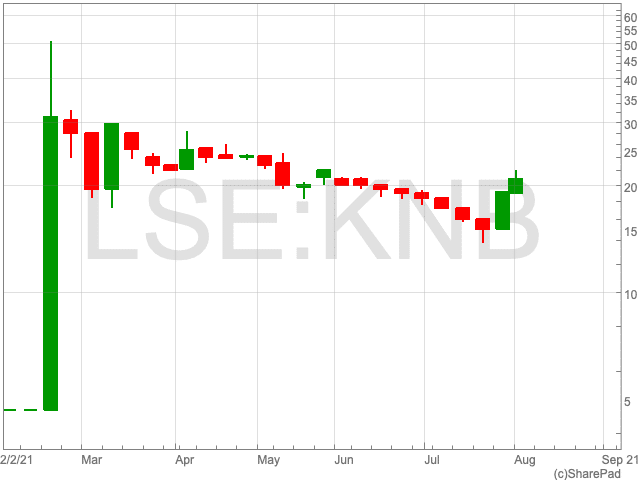
The Kanabo share price (LON:KNB) is up by 6.68% on Monday after the medical cannabis company enjoyed a mini-surge over the past few days. The last five days saw the Kanabo share price rise by 28.06%. It came following a broad sell-off in cannabis stocks, which led to the Kanabo share price spending eight weeks in the red. Nonetheless, the company has made significant progress since its IPO in February which it will hope can see it through any temporary downturns. This article will analyse where the company is at and the outlook for the Kanabo share price.

Progress

Kanabo has made strides in generating sustainable revenue streams by selling its medical cannabis cartridges in the UK. It also intends to expand its plans to sell across Europe.

The medical cannabis company has signed a host of supply deals, including its partnership with Hellenic Dynamics S.A, a medical cannabis cultivation company with a substantial cultivation facility in Northern Greece.

Kanabo also signed a production agreement with Pure Origin and its affiliates to utilise their significant expertise in best practices for EU GMP manufacturing.

However, investors appear not to appreciate the significant of the deals, as the share price didn’t react too favourably.

This could bode well for the Kanabo share price in the long-term, as it makes strides forward, while potentially remaining undervalued.

Cannabis Market

Despite the sell-off in the cannabis market mentioned above, the long-term outlook for the industry remains bright.

According to reports by Emergen Research, the global medical cannabis market is expected to get to $47.15bn in 2027 at a compound annual growth rate of 16.9%. Specifically market revenue growth can be attributed to the rising use of medical cannabis to treat diseases and conditions. Additionally, with regulations being relaxed, there could be a spike in legal demand. One of the companies to benefit from this trend is Kanabo.

In the short-term the immature nature of the cannabis market could be vulnerable to oncoming regulations which could cause volatility in the Kanabo share price.

Strong fundamentals supporting the Barratt share price

Barratt Share Price

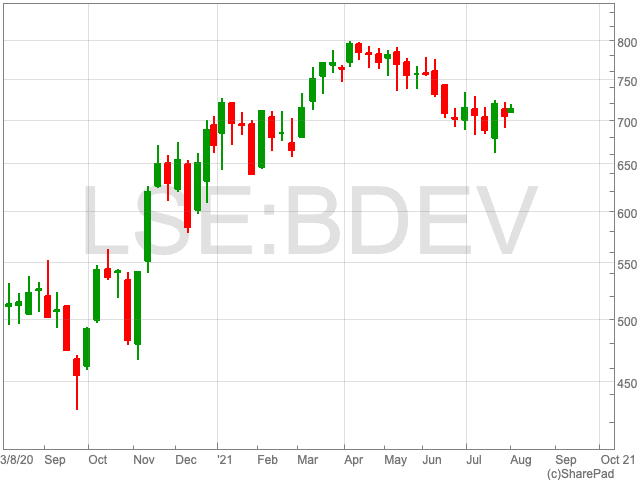
The Barratt share price is up by 1.05% on Monday after the homebuilder found some momentum during the second half of July. Despite a fall in June, the Barratt share price has performed well over the past 12 months, thanks to its strong fundamentals and a booming housing market. As the stamp duty holiday comes to an end, and with many expecting the housing boom to cool off, now is an ideal time to analyse the stock.

Rising House Prices

Government policies aimed at boosting demand for homes have helped push the sector to recover following the pandemic. UK house prices rose by 13% in June compared to the same month in 2020.

As seen by the above graph, the Barratt share price has reaped the benefits, with the average selling price of properties soaring.

For the year to June Barratt completed 17,243 homes, which was just shy of its figure for the same period in 2019, before the pandemic.

However, in July, the market cooled off somewhat, although house prices were still 10.5% higher than the same point a year ago. This might give some investors a moment of pause when considering betting on the Barratt share price over the longer-term.

Outlook

Barratt possesses some fundamentally good qualities as a stock. Firstly, it has a strong pipeline for the year to June 2022 of more than 14,000 homes sold at a value of £3.5bn. In addition, the FTSE 100 homebuilder is atop £1.3bn in net cash. This offers investors a level of stability and predictability that buyers of airline shares could only dream of.

Martin Beck, senior economic adviser at EY Item Club, told the Financial Times that “The odds of a significant correction in house prices anytime soon looks small”.

However, Gabriella Dickens, senior UK economist at Pantheon Macroeconomics, countered Beck’s point: “house price growth has probably now peaked. The larger than expected slowdown probably marks the start of a sustained deceleration in house price growth between now and the end of the year.”

While the level of demand for homes and the ongoing price level remains up for debate, there will still be plenty to do for Barratt. This, in addition to the company’s strong fundamentals, bodes well for the Barratt share price.

China manufacturing slows in July to 15-month low amid weak exports

0

The monthly purchasing managers’ index decreased to 50.3, down from 51.3 in June

China’s manufacturing growth eased in July to a 15-month low while demand for exports slowed down as factories struggled to cope with supply issues, according to the China General Manufacturing PMI.

The monthly purchasing managers’ index decreased to 50.3, down from 51.3 in June, with anything above 50 showing activity increasing.

Compared to other countries, China recovered speedily from the pandemic, however, manufacturers have struggled as they wait for supply chains to get back to the levels seen before the pandemic.

In addition, foreign export markets are struggling as new variants of Covid continue to keep their respective recoveries in check.

New export orders rose only slightly as the pandemic continued to hinder sales overseas.

”The Chinese economy has largely recovered from disruptions caused by the coronavirus pandemic, but it has faced new challenges in recent months such as higher raw material costs, which dragged on profit growth at industrial firms in June,” the report said.

Supply chain delays persisted in July, with average delivery times for inputs increasing solidly. Anecdotal evidence indicated that material shortages and transport delays due to the pandemic had driven the latest increase in lead times.

Capacity pressures eased at the start of the third quarter, with backlogs of work rising at the softest pace for five months. Employment levels meanwhile were little-changed in July, after a slight uptick in payroll numbers in June.

Commenting on the China General Manufacturing PMITM data, Dr. Wang Zhe, Senior Economist at Caixin Insight Group said:

“The Caixin China General Manufacturing PMI came in at 50.3 in July, down from 51.3 the previous month. The July reading was the lowest in 15 months, though it marked the 15th consecutive month of expansion. That meant while the manufacturing industry continued to grow, the rate of expansion slowed further.”

Zhe added that inflationary pressure eased slightly.

“Both the gauges for input prices and output prices fell in July, with the latter dropping at a steeper pace. Still, the gauge for input prices was well above 50, as surveyed enterprises said raw material prices remained high, especially for industrial metals. Notably, the gauge for input prices remained above 55 for the eighth consecutive month in July.”

Sandstone launches new REIT fund fuelled by property market growth

Sandstone has achieved returns of 28% per annum, over the past 25 years

Sandstone, a UK-based private property investment company has launched the Sandstone Residential REIT, focused on traditional residential property across ten cities in the UK.

The trust will allow a host of entities, including family offices, fund managers and private clients with SIPPS to invest in the UK residential market in a ‘tax efficient way’.

Projected returns are expected to be in the region of 17%, as there is a maximum gearing of 50%.

The UK’s property market continues to offer highly attractive investment opportunities, growing at its fastest rate since 2007 in March.

Sandstone was founded in 1997 with the purpose of helping clients to build portfolios of residential properties, which are then rented to university students.

“The Sandstone REIT is a logical next step, for clients – existing and new,” the company said.

Performance

Sandstone produced a White Paper on its history and market segment, which demonstrates high and steady returns, driven by rising demand and constrained city centre or prime location supply.

The company has achieved returns of 28% per annum, over the past 25 years, based on 75% loan-to-value gearing.

The resilience of the student accommodation market and Sandstone’s experience during the pandemic bears this out: occupancy in the portfolio has been above 95%, and rental income rose by 12% in 2020.

In addition to its core services of property sourcing, renovation, furnishing and ongoing rental and management, clients also benefit from annual reviews, green upgrades, and bespoke reporting.   

The Sandstone Residential REIT will allow clients, old and new, to invest into a listed fund, “benefiting from the advantages of a booming rental market, capital gains, corporation tax efficiency as well as diversification of investment and liquidity”, the company said. Existing clients will also be able to move their properties into the REIT.

Peter Grant, founder and CEO of Sandstone Group said:

“Sandstone’s new REIT allows a whole new group of clients including Family Offices, Institutions and Charities to capitalise on high performing investments in the UK residential property market, in a hands-off way. It gives them the opportunity to move assets into a listed fund and benefit from the associated gains.”

“We are already seeing interest from client groups in the UK and Europe, as well as Singapore, Hong Kong and across Asia.”

“Private clients often have strong connections with the UK, whether it’s because of them, their children or grandchildren being educated here. The UK residential market has an incredible track record, combining low risk and high returns.”

“There are very few residential REITS in the UK, and our new Sandstone Residential REIT has been created with large institutional investors in mind.”

Meggitt agrees £6.3bn takeover by US tech company Parker-Hannifin

1

Meggitt shareholders will stand to earn 800p per share, a 71% premium on last week’s close

Meggitt, the British aerospace company, has agreed a takeover deal from Parker Hannifin, its American rival.

It is the latest in a string of approaches for UK-listed companies from buyers based overseas.

If the deal goes ahead, Meggitt shareholders will stand to earn 800p per share, amounting to a premium of 71% on last week’s close.

The board of the FTSE 250 engineering company has unanimously recommended that shareholders accept the 800p-per-share deal.

“Meggitt is one of the world’s foremost aerospace, defence and energy businesses, leading the market with a strong portfolio of technology and manufacturing capabilities, and holding a significant amount of intellectual property,” said the Meggitt chairman, Sir Nigel Rudd.

“While Meggitt is currently pursuing a strong, standalone strategy which will deliver value to shareholders over the long term, Parker’s offer provides the opportunity to significantly accelerate and de-risk those plans, while continuing to deliver for shareholders.”

The bid comes amid a flurry of bids for UK companies by US buyers, specifically in the defence sector.

Recently, the UK government has been keeping a close eye on Cobham’s private-equity backed takeover of Ultra Electronics.

In addition, Senior, the FTSE 250 aerospace and defence group, rejected an approach by Lone Star, the US investment firm.

Parker would nearly double its aerospace operation with the acquisition of Meggitt, the company that supplies the UK government.

Parker has made a series of legally binding pledges to the government to guard Meggitt’s operations.

Following the downturn caused by the pandemic, Meggitt was forced to cut 1,800 jobs as Covid-19 ravaged the travel sector.

The company has also confirmed that it swung to a profit for H1 2021 as it continued on its path to recovery.

The Meggitt share price is up by 56.85% on Monday to 735.80p, blowing past the previous record high of just under 700p.

Flurry of takeover activity causes lifts UK markets

0

The FTSE 100 is up by 0.98% to 7,100.99 during the morning session on Monday amid a new wave of takeover activity.

The FTSE 250 hit a new record high of 23,305 as its cohort of mid-cap stocks is seen to be better hunting ground for takeover targets than the large cap FTSE 100 index.

“Aerospace and defence components group Meggitt has become the latest target for an overseas buyer, and one pitched at a very generous 70.5% premium to last Friday’s closing market price,” says Russ Mould, investment director at AJ Bell.

The bid for Meggitt, together with well-received numbers from HSBC and rumours about a potential counterbid for Morrisons, helped to push up the FTSE 100.

“With a 6% gain, the top FTSE 100 riser was Melrose Industries on positive read-across from Meggitt given it also has interests in the aerospace and defence sector, having bought GKN in 2018. It would be interesting to see if this predator becomes prey, as Melrose has historically been the one doing the bidding,” Mould added.

Existing FTSE 250 bid target Sanne received an offer from private equity group Apex at 920p per share, having previously been subject to 830p, 850p and 875p per share offers from Cinven.

“We’ve seen quite a few private equity suitors having to raise their offers this year as companies and shareholders push back on initial approaches, saying they are too low. Private equity firms have a reputation for trying to get a bargain, but their tactics have been fully exposed this year and it now seems rare for the first offer to be the winning one.”

FTSE 100 Top Movers

Melrose Industries (6%), IAG (4.22%) and JD Sports (3.87%) are ahead of the rest a couple of hours into trading in August.

Trailing the UK’s top 100 companies at the back is Fresnillo (-1.91%), Pearson (-1.23%) and Smith and Nephew (-0.89%).