Lockdown easing set to be delayed as working from home will continue

0

The prime minister is expected to confirm the decision during a press conference later on Monday

The UK government is set to end the lockdown restrictions in England later than June 21, the originally planned date, meaning workers’ returns to their offices will be delayed.

The BBC has reported that a number of senior ministers have agreed on a decision to maintain current rules for an additional four weeks.

As a result of the delay, people will still be encouraged to work from home if possible, while nightclubs will stay closed.

The prime minister is expected to confirm the decision during a press conference later on Monday.

The extension will be put to a vote in the House of Commons later in June, and could face a rebellion from a number of Conservative MPs.

Stage four of the roadmap out of lockdowns will see limits on social contact gone, although mask wearing and social distancing could however remain.

Scientists have suggested the next step should be delayed as the Delta variant is more transmissible.

This, it is suggested, would allow the rate of vaccinations to increase, and minimise a potential rise in vaccinations.

On the other hand, some politicians and business owners are becoming frustrated at the news, as they consider the vaccine roll-out to have been a success.

Over 70m vaccine doses have been given out across the UK, as 55% of people receiving two jabs.

The hospitality industry is one in particular which has warned against the potential harm caused by the continuation of social distancing measures. Nightclubs and theatres also remain unable to operate.

Nightclubs and bars could sue the government to prevent a delay to coronavirus restrictions being lifted on 21 June in England.
Ted Baker records £107.7m pre-tax loss as sales slashed

0

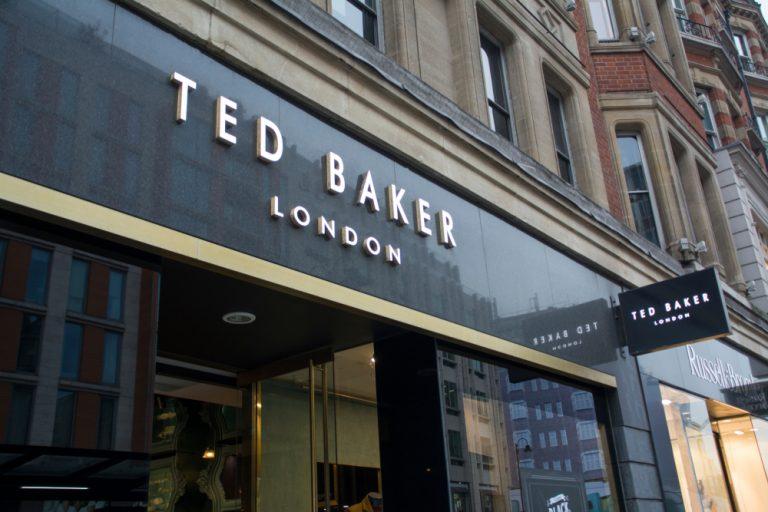
Ted Baker (LON:TED) saw its revenue fall by 44% to £352m during 2020 as the retail industry was left reeling from the multiple lockdowns across the UK.

The UK fashion brand also confirmed it made a pre-tax loss of £107.7m, rising from £77.6m the year before.

In better news for the company, Ted Baker secured two long-term territory licenses in March to broaden its reach into Indonesia, the Middle East and North Africa.

While its retail sales fell by 42.2%, Ted Baker‘s eCommerce sales rose by 22% £144.9m. This in part a result of the fashion brand’s increased investment.

James Andrews, Personal Finance Expert at money.co.uk, said:

“If you set out to design a shop to do badly under coronavirus restrictions, you’d end up with something a lot like Ted Baker,” said Andrews.

“It’s reliance on physical stores – not infrequently in airports – while shops were shut and holidays outlawed. Concessions in department stores that are now in insolvency or closing branches. A focus on workwear as people set up home offices and special occasion outfits while weddings and other parties were banned.”

“The good news for investors is that as offices reopen, weddings start again and travel tentatively returns later on in the year, things will get better – especially as the firm continues its pre-pandemic push into online sales.”

In response to demand for climate aware clothing, Rachel Osborne, chief executive of Ted Baker, said the company had improved its sustainability strategy.

“We are making good progress against our strategic transformation plan and Ted Baker is increasingly well placed to take advantage of the significant growth opportunities ahead of us. The Ted Baker brand has strengthened further, with the number of active customers growing to 1.2m by the end of the year,” Osborne said.

“While the impact of COVID-19 is clear in our results and has amplified some of the legacy issues impacting the business, Ted Baker has responded proactively and is in a much stronger place than it was a year ago. During the period, we delivered robust cashflow generation, fixed our balance sheet, refreshed our senior leadership team and today we are upgrading our financial targets for the second time since outlining our new strategy last summer.”

“Additionally, we have made good progress with our sustainability strategy, Fashioning a Better Future, including the mapping of all of our factory partners within our supply chain and significantly increasing our usage of cotton from sustainable sources to 69%.”

boohoo sales comparatives get tougher

Online fashion retailer boohoo (LON: BOO) is releasing a first quarter trading statement on Tuesday 15 June. boohoo adapted to the changing conditions last year more quickly than many of its peers, so the comparative performance will be interesting, however the second half is likely to be most significant this year.
There is already guidance in the market of 25% growth in revenues for the year, with 20% organic growth and the rest coming from the additional brands that have been acquired in the past year. The EBITDA margin is expected to be 9.5%-10%.
Comparatives
Comparative figures will get t...

Revolting shareholders: Morrisons directors’ not thought to be good value

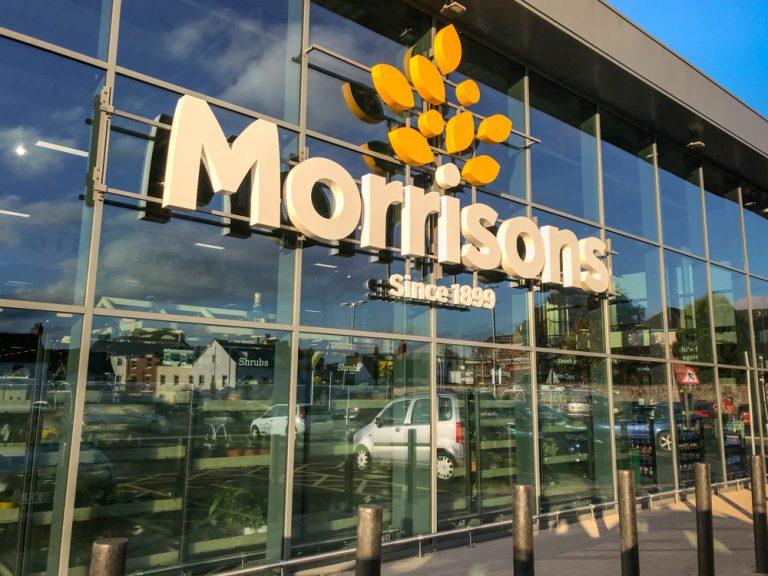
Supermarket operator Wm Morrison (LON: MRW) has upset shareholders with selective decisions on executive pay. There were 70.1% of the votes at the AGM cast against the directors’ remuneration report.
Last year, like-for-like sales, excluding fuel, increased by 8.6% and total revenues were 0.4% ahead at £17.6bn. Underlying pre-tax profit was 6% higher at £431m, before returning government assistance, although earnings per share before exceptionals halved to 5.95p. That pre-tax profit should improve this year.  
There were adjustments for direct Covid-19 costs included in the calculation of...

AB Traction adds to Driver stake

AB Traction has increased its stake in construction dispute and property services provider Driver Group (LON:DRV) from 17.32% to 18.27%. This is something worth taking note of.
That is the first change in the stake since last November. NASDAQ OMX Nordic Stockholm Mid Cap-listed AB Traction has a record of buying stakes in professional services companies when they are depressed and then selling to a bidder.
AB Traction previously built stakes in Waterman and WYG and then sold them when a takeover was launched. AB Traction built up a 17.2% stake in property consulting company Waterman before sel...

New Aquis admission: Clarify Pharma

Yet another Aquis flotation of an investment company from Michael Edwards following on from NFT Investments, Dispersion Holdings and Pioneer Media Inc. Three other Clarify directors are also directors of NFT Investments and one is also on the Dispersion Holdings board. In this case, Jonathan Bixby is executive chairman, although he does not own any shares in Clarify Pharma – he does hold 10 million warrants he can exercise at 1p each if he wants to.
Clarify Pharma will focus on investing in psychedelic medicine businesses and products in the UK and Canada.
There seem to have been some lessons ...

Scottish Mortgage Investment Trust share price is a long-term investment

0

Scottish Mortgage Investment Trust Share Price

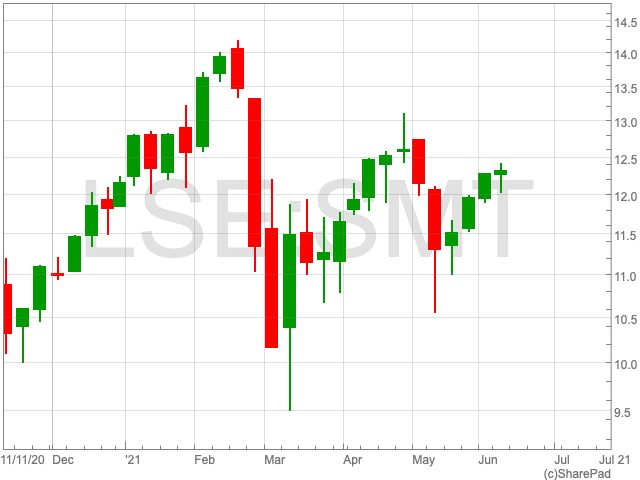
The Scottish Mortgage Investment Trust share price (LON:SMT) performed outstandingly well during 2020. However, the company faced some bumps in the road early this year, during the tech sell-off and when James Anderson, one of the fund managers, announced he would be stepping down. At the time of writing, the Scottish Mortgage Investment Trust share price is at 1,229p, nearly 200p down from its all-time-high in February. The fund seems to have responded well following its mid-February dip, and now could represent an opportune time for investors while the share price is low.

Volatility

Following a tumultuous year, the Scottish Mortgage Investment Trust share price, with both peaks and troughs along the way, is up by 0.98%. In addition to this, the short-term volatility that has occurred may serve to put investors off.

The FTSE 100 company has a high exposure to tech firms which makes it vulnerable to mass sell-offs. In addition, it seeks out companies in the early period of their growth with massive potential. For example, it bought Tesla shares as early as 2013.

More recently it confirmed it has invested £72m in Blockchain.com, the UK’s largest cryptocurrency company, which could be a sign of things to come. It is important for investors to consider the longer-term with the Scottish Mortgage Investment Trust share price for this reason.

“The managers are true long-term investors since they believe it’s the best way to capture the potential growth of their companies. Currently the trust invests in around 95 companies, eight of which have been held for over ten years, including technology firms Amazon and Tencent, and French luxury goods company Kering,” said Hargreaves and Lansdown investment analyst Henry Ince.

Over the past 12 months the Scottish Mortgage Investment Trust share price is up by 70%, while going back as far as five years, it has gained 387%.

James Anderson stepping down does remain a long-term risk as he led he trust to make some excellent decisions over the past decade. Although he will not depart until April 2022 and will be replaced by Lawrence Burns who joined Baillie Gifford in 2009 straight from the University of Cambridge where he studied geography.

Oil prices at multi-year high with demand set to exceed pre-pandemic levels by 2022

Brent crude oil futures made it to $72.73 per barrel on Friday

Demand for oil is expected to surpass pre-pandemic levels before the end of 2022, according to the International Energy Agency (IEA).

The Financial Times reported that consumption fell by a record 8.6m barrels per day in 2020 as lockdowns were mandated across the world.

The IEA anticipates an additional 3.1m barrels per day increase in 2022, bringing the average to 99.5m barrels per day, with an increase towards the end of the year that will go past the level of demand last seen before the coronavirus pandemic.

However, the agency also said that oil’s recovery is likely to be “uneven” among both different regions and business sectors. While any delays in the vaccine roll-out could lead to further issues.

Oil prices also jumped to a multi-year high on Friday look set for a third consecutive week of gains as nearer-term expectations are that there will be a recovery in demand across the world as restrictions are eased.

Brent crude oil futures made it to $72.73 per barrel, one day after closing at its highest point since 2019.

Analysts at Goldman Sachs believe that Brent crude oil could reach $80 per barrel this summer.

Support for the price of oil also came as talks between Iran and other nations over a nuclear deal stalled.

Gold touches $1,900 on fastest US inflation since 1992

Over the past three months gold is now up by 10% as inflation fears mount

The price of gold soared yesterday following three consecutive days of losses as America revealed its inflation rate rose during May at the fastest pace in nearly 13 years.

Compared to the same month a year ago, consumer prices increased by 5% in May, according to the Bureau of Labor Statistics. 

It is the most significant increase since August 2008, when prices rose by 5.4%, and is 0.8% higher than April’s price rise.

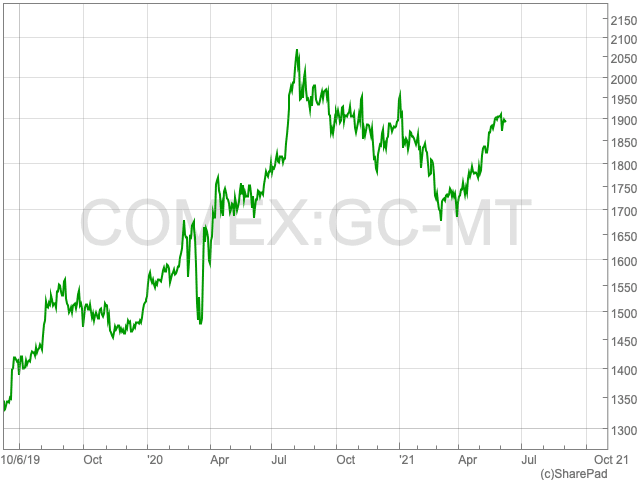
While rising prices are not having a negative impact on equities at the moment, gold is starting to enjoy a decent run. The precious metal price is back above $1,900 per ounce and if it can maintain its recent momentum, traders may start to eye last year’s record highs.

Over the past three months gold is now up by 10%.

Along with the inflation figures coming out of the US, wage data is showing “the biggest decline in real average earnings since ’08,” according to Bloomberg columnist John Authers.

“Gold thrived during the 1970s, when inflation was rampant (although it could be argued that stagflation was the problem then), and then fell right out of favour in the early 1980s after the Paul Volcker-led Federal Reserve clubbed it into submission with brutal interest rate increases,” says Russ Mould, investment director at AJ Bell,

“The tide turned again after 2000, since when the precious metal has outperformed even the S&P 500, as gathering Government budget deficits and then record-low interest rates and Quantitative Easing have persuaded some investors to abandon ‘paper’ money and ‘fiat’ currencies in favour of ‘real’ assets.”

“A vindication of central bankers’ view that the current inflationary spike is transitory, or an unexpected tightening of monetary policy, or a new round of tax-rises and hair-shirt fiscal policy could all stop gold in its tracks, and by implication make gold mining stocks less appealing,” Mould said.